Author: mcullen

  • Debbie Macomber had so many rejections . . .

    I enjoy books that take me away, where I can escape into other worlds, like Cedar Cove, the fictional town Debbie Macomber created for her cast of characters.  A Costco Connection article about Macomber invites readers into her real world.

    “When I first started out, the rejections came so fast they hit me in the back of the head.”  November 2013, The Costco Connection. 

    The article continues, “Macomber describes her desire to write as a ‘dream that pounded inside of me.’”  She overcame dyslexia and taught herself the art of writing by dissecting Kathleen Woodiwiss’ The Wolf and the Dove. “Whatever was inside that story that made me want to go back and read them again and again, I wanted in my own story.”

    From Debbie Macomber’s website:

    “. . . I wanted to become a writer because I had stories to tell. And I was always interested in people—in what happens to them and what they choose to do or not do and why—which is the basis of story. I knew from the time I was in grade school that I wanted to write books, but it was a dream I kept close to my heart for fear someone would laugh or tell me I’d never be published.”

    How about you? Let’s nurture your dream. . . start writing. Use any of the prompts on this blog to spark your flame to write. Write now! Just write!

  • You may have tangible wealth untold . . .

    You may have tangible wealth untold;
    Caskets of jewels and coffers of gold.
    Richer than I you can never be —
    I had a Mother who read to me.

    from The Reading Mother by Stickland Gillilan (1869-1954)

  • Change is good and . . . — James Seamarsh

    Change is good and flexibility in a world of change is even better.  — James Seamarsh

  • Guest Blogger Rob Loughran writes an unforgettable essay.

    The best view in Santa Rosa, it is said, is from Paradise Ridge Winery. The tasting room looks westward toward the semi-organized suburban sprawl where we live and thrive and call home. There is, however, another view from just a tiny bit down the mountain from the winery.

    On Round Barn Circle.

    A slightly different view.

    Sutter Oncology Clinic has the same view, just not as high on the mountain. And the people who get to see it truly appreciate the vista. Sutter Oncology Clinic is the place where people go to receive a drip, drip, drip that will hopefully cure their cancer.

    I have had the opportunity to savor the panoramic splendor of Santa Rosa, California from the glassed-in aerie of this clinic.

    It’s a beautiful view. It’s a beautiful city.

    We, from here, can see the city sprawled out before us. We can also see the clouds and storms from the Pacific bringing us fog, drizzle, rain.

    Today as I waited, patiently and hopefully, for the juice to enter my veins for my specific illness I savored the view of this city of Santa Rosa. From up here, as the medicine seeps into my veins, I have a sense of distance from the ant farm that is the modern American city. There is another community, another city, brought together because we are in the same leaky rowboat, of cancer patients who see this panorama – this beautiful city of Santa Rosa – while accepting the latest and hopefully most effective and propitious drug.

    Drip, drip drip.

    An impromptu community.

    I have been coming here since June for my particular problem and I have to say that I have never been more welcomed, befriended, and accepted as I have been every time I show up for my chemotherapy.

    And I think it might be the view.

    Today I walked in and two of the nurses greeted me by my first name and asked if the restaurant where I worked, The Farmhouse, was busy. I said yes, indeed, we were. Booked until Thanksgiving. They nodded and efficiently, elegantly, found a proper vein for the drip, drip, drip, that I would be receiving for the next seven hours.

    In those seven hours I would learn that I am, indeed, the luckiest guy on the planet. I do have a bit of cancer that’s circulating, perambulating, goofing off in my bladder. This little drip, drip, drip, of chemotherapy that I receive will address and resolve that problem.

    I wish it were so simple for the people in the chairs surrounding me. I’m here for seven hours and I am one of the few without a port. A port is a plastic junction where the chemotherapy is injected. It is a semi-permanent appliance where cheerful and smiling nurses inject merciless, hopefully effective, drugs for deadly and mysterious ailments.

    A beautiful young lady sat next to me and had her elixir administered through such a plastic port. This thirty-year-old woman endured visits from in-laws and friends. Obviously in pain, she perked up whenever someone visited. She was the perfect hostess in English and Spanish as the visitors arrived and left.

    Until her children arrived.

    The boys, aged nine and eleven, spoke perfect English to the nurses and myself when I said “Hey” but they spoke in Spanish to their mother and their aunt who had accompanied them. Their mother had been on her medication for about two hours before they arrived. I could tell by her breathing that it was not a comfortable situation. But when her boys appeared she became a vibrant and caring mother. She transcended the side effects of whatever drug, whatever poison, for whatever malady was in her system and she became a mama. In Spanish the youngest son said, “My baseball game is at 10 o’clock on Saturday.”

    Auntie raised a finger and said in Spanish to her sobrino, “There are more important things right now.”

    The young man fought back tears and said, “You are right.”

    This stuff that they are pouring into my veins is truly miraculous. Whether or not it snuffs out what is growing wildly within me really doesn’t matter. Today, because I had to be here in this place, at this time, I watched a boy become a man.

    That is the best view in Santa Rosa.

    Because of the people who are in it.

    Rob Loughran usually writes about sillier stuff. His latest novel Beautiful Lies is available at Pages On the Green bookstore in Windsor, CA
  • Elizabeth Berg demystifies how to describe characters

    I love it when writers describe characters in a way that I can really see them, beyond eye and hair color. The trick is how to describe a character that gets into the essential details of the person.

    Elizabeth Berg demystifies how to describe characters, using interesting details, in “Escaping into the Open,” The Art of Writing True, page 91:

    Whether you’re writing fiction or  nonfiction, you can greatly help define a character by sharing not only what he says and does, but also how he looks. Again, details matter. don’t tell the reader that someone is old; show it by describing the dime-size age spots, the sag of the cheeks, the see-through hair, the spiderlike spread of veins at the back of the knees. Are nylons falling down? Are belts too big? Are there greasy thumbprints on the lenses of bifocals? Is the posture stopped or stubbornly erect? Is there a periodic squeal from a hearing aid? What does he eat for breakfast? How does she speak on the phone? Do medication bottles rattle in his front pocket? Does she keep nitro-glycerin in a silver monogrammed case?

    Your Turn:  Write a character sketch. Write so that readers can hear, see, smell, feel your character.

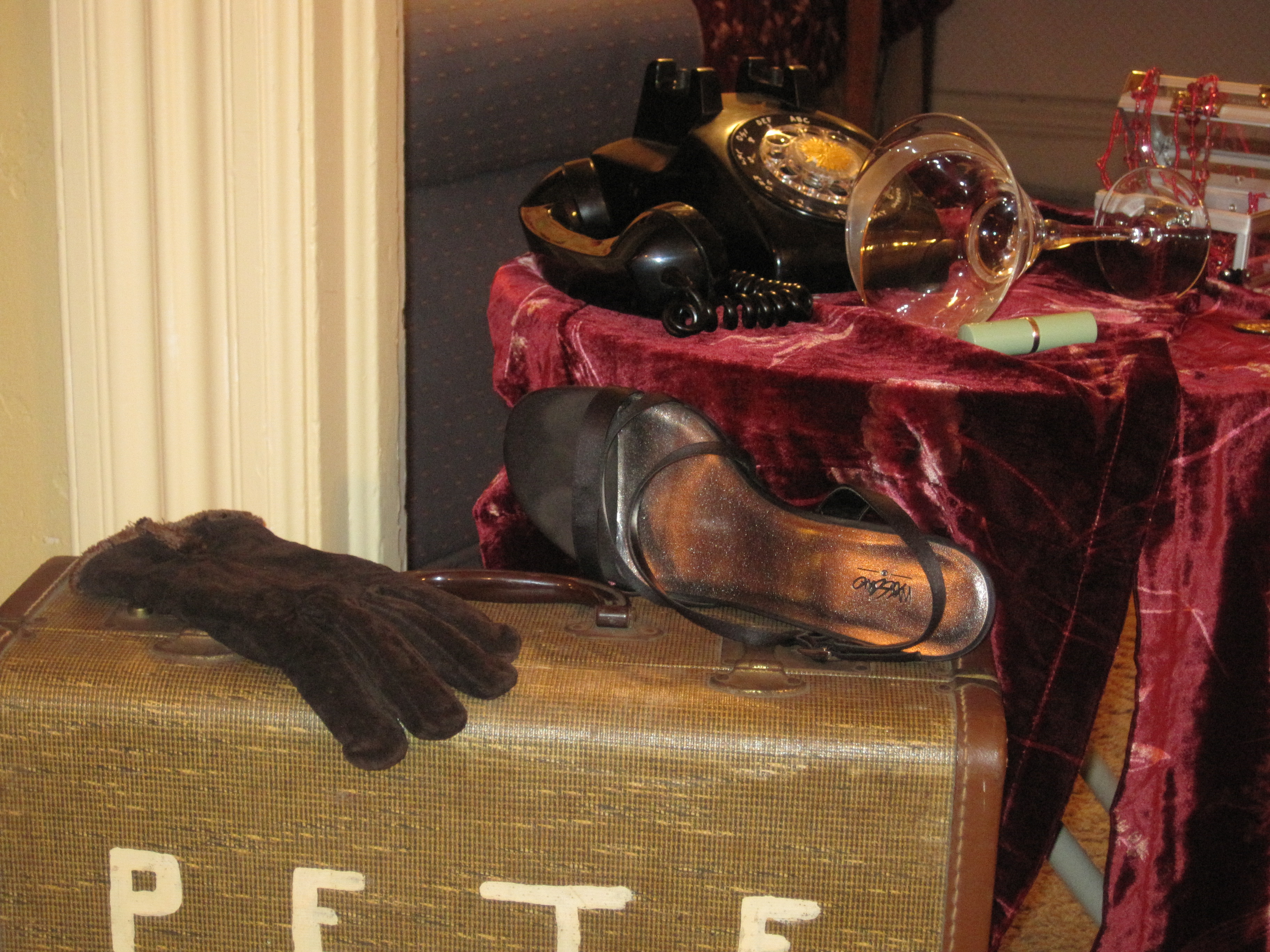
  • What happened here? #23

    Pete Prompt

    What can you do with this photo prompt?  Write whatever comes up for you.

  • Guest Blogger Suzanne Murray explains How Nature Can Enhance Your Creativity

    When I received the inspiration for the name of my business Creativity Goes Wild, I was on a modern day vision quest with Bill Plotkin in an extraordinary canyon in southern Utah that allowed me to really open to the flow of new ideas. Along with the name, I also got that the essence of the work included three different elements: Nature, creativity and the soul which are aspects we can connect to that can really help us live full and authentic lives.

    I have long thought of nature as the original artist. If you spend any time in nature and pay close attention, you become aware of the beauty and design and patterns in both small things like the symmetry in pine cones and snowflakes or on a grander scale the patterns in the erosion of mountains or the movement of clouds across the sky.

    At first glance nature might look chaotic or random or disordered but the more you observe and learn about the natural world the more you become aware of the elegance of design in every creation. We can draw inspiration for our own creativity from spending time in Nature, the same way we feel inspired by visiting an art exhibit, going to a play or watching a good movie.

    Spending time in nature actually slows down our brain waves, taking us from the beta waves where our mind attends to daily activities into alpha waves which offer a naturally meditative state where we access the part of our mind that has new thoughts and ideas, flashes of insight, and more readily makes connections. This can help us with the essence of the creative impulse and process.

    Whenever I find myself stuck on a creative project I will go for a walk in nature and it always opens me back up to the flow. Or if I am looking for a place to begin a creative work I will plant the seed in my subconscious mind and then go to nature, not to think about it, but to allow the inspiration to rise to the surface of my mind.

    Try it. Whether you like to sit in the garden or go for a walk among the trees, see if you don’t find that connecting to nature doesn’t open you up to new ideas and possibilities.

    Suzanne Murray is a gifted writing and creativity coach, EFT practitioner, intuitive healer and writer with deep ties to Nature and the wisdom of the Earth. She offers writing and creativity retreats in beautiful natural places including Yosemite and the West of Ireland.

  • “Writing is easy.” Mark Twain

    “Writing is easy. All you have to do is cross out the wrong words.” Mark Twain

  • “Pass on the dream and tell its truth” — Natalie Goldberg

    In her book, “The True Secret of Writing” Natalie Goldberg writes:

    Writing is for everyone, like eating and sleeping. Buddha said sleep is the greatest pleasure. We don’t often think of sleep like that. It seems so ordinary. But those who have sleepless nights know the deep satisfaction of sleep. The same is true of writing. We think of it as no big deal, we who are lucky to be literate. Slaves were forbidden to learn to read or write. Slave Owners were afraid to think of these people as human. To read and to write is to be empowered. No shackle can ultimately hold you.

    To write is to continue the human lineage. For my grandfather, coming from Russia at seventeen, it was enough to learn the language. Today, it’s our responsibility to further the immigrant dream. To write, to pass on the dream and tell its truth. Get to work. Nothing fancy. Begin with the ordinary. Buddha probably knew, but forgot to mention, that along with sleep, writing can be the greatest pleasure.

  • Today I know . . .Prompt #22

    Today’s prompt is inspired by B. Lynn Goodwin, owner of Writer Advice, and the author of You Want Me to Do WHAT? Journaling for Caregivers, available on Amazon.

    Prompt:  Today I know . . .