Category: Prompts

  • Symbolism . . . Prompt #854

    Photo by ArtHouse Studio on Pexels.com

    Using Symbolism in Writing

    Symbolism refers to using a material thing to represent a nonmaterial thing, usually a tangible item that illuminates an intangible concept. Paraphrased from “Thematic Writing” by Jane K. Cleland, Writer’s Digest, Jan/Feb, 2024

    The importance of Symbolism

    Symbolism has the power to evoke an emotion or an idea without overtly saying it. When we pair a part of a poem, story, scene, character, or emotion with a repeated object, we begin to transfer the character’s wants, needs, and dreams onto that object.

    The symbol serves as an echo of that idea or sentiment, without retelling the story.

    Symbolism is the secret language of storytelling, adding depth and layers to what appears on the surface. It’s like finding a hidden treasure within a story, enriching the reader’s understanding and enhancing the reader’s appreciation of the narrative. 

    Examples of Symbolism

    An object becomes a symbol when it reappears, and the symbol becomes stronger. For example, in The Hunger Games, Katniss receives a Mockingjay pin before entering the games. Initially, it serves as an example of family and home. Katniss then uses the Mockingjay in the Games to communicate with Rue, making them a symbol of hope and alliance. Later, the Mockingjay become a symbol of rebellion and contempt for the Capitol, representing the chance for change, for the people to regain their power.

    The One Ring in the Lord of The Rings trilogy represents evil. The One Ring was forged with the intention of evil, destruction and darkness and symbolizes desire and greed.

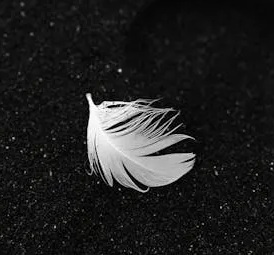
    In the film, Forrest Gump, the feather symbolizes Forrest’s life journey.

    In The Scarlet Letter the red letter A is meant to be a symbol of shame. It becomes a powerful symbol when its meaning shifts to stand for “Able.” 

    In Giving Up the Ghost, Samantha Rose refers to snow globes and flowers as symbols in her healing process. A rose, California poppy . . . symbols of new life.

    A symbol could be a repetitive action, like a finger on the side of nose in the movie, The Sting.

    Excerpts from “What Is Symbolism and How to Use It in Your Writing,” by Emily McCrary-Ruiz-Esparza, Written Word Media, April 26, 2024

    Writing Prompt

    If your family had a motto, what would it be?

    Or, what motto do you live by?

    What word or phrase do you and your circle of family/friends use when remembering something that happened? When you say this word or phrase, your people know what you are referring to.

    It could start like this: Remember when . . . and then don’t tell the whole story . . . use a symbol that refers to what happened. The symbol could be a word or a phrase that represents what happened.

    Freewrite: Use a symbol to tell your story.

    Just Write!
  • Metaphors and Hyperbole . . . Prompt #853

    Make a list of things that surprised or astonished you or made you feel uncomfortable. Something from a long time ago or recently.

    Just a list for now.

    Using your list, make a list of emotions you felt either during what you experienced or emotions you felt today or are feeling right now.

    For example: Fear, anger, surprise, annoyance, joy, angst, acceptance

    Prompt Three

    A metaphor compares two unlike things to show a relationship without using “like” or “as.” Metaphors imply that one thing is another.

    Chaos is a friend of mine. Bob Dylan

    You ain’t nothin’ but a hound dog, cryin’ all the time. —Elvis Presley

    Darling, I’m a nightmare dressed like a daydream. Taylor Swift

    My heart, a church where no one prays. Lonely pews and smudged stained glass. The Forever Workshop

    Writing Prompt: Choose an emotion from your list.

    Write what happened that caused these emotions.

    Use sensory detail.

    Sight. Sound. Touch. Taste. Smell.

    Use metaphors.

    Just Write!

    Use hyperbole to describe an emotion. You can expand upon something you have written or use a new topic to write about.

    Hyperbole is exaggeration to the extreme.

    No one is going to judge you nor your writing. So you can exaggerate as much as you want.

    Cry me a river              

    Enough food to feed an army

    He has the memory of an elephant

    I could sleep for a week

    I died of embarrassment 

    I had to walk to the ends of the Earth to find it

    It’s a jungle out there

    It’s so hot, you could fry an egg on the sidewalk

    Choose something from your list. Write what happened as if you are telling a gullible listener.

    Or:

    Expand upon one of the above hyperbole examples.

    Or:  

    Write whatever is popping up in your head.

    Idea for this prompt inspired from The Forever Workshop.

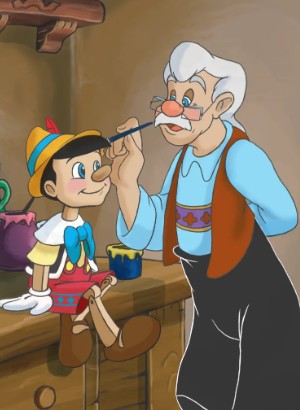
    The story of Pinocchio, as metaphor:

    Gepetto, a woodcarver, prays that a puppet he carved could become a real boy. According to Phil Romo, a “real boy” is a metaphor for being an autonomous individual, not bound to ideologies or to existing institutions. “To think for yourself . . . Don’t be bound to the strings you are born into.”

    The Blue Fairy grants life to Geppetto’s puppet. This is a metaphor for human birth, the ‘miracle of life.’

    Excerpted from Life is a Beautiful Rideby Phil Romo.

    Future writing: Choose something from one of your lists and Just Write!

  • Our brains like order . . . Prompt #852

    ceramic bowls on brown wooden shelves
    Photo by Tony Smith on Pexels.com

    “Our brains like order,” explains Kristi Phillips, a Minnesota-based psychologist “having less stimuli around us helps promote relaxation.”

    She points out the popularity of home-decluttering Reels and TikToks, as well as TV series such as Get Organized With the Home Edit and Hot Mess House.

    “But while we enjoy the afterglow of a cleaned-out junk drawer, we still procrastinate when it comes to tackling more complex areas of clutter in our lives. When we’re trying to declutter our own spaces, we have an emotional attachment to those items,” she says.

    “Whether there are memories linked to those objects or simply the guilt of getting rid of something you spent money on, the task of mentally weighing each item can be overwhelming, with a video, you see the fast-forward of how quick it is … so it gives us that hope and positivity of, Oh, I can do that too.”   — “Why Watching Decluttering Videos Feels So Good” by Abby Alten Schwartz

    Writing Prompt

    Write about your cleaning out habits or your decluttering experience, could be your things or someone else’s things.

    OR: Write about what helps your brain to relax.

  • Can’t explain . . . Prompt #851

    Write about something you can’t explain.

    Something that makes no sense that’s happening to you now, or happened in the past.

    #justwrite #amwriting #iamawriter

  • A quirk . . . Prompt #850

    Write about a quirk you have.

    It could be something you do, or participate in, or watch.

    There may not be a logical explanation for this, except that it brings you joy or satisfaction.

    #justwrite #amwriting #iamawriter

  • Photo prompt. An owl . . . Prompt #849

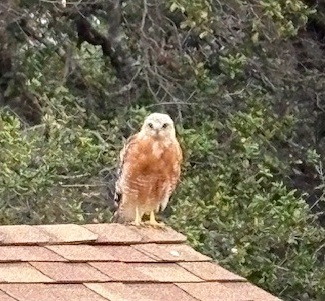
    Today’s writing prompt is a photo of an owl.

    Photo by Marlene Cullen

    Here’s what happened:

    I looked out my kitchen window and saw the most majestic owl sitting on the roof of our shed. 

    She (he?) literally took my breath away.

    I took a picture through the window.

    Then I went outside to take a better look and a better photo.

    She swiveled her head and looked right at me.

    I snapped a photo.

    Then she flew away to the top of a pole.

    Poetry in flight.

    My friend Kathy, who works at a bird sanctuary, said it’s a juvenile great horned owl.

    Prompt: Photo of an owl

    Just Write!

    #iamwriting   #iamawriter   #justwrite

  • Mondegreen . . . Prompt #848

    green frog resting on lily pads in tranquil pond
    Photo by Mohan Nannapaneni on Pexels.com

    Excerpt from June 16 River Teeth, “Mondegreen,” by Diane Gottlieb:

    A mondegreen is a mishearing or misinterpretation of a phrase in a way that gives it a new meaning.

    Mondegreens are most often created by a person listening to a poem or a song; unable to hear a lyric clearly, substitutes words that sound similar.

    American writer Sylvia Wright coined the term in 1954, recalling a childhood memory of her mother reading the Scottish ballad “The Bonnie Earl o’Moray,” and mishearing the words “laid him on the green” as “Lady Mondegreen.”

    Diane’s piece begins like this:

    “I found a lost memory today. Discovered it inside a writing prompt: recall something you’ve misheard. The title of the 1971 Sly and the Family Stone song is ‘It’s a Family Affair,’ but I swore it was ‘A Family of Bears.’ How wonderful it felt to belt out a song about bears and more bears, a family of bears.”

    A mondegreen inspired from “Blue Jay Way,” by the Beatles:

    Misheard Lyrics: There’s a frog upon a lake.

    Original Lyrics: There’s a fog upon L.A.

    Prompt: Write about a mondegreen.

    #justwwrite #iamawriter #iamwriting

  • Beyond Your Neighborhood . . . Prompt #847

    open gray wooden door
    Photo by Dmitry Zvolskiy on Pexels.com

    Recall a time in your young life when you went beyond your neighborhood.

    Perhaps you had the experience of being somewhere out of your comfort zone.

    How old were you?

    Did a grownup or older child stay with you?

    Or, were you left alone?

    Look around.

    Describe this place.

    Did it feel friendly?

    Scary?

    Were there a lot of people there?

    What did you do?

    What emotions roll over you as you remember?

    What energy did you pick up at the time?

    What is that energy like now?

    Does that energy still have a hold on you?

    #justwrite #iamwriting #iamawriter

  • Your Neighborhood . . . Prompt #846

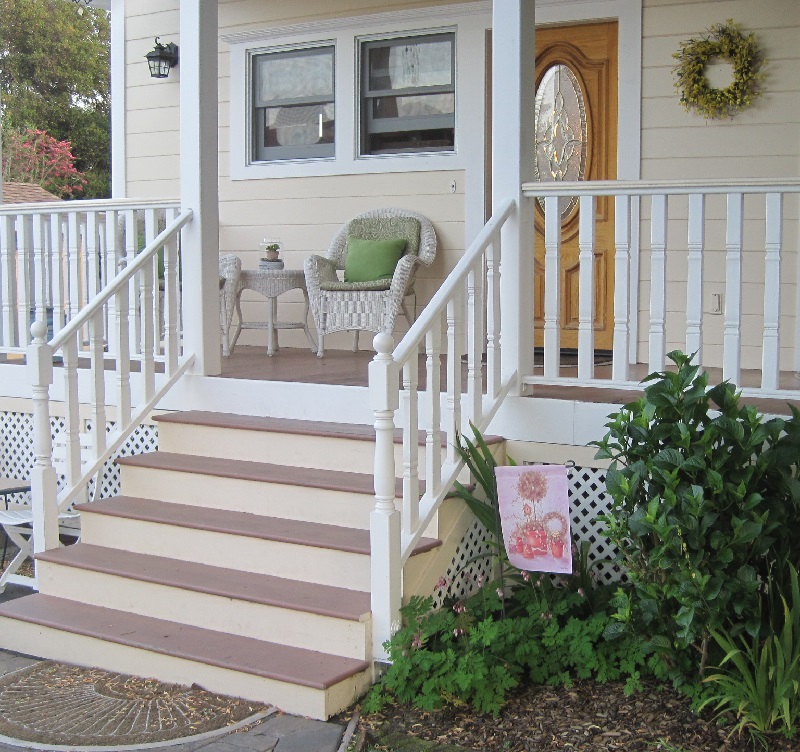
    Picture yourself standing in front of the house, apartment, flat, whatever type of building you grew up in.

    If you lived in more than one place, choose the one that holds the most memories.

    Take a moment to look around. Scan from one side to the other.

    What do you see?

    What do you smell?

    What do you hear?

    Take some deep breaths as you see this scene.

    Mentally take a walk to where you often walked:

    School, library, playground, theater, skating rink, store.

    Picture yourself on this walk.

    What did your neighborhood smell like?

    What did you hear as you walked along?

    Just Write~!

  • What’s bugging you? . . . Prompt #845

    Writing Prompt:
    What’s bugging you?

    Just Write!

    #amwriting #iamawriter #justwrite