
Write about something you wish you could un-do or un-see or un-know.
You can use this prompt to write about yourself, someone you know, or write how your fictional character would respond.
Just write!
Write about something you wish you could un-do or un-see or un-know.
You can use this prompt to write about yourself, someone you know, or write how your fictional character would respond.
Just write!
 Today’s Guest Blogger Rachael Herron has this to say about revision.
I’m back in the middle of revision of a book, and I’m finally swimming in the water I love.
What I adore about revision is this: I know the world. I invented it, after all! When I open the document, I’m right in the middle of something I understand. It’s much easier, for me, to drop in for hours and rest on the page. It’s also easier to come out of, to shake off.
First drafts remain torture for me. So many of you love the first drafts, and I can admit that sometimes, the writing of new words is glorious. You surprise yourself with a turn of phrase that you’re pretty sure is genius and has probably never been said before. The plot bends and a tree you wrote about comes to life and points a branched finger in a direction you never saw coming. Inspiration flows, hot and heavy.
But maybe I’m just more of a down-to-earth gal. I love falling in love, but I love remaining in love more. Give me a passionate kiss before you take the trash out—that’s happiness to me. I like the comfort of What I Know. I like to tuck my feet under the thighs of my manuscript as we cuddle on the couch. I love knowing my manuscript likes the lights on till sleep-time, even though I prefer to read in the dark.
Revision is both comfortable and exciting, like a sturdy marriage. Oh, I love the word sturdy. It’s prosaic, but it’s so me. My legs are sturdy. My emotions are, too. I love my books to be sturdy enough to lean on.
And lean on them, I do. I fall into them, really. Revisions are getting in the bed you made of out words and pulling up the covers. Then you roll around, making those words better, cleaner, more focused.
Revision is when the REALLY big ideas show up. Then you have to move parts around, like those flat puzzle toys you slid pieces around on to make a picture, to make those new ideas fit. You might have to pry out some pieces and manufacture new ones. But then you click one piece left, and another one right, and suddenly, you’re looking at it. The whole picture. Your book.
Ahhh. I’m reveling.
Note from Marlene: Yes! I also love revising. Moving parts around, like a puzzle = Exactly! And the euphoria when the pieces fit = Joy!
Rachael Herron is the bestselling author of the novels The Ones Who Matter Most (named a 2016 Editor’s Pick by Library Journal), Splinters of Light and Pack Up the Moon (all from Penguin), the Darling Bay and the Cypress Hollow series, and the memoir, A Life in Stitches (Chronicle). She received her MFA in writing from Mills College, Oakland and she teaches writing in the extension programs at both UC Berkeley and Stanford. She’s proud to be a New Zealander as well as a US citizen, though her Kiwi accent only comes out when she’s very tired. She’s honored to be a member of the NaNoWriMo Writers Board. She is currently a Writer in Residence at Mills College.


EPOCH is an open forum for literary fiction, poetry, essays, screenplays, cartoons, graphic art, and graphic fiction.
Reading Period: September 15 to April 15
Guidelines: Submissions by mail only, addressed to the appropriate editor: e.g. Fiction Editor, Poetry Editor, Essay Editor. Screenplays, cartoons, graphic art, and graphic fiction should be so labeled on the envelope.
Good Luck
Whether you tell your story chronologically, or with flashbacks, or with intercutting, it’s important to write your memoir in the voice of the narrator. Examples of these different ways of telling a story are used in The Write Spot Anthology: Discoveries.
“Maintaining a solid narrative structure is critical to ensure readers move in step with the sequence of life events. . . When they [readers] can follow your progression as a character, they can also fully enter your story.” —Dorit Sasson, “Refresher Course,” The Writer, February 2016
 Note from Marlene: When writing about something that happened in childhood, use appropriate age-based language. Show character growth by using adult language when writing about the character as an adult.
Examples of narrative structure, character growth and details on how to use intercutting in your writing can be found in The Write Spot Anthology: Discoveries.

Helen – A Literary and Arts Magazine is published biannually in innovative print options and digital media. In Spring 2016, Helen moved from a traditional print form to a more innovative structure. Most writing is published online except for the micro prose printed on poker chips to celebrate their hometown of Las Vegas, Nevada.
“Our goal is to inspire and support emerging writers in all genres.”
They also publish a weekly blog series called “Friday Night Specials.”
Submit: Contests
Visual Prompts
Visual Prompt Contest
 “A writer’s problem does not change. It’s always how to write truly and having found what is true, to project it in such a way that it becomes a part of the experience of the person who reads it.” — Ernest Hemingway
Photo by Breana Marie

I like the possibilities this prompt suggests, perhaps an opportunity for reflection.
Note from Marlene: Write whatever comes up for you. Trust the process of free writing. Write with no worries about the outcome. Write for yourself with no cares about the end product. Just Write!
Photo by Christina Gleason.
“One reason we choose to write essays instead of another kind of nonfiction piece is because we can use the personal essay as a kind of therapy. Sometimes the act of writing gives us the opportunity to work through the conflict and come up with another way of looking at the situation.
As the writer explores her problem, owns it, and then comes up with a resolution that will change how she relates to her problem in the future, the reader will be looking at her own life and doing the same thing. That’s why the essayist must be committed to the process of discovery and must be as honest as she possibly can be about what she uncovers.
More than any other piece of nonfiction, the personal essay has to be written and rewritten and rewritten, often many times, to get to the heart of what it is we really want to say.” — Gloria Kempton, “Making a Point,” August 2006 Writer’s Digest Magazine
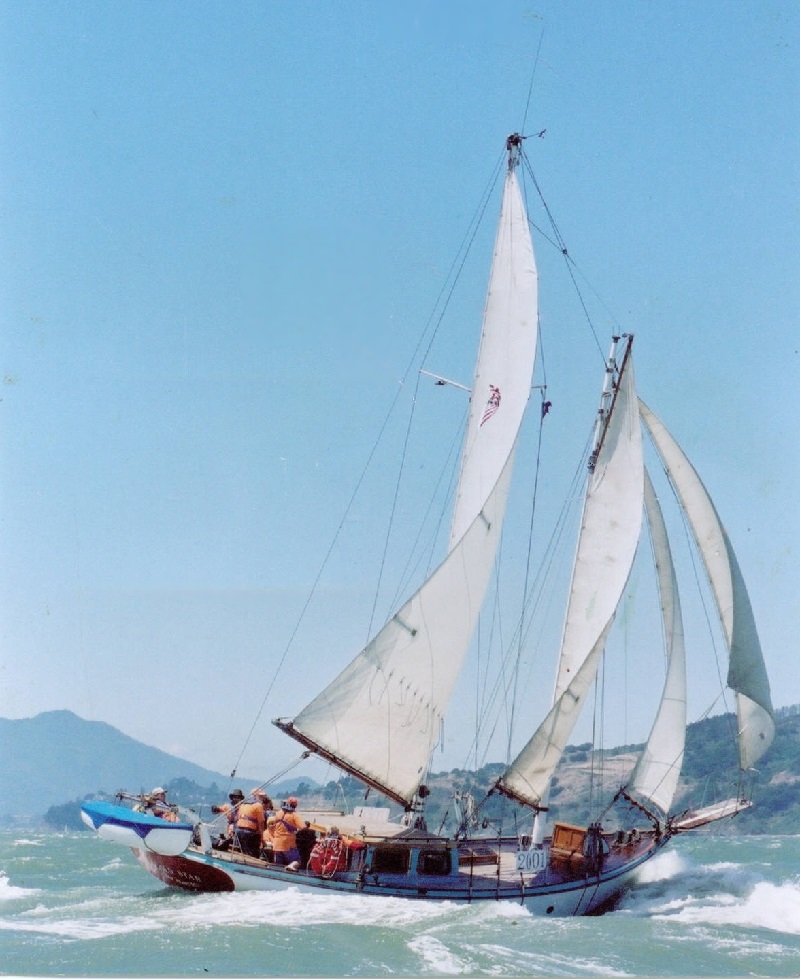 Note from Marlene: So true! Much of writing is re-visioning, re-thinking, re-writing. My essay in The Write Spot Anthology: Discoveries about how I spent my summer in 1974 was originally written that autumn. I spent the next 43 years revamping it. Yeah, that’s a lot of rewriting, but it got better with each twist and turn. It took that many years to fine tune my writing and to realize what the message was. I’m not suggesting you need 43 years to tweak your writing to where you like it. I am suggesting that you Never Give Up.
Just write!
Photo: The Schooner Gold Star, my home for most of the summer in 1974.
Wordrunner is accepting fiction, memoir and poetry, with the theme rites of passage for an echapbook anthology to be published March 2018.
The rites of passage theme includes any kind of passage through life, time or space.
Submit up to three poems or a short story, novel or memoir excerpt, or personal essay (1,000 to 5,000 words). There are separate categories for each genre (poetry, fiction, nonfiction). Note that really long poems are not suitable for this venue. Send us your best.
*Note from Marlene: Polish your writing now, so you will be ready to submit during the submissions timeline.