
We know what we know.
What’s more interesting:
~ What don’t you know?
~ What are you confused about?
We know what we know.
What’s more interesting:
~ What don’t you know?
~ What are you confused about?
Write from your point of view or from a fictional character’s pov.
Don’t have a fictional character? Today might be a good time to create one.
Use these words in your writing:
Illusion, jar, hope, shatter, widget, super, awkward
Hope = hoping, hopeful
Jar = jars, jarring

Guest Blogger Shawn Langwell shares smart writing tips, focusing on three important questions.
Octavia E. Butler said, “You don’t start out writing good stuff. You start out writing crap and thinking it’s good stuff, and then gradually you get better at it. That’s why I say one of the most valuable traits is persistence.”
Writing and leadership have a lot in common. Both require creativity, passion, and persistence. Both are conversations. And every good author as well as effective leaders know their audience. Each requires a level of confidence and humility to listen. To listen to the suggestions of an editor. To listen to the inner voice that says you need to sit your butt down on a regular basis and write. Or, upon awakening to listen and follow the conviction of a dream so vivid and powerful that the story just unfolds and becomes a book and a short memoir entitled: “Cathartic Writing: The Healing Power of a Story Now Told,” included in The Write Spot: Writing as a Path to Healing, by editor Marlene Cullen.
I am still very much a rookie when it comes to writing and, like many people, tend to overthink the entire process before I even write the first word. For me, focus is a key to establishing a successful plan for any endeavor. Sure, there’s a lot more to writing than focus but I have found that lack of focus tends to lead to overthinking, which is a result of fear about not knowing where you want to go or believing enough in your abilities that one becomes consumed with analysis paralysis.
Not everyone wakes up from a dream with a crystal-clear vision of what they want to write. Sometimes you need to kick that doubt to the curb and sit your butt down in front of your computer and write. Don’t worry about the results, yet. And certainly, don’t try and edit as you go. Some may be able to do this, but I find it messes with my flow and I get back onto the perfectionism merry go round and lose any emotion or momentum I may have finally gained.
Writing is messy and not many like being messy. Writing also means you must become vulnerable. You are putting your thoughts and ideas out there for the world to see and some people may not like them.
“Almost all good writing begins with terrible first efforts. You need to start somewhere. Start by getting something—anything—down on paper. What I’ve learned to do when I sit down to work on a shitty first draft is to quiet the voices in my head.” ― Anne Lamott
I’ve been in sales and marketing for over twenty-eight years and, like authors, occasionally feel stuck. A few years ago, I went to a colleague to get input on a big proposal I was working on. He stopped me before I even got started and asked me if I had done a needs assessment.
“What do you mean? Yes, I know they need to increase their business.” I said.
“No. Have you asked them the three questions?”
“The three questions?”
“Before you can give a business presentation or any type of communication you need to ask these three questions:
One: Who do you want to reach?
Two: What do you want to say to them?
Three: What do you want them to do?”
Before they write or submit for publication these same three questions need to be decided by every author or speaker. In other words, who is your audience or what genre do you want to write?
Are you writing fiction or non-fiction? Each of these will dictate the voice, narrative and theme of your work.
Lastly, What’s the purpose of your writing? Is it to entertain (Fiction)?
Or, is it to inform? Persuade? Or share a unique experience? (Non-fiction).
Taking time to focus on these three questions has dramatically helped me increase my success rate in sales and made it easier to get started with writing. I have learned that answering these questions up front and not worrying about writing crap at first takes the pressure off. My persistence in practicing these steps has enabled me to finish three years of creative writing at the junior college, write and submit to three additional anthologies, give six speeches for Toast masters, and be asked to share a few words about the process with other writers like you.
I look forward to meeting you on August 5th when we explore this a little more in depth at a Writers Forum Zoom Event.
Be well, Shawn Langwell
Note from Marlene: Shawn leads the parade in a series of Zoom talks based on the anthology, The Write Spot: Writing as a Path to Healing. Please join us for these free Writers Forum events.
Shawn Langwell is a graduate of San Francisco State University with a Bachelor of Science Degree in Marketing and Advertising. He earned certificates from Dominican University, Barowsky School of Business Executive Education Leadership Program, and the San Rafael Chamber of Commerce Leadership Institute.
He is President of Redwood Writers, a branch of the California Writers Club, and immediate past President of Toast of Petaluma.
Shawn’s personal mission is to add value to people and businesses everywhere. He is a sought-after speaker for recovery and has over 33 years of continuous sobriety. He lives in Petaluma, CA with his wife, three adult children, and a Maine Coon cat, Cleo.
Shawn is the author of the memoir, Beyond Recovery: A Journey of Grace, Love, and Forgiveness.

“At the time it seemed very important. That’s the funny thing about arguments. Now, I can’t even remember what it was all about.”
Quote by Dr. Chilton in the movie, Pollyanna.
Writing prompt: Write about an argument or a disagreement.
After you have written all you want on this subject, put on your screenplay hat. Write this same scene from the point of view of the other person involved in the argument or disagreement.

Sy Safransky has this to say about editing:
Readers sometimes ask how much I edit my own writing.
I edit until each paragraph has lost the ten pounds it gained over the winter.
I edit until each sentence can survive three days in the wilderness on its own.
My father taught me to look at a sentence and, if it didn’t deserve to live, shoot it between the eyes.
Sy Safransky, The Sun Magazine, May 2011
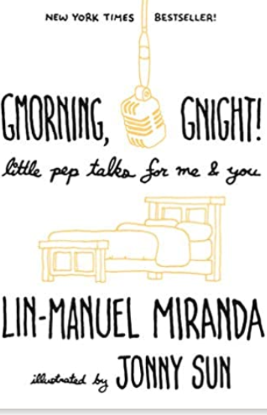
Like Prompt #510, this prompt is also inspired by Lin-Manuel Miranda, besides being an amazing lyricist, he is the author of Gmorning, Gnight!: Little Pep Talks for Me & You which came from his Tweets.
Jonny Sun said Lin should make the tweet comments into a book.
Lin asked Jonny, “Why would I write a book when you can get this free?”
Jonny, the person who became the illustrator for the book, answered, “Because people like to hold things.”
Prompt: What do you like to hold or carry?
Next Avenue is a nonprofit journalism website.
Next Avenue is extending an invitation to share your story (for those over the age of 50).
We are seeking original essays with an insightful perspective on aging.
Every day on Next Avenue, we tell the stories of what makes us different and where we share commonalities. It is our hope that readers will glimpse themselves in someone else’s story; find a nugget of information they need; or discover a fresh perspective on an issue relative to aging.
We’re looking for insightful essays that illuminate a truth or teach us something new.
As the pandemic persists, and life continues to swirl around all of us in unexpected ways, perspective has taken center stage. You may have discovered there has been more space for quiet, like the calm in the center of the storm. Perhaps the quiet is not always welcome, but it is there. In the quiet, opportunities for reflection, for finding perspective, can emerge.
Stories are waiting to be told.
From July 24 through August 31, 2020, readers age 50+ may submit a 500-word original essay focused on a topic or experience of your choosing.
Beginning on July 24, you may submit your work here. One submission per person, please.
We’re looking for insightful essays that illuminate a truth or teach us something new.
Share a personal perspective with fellow readers about what it means to “act your age.” Tell us how you have found resilience in difficult times. How has growing older surprised you?
What is the story you want to tell?
The Next Avenue editorial team will select 12 essays, representing a diverse collective of voices, for publication on the site this fall.
The 500-word format should be strictly followed; longer essays will not be considered.
Be sure to check spelling, grammar and punctuation before submitting your essay.
Please give your piece a title.
We are looking for engaging and well-crafted personal narratives.
Next Avenue Editor’s note: The Joy of Writing by Elizabeth Berg, a New York Times bestselling author, is the first in a series of essays in conjunction with Next Avenue’s Telling Our Stories initiative, inviting readers to submit their own personal essays.
Elizabeth wrote on Facebook:
“Okay, all you would-be writers! This is your chance! Take a look at this invitation to submit essays. I would like to point out that this is exactly how I got my start as a published writer, by entering an essay contest. Good luck to all of you!”
Note from Marlene: You can’t win if you don’t enter.
Berg’s essay begins with:
“There I was, a nine-year-old girl with a bad pixie cut, sitting at my card table desk, drinking pickle juice and writing a poem meant to inspire rapture and envy in every reader’s heart. It wasn’t much of a poem, though I thought it was terrific. I mailed it to American Girl magazine and waited for my acceptance check (of about a million dollars, I figured) to arrive. Then I was going to buy my father a Cadillac.
The poem was swiftly (and rightly) rejected, and so wounded was I that it took another 25 years before I submitted anything. By then, I was a registered nurse wanting to find a job that would let me stay home with my daughters. So I entered an essay contest in Parents magazine, won it and went on to write essays for many magazines. I moved on to short stories, then books. I’ve now published over thirty books, I’m long past the usual retirement age, and still I keep on. Why?” continue reading.
Note from Marlene: Even if you don’t submit your writing, there are a lot of ideas for writing prompts at Next Avenue.
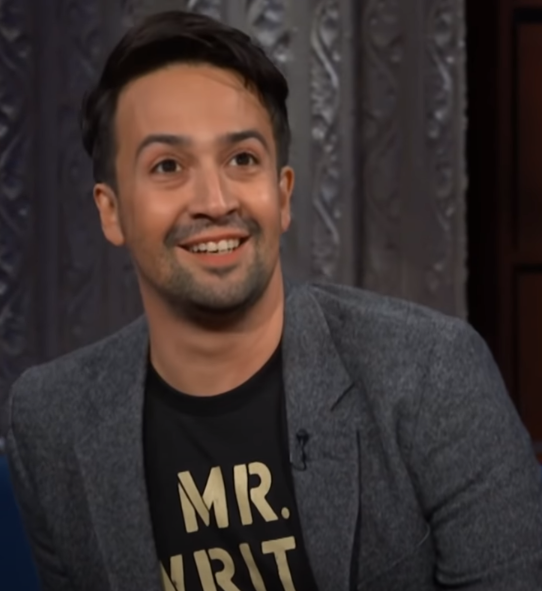
This prompt is inspired by an interview with Lin-Manuel Miranda, an American composer, lyricist, actor, singer, rapper, producer, and playwright. He composed music for Moana, and starred in Mary Poppins. He is possibly best known for creating and starring in the Broadway play, Hamilton.
He is the author of Gmorning, Gnight!: Little Pep Talks for Me & You which came from his Tweets.
Jonny Sun said to Lin, “You should make these tweet comments into a book.”
Lin replied, “Why would I write a book when you can get this free?”
Sun, the person who became the illustrator for the book, answered, “Because people like to hold things.”
Lin’s tweets came from asking himself, “What do I need to hear right now?”
Prompt: What do you need to hear right now?

Write about:
~ A performance you were in, or a performance your fictional character was in.
Or:
~ A live performance you will always remember.

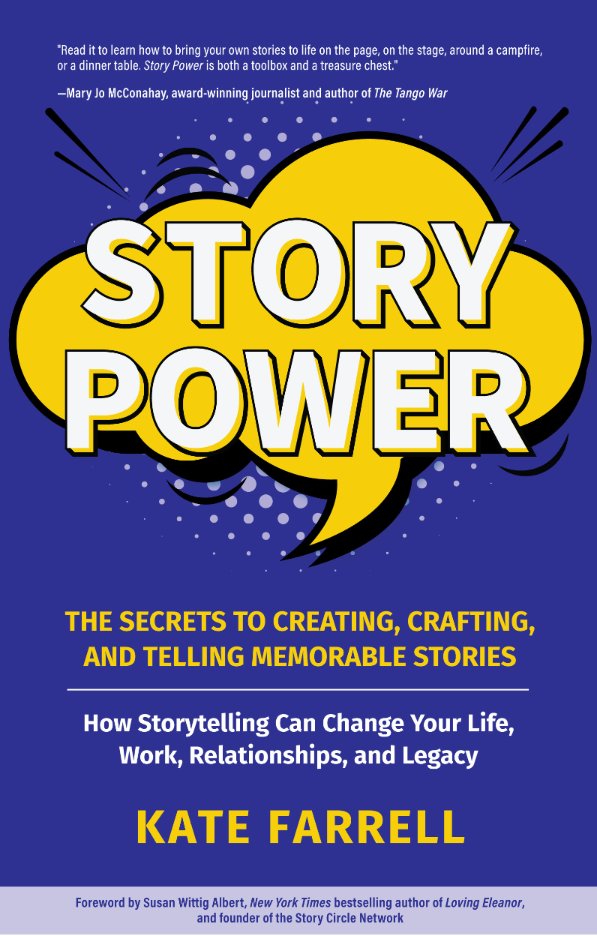
Today’s Guest Blogger, Kate Farrell, author of Story Power, with her unique experience as a storyteller, shares methods to unlock family secrets,
There’s nothing louder than a family secret—it pesters and pokes until someone speaks up. Secrets have a way of hiding in plain sight. There are always the whispered rumors, missing pieces of a puzzle, stories that keep changing. But just as shared family folklore can develop strength and identity, keeping family secrets can destroy trust. Secrets that persist, unspoken and misunderstood, can erode the very foundation of a family. Family members who are perceptive, who sense hidden truths, may become fearful or internalize guilt and shame. At the very least, family secrets isolate—family members from one another and the entire family from their community.
Some family secrets are more harmful to keep than others. Those that were traumatic, that violated some taboo, or were life-changing are vital to expose. Some of these important secrets can only be shared privately, within the family, and only with members old enough to understand. Certainly, by the time most children reach adulthood, they ought to know most of the essential family secrets that were kept from them, yet influenced their lives in ways both known and unknown.
When considering the sensitive nature of family secrets, a storyteller should proceed with care. There will be those in the family who will never accept the truth, once exposed. And there will be those members who will feel relieved or validated by newly discovered stories that make sense of a puzzle. It can be a powerful healing process for many. Of course, there will also be relatives who find family secrets fascinating and telling them juicy entertainment. As a family member and storyteller, it’s often a challenge to share family secrets in a responsible, but enduring way.
As you ponder what secrets you’ve learned about your family, either from relatives or from research, choose the ones whose revealed truth meant the most to you. Which ones contributed most to your identity, and resolved issues that had once confused you. Select the ones with the most personal impact to shape into stories and tell, to store in notebooks or to record. As you share these, other family members might be encouraged to share theirs.
Exercises & Prompts: Family Secrets & Shadows
Prompts: Shadows
Prompts: Secrets
Let all these memories and stories play in your mind’s eye as you search for one story to tell. Select one that has a clear structure with a beginning, middle, and end. Choose one that has a conflict, a problem, suspense, tension, or an adventure.
Freewrites
Freewrites, or stream of consciousness writing, might reveal new thoughts and perhaps uncover information and present answers that haven’t been previously discovered. With freewrites, personal experiences emerge for your writing. Writing prompts can be used to inspire writing. Prompts can be a word, a phrase, a picture, a sound, a smell, a line from a book or a poem. Set a timer for fifteen minutes to corral your writing time. Choose a prompt and start writing.
Freewrite Example: Family Secrets
Marlene Cullen employs the practice of free writing or “freewrites” with great success and has shared it with many writers over the years. It is also called timed writing and the results are unpredictable, creative, and at times, surprising. It’s one sure way to reach into the shadows to a family member whose status in the family was diminished, as Marlene does with her father. By letting her mind probe a theme without judgement, she reveals her own feelings, ones she’s kept under wraps for a lifetime. Start, as Marlene does, with a prompt about family secrets and see where your free writing takes you. Use a freewrite to explore the secrets and shadows within your own family.
“Meeting My Father”
Marlene Cullen
I have always had a hard time describing how my father didn’t fit into our family. He was a merchant seaman, away from home for months. He brought home exotic toys, and clothes for me and my sisters, always too small.
“I have the perfect family. A daddy, a mommy, and two little girls.” I knew I wasn’t telling the truth to my second grade playmates, but if I pretended hard enough, maybe it would come true.
When my father was home, it meant he was out of work, and could be found at one neighborhood bar or another. I have a child’s handful of memories about my father—none of them are good. The best I could say was that he was a “Third Street Bum.” He died when he was thirty-seven of alcohol related diseases. I was sixteen.
When I was fifty-four, through a series of serendipitous happenings, I met my father’s high school best friends. They painted a picture of him as a happy-go-lucky kid. They said Bill was a quiet guy, a gentleman, a prankster, and very sensitive. Seeing my father through the eyes of his teenage friends introduced me to the person I never knew.
Sloshing my way through freewrites, I realized my father was more than a person with an alcohol problem. He was a husband and a father, a loving son, and a loyal friend, struggling to navigate the challenges of life.
Several free writes about my father evolved into a story revealing my epiphany about him, published in The Write Spot: Memories. My insight concludes: “He is a part of me, imperfections as well as the good parts. He is part of my granddaughter who shares his hazel-colored eyes.” Without freewrites, my father would have remained a “lesser” person in my mind.
Kate Farrell, storyteller, author, librarian, founded the Word Weaving Storytelling Project and published numerous educational materials on storytelling.
She has contributed to and edited award-winning anthologies of personal narrative.
Farrell recently completed a how-to guide on the art of storytelling for adults, Story Power: Secrets to Creating, Crafting, and Telling Memorial Stories, released by Mango Publishing.
She is past president of Women’s National Book Association, San Francisco Chapter.
Kate blogs at Storytelling For Everyone.