Blog

  • Ninth Letter

    Ninth Letter publishes one issue in the spring and one in the fall and accepts submissions of fiction from September 1 to November 30 and from January 1 to February 28 (postmark dates)

    We are accepting submissions of poetry and essays from September 1 to February 28 (postmark dates). 

    We are interested in prose and poetry that experiment with form, narrative, and nontraditional subject matter, as well as more traditional literary work.

    Please adhere to the guidelines when submitting your work to Ninth Letter.

    Ninth Letter pays $25 per printed page, upon publication, for accepted material, as well as two complimentary copies of the issue in which the work appears.

  • Bella Mahaya Carter & The Priority Pyramid

    Today’s guest blogger, Bella Mahaya Carter offers inspiration with a “Priority Pyramid.” The following is an excerpt from her original post.

    Last November, I worked with Dan Blank, author of Be The Gateway: A Practical Guide to Sharing Your Creative Work and an Audience. In his book, Dan recommends an exercise to help creative professionals get clear about their life and work priorities.

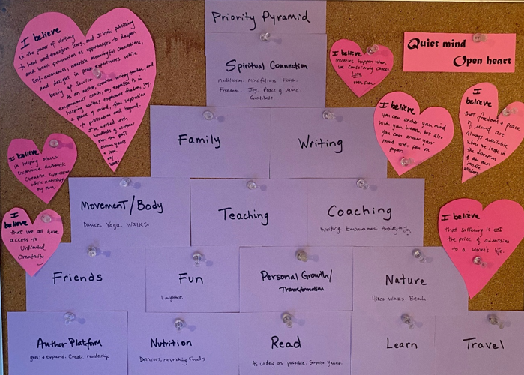
    If you’d like to try this exercise, get fifteen index cards and write down one word on each card indicating what’s important to you. Then prioritize your cards into a pyramid, with your most important priority at the apex, and work down from there. These cards are a wonderful reminder of what matters if you lose your way. Each person will obviously have different words on their cards.

    Here’s what mine looks like:

    For me, a deep spiritual connection with Self comes first. When I lose that I’m like seaweed tossing in the ocean, and life feels disorienting, even painful. After that my priority is my family and also my writing. While the importance of family is obvious, it’s not always been easy for me to explain why my writing holds such a high priority in my life. The best way to describe it is to say that writing enhances my connection with my True Self. It helps me remember who I am.

    Many of my students and clients tell me that writing is also foundational in their lives. It helps them navigate their days with greater clarity and grace, stay grounded, identify and release limiting thoughts, express joy, share stories, and reimagine what’s possible.

    It’s useful to look at priorities independently, but also in relationship to one another.

    I’ve added “I believe” statements to my “pyramid landscape” to remind me why I do what I do.
    I believe in the power of writing to heal and transform lives, and I view publishing and book promotion as opportunities to deepen self-awareness, nourish meaningful connections, and delight in peak experiences while being of service.
    I believe in authentic, creative self-expression.
    I believe that we all have access to unlimited creativity.
    I believe miracles happen when we consciously choose love over fear.
    I believe suffering is not the price of admission to a creative life.
    I believe that freedom and peace of mind are available when we look in the direction of our own innate wisdom.

    I agree with Natalie Goldberg, who, in her book, The True Secret of Writing: Connecting Life with Language, says “you can anchor your mind with your breath, but also you can anchor your mind with pen on paper.”

    But perhaps the most reliable “anchor” of them all is love, which, ironically, is also the ideal launching pad. The best of what gets created through us comes from love.

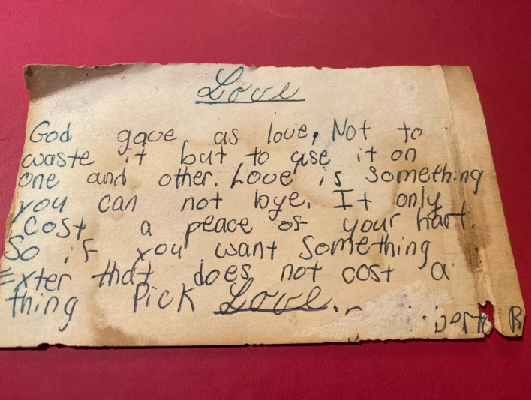
    This index card—the oldest of my bulletin board relics which I wrote around age six—sat for years beneath a sheet of glass that protected my mother’s mahogany sewing machine table. Mom put in long hours there. It was a palace of creation and love—and so was she!

    I had no clue when I wrote this all those years ago that as an adult I’d need to keep reminding myself to be guided by love rather than fear. Old habits may die hard, but they pass more peacefully—and lose their power over us—when we see them for what they are and let them go.

    Love is patient and kind, and it allows us to start over and reinvent ourselves. Again and again.

    As I sorted through the items I removed from my bulletin board, two of them went right back up. I wasn’t ready to clear these messages. One says, “Listen,” and the other says, “The only time is NOW!” I don’t know about you, but I need reminders like these.

    I’ve also left a lot of blank space on my bulletin boards to create room for what’s coming.

    Writing Circles begin January 29th. Enroll here.

    I have two openings for private coaching clients. Let me know if you’d like to work with me one-on-one.

    I wish you a new year filled with health, happiness, creative expression, and love.

    Thanks for being part of my journey.

    Blessings and gratitude, Bella

    Click to read Bella Mahaya Carter’s original post.

  • It’s a miracle . . . Prompt #468

    Today’s writing prompt:

      It’s a miracle . . . 

    Write whatever comes up.

    Write whatever pops into your head.

    Don’t judge. Don’t edit. Don’t be critical.

    Just write!

    It’s a miracle . . .

  • Jeff Goins & His System

    Today’s guest blogger, Jeff Goins, shares the system he uses to write books and blog posts. 

    Excerpt from Jeff:

    Most writers think writing is a one-step process . . . it’s a three-step process: coming up with ideas, turning those ideas into drafts, and then editing those drafts into publishable pieces.

    The Three-Bucket System . . . how I get my writing done.

    Bucket #1: Ideas

    Capture ideas [and keep] in a place where you can return to.

    Bucket #2: Drafts

    Pull an idea out from the first bucket and start writing. Save in a draft folder.

    At any given time, I have a whole bunch of half-finished chapters and blog posts on my computer begging to be edited and completed.

    The point of this system is to think as little as possible and just do the next thing.

    Bucket #3: Edits

    Pull out one of those drafts and edit it. Either schedule it for a blog post or tuck it away in another folder called “Finished pieces.”

    These are pieces of writing that are more or less ready for the world to see.

    Putting it together

    1. Collect Ideas. Shoot for five ideas. Write down a sentence or a phrase. Just enough to save the idea.

    2. Write and Save.

    When it’s time to write, pull one of those ideas out of that first bucket.

    When you’re done, put this piece in the “drafts” folder and save it for later.

    3. Edit and Publish.

    Edit the draft. Then move it to bucket three, maybe even publish it on your blog or wherever. Then go to bucket one to pull out a new idea and start writing again.

    Do this every day, and you’ll never run out of writing topics. You’ll never run out of things to edit and publish. You’ll never have writer’s block again.

    As long as you remember: writing is not one thing. It’s three things.

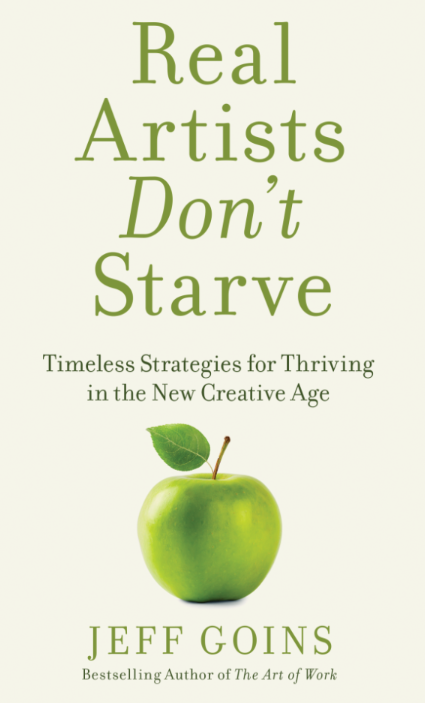
    Jeff Goins is the best-selling author of five books including the The Art of Work and Real Artists Don’t Starve. He shares his thoughts on writing, life, and creative work on his blog.

    Click here to read “The System I Used to Write 5 Books and Over 1,000 Blog Posts” by Jeff Goins.

  • Childhood dream. Prompt #467

    Write about your childhood dream.

    Is your childhood dream still calling you?

  • Anne R. Allen & Indie Publishing

    The following is an excerpt from Anne R. Allen’s December 22, 2019 blog post. You, too, can be an indie-author. It helps to be informed with willingness to do the work.

    From Anne:

    In a few days we’ll be leaving the twenty-teens to enter the 2020s. We’ll be saying goodbye to a decade of wild upheaval in the publishing industry.

    It’s been quite a ride.

    On January 5th, [we hosted] agent Laurie McLean from Fuse Literary Agency, for her annual “Crystal Ball” predictions for publishing in 2020.

    But today I’m thinking about the decade that’s passing, and how it disrupted and radically changed the way authors approach publication.

    A lot of us got to behave like teens—experimenting with radical publishing ideas and trying on lots of new writing venues for size.

    Amazon’s Kindle had the right name. It fired up the writing community in a major way. Self-publishing became a viable, lucrative alternative to the soul-crushing process of breaking into traditional publishing.

    But now things are changing again. Sales of Kindles and other ereaders are way down. A lot of indie authors have disappeared.

    Is the Self-Publishing Revolution Over?

    Experts agree the “Kindle gold rush” is history.

    But self-publishing is still here.

    However, it has gone through drastic changes since 2010.

    In the early days, there weren’t many ebooks for Amazon to sell to their newly-minted Kindle owners. So they encouraged writers to publish their own work through their new “Kindle Direct Publishing” (KDP.)

    But then Amazon started its own publishing imprints like Montlake, Thomas and Mercer, Lake Union, etc. They wanted to market their own publishing companies.

    Then came Kindle Unlimited, the book service that allows unlimited reads per month for a flat fee.

    Indie incomes went down a lot more.

    A swarm of scammers, plagiarizers, and crooks learned to game the KU system and top the charts with stuffed, fake, and stolen books.

    Real indies lost out.

    Readers left Facebook’s privacy-invading machine. And new algorithms no longer let as many readers see our author pages.

    Indie incomes went down a bit more.

    E-books were the bread and butter of the self-publishing revolution, but as people started reading more on glaring tablets and phones, they rediscovered paper books.

    Big tech, which had once seemed so friendly to indie authors, became a minefield.

    But the Self-Publishing Revolution Didn’t Die

    It’s true that indie sales are more modest than they were mid-decade, and you’re not hearing about any new “Kindle Millionaires.”  

    But a lot of indies are still thriving.

    Many romance, mystery, and thriller writers who joined the self-publishing revolution are now making a good deal more than their trad-pubbed counterparts.

    Others are happily plugging along, not making a big income, but enjoying writing as a second job or hobby.

    Self-publishing is still an excellent way to publish. But it’s not the same as it was in 2010.

    Indies now need to have the training and capital to turn out a top-notch product and advertise it. They also have to be willing to learn the ropes of online marketing and put in the time with social media to build a following. They need to allot the time to put out a blog or newsletter.

    Self-publishing allows you to control your career. You’re not dealing with agents or editors who might ghost you, get fired, rope you into predatory contracts, or lose their marbles. (The majority of agents are honest and hardworking, but their incomes are falling with decreasing advances, and many simply can’t make ends meet without a second job.)

    My Advice

    Don’t choose self-publishing as the “easy” way to a writing career in the new decade. Choose it because you have an entrepreneurial spirit, enjoy social media and online marketing, and have the time to commit to running a business.

    Should You Plan to Self-Publish in the Next Decade?

    Only you know that. Do you write fast? Write in a popular genre? Have good marketing skills? Enjoy social media? Do you blog? Are you okay knowing you won’t be nominated for a prestigious book prize or get a review in The New Yorker?

    A “yes” to most of those questions would make you an excellent candidate. The only other big thing you’ll need is luck.

    So good luck to you. The 2020s may be the time your career soars!

    Click here for Anne’s full blog post with almost 100 comments.

    About Anne R. Allen

    My books are mostly romantic-comedy/mysteries. Maybe a little more comic than romantic. Since two of my favorite writers are Dorothy Parker and Dorothy L. Sayers, I guess it makes sense that I ended up writing a mash-up of the two “Dorothy” styles. Ruth Harris calls it “Chick Lit Noir.”

    I’ve been in the writing business long enough to have collected a pretty full set of mistakes. I blog in hopes of helping some of the new writers out there make better choices.

    In a former life I was an actress, bookseller, and the former artistic director of the Patio Playhouse in Escondido, CA. I last appeared in A Comedy of Errors at the Pacific Conservatory of the Performing Arts. I grew up in New England (Waterville, ME and various college towns in CT) graduated from Bryn Mawr College, and spent some time doing the hippie vagabond thing in several continents. Even got married once. All excellent adventures.

    I’m the author of 10 comic mysteries and a collection of short stories and poems. I’m also the co-author of a guidebook for writers, written with Amazon superstar Catherine Ryan Hyde, and I’ve written a new guidebook for author-bloggers: The Author Blog: Easy Blogging for Busy Authors.

    All my book-length works are detailed on my book page.
  • Chicken Soup for the Soul

    From the Chicken Soup for the Soul website:

    We have many Chicken Soup for the Soul books in development and we frequently add new titles. If you have a great story or poem you want to submit but it doesn’t fit with any of the topics listed below, please save it and check back to see if we have added a topic that’s a better match.

    If you have a story or poem that you think fits two of the topics below, you may submit it to both. Then let them know in the Comments section that you’ve done so. Also, you may submit more than one piece for each book.

    We are always looking for new talent. So whether you are a regular contributor or new to our family, please share your story or poem with us. If this is your first time, please visit the Story Guidelines page, which will answer many of your questions about subject matter, length, and style.

    Topic and deadline:

    Be You – January 31, 2020

    The Magic of Cats – January 31, 2020

    The Magic of Dogs – January 31, 20210

    Listen to Your Dreams – February 28, 2020

    Stories about Self-care and Me Time – April 30, 2020

    Christmas Is in the Air – April 30, 2020

    Age Is Just a Number – May 31, 2020

    Note from Marlene: You know what to do. Write your story. Revise. Ask someone for feedback. Revise again. Polish to the best of your ability. Submit!

  • Who? Where? When? Why? Prompt #466

    Who?

    Where?

    When?

    Why?

    Just write!

  • Nathan Bransford

    Guest Blogger Nathan Bransford reflects about this past decade with the constant of books by his side.

    The following is excerpted from Nathan’s December 30, 2019 blog post.

    So much can change over the course of a decade or two. Thank goodness the books we read and write will still be there waiting for us when we need them.

    When the clock struck midnight to ring in January 1, 2010, I was a literary agent with Curtis Brown Ltd. in San Francisco, I was married, and the ink was barely dry on my first book deal for the Jacob Wonderbar series.

    Little did I know that within a year and a half all that would change.

    Amid all this change, amid all of this upheaval and turmoil, there’s only one thing in my life that hasn’t changed.

    Books.

    The first time I visualized my current life was during a vacation in 2010 in Hawaii. I looked around and felt like a bolt of lightning hit me.

    I thought, “What if I just focused on helping authors with their manuscripts, wrote my own books, and worked remotely?”

    It took me a whole decade to achieve that dream. What if I’d leaped when I first had the idea?

    Regrets are pointless, lessons are valuable

    As much as we might want to change the past, the truth is that the past makes us who we are. (Something I explored at length in Jacob Wonderbar and the Interstellar Time Warp).

    I know I needed to go on my career odyssey to see what was out there, to learn new skills, to make new friendships, and grow as a person.

    I’ve definitely made some huge mistakes along the way. When I look back, the worst ones happened when I didn’t follow my own instincts, whether because I had talked myself out of what I was feeling or because I lacked the nerve to act on my gut.

    The comforting power of books

    In a world where things constantly change and often disorient us, there’s something comforting about the way books are stuck in time, artifacts of a particular moment and place. They provide that soothing certainty that we can return to them and they’ll be there, unchanged, ready for us to revisit.

    This especially applies to the books we write ourselves. It’s such a powerful and meaningful pursuit to write a book.

    Note from Marlene: I hope Nathan’s story inspires you to pursue your writing project.

    Click here to read the entire reflective post, including an endearing letter from Nathan to Roald Dahl.

    Nathan Bransford is the author of How to Write a Novel and the Jacob Wonderbar series. Nathan is dedicated to helping authors chase their dreams.

    Nathan’s blog has everything you need to know to write, edit, and publish a book. Can’t find what you need or want personalized help? Contact Nathan for help with your book.

  • How did I get here? Prompt #465

    Sometimes we drive a familiar route as if in a daze. At some point we become aware that we have been driving unaware and wonder, “How did I get here?”

    Sometimes we’re at a job, either paid or volunteer, or we’re enmeshed in an activity, either fun or dramatic or both. Perhaps we’ve been consumed with this activity. Maybe we wake up one day and wonder, “How did I get here?”

    Sometimes we look around and all of a sudden we’re 40, or 50, or 60 years old, or in my case, in my early seventies. Sometimes we wonder, “How did I get here?”

    Becoming: A Guided Journal for Discovering Your Voice is inspired from Michelle Obama’s book, Becoming.

    This journal helps “to alleviate the pressure of knowing what to write about.”

     “Writing Becoming led [Michelle] Obama to see the importance of taking time for contemplation. When asked about her writing process, she explains, ‘I spent a lot of time just reflecting and thinking, which is something I just didn’t have much time to do for about a decade. It was nice to decompress a little bit and ask myself, ‘How did I get here? Where did my story take a turn? I uncovered a lot of smaller moments . . . [that] were really foundational to the woman I became.’” —Paul Anderson, December 2019 Costco Connection

    Note from Marlene: If you need help in figuring out what to write about, or ideas about writing on difficult things without feeling re-traumatized, take a look at the prompts on The Write Spot Blog, especially “How to write without adding trauma.”

    Today’s Prompt:  How did I get here?