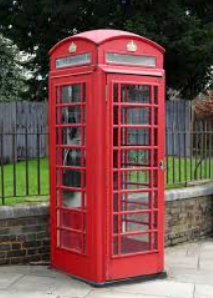
Suppose you had a magic red phone booth that allows you to go back in time and change one thing, what would you change?
Or, write about red phone booths.
Suppose you had a magic red phone booth that allows you to go back in time and change one thing, what would you change?
Or, write about red phone booths.

Today’s Writing Prompt: Who can you depend on?
Or: Write about who you depend on.
If there is no one you depend on, write about that.
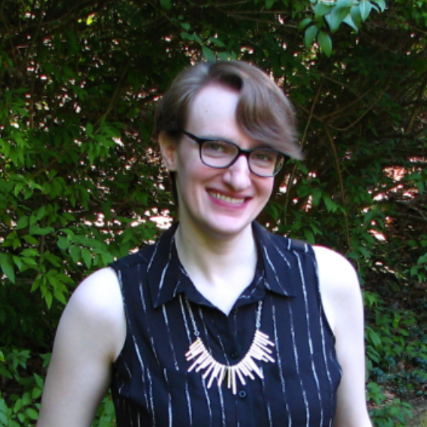
Guest Blogger Jenn Gott writes about 3 Inspiring Ways to Unlock the Book Inside You.
Does this sound familiar: You’ve always been drawn to writing and have a mind brimming with ideas. You’ve always loved the idea of holding a book you have written — but somehow, despite all your best intentions and New Year’s Resolutions, it just hasn’t happened.
Or maybe you’re a writer who has started a thousand writing projects, only to abandon them all within a few pages. Perhaps you’re not even sure if you want to be a writer, but you’ve always wanted to write a children’s book for your kids.
Maybe you’re a poet, or a copywriter, or a journalist, and there’s a book you know you could write, if you just find the right words inside you.
Maybe, maybe, maybe. One day.
The trouble with “one day” is that it doesn’t exist — each day, there’s only today. Which is why I’m bringing you the three best practices that I’ve found to unlock and supercharge creativity. It doesn’t matter whether you’re a beginner who has always wanted to tell your story, or a seasoned pro who’s gotten mired in delays, worries, and self-doubt. Either way, these habits will have words flowing in no time.
From National Novel Writing Month (NaNoWriMo) participants to your local writer’s group to authortube, it’s important to find your people wherever you can. Support is everything on your journey toward finishing a book, and it will inspire you more than anything else. To start, identify what kind of groups appeal most to you. Would you prefer to interact online,where you can hang out in your pajamas and reply at your leisure? Or would getting out of the house and seeing people face-to-face reinvigorate you? Are you interested in a classroom setting, a critique circle, or just some supportive friends who will provide lively discussion? Do you want to learn from people who are much more experienced than you, or strive together with peers at your skill level?
Don’t feel you need to limit yourself to only one group. There’s nothing to keep you from making writer-friends on Twitter, and in person at bookish events, and through workshops. In fact, the more avenues you explore, the more likely you’ll find “your people.” Consider going to conferences, book signings, and events at your local library.
Your community doesn’t need to be all writers. While it’s important to know some — to understand exactly what you’re going through, and bounce ideas off each other — a supportive and understanding friend or partner can go a long way. As you seek out connections, make sure to you surround yourself with people who believe in you. Remember, helpful and constructive criticism is good — how else can you learn the skills you’ll need to edit your book to perfection? But ragging on you and your work is toxic for everyone involved.
Sometimes the reason we’re not writing is simply that we’re emotionally tapped out. There are many factors that can cause creativity to dry up — everything from stress to poor mental health, to overwork, fatigue or illness, and creative burnout. And while it may feel silly to take time off to recharge if you haven’t been writing lately, sometimes that’s exactly what you need to do. Think of it like an arrow: pulling back first, in order to shoot forward.
It’s important to make sure you’re recharging the right way, though. Scrolling through social media may be satisfying, but is it really going to inspire you to sit down at your laptop and write? Or would that time be better spent going for a walk, seeing a play, or reading an exquisitely written book?
If you’re having trouble writing, take a minute to sit down and make a list of the things that energize you — physically, mentally, and creatively. Maybe plays aren’t your thing, but poetry is. Maybe a walk exhausts you, but yoga centers your mind. It really doesn’t matter what it is (truth be told, sometimes a movie or a video game inspires me). You just need to walk away from it refreshed, rejuvenated, and ready to tackle your big creative project.
However, be careful not to let this turn into further procrastination. Remember, the point of these activities is to inspire you, not consume you. Always take a few minutes afterward to reflect on which parts of the experience spoke to you, and how you might use similar themes, moods, or ideas and blend them into your own work — or which mistakes you’ll want to avoid.
Of course, we’d all love to go to a week-long retreat at a fancy cabin in the woods, but for many of us that simply isn’t an option. Luckily, there are ways to recreate the retreat feeling without venturing far from home or taking a lot of time out of your busy schedule.
First, start by identifying any and all locations near you that might offer some peace and solitude. This can be as simple as locking your bedroom door, or as elaborate as a nice hotel nearby where you can book a room for a night or a weekend. Coffee shops, parks, or trains, and subways can do the trick, especially with a good pair of headphones! The point is to find someplace where you can block out thoughts of the outside world, including all your daily responsibilities. If you’re lucky enough to have a home office or a “room of one’s own,” try to find someplace else for your retreat — someplace you don’t work in every day.
Next, consider what approach would best make that space feel more “writerly.” Would music help you, and if so, what kind? Would you feel more soothed with a soft blanket, a hot water bottle, or a big glass of wine? Candles, fairy lights, or other mood lighting can also help set the stage of your imagination. Remember, the point of this is to feel pampered, so don’t skimp on the creature comforts.
Once you’ve identified where you’re going to take your “retreat” and how you’re going to cozy it up, the final step will be scheduling. This is, admittedly, the hardest part of your task, but with a bit of effort you can make it work. Try to block out a whole day, although even a few hours will be a huge boost.
For magically productive people, just showing up might be enough to get the words flowing. For the rest of us, it might take a little more work, and a few handy tips and tricks. If you find yourself frozen at the prospect of getting started, consider freewriting as a warm up.
Still unsure what to write about? Writing prompts might just be the kick your brain needs.
Whatever you do, don’t stress out if your first “retreat” isn’t as fruitful as you’d imagined. Any progress is still progress, and the more often you repeat the writing habit — in any environment— the faster your creativity will kick into gear.
Above all, remember: only you can tell your story. So, what are you waiting for? Get out there and tell your story. Today.
Jenn Gott is an indie author and a writer with Reedsy, so she basically spends all her time either writing books, or helping people learn how to write books. She firmly believes there is no writing skill you cannot learn with practice and the right guidance. When she’s not working, she enjoys keeping up with the latest superhero movies, reading, and swimming.
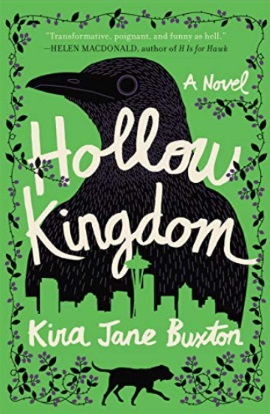
I read about author Kira Jane Buxton in the Breaking In column, Writer’s Digest, October 2019 issue. I especially appreciate what she worked through to realize “. . . letting go of outside expectations while writing Hollow Kingdom afforded me the freedom to take great risks.”
Her advice for writers: “Just have fun with it. Write the thing that’s burning inside you.”
I enjoyed reading about her writing journey. I hope you will, too.
I had a solid ten years of professional rejection under my belt by the time I realized I wanted to be a writer. Ten years of trying to ignite an acting career and an art career, seemingly with a broken match and wet kindling. A creative writing class at Santa Monica College (a gift from my husband that I deferred for a year because I was petrified) got my blood pumping and made me realize that all along, what I’d wanted to do was bring characters to life, and it didn’t have to involve the grueling audition process. I realized I wanted to write a book, and—since I’ve always believed that a dream should never be burdened with limits or stipulations—I wanted to publish that book. To be very brave and share my words with the world.
I wrote my first novel, painstakingly tapping it out on an iPad because I’d saved up for one and it made me feel fancy. It was, in line with many a first novel, not spectacular. The plot was exciting, but I hadn’t yet found my voice. It was, however, filled with passion and something that can’t ever be phoned in—a writer’s enthusiasm for writing itself. I queried agents with this novel to a response like the chirping of crickets (I should mention that the query itself was absolutely horrendous and started with, “Dear Agent, The leg is human.”)
No stranger to recovering from a letdown, I picked myself up and wrote a memoir about a strange experience I had while living in LA (one of a great many strange experiences I had in Hollyweird, La La Land). I queried agents again, this time with some interest. An agent who reps one of my favorite authors wrote back, saying that while she felt the book didn’t work, she loved my writing and could see this memoir fictionalized as a humorous mystery series. Huzzah! I jumped back into the saddle and spent the next year rewriting the novel. I sent it back to the agent who felt that it was on its way, but still needed work. I hired two great independent editors (working with them separately). I edited this novel for many, many more months. In fact, I edited it into the high heavens. I edited it into oblivion.
One day, I opened up my document and couldn’t see a word of this novel I’d worked so very hard on. I took breaks and would come back to it, only to discover I still couldn’t see it. Ever the optimist, I decided that I should write the sequel to this novel I was blind to! I wrote the sequel, came back to open up the document, and still couldn’t see it.
The words no longer felt like my own. And I had to admit that I’d lost the novel, that it was well and truly dead. Things with the agent fizzled out, and years of work suddenly seemed like a phenomenal waste of time.
I fell into despair. All the rejection I’d ever experienced (which was, frankly, all I’d ever experienced) came crashing down on me. I cried a lot. I figured I’d never achieve anything creatively. I often make light of this time, because that’s how humorists cope with difficult times, we transmogrify them into manageable jokes—but it was incredibly hard.
It was my husband who told me to “go and write the thing about the crows.” I love crows. I’m an animal lover and spend time with two wild crows daily, they’re family to me. My husband then gave me the best writing advice I’ve ever had. He said, “Just have fun with it. Don’t write it with an expectation of getting an agent or getting published, just write for you.” I took his advice to heart. I wasn’t sure how to write about crows, but one day, while driving, it hit me. “What if a crow is telling the story of our species? And what if a crow is telling the story of our extinction?” I got goosebumps. I raced home and wrote the first chapter, from the perspective of S.T., a domesticated crow who loves humans. His language was fouler than I’d anticipated or ever imagined writing (and certainly couldn’t see getting published!), even his name is an expletive. I poured my passion into the book—my deep love of animals and an exploration of how disconnected we’ve become from the natural world (which is frankly, the only world we have). It was an environmental parable filled with humor, horror, adventure, facts about nature, and poop jokes.
I braved reading the first chapter to my writing group, who encouraged me to query this novel I called Hollow Kingdom. And then I was flying out to New York to interview the agents who had offered me representation. I signed with Bill Clegg of The Clegg Agency and we sold Hollow Kingdom at auction to Grand Central Publishing. It is being translated into many different languages and AMC have optioned the rights for a TV series.
I don’t believe that words are ever wasted. The novels in the drawer are essential to our process and should be cherished, whether they get published or not. No one should ever be made to feel ashamed about their ambitions and dreams—the bigger, the better, I say—but those external goals shouldn’t be the only reason you’re writing. They can be motivating and used as fuel, but they shouldn’t be the core reason you share your words. Write the thing that’s burning inside you. Write your story, no matter how weird or different or afraid you are to tell it. There are currently 7.7 billion people on earth and you’re the only one who can tell us your tale. Enjoy the journey as much as you can. Now that I’m on the other side of publishing a book, I can tell you that the most magical part of the whole process is still sitting down, tuning out the real world, and exploring the creative dance between mind and page. Take breaks when it’s hard and be careful of over editing. Know that you are always going to be the leading authority on your writing. Build community. Be kind to other artists, especially because you know how tough the process can be. Reciprocity is everything, when one writer does well, celebrate, it’s a victory for all of us. Above all, just have fun with it. Every editor who made an offer on Hollow Kingdom said that they could feel what an incredible time I had writing this novel. I stopped trying to be the writer I thought I should be. I let go. Energy is everything and everything is energy. Take the pressure off yourself and trust that when you are in the flow, when you let go of your chokehold on an outcome, your very best writing will take you places, literary and literally, you could never imagine.
Kira Jane Buxton’s writing has appeared in The New York Times, NewYorker.com, McSweeney’s, The Rumpus, Huffington Post, and more. She calls the tropical utopia of Seattle home and spends her time with three cats, a dog, two crows, a charm of hummingbirds, and a husband.
Writing Prompt: An hour won’t make a difference.
When using prompts to inspire writing, you can also use the opposite of what the prompt suggests:
An hour will make a difference.
Just Write!

Today’s brilliant post is by Nancy Julien Kopp:
I’m a proponent of starting with small projects and moving on, step by step, to the bigger ones. Many writers dream of publishing a novel or a full book memoir. Some will start out their writing journey by beginning the pursuit of that dream immediately. It’s fine to have a worthy goal, but diving in the deep end before you know how to swim can bring big problems.
Start small. Write a personal essay or memoir about an occurrence, something that happened and had some meaning for you. Later, it might become a part of the book you hope to write. Those little snippets of memoir can grow into something much larger, as can your personal experiences that taught you a lesson, as we see in personal essays.
Novelists can practice their skill by writing short stories before attempting a full novel. Lots of short stories. Use all the tools you have as a writer to write a good short story, then submit it. If you have some success in selling your short stories, it could very well be time to begin writing the novel you’ve been thinking about for a very long time.
Many writers want to start with the big project, to write a memoir or a novel before writing anything else. They have read many books. How hard can it be? Some will begin by reading a book or two on writing novels (or memoirs), and that’s fine. Others will not bother with reading a book about how to write a novel. They’ll start with chapter one, page one. A few might do very well with this method, but most are going to run into one roadblock after another. At some point, the whole thing could become overwhelming.
If that happens, step back and work on smaller projects for a while. Read some of those reference books on writing a memoir or novel. Attend a workshop about the same. Talk to other writers. Gather all the information you can before you tackle that big idea.
One of my keywords is patience. Don’t be in such a hurry to tackle the big game plan. Take your time, learn as you go, but continue to keep the original goal in mind. Start on the big scheme when you feel ready. With some success at smaller projects, you’ll have some confidence in your ability to take on the big one.
Nancy Julian Kopp has been published in 22 Chicken Soup for the Soul books, several anthologies including The Write Spot: Possibilities, newspapers, magazines and ezines. Her writing includes award-winning fiction for children, creative nonfiction, poetry, travel and personal essays. She was named Prose Writer of the Year in 2013 by the Kansas Authors Club.
Write about a perfect moment.
You can write this as a scene in a play, a TV show, or a movie with scenery details. Include characters in this scene and include location (a specific room, a certain place).
You can include details about the weather, time of day or evening or night, time of year, the mood of each person or the emotional feeling of the people in this scene.
Or: Just write about a perfect moment.
You can write fantasy or fiction. Or you can write about what really happened.
A perfect moment. Just write!


What isn’t working in your life?
What is working?
What are you resisting?
What needs to change?
What really matters?
What do you want?
Ready? Set. Go! Just write!
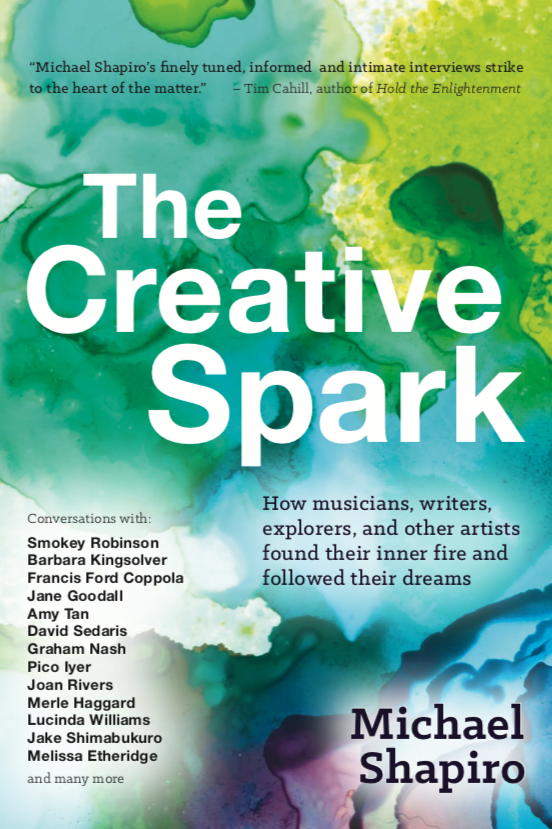
Michael Shapiro’s latest book is a winner.
Below is an excerpt from the introduction of The Creative Spark: How musicians, writers, explorers, and other artists found their inner fire and followed their dreams.
It reminds me of an important message for every one: We are all unique and have our stories to tell. No one else can tell your story. Only you can.
Something magical happened as I completed this book. One evening just before sunset I was in our backyard watering the planter boxes. On a stem of parsley I noticed a startling pattern of color, concentric rings of orange and black dots. Looking closer I saw the segments of a swallowtail caterpillar and could identify its tiny feet. For the next few days the caterpillar chomped on the parsley plant, absorbing energy for the next stage of its life. I placed a stick in the pot, at an angle to give the caterpillar a place to hang its chrysalis.
The caterpillar’s appearance felt like a message from the universe. For many months I’d been working on transforming interviews I’d conducted with some of the world’s most creative people into a coherent set of chapters. I’d distilled the essence of these interviews into a tonic of ideas about the creative process. And I’d written biographical introductions that sought to put each person’s life in perspective and offer insights about the sources of his or her art.
As I write this, on 2019’s summer solstice, our adopted caterpillar (my wife has given it the gender-neutral name Jordan) is undergoing a miraculous transformation into a butterfly. During the past week, we’ve watched the caterpillar turn into a chrysalis that matches the color of the branch from which it hangs, its striated brown camouflage the antithesis of the colorful creature it was just a few days ago. Yet it’s what is happening inside the chrysalis that is truly astonishing.
The caterpillar is dissolving, using enzymes to digest itself. It’s being broken down into nonspecific cells that can be used for any part of the butterfly. Yet some “highly organized groups of cells known as imaginal discs survive the digestive process,” according to Scientific American. Each of these constellations of cells is programmed to build a specific part of the butterfly. There are imaginal discs for wings, for eyes, for legs, for every part of the butterfly. Typically, after about two weeks, a yellow-and-black swallowtail butterfly will crack open the chrysalis, dry its wings in the morning sun, and fly off seeking nectar.
Why bring up a caterpillar in a book about creativity? First, because it offers such a rich metaphor, and the name “imaginal discs” suggests that making art depends on imagination. And to prepare for its transformation, the caterpillar needs to first feed itself, just as a musician or author must absorb the thoughts and influences that come from songs, books, conversations, memories, and observations. Many creative people seek to isolate themselves, cocoon-like, to escape the relentless drumbeat of popular culture so they can hear their own voices.
“What I noticed at an early stage was that the writers I admire are living a long way from the world,” the author Pico Iyer told me. “The great originals are originals because they’re living outside the received conversation, outside secondhand words and secondhand ideas, to some extent living in a space of their own where they’re able to hear their deeper self and come up with things completely outside the norm. I think that’s why they really shake us.”
Isn’t that what we crave in this era of information overload: songs or stories that really shake us and offer new ways of seeing the world, of hearing ourselves, of feeling, on a soul level, our deepest truths? That’s why I’ve chosen the 31 creative people in this book. They’re original, pioneering, dynamic, and insatiably curious. The authors, musicians, and others profiled in these pages could coast on their earlier accomplishments, but every one has continued to seek adventurous new avenues for igniting their creative spark.
Of course, seeking solitude to hear one’s inner voice doesn’t mean we should shut out those who came before us. As Iowa folk singer Greg Brown says, “I feel links back to a time that not much is known about. Songs, poetry, whatever you want to call it, that urge, it just goes way, way, way back there. And that’s a good connection to feel to life. It’s hard for me to imagine life without that.”
I hope you can spend 15 minutes a day (or longer, if you can) and write your story, as only you can.
Sometimes writing prompts are complex:
Physical location and action to describe emotional state – Prompt #12
And: Location, or place as a character – Prompt #8
And: Imagine you are invited. . . Prompt #64
Sometimes writing prompts are simple, like today’s writing prompt: Yesterday . . .
Don’t over think. Just write!
Prompt: Yesterday . . .