Your fictional characters should be as different from one
another as the real people in your life. One way to show differences is in
their voices.
Years ago, returning home from Aqua Zumba, I drove past
Hermann Sons Hall and remembered the German woman who managed the building as
if it were her immaculate residence. On our early morning walks, my husband and
I watched as she polished door knobs, washed windows, and replaced gravel in
the driveway. Her mission was to keep “her” building spotless. You
didn’t want to cross her.
How does a writer establish “voice” for
characters?
If your character is a stoic German woman who manages a
building as if it were her pristine cottage, picture what she looks like. Short
hair, stern features, sensible shoes, tailored clothing. Then you can imagine
what she sounds like: sharp, clipped sentences, uses precise words sparingly.
Contrast that with a Mother Goose type: round in looks, ample lap for children to sit
on, laugh lines forming parenthesis around her mouth, her eyes crinkle with
merriment. She might talk softly or slow. You can hear the smile in her sugary
voice.
Write a scene showing two characters’ personalities using dialogue.
For more on writing about character: Three-dimensional characters . . . Prompt #444 on The Write Spot Blog.
You have probably heard about the importance of knowing your fictional characters so well that you know what he/she had for breakfast. Readers don’t need to know this, but the writer does.
You don’t need to include everything you know about your characters in your story, but as the writer/creator, you need to know a huge amount of information about the people (and animals) who populate your story.
The challenge is to create memorable characters rather than one-dimensional characters. Your fictional characters are like actors in a scene.
Some fictional characters seem shallow while others seem
richer. The difference could be that the writer knows the characters/actors so
well, that the dialogue and the details fit the character.
Your fictional actor may want to step out of character and
exhibit new behavior. This is fine, as long as it’s credible. Your job as
writer is to drop convincing clues so when the character does an about face,
the reader believes it. You can still have twists and turns that are surprising
for the reader, but everything needs to be consistent with what the character
would or could do.
Examples:
Is your character a loving husband who shows his affection with gentle actions towards his wife? If yes, then it would be out character for him to leave her stranded at a party. There would need to be a reason for his out-of-character behavior. Maybe he found out she isn’t who he thought she was.
If your character shuffles in worn-out bedroom slippers,
listens to the radio from 4:30 pm to 6 pm in her favorite armchair while knitting,
then goes to bed at 7:30 pm, it would be strange for her to dress up in Spanx
and a tight red dress to go bar hopping. She could do this, but you would have
to set up the scene so it’s believable.
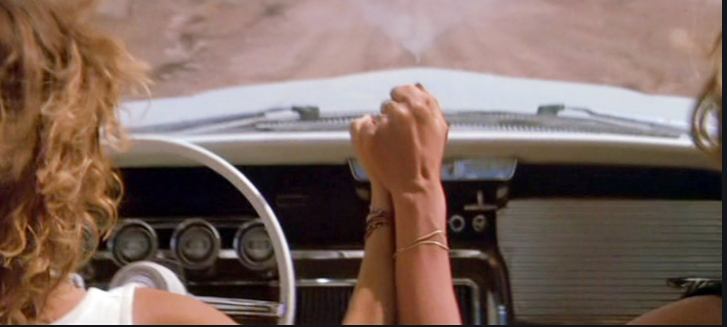
If you portray your characters as authentic, then when your characters
drive off a cliff in a convertible, the reader believes they would really do
this. Yes, I’m thinking about Thelma and Louise.
Want to practice?
Write three scenes.
Show your character in an ordinary scene . . . something they
usually do, their routine, their habits.
Write a scene with details about what might make that character go over the edge, a “last-straw” type of thing, a friend or a relative did something one too many times. Or the character receives news that spins his/her life in a new direction.
Write the final scene showing the character exhibiting new
behavior.
Stories
should be aimed not at our heads but at our hearts.
“And this is
where things get interesting, because description actually allows access to our
hearts in a neurophysical way.”
I have
wondered why reading something with sensory detail leaves more of an impression
than writing that doesn’t have sensory detail.
According to
studies, “when we read about an odor, it engages the exact same part of the
brain as actually smelling it, and those parts of the brain reside in the lower
region, alongside our emotional centers. . . When you write using smells, or
images, or sensations, you’re actually gaining access to the emotional area of
the brain, and this is why stories can take such precise aim at the heart.
Words like
lavender, cinnamon, and soap, for example, elicit a response not only from the language
processing areas of our brain, but also those devoted to dealing with smells. The
brain, it seems, does not make much of a distinction between reading about an
experience and encountering it in real life; in each case, the same
neurological regions are stimulated.”
Excerpted
from “The Heart and the Eye: How Description Can Access Emotion,” by J. T.
Bushnell, Jan/Feb 2013. Poets & Writers Magazine
J. T. Bushnell applies neurophysics to effective writing, shedding light on how strong description gains access to the emotional area of the brain.
Mid-American Review publishes works of fine literary art from a diverse body of artists.
“We are on
the lookout for work that has the power to move and astonish us while
displaying the highest level of craft.
We dedicate
ourselves to encouraging, nurturing, teaching, and learning from the writers we
meet through careful consideration of their work and meaningful dialogue.
The writers
in each issue shall include both well-established poets and authors and brand
new voices.
Because the
acts of writing and reading force people to slow down and examine the world and
their part in it, MAR is in a position to foster peace and understanding and to
make a positive difference, and we fully embrace the challenge of making the
world a better place through literature. We are dedicated to finding new
audiences for contemporary writing and to building the audience for our
journal, while also providing an outlet for professional development and
personal growth among staff members.
In “The Art of Fiction,” John Gardener describes “the
fictional dream.” This is when the author has described a scene so viscerally,
the reader can see, feel, hear, taste, or smell what’s going on in the scene. Sensory
detail is important in writing, but how to achieve it?
Practice!
Try this:
Study an object for ten minutes. It can be something you are wearing, an item on your desk or on a kitchen shelf. It can be something you use every day or a special item put away to keep it safe. You can describe the glass flower decoration above.
Notice the details of the object — the shape and texture.
Explore the pieces that make up the whole. Hold or touch the item. Notice the texture,
the heft. How does it feel? Does it have a smell? Look at the object from all
angles.
After ten minutes, write a description of the item so
thorough that a reader can imagine, see, feel, smell this object.
Next, if appropriate, write about a memory associated with
this object.
That’s it. This is great practice for writing details that enrich your stories with visceral elements.
I am delighted to recently “meet” today’s guest blogger, David Moldawer, through a friend’s recommendation of his newsletter, The Maven Game.
“going through the goop” by David Moldawer
Just hold that happy thought, Peter!
—Tinker Bell, Hook
I’d always imagined a pupa as something straight out of the original Transformers cartoon, the caterpillar sealing itself up in its chrysalis only to [transform] into a beautiful butterfly. Turns out, no. The caterpillar actually digests itself, squirting enzymes throughout its own body to dissolve all its tissues. This goop is then assembled into a new insect. Thus the caterpillar doesn’t transform; it transcends. Only through this sacrifice can the butterfly take shape.
I’ve come to learn that I need order in my
life in order to function. Absolutely require it, in fact. Yet to write
anything worthwhile, I must pass through one or more stages of disorder—of
goop—with my ideas jumbling together and coming apart and turning inside-out in
extraordinarily uncomfortable ways. I think this is why messy thinkers are so
creative and prolific. They’re comfortable working with goop. Not me. I hate
it. But when I refuse to acknowledge the necessity of the goop stage, I become
inescapably blocked.
I say this as much to myself as I do to
you: There is no creative work without a goop stage. Likewise,
no creative career. You, too, must become goop in order to fly, not just once
but over and over again throughout your working life.
Or you could just stop creating altogether. I
still think about law school now and then. I really don’t like goop and I don’t
think I ever will.
More than a decade ago, The Girl with
the Dragon Tattoo was published and became an international
phenomenon. To date, nearly 100 million copies of the book and its sequels have
been sold worldwide. Dragon Tattoo wasn’t to my taste, but I
still found myself admiring the author, Swedish journalist Stieg Larsson. The
guy had vision.
Larsson embarked on writing his Millennium
“trilogy” (he actually had a ten-book series in mind) with absolute confidence
in its eventual success. His professional experience had been entirely rooted
in journalism—he’d written some short stories as a teenager—but he told friends
he was certain the books he was writing would not only find an
audience but make him rich to boot. Were it not for his sudden, if not
shocking, heart attack at fifty—according to Wikipedia, “his diet largely
consisted of cigarettes, processed food and copious amounts of coffee”—Larsson
would have far exceeded his ambitious goals.
Though he may not have used the Swedish
version of the term, Larsson had decided to write potboilers. In “the
old-fashioned days,” as my daughter likes to call the past, authors were
sometimes forced to lower themselves to writing books with commercial
potential. This kind of book was called a potboiler because it was intended to
“boil one’s pot,” i.e. pay the author’s daily living expenses so they could
write “real” books, i.e. the artsy kind most people don’t want to read.
Isn’t that funny? Can you imagine knowing how
to sit down and write a book guaranteed to make a lot of money and doing so
only under duress? Today, nobody knows how to do that!
Here’s the thing about Larsson: He’d nearly
completed the third book before he found a willing publisher for the first
one. That’s confidence. That is exactly the kind of long-term
thinking I advocated in last week’s essay. Larsson could have stopped working
on the series after finishing The Girl with the Dragon Tattoo,
investing all his energy into finding a publisher or simply waiting for
approval to come to him, as so many would-be authors tend to do. Instead, he
kept working, kept executing on his plan. More goop. He knew, or allowed
himself to feel, that success was inevitable. As a result, he felt no need to
spare himself any effort. He had no fear of that universally dreaded fate:
working on a project that doesn’t end up succeeding in the end. (Isn’t that the
real terror lurking in every blocked writer? “Wasted effort”?)
In retrospect, of course, Larsson’s second and
third book would never have been written had he waited, but even if he’d had
many years ahead of him, putting his project on hold because of any external
circumstance would likely have sapped the precious motive energy at the heart
of it, the kernel driving the books in his own mind.
Ideas just don’t age well, people. When have
you ever looked back at a scribbled note from more than a few months ago and
thought, “Hey, I can use this. Glad I held onto it.” More often than not, it’s
“I can’t believe I thought that way back in May. How embarrassing. I’ll have to
eat this paper to hide the evidence.” Use it or lose it.
Meanwhile, creative seeds grow to all sizes.
One idea is just a pyrite nugget; another is a vein of gold so deep it threads
the roots of the earth. Antiheroine Lisbeth Salander runs deep enough that
another Swedish journalist, David Lagercrantz, is continuing the series
himself with the permission of Larsson’s estate.
Think of how many ideas of similar potential
never achieved their true scope because their creators didn’t have a signed
contract from the Universe promising them life everlasting to complete their
work under perfect conditions and blockbuster success at the end of the road.
Think of how many great works only exist because their creators held onto their
confidence in the face of universal rejection or, worse, apathy.
Personally, I never feel all that certain I’m
even going to finish what I start. The idea of beginning a project with full
confidence in its eventual success feels crazy to me. And yet, we have two
children.
Unlike, say, science or economics, writing
seems to benefit from a kind of absolute self-confidence that simply has to be
decided, worn like a mantle. Yes, I will finish this. Yes,
it will turn out as well as I imagine, no matter how gruesome it appears along
the way. Come what may, I’m going through the goop.
Your work will suck until it doesn’t. Always. To quote multiple characters in Mission: Impossible—Fallout, “That’s the job.” There’s nothing pretty going on inside a chrysalis, either. You don’t judge the butterfly by its goop. All you can ever really do is decide to have full confidence in your ability to wrest order from chaos. As Tinker Bell tells Peter Pan, the trick is to hold onto that happy thought. Otherwise, you’re going to eat dirt.
About David Moldawer
David spent over a decade as a book editor at a slew of New York publishing houses including St. Martin’s Press, McGraw-Hill, and Penguin’s prestigious Portfolio business imprint, acquiring and editing bestselling nonfiction in the areas of business, technology, health, and memoir.
Today, he is an independent writer, editor, and creator of the Maven Game, a newsletter for experts, authors, publishers, and agents on making ideas and knowledge public—writing, speaking, sharing—without hating yourself in the morning. Sign up here for a new issue of the Maven Game every few weeks.
Like a pie crust, balance is sometimes tender and light, and
sometimes fails.
Sometimes we find balance. Then we totter. Then we regain balance. And totter again. And find balance once more.
Write about finding balance.
You can use any of these phrases for your writing prompt or use the image. Isn’t this a beautiful pie crust topping? Not something I made. But something I would enjoy eating!
J.T. Bushnell wrote, “I once burst into tears during a
Tobias Wolff reading . . . as Wolff intoned the final passages from ‘Bullet in
the Brain,’ I broke the silence of the packed auditorium with a gasp, a sob.”
Bushnell goes on to explain his strong emotional reaction.
“It was the final scene that set me off.”
This is what he remembered. Heat. A baseball field. Yellow
grass, the whirr of insects, himself leaning against a tree as the boys of the
neighborhood gather for a pickup game.
“Half a page later, the story ends with the passage that
brought me to a fever pitch.”
For now Anders can still make time. Time for the shadows
to lengthen on the field, time for the tethered dog to bark at the flying ball,
time for the boy in right field to smack his sweat-blackened mitt.
“These passages by themselves seem innocuous enough. Each
offers a series of descriptions, nothing more. But the conclusion I’ve come to
over the years is that the description is exactly what produced my reaction.
By description I mean the concrete, the things we can observe
with our five senses: sight, sound, smell, taste, and touch. I do not mean simple
adjectives. I do not mean descriptions such as ‘The weather was glorious.’
Glory is an abstraction. The glorious is useless because it can’t show us
anything concrete.
It can’t show a white-hot sun perched overhead, or a sky so
hard and blue that a fly ball might shatter it. It can’t show a pitcher’s
shadow puddled under his cleats, or heat rising from the ground in shimmering corrugation.
It can’t produce the smell of hot aluminum bleachers. It can’t let you taste
the sweat on your lip when you go too long between slugs of cold beer. Only
concrete description can do that.
As novelist Richard Bausch advises, . . . a
good story is about experience, not concepts and certainly not abstractions. .
. . get rid of all those places where you are commenting on things, and let the
things stand for themselves. Be clear about the details that can be felt on the
skin and in the nerves.”
Excerpted from “The Heart and the Eye, How Description Can Access Emotion” by J.T. Bushnell, Jan/Feb 2013 Poets & Writers
Michigan
Quarterly Review is an interdisciplinary and international literary
journal, combining distinctive voices in poetry, fiction, and nonfiction, as
well as works in translation.
“We seek
work from established and emerging writers with diverse aesthetics and
experiences.”