“The seasonal ingredient that might be the most powerfully evocative is scent.
Physiologically speaking, the central location for identifying aromas lives in the front of our brains in the olfactory bulb.
This structure is closely tied to the limbic system, a command center for our emotions and long-term memory. That explains why scent is so closely allied with thought.” — Stephen Orr, Editor in Chief of Better Homes & Gardens magazine (December 2023).
Choose a prompt related to sensory detail and Just Write!
Prompt: What nourishes you? Write for 15 minutes. Use sensory details: sight, smell & sound.
*********************
Next: Picture the kitchen in the house you grew up in. See the table and chairs, the counter, the cupboards.
Open a cupboard . . . or walk into the pantry. Take a look around. Open the spice cabinet. Breathe deeply.
Prompt: What food reminds you of the kitchen in the house where you grew up in? Memories surrounding that food?
*********************
Prompt: Take a few words from previous two freewrites and expand, or describe, using smell and sound. For example, from “The Martian Chronicles by” Ray Bradbury:
“There was a smell of Time in the air tonight . . . What did Time smell like? Like dust and clocks and people. And if you wondered what Time sounded like, it sounded like water running in a dark cave and voices crying and dirt dropping down upon hollow box lids, and rain. Time looked like snow dropping silently into a black room or it looked like a silent film in an ancient theatre one hundred billion faces falling like those New Year balloons down and down into nothing. That was how Time smelled and looked and sounded.”
Use sensory detail: Smell
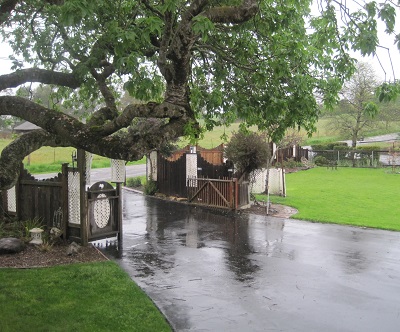
What does rain on asphalt smell like?
What does a crunchy red apple smell like?
Mentally walk through an apple or a pear orchard where the earth has recently been plowed. Describe that earthy smell.
What does a redwood forest smell like, deep in the grove where it’s quiet?
It might smell old or ancient and calm. What does old, ancient, and calm smell like?
old . . . smells like parchment paper
ancient . . . smells like musty book
calm . . . smells like summer rain candle
Use sensory detail: Sound
What does old, ancient, calm sound like?
old sounds like coughing and wheezing
ancient sounds like rattling breath
calm sounds like church . . . sitting in an old Catholic church in the middle of the afternoon with no else there. That’s calm. The neurological impact of sensory detail
“Your main job as a writer is to transport the reader to a fictional world, as in a dream. ” — “The Geyser Approach to Revision,” James Scott Bell, July/August 2011 Writer’s Digest Magazine
You probably know this, but perhaps you’re stuck with knowing how to achieve that. A big part is the revision process.
The following steps for revision are based on the Writer’s Digest article.
Write Hot. Revise cool.
Wait two weeks after writing to begin the revision process. Then, read fast as if you were a first-time reader. Take notes about what needs fixing.
Capture original emotions you felt when writing.
Listen to music that evokes the mood of your story.
“Music reaches a part of your mind that you usually have inactive when analyzing. Wake it up and put it to work with tunes.”
Create a collage to capture a visual representation of your work to keep you inspired and focused.
Scenes
Analyze every scene.
Make sure every scene is strong with:
~ A single point of view
~ A clear objective for the character
~ Tension
~ Conflict
~ An emotional struggle
~ A compelling reason for the reader to keep reading
Revision Process
A crucial part of the revision process involves making sure all your details are as strong as they possibly can be, that no word is underutilized or wasted.
Sensory Detail
As you revise, determine where you can add sensory detail: visual, sound, taste, smell, touch, and extrasensory perception.
Specific Details
Give your characters distinguishing characteristics.
Today’s post is inspired by Nancy Julien Kopp’s blog post about using sound in writing.
Nancy wrote:
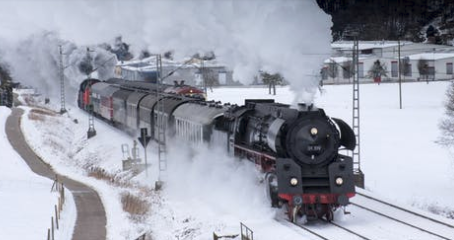
This morning, I was catching up on email when I heard the whine of a train whistle, blown several times. I wondered if it was the historic Union Pacific train, known as Big Boy, making its way across Kansas this week in celebration of 150 years of the Transcontinental Railroad. It was due to stop here in our town at 9:30 a.m.
The sound of that whistle made me stop and listen. I always liked to hear train whistles when I was a child. We lived across the street from the railroad tracks, so we were treated to that arresting sound on a frequent basis. I can remember being in bed on a summer night, windows open, hoping for the train to come by and announce its presence. When I did hear it, I wondered where it was going. My own world in those days was quite small, but I knew a train went to many places.
What do you think of when you hear a train’s whistle? Does it trigger any memories for you? Do you think of it as mournful or cheerful? Is it different at nighttime when the train moves through the darkness than it is on a sunny day?
Readers knows what a train whistle sounds like, so you don’t need to write “The train blew its whistle.” You can enlarge that thought to make it more interesting: The train’s whistle whined loudly as it passed by the crossing gates, growing dimmer and dimmer as it sped down the track.
Write a sentence or two for each of the items below, using sensory detail.
jet plane
waves on the shore
ball hitting a baseball bat
washing machine
school bell
air brakes on a bus
popcorn popping
crying child
church bells
piano
cow mooing
birdsong
Note from Marlene: Adding sensory details enhance the story and help readers “see” the scene and the characters.
Start with: The problem began with wanting something.
I wanted . . .
I wanted it
because (back story) . . .
To get it, I . .
. (action)
However, something got in my way: (there may be several actions/reactions/sequences that got in the way) . . .
I had to try something different, so I . . .
At the time I was thinking that . . .
The turning point came when . . .
When that happened, I realized . . .
Resolution: After that I . . .
Another way to get to an epiphany:
Write about a pivotal event in your life. Something happened and you weren’t the same after. Narrow it down to the exact moment and location where it took place. It could be something wonderful or something painful. It could be funny, sad, heartbreaking or touching. Ideally, it’s a moment that changed your life. It changed how you live your life, how you view life.
If it comes
from your childhood. . . how has it formed you as an adult?
If it happened after you became an adult, how has it changed your life?
To get to the epiphany, drill down to the fine-tuning details of what happened that changed you. Be specific: Where, when, who was there, add any details you can remember.
By pacing your scenes well and choosing the proper length for
each scene, you can control the kinds of emotional effects your scenes have,
leaving the reader with the feeling of having taken a satisfying journey.
Pace should match the emotional content of your scene. First
scenes should get going with an emotional bang—start big or dramatic, ratchet
up the suspense or lay in the fear, since you’re capturing the reader here.
Your first scene is like a cold pool—the reader needs to dive
in and get moving fast, or he’ll be too cold to stay in the water for very
long. In other scene types, you’ll have more leeway with pacing. In the first
scene, however, a quick pace—with more action and less reflection or exposition—will
be a better sell.
Dramatic scenes – Start slow, speed up pace to match
emotional intensity, slow down for reflection.
Speed up pace: Strip away exposition, use dialogue, quick
action, and hot emotional content to build intensity.
When and how to slow the pace
After a lot of action or intense dialogue give the reader time
to digest what happened.
Use description, narration, details and interior monologues
to slow the pace.
When a character is contemplative, time slows down.
During these contemplative scenes you can weave in details. Be
specific and descriptive. Give your character something to observe or something
to do, more than hair twirling.
Your turn:
Do a freewrite about pacing.
Here’s mine, thinking about Mairzy Doats. This was a quickly written spontaneous
type of writing, just for fun.
Go too fast and we get frantic and hear garble versus calm,
steady breaths and an even, gentle flow.
Calm is water caressing rocks, dark green moss going with the
flow.
No rough and tumble white water rapids. No gurgling over
brooks, no water cascading over boulders.
Rather, when we slow our writing, we achieve a calm, quiet,
graceful feeling.
Pace yourself. Eat watermelon slowly. Savor the juices.
Pace yourself.
Write fast let you lose that thought.
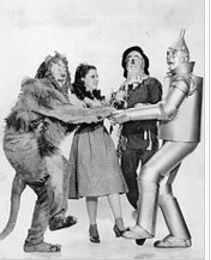
To slow down, think about the poppy scene in Wizard of Oz.
Slower, slower, snail’s pace slow.
Meditate. Ommmmmmm.
To pick up the pace, think caffeine and the energy of a
toddler/child, always on the go. Child knows no pacing. Always running,
talking, doing.
Challenge self: No
such thing as Writer’s Block. Just keep writing.
Not interested in making a list? You are welcome to use any of the 33 ideas listed below to start sensory writing. Or just look around, choose items within your view, and write, using sensory detail, of course. Scroll to bottom of this post for links about using sensory detail in writing.
Expand these images into full sentences, using sensory detail. Write as if you had to describe these visions to someone who has never seen or experienced these things.
What do these things look like? How do they sound, taste, feel, smell? Answer these questions and that’s using sensory detail in writing.
Write a sentence using these impressions, expand into a paragraph, a short story, a poem.
The musky smell of tomatoes on the vine in the heat of the warm summer sun.
The smell of a freshly mowed lawn.
The rustle of a plastic bag.
The burnt smell of overly cooked popped corn. Burnt popcorn.
The smell of popcorn when walking past a movie theatre.
The sound of someone blowing their nose into a tissue.
Blaring music from a passing car.
The sharp intake of breath when hearing that a friend died.
Brown freckled skin of a soft banana.
Gears grinding.
Wind chimes.
Dew on the lawn.
Morning mist.
Snoring.
Drool.
San Francisco cable cars.
Crunchy pickles
Snap of a fresh green been
Strawberries, fresh from the vine
Licking a stamp
Shaking a rug
Dust flying
Fingers curled over keyboard – striking/ready to strike
Hands on stomach. Too much watermelon.
Swish of wash cycle
Hands folded in prayer.
Heads bowed.
Grieving for what the person could have been but never was.
He phoned yesterday with a single question that I answered in an instant.
She didn’t mean to tell me so many sordid details and revealing incidents, but I’m glad she did.
He uncorked the bottle, releasing maggots.
She took the lid off and let some of the fireflies escape.
I could feel her pain and had to be careful to not let her pain become my pain.
Posts on The Write Spot Blog about sensory detail:
“Write five images every day, for seven days, using as many of the senses as possible.”— Adair Lara
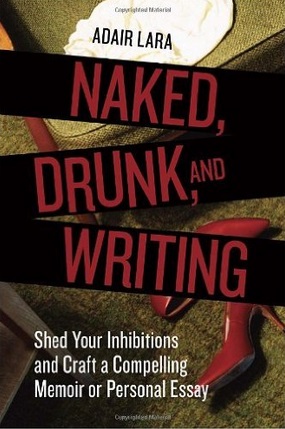
From Adair’s book, Naked, Drunk, and Writing:
“Writing is turning your thoughts, abstractions, generalizations, and opinions back into the experiences you got them from.”
Adair’s example:
“Not ‘women my age become invisible,’ but ‘they handed drinks around and forgot me, again.’”
Using imagery involves the details about what happened.
Show what happened so that readers can see the scene, hear the sounds, feel the sensations, taste the elements, and smell the aroma.
Adair advises, “. . . every time you write a sentence, ask yourself, How can I show this? Try to get image and detail into every sentence. ”
Tidbits from Chapter Six, Using Images and Details:
“We want experience, not information. ‘Joan was distressed’ is information. ‘Joan looked away’ is an image. The reader notices Joan looking away, and has the pleasure of concluding for herself that Joan is distressed.”
Today’s writing prompt is the same one Adair assigned to her students on that hot August night in the octagonal room that served as her writing classroom, the room in the sunny yellow Victorian, where we had to walk up a gazillion stairs to reach the front door. I so want to add, . . . and where we were greeted by her tail-wagging, smiling pooch, but that would be too much, wouldn’t it?
Writing prompt: Write five images for seven days using as many of the senses as possible. Set aside to simmer.
Stir the imagination when re-reading your list, looking for images that call to you, that want to be sniffed out, that won’t fade away, images that linger.
Use that imagery to write whatever comes up for you.
For more creative and juicy writing ideas, pick up a copy of Adair Lara’s book, Naked, Drunk, and Writing, with over seven pages of “Suggestions for Writing” as Adair calls these writing prompts.
Writing Prompt #276 and my freewrite in that post were inspired from Adair’s assignment first encountered on that hot August night in the octagonal room . . .
Some gardens are bursting right about now with zucchini, green beans, summer squash, cucumbers, yellow squash, kale, rhubarb, patty pan squash, lettuce, have I mentioned squash?
Here in northern California, growing squash is easy and so abundant that we don’t leave our car doors unlocked, or we might find a bushel of zucchini on the seat.
If you don’t want to write about what happened exactly as it happened, you can use the emotions you felt during the event. Tap into those emotions to write strong scenes.
Sometimes it’s helpful to see examples of ideas you want to pursue. The following novels are based on fact.
Half-Broke Horses, by Jeannette Walls, is considered “A True-Life Novel”