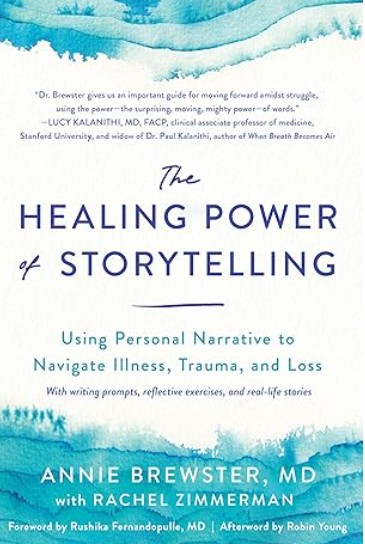
I have re-read a Wall Street Journal article numerous times since its publication, July 2024, partly because of the subject, mostly because of the riveting way it was written . . . the account of the days before and after Rachel Zimmerman’s husband’s death by his own hand.
“As a health reporter, I wrote years ago about a study that showed the psychological benefits of storytelling. I was fascinated by research that found that people felt differently about themselves and their lives when they reframed their stories so that they were agents, not victims or bystanders. Essentially, the story matters less than how we tell it to ourselves.” Rachel Zimmerman, “A Decade Ago, My Husband Killed Himself. Could I Have Stopped it?” The Wall Street Journal, July 6-7, 2024
As Zimmerman wrote, “This is my effort to make sense of something senseless.”
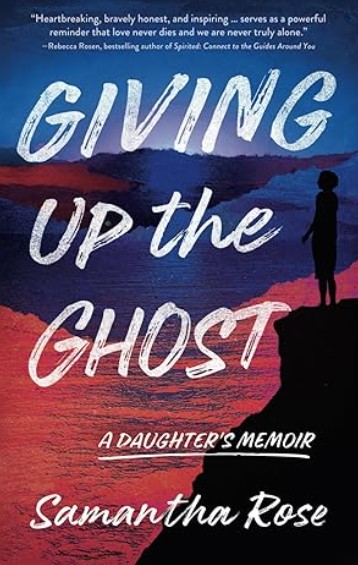
Both Zimmerman and Samantha Rose (Giving Up The Ghost) wrote about extremely difficult subjects with an eloquence that makes their writing and their stories memorable.
The trick to writing about hard topics is to practice self-care while writing.
“If we write about our pain, we heal gradually, instead of feeling powerless and confused, and we move to a position of wisdom and power.” — Louise DeSalvo, Writing as a Way of Healing
Even though “Giving Up The Ghost” by Samantha Rose is about a difficult topic (her mother’s decision to end her life), the gorgeous writing, the meaningful themes, and demonstrations of the importance of connections make this a powerhouse of a memoir.
I was curious how Sam accomplished this masterpiece, so I took a deep dive to discover how she did this; reading the first time to learn the story, the second time to discover gems I missed the first time, and a third exploration, using “Ghost” as a textbook for how to write a memoir.
Sam skillfully uses sensory detail and strong verbs to word-paint scenes that readers can “see,” unspooling across their minds like a well-crafted movie.
Her ability to transform conversations and scenes into poignant moments paired with her willingness to be vulnerable while releasing the truth of her mother’s life and death are remarkable.
Sam’s mother, Susan Swartz, was a popular journalist who uncovered facts at a time when people wanted and needed to be informed. Sam expertly captures meaningful truths about life, connections, mental health, friendships, grief, moving on, keeping secrets, and profound wisdom in sharing her journey traveling from disbelief to realizations about people, life, and our journeys.
“Giving Up The Ghost” is so much more than a daughter’s telling the story of how her mother died.
Sam’s unique ability to tell her family story in an honest and forthright manner with a variety of important themes rocked my world.
One of the threads in this strong story is the idea of being a witness to one another’s lives. Sam explores the idea that after someone dies, especially someone who has been in your life for a long time, they are no longer a witness to your life.
I never thought about this. After reading “Ghost,” I realize the importance of this concept: How we are witnesses to one another’s lives and what that means.
Sam grapples with (and comes to a resolution) about what happens when the person who has known us the longest dies prematurely. What happens when we no longer have that person in our lives? How do we go on?
Now, I’m contemplating that concept.
I asked Sam how she became such a good writer.
She answered, “I’m a visual person. I write what I see.”
“And,” she added, “I’m a good listener.”
Excerpt from the prelude:
“. . . the best books challenge readers to see things in a way they haven’t before.”
Symbolism refers to using a material thing to represent a nonmaterial thing, usually a tangible item that illuminates an intangible concept. Paraphrased from “Thematic Writing” by Jane K. Cleland, Writer’s Digest, Jan/Feb, 2024
The importance of Symbolism
Symbolism has the power to evoke an emotion or an idea without overtly saying it. When we pair a part of a poem, story, scene, character, or emotion with a repeated object, we begin to transfer the character’s wants, needs, and dreams onto that object.
The symbol serves as an echo of that idea or sentiment, without retelling the story.
Symbolism is the secret language of storytelling, adding depth and layers to what appears on the surface. It’s like finding a hidden treasure within a story, enriching the reader’s understanding and enhancing the reader’s appreciation of the narrative.
Examples of Symbolism
An object becomes a symbol when it reappears, and the symbol becomes stronger. For example, in The Hunger Games, Katniss receives a Mockingjay pin before entering the games. Initially, it serves as an example of family and home. Katniss then uses the Mockingjay in the Games to communicate with Rue, making them a symbol of hope and alliance. Later, the Mockingjay become a symbol of rebellion and contempt for the Capitol, representing the chance for change, for the people to regain their power.
The One Ring in the Lord of The Rings trilogy represents evil. The One Ring was forged with the intention of evil, destruction and darkness and symbolizes desire and greed.
In the film, Forrest Gump, the feather symbolizes Forrest’s life journey.
In The Scarlet Letter the red letter A is meant to be a symbol of shame. It becomes a powerful symbol when its meaning shifts to stand for “Able.”
In Giving Up the Ghost, Samantha Rose refers to snow globes and flowers as symbols in her healing process. A rose, California poppy . . . symbols of new life.
A symbol could be a repetitive action, like a finger on the side of nose in the movie, The Sting.
What word or phrase do you and your circle of family/friends use when remembering something that happened? When you say this word or phrase, your people know what you are referring to.
It could start like this: Remember when . . . and then don’t tell the whole story . . . use a symbol that refers to what happened. The symbol could be a word or a phrase that represents what happened.