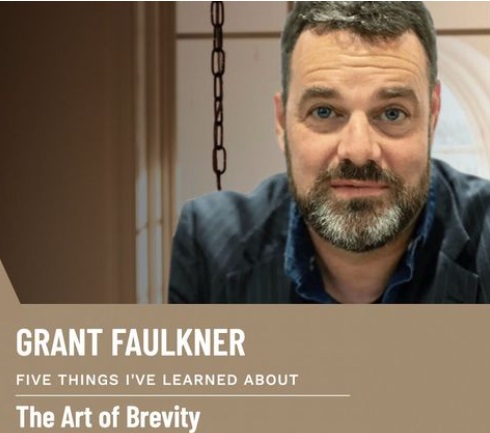
Note from Marlene: Grant Faulkner’s musings on his Substack page are golden comfort to a writer’s soul, offering unique perspectives that inspire writing.
For example, his essay on “Surrender as Action Verb.”
“When we surrender ourselves to our art, we allow ourselves to soften. Surrender invites us to give ourselves up to something larger, to meld with wonder and awe. Surrender creates intimacy and expansiveness at the same time. It sparks curiosity, exploration. It’s the equivalent of going to sleep: by sinking into an unconscious state, we allow dreams to fill us. We give up trying to change and control things. The rigidities of expectations, desires, and aspirations melt away.
Think what would change if you allowed yourself to surrender in a conversation. What if you committed to listening, to let another’s words and spirit rise up and take you instead of focusing on your point of view, your needs. What if you decided not to try to win the next argument you find yourself in? What if you decide not to be the star of the conversation?”
Excerpted from “Surrender as Action Verb” on Grant Faulkner’s August 18, 2024 Substack: Intimations: A Writer’s Discourse.
“Words have halos, patinas, overhangs, echoes.” —Donald Barthelme
“I steal “frotteur” from James Salter, who said, “I’m a frotteur, someone who likes to rub words in his hand, to turn them around and feel them, to wonder if that really is the best word possible.”
As a frotteur of words, I love this quote, because a word is never a definite thing. A word holds textures and nuances and surprises. It’s erotic, shape-shifting, enticing, and elusive.” — Grant Faulkner
Back to me: Yes! Simply yes.
Your turn: Write what you are passionate about.
Note: “The Write Spot: Memories” was carefully curated to make sure all the words are “just right.”
“. . . the urge to be a writer is a generous act at its core: we want to share our story with others, to give them a world that will open doors to insights and flights of the imagination.” — Grant Faulkner
As a boy, I spent my allowance on all sorts of pens and paper, so there was never much question I would become a writer. I received my B.A. from Grinnell College in English and my M.A. in Creative Writing from San Francisco State University.
It seems like I should have other degrees, such as an MFA in Novels about People Doing Nothing But Walking Around, a PhD in Collages and Doodles and Stick Drawings of Fruitless Pursuits, or a Knighthood in Insomniac Studies, but I don’t.
Since it’s National Novel Writing Month, I wanted to share my thoughts on the creative process that is at its core: writing with abandon. This is a reprint of an essay that originally appeared in Poets & Writers.
A few years ago I grappled with a simple question I had never before bothered to ask myself: Did I decide on my writing process, or did it decide on me?
Despite an adult lifetime of reading innumerable author interviews, biographies of artists, and essays on creativity, I realized I’d basically approached writing the same way for years. And I didn’t remember ever consciously choosing my process, let alone experimenting with it in any meaningful way.
My approach formed itself around what I’ll call “ponderous preciousness.” I’d conceive of an idea for a story and then burrow into it deliberately. I’d write methodically, ploddingly, letting thoughts percolate, then marinate—refining and refining—sometimes over the course of years. It was as if I held a very tiny chisel and carefully maneuvered it again and again through the practically microscopic contours of my story world.
I distrusted the idea that anything of quality could be written quickly. A story, a novel, or even one of my pieces of flash fiction had to be as finely aged as a good bottle of wine in order for all of the nuanced tannins and rich aromas to fully develop. My writing moved slowly from one sentence, one paragraph, to the next, and I often looped back again and again with the idea that I needed to achieve a certain perfection before I could move forward.
But as I hit middle age, the golden age of reckoning with all things, I decided I needed to shake things up, just for the sake of shaking them up. If I viewed myself as a creator, I needed to approach my own creative process with a sense of experimentation and outright dare.
And, truth be told, my writing had veered toward being as much of a job as my day job. My publishing goals had stifled any sense of playfulness. My stories hewed to narrative rules as if I was trying to be a good citizen in a suburban neighborhood where I felt like an outsider.
I thought back to the reason I became a writer in the first place: that ineffable impulse to explore matters of the soul, the need to put words to the hidden spaces of life, the desire to probe life’s mysteries. I concluded that my labored approach had smothered my verve. I wanted to cavort through words again, to invite the dervishes of rollicking recklessness back into creation.
Cavorting with words
Around this time a friend invited me to join him in National Novel Writing Month: the annual challenge to write a fifty-thousand-word novel during November. I knew about the event, but had never thought it was for me. The object was to write faster than I was accustomed to—to produce approximately seventeen hundred words per day for thirty days straight, a word count at least double what I was used to.
I feared writing a novel littered with unconsidered words and loose connections. I feared writing something flimsy.
As a boy, I spent my allowance on all sorts of pens and paper, so there was never much question I would become a writer. I received my B.A. from Grinnell College in English and my M.A. in Creative Writing from San Francisco State University.
It seems like I should have other degrees, such as an MFA in Novels about People Doing Nothing But Walking Around, a PhD in Collages and Doodles and Stick Drawings of Fruitless Pursuits, or a Knighthood in Insomniac Studies, but I don’t.
I have published in many publications. My stories have been nominated for the Pushcart prize and included in such collections as W.W. Norton’s New Micro: Exceptionally Short Fiction and Best Small Fictions 2016.
“Revising is like being an optometrist—always asking, ‘Is it better like this? Or like this?’” —George Saunders, quote from “The Alchemy Required to Finish a Novel,” by Grant Faulkner, Writers Digest, Nov-Dec 2021
“As you work through revisions, you see your story from all angles and you discover things you wouldn’t have ordinarily been able to see. A deep revision can give you the clear vision of laser eye surgery.” —Grant Faulkner
As for me? Yes, I have participated in NaNoWriMo. It was fun to “pretend to be a writer for a month.” And then, guess what? I did become a writer. I wrote about my experience, with tips on how to prepare and succeed with NaNoWriMo: “Concept is simple, execution is difficult.“
Have you heard of NaNoWriMo? National Novel Writing Month.
“NaNoWriMo believes in the transformational power of creativity. We provide the structure, community, and encouragement to help people find their voices, achieve creative goals, and build new worlds—on and off the page.” —NaNoWriMo website
“A month of NaNoWriMo can lead to a lifetime of better writing.” Grant Faulkner, founder and creator of NaNoWriMo.
NaNoWriMo
National Novel Writing Month began in 1999 as a daunting but straightforward challenge: to write 50,000 words of a novel during the thirty days of November.
Each year on November 1, hundreds of thousands of people around the world begin to write, determined to end the month with 50,000 words of a brand-new novel — but that’s not all that NaNoWriMo is!
NaNoWriMo is a nonprofit organization that supports writing fluency and education.
It’s a teaching tool, it’s a curriculum, and its programs
run year-round.
Whatever you thought NaNoWriMo was, it is more than that. — NaNoWriMo
website
The following is excerpted from an article by Grant Faulkner,
Nov/Dec 2016, Writers Digest magazine.
“Wharton professor Katherine Milkman and her colleagues
found that we’re most likely to set new goals around ‘temporal landmarks’: a
birthday, a holiday, the start of a new semester—or a new month, such as National
Novel Writing Month. These milestones create a new ‘mental accounting period’
(past lapses are forgiven, and we have a clean slate ahead of us) and prompt us
to turn our gaze toward a better vision of what we want for ourselves and how
we can achieve it.
NaNoWriMo invites you to generate many new ideas—to rip
through failures, learn from them and build on them.
“I like to think of Nano-ing as excavating. You uncover different things at the 30,000-word mark than you do at 10,000,” says Erin Morgenstern, who wrote the rough draft of The Night Circus during NaNoWriMo.
A sense of playful wonder is important for writing mastery,
and NaNoWriMo teaches you to trust the gambols of your imagination, to test
your ideas on the page. When you stop demanding perfection of yourself, the
blank page becomes a spacious place, a playground. So what if your writing
feels a bit sloppy? It’s just a first draft.
NaNoWriMo gives you the opportunity to reflect on your writing, to understand what creative approaches work for you, and to develop the grit, resilience and can-do gusto of a true master.
Need ideas for when your stuck? How about doing a 15-minute freewrite as a warm-up before your writing? You can use writing prompts for freewrites and they might just end up in your novel, or help you get your characters from Point A to Point B.
“Baby shoes for sale. Never worn.” Hemingway wrote this six-word tale that has become the ultimate short, short-story. The reader can fill in the blanks. I wonder how many variations of a theme these few words have inspired.
Grant Faulkner honed his skills to write short, 100-word essays and writes in the August 2015 issue of The Writer magazine:
“A flash writer has to paint characters in deft brushstrokes, with the keenest of images in such limited space. Shorts require immediacy; they’re a flicker of light in the darkness, a prick, a thunderclap . . . Paring down my writing and focusing on what goes unsaid and unexplained help me build suspense.”
Faulkner says, about Hemingway’s six-word story, “The story moves by implication– the empty space around those few words invite the reader to fill them, transforming the reader into a co-author.”
If this type of writing appeals to you, start writing now. Faulkner’s 100 word story will accept submissions after September 15. Hone your short story skills now and be ready to submit.
“A rough draft is inherently an experiment, or, rather, a series of experiments. each novel, each piece of writing, is a new thing with different possibilities that demand to be explored. Many of these experiments will fail, but failure is necessary to find those wondrous and magical moments of success.” — “More Ideas Faster, Writing With Abandon” by Grant Faulkner, Jan/Feb 215 Poets & Writers magazine.
Grant Faulkner is: Executive Director of National Novel Writing Month, co-founder of 100 Word Story, writer, tap dancer, alchemist, contortionist, numbskull, preacher. Click here to read more about Grant Faulkner.
Note from Marlene: Click here for ideas of what to write about. Choose a writing prompt, set your timer for 12-15 minutes and Just Write!