Tag: Jeannette Walls

  • Memoirs As Textbooks

    Use a published memoir as a textbook to write your memoir.

    Read the memoir. Read it again to examine structure.

    Notice where author used narration vs. dialogue to tell the story. Notice the balance between fast-paced action scenes and slower, contemplative scenes. Note when and how backstory is used.

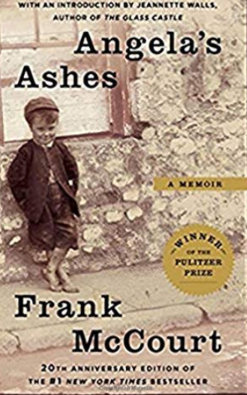
    Let’s use Angela’s Ashes by Frank McCourt as our textbook.

    McCourt’s ability to write as if experiencing events as they unfold, pacing, and his strong writing voice made Angela’s Ashes a New York Times beloved best seller.

    Angela’s Ashes takes the reader on an emotional journey. There is so much vulnerability in this book. McCourt reaches into our compassionate hearts as he tells his story, moving from childhood to adulthood.

    He weaves details into a story, similar to the Glass Castle by Jeannette Walls.

    McCourt taps into universal messages and themes.

    Understanding your theme will help to write your memoir.

    Possible themes:

    Being different                 

    Poverty

    Religion

    Coming of age                  

    Alcohol/drug use

    Death

    Despair

    Dignity

    Disease

    Ethnicity                           

    Feeling helpless

    Not fitting in

    Technique

    McCourt uses a variety of techniques to create intimacy in his themed books of children in poverty in Ireland. He changes his writing voice and tone to match his age progression.

    He employs rhythm and repetition, keeping the thread of the theme/plot running throughout the book.

    He “shows” situations so that readers understand what is going on. There is a lot that doesn’t get said. For example, when Frank’s sibling dies, and when a friend’s sister dies, there are no death scenes. Rather, there is action and dialogue seen through the lens of children. This is one method of avoiding too much tragedy: Keep it fast paced and use humor where you can. No woe is me, no pity-parties.

    When writing about unsavory characters, use compassion and find redemption.

    These ideas are based on a webinar by Linda Jo Myers and Brooke Warner, intertwined with my thoughts and observations.

    Another example of going deep in writing and willing to be vulnerable about a difficult subject is “Meeting My Father,” which I wrote and published in The Write Spot: Memories. I have written in my journal about my father for over thirty years. After a series of fortunate experiences, I had the epiphany that he was more than a Third Street bum and more than just a sperm donor. I was able to give him the loving tribute I felt he deserved, even though I do not have one good memory of him.

    More thoughts about writing memoir:

    Write Memoir in Voice of Narrator

    Does Your Memoir Have A Theme?

    Mini Memoirs Unfold Naturally

  • Make characters real and likable.

    Play around with different ways to describe characters in stories.

    Here are examples of how to make characters real and likable and how to capture readers’ interest.

    What we keep.112What We Keep by Elizabeth Berg

    “My mother was dressed in her beautiful yellow summer robe, the tie cinched evenly into a bow at the exact center of her waist, but her auburn hair was sticking up in the back, an occasional occurrence that I always hated seeing, since in my mind it suggested a kind of incompetence. It was an unruly cowlick, nearly impossible to tame — I knew this, having an identical cowlick of my own — but I did not forgive its presence on my mother. It did not go with the rest of her looks: her deep blue eyes, her thin, sculptured nose, her high cheekbones, her white, white skin — all signs, I was certain, of some distant link to royalty.”

    Splinters of Light.112Splinters of Light by Rachael Herron

    “When my daughter kissed me at midnight that year, I missed my old life a tiny bit less than I had the previous New Year’s. Paul was becoming more and more adept at dodging phone calls from his first daughter as he busied himself with his new family, but his leaving us meant I got this little girl all to myself. A girl with his blonde eyebrows and my concern for wrongs to be righted. A little girl who liked to suck the rinds of our homegrown lemons (making faces all the while) as much as she liked to lick the honey spoon I handed her in the kitchen.”

    The Glass CastleGlass Castle by Jeannette Walls

    “I was sitting in a taxi, wondering if I had overdressed for the evening, when I looked out the window and saw Mom rooting through a dumpster. It was just after dark . . . I was stuck in traffic two blocks from the party where I was heading.

    Mom stood fifteen feet away. She had tied rags around her shoulders to keep out the spring chill and was picking through the trash while her dog, a black-and-white terrier mix, played at her feet. Mom’s gestures were all familiar—the way she tilted her head and thrust out her lower lip when studying items of potential value that she’d hoisted out of the Dumpster, the way her eyes widened with childish glee when she found something she liked. Her long hair was streaked with gray, tangled and matted, and her eyes had sunk deep into their sockets, but still she reminded me of the mom she’d been when I was a kid, swan-diving off cliffs and painting in the desert and reading Shakespeare aloud. Her cheekbones were still high and strong, but the skin was parched, and ruddy from all those winters and summers exposed to the elements. To the people walking by, she probably looked like any of the thousands of homeless people in New York City.”

    Note from Marlene:  It occurs to me that this might be what it’s like for an actor to get into character: inhabit another personna. . . make that character alive.

    Your Turn . . . think of a real person. . . write about his or her mannerisms, quirks, habits, weave in physical description. Bring this person to life on the page. Just Write!