“If I had more time, I’d write a shorter story.”— Mark Twain
Today’s Guest Blogger, Guy Biederman, talks about crafting short fiction.
I’ve always been intrigued by the challenge of creating something small that has big power. Giacometti said he wanted to make a sculpture the size of a matchbox, but so dense no one could lift it.
The first micro story I remember reading was “Coup de Grace” by Ambrose Bierce, with a gotcha ending. O. Henry’s “Gift of the Magi used” a similar technique. I was astonished by the wallop a short piece could pack.
As a young writer, I cut my teeth on Raymond Carver’s work. Carver’s stories weren’t always short, but they were spare and vivid, conveyed feeling, empathy and understanding, and explained very little. I didn’t know what he was doing or how he did it. I only knew that reading his work was like glimpsing beautiful pebbles through clear water on the bottom of a lake. And I wanted to write like that.
I began to practice, and later teach what I called low fat fiction, the art of expressing more with less. And I began to apply what I learned to the short form.
As a gardener, I became fascinated by bonsai—how a miniature plant in a pot evoked the grace, power, and wonder of an ancient tree; how pruning created space between leaves and branches that defined what remained. But how to create that empty space, that room between the sentences in fiction?
What I learned from reading Carver and others, was the compelling power of evocation. To evoke rather than explain is a strong and efficient style of craft that creates room for readers who bring their imaginations to the page and make the experience their own. I call this practicing the reader’s art. By providing opportunities for them to have their own aha moments, readers can sync with a story and make profound connections, and in this way, writer and reader together create something new that may or may not even be on the page.
In the 80’s this genre of very short stories went by many names including short shorts, palm-of-the-hand stories, and smoke-long-stories (short enough to be read in the time it takes to smoke a cigarette).
Today we know them as micro and flash fiction, defined by word counts which vary from publisher to publisher; generally, micros are under 400 words, and flash runs up to 1,000.
Subgenres include the well-known six-word stories, 100-word stories, and even six sentence stories.
It’s tricky business—what to include, what to leave out, how much to reveal, how much to distill, and that’s part of the craft. Micro fiction and prose poetry are close cousins. Both are spare, rely on metaphor, vivid language, and lyrical rhythms.
And they don’t always have conventional story endings. No-doubt-about-it endings can be satisfying and pack a punch. But there’s also something exquisite and expanding about not so much ending a story, but landing it, finding a place to bring it down (and walk away in one piece!); the way a painting extends beyond the frame, a story beyond the page.
Artful ambiguity is a useful, streamlining technique that creates possibilities, while using sharp, clear, specific language to conjure distinct images and pictures. And it’s not the same as vagueness.
When I read fiction, I don’t look for answers.
I look for understanding. Astonishment. A turning of the corner.
Ambiguity can make way for those moments without reducing big picture questions or enigmatic milieus to narrow explanations with neatly wrapped answers that risk draining the juice from a complex, dynamic story.
Imagine turning all the lights on in your house and walking across the street to see how you live. That’s how I look at fiction. It may not be my life, my house. But I know it, understand it, and feel it. As Fellini said, “All art is autobiographical, the pearl is the oyster’s autobiography.” Truth.
I tend to riff within limits in my rough drafts, say for ten minutes or a single page. Surface limits can provide helpful containment. Try writing on the back of an envelope, or an ATM receipt with a negative balance. Space dictates what you include, like living on a boat. So does balance.
In the rewrite, I check for pace and flow, removing the scaffolding of excessive adjectives and adverbs, compressing, and distilling the prose, trying to get to the essence of what I began. Hemingway believed you could take out what you know, once written, and the reader will feel it as if it is still on the page. But if you leave out something that you don’t know, it creates a hole in the story.
This is one of the mysteries of craft, a discovery we make along the way, in what for me is a lifelong apprenticeship in the astonishing, compelling genre-bending form of very short fiction. What I know is this: if you’re feeling it when you write it, the reader will feel it too. That’s a beautiful way to create a small story with big power while expressing more with less and allowing a story to linger long after the book has been closed. That’s good fiction. The shorter the better, the finer the craft.
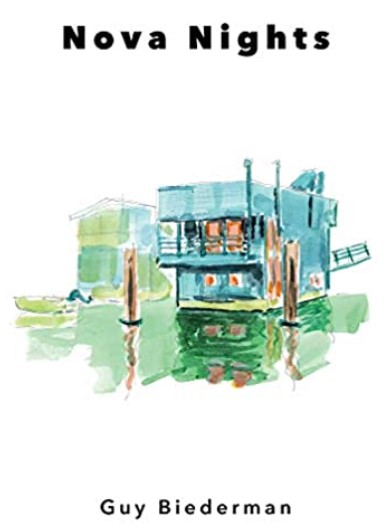
Guy Biederman teaches short fiction and is the author of five collections of short work, including Nova Nights (Nomadic Pres,), Edible Grace (KYSO Flash Press), and Soundings and Fathoms, stories (Finishing Line Press).
His work has appeared in many journals including Carve, Flashback Fiction, MacQueen’s Quinterly, Bull, great weather for Media, Riddled with Arrows, The Disappointed Housewife, and Exposition Review.
He’s been a creative-writing midwife since 1991. His collection of short work, Translated From The Original: one-inch-punch fiction will be published by Nomadic Press in 2022.
You can purchase a copy of Nova Nights (and support a really great independent publisher).
Note From Marlene: Right before I read “Crafting Short Fiction,” I sent off a submission to a contest with the theme of “imagine.” After reading “Crafting Short Fiction,” I was surprise to realize I created “room for readers who bring their imaginations to the page and make the experience their own.” At least, I hope that’s what I did.
But when I wrote it, I didn’t know I was doing that. So, yay, for playing with words, making changes bonsai style for writing that opens the door for possibilities and also respects the reader.
I like to think that’s what I did with my contest entry. And, maybe I did~!
Your turn: Just write!