Tag: Nona Smith

  • Claudia

    Memorable writing that sparks imagination. Lean in. Hear the writer’s voice on the page.

    Claudia

    by Nona Smith

    We held our wine glasses up and tapped their rims together. Clink.

              “Do you know why that’s done?” Claudia asked.

              “I have no idea,” I said.

              “The French began the custom centuries ago. It’s to make us appreciative of all five of our senses.”

    Claudia had a treasure trove of that kind of information.

     “Ahhh, les Francais; ils savent tout,” she added.

              She spoke three languages fluently and had enough vocabulary in others to find bathrooms in foreign countries and order wine in restaurants. Born in Germany and well-travelled, Claudia had European sensibilities and a sophisticated sense of style. Her hair was cut by a Sassoon-trained stylist, she wore only Italian-made shoes, and the walls of her dining room were painted Chinese red, seasons before that trend appeared in Architectural Digest. She owned a few expensive, elegant gold pieces, but most of her jewelry was purchased during her travels from local artisans or at art fairs at home. It was this we bonded over.

              On her first day working as a travel agent at Trips Out Travel, I admired her earrings: thumb-nail size, straight-back chairs, crafted from black metal. Definitely not gold, but certainly expensive. Something she might have found in a museum gift shop.

              My compliment caused her to tuck a strand of red hair behind her ear and caress her earlobe. “I found them in Taormina. I had to sort through all that cameo crap they sell there before I found anything interesting.”

              Claudia had opinions. Very firm opinions. About food and clothing and what was worth spending money on. Her generous smile drew people to her; her sharp tongue sent them away. She possessed a quirky, wicked sense of humor and had a flare for the dramatic. She’d once been married and had a son Adam she adored, but when I met her, Claudia was living alone in a one-bedroom gem of a house secreted into the Berkeley hills. She took her cockapoo Milo, a yappy attention-grabbing dog, with her almost everywhere. And Claudia was devoted to the game of What If… What if you weren’t a travel agent; what else would you be? What if you didn’t live in this country; where else would you like to live? What if you knew how to play a musical instrument; which one would it be?

              Milo was not with us the afternoon we dined at our favorite dim sum restaurant in the City. We’d already polished off a bamboo steaming-basket of shrimp dumplings and a platter of al dente Chinese broccoli with oyster sauce when Claudia nodded to the waitress rolling another dim sum-laden trolley towards us. “We’ll have the shu mai and the pork buns,” she said with authority.

              We held our wine glasses up and tapped their rims together. Clink.

              “What if,” Claudia began, “you were on Death Row and going to order your last meal; what would it be?”

              I don’t recall what I answered, but Claudia’s answer came quickly and definitively. She waved her chopsticks over the bountiful table. “This is what I would order.”

              Late the next morning, Adam called. “It’s bad news. It’s Mom. She died yesterday.”

              “Oh, Adam,” I said. Tears sprang to my eyes.

              He continued to speak, “… alone in the house … Milo was with her … brain aneurism …”

              I heard his words, vaguely, but the picture in my mind was of Claudia, her chopsticks held aloft, pronouncing the dim sum her last meal of choice.

    “Claudia” by Nona Smith is one of the featured pieces at the Artists’ Co-op of Mendocino, Traditional and Contemporary Fine Arts 2021 Ekphrasis X Exhibition, where writing is paired with visual arts. You can see the artwork inspired by “Claudia” and the other winning entries at 2021 Ekphrasis X Exhibition.

    Ekphrasis: Art describing other art. Writing is paired with visual arts.

    Nona Smith is the author of Stuffed: Emptying the Hoarder’s Nest and numerous short stories, humorous personal essays, and bad poetry. She was a long-time board member of the Mendocino Coast Writers’ Conference and currently sits on the board of the Writers of the Mendocino Coast and is editor of the club’s annual anthology. Nona lives with her patient husband Art and two demanding cats.

    Her writing is featured in many anthologies including The Write Spot: Musings and Ravings From a Pandemic Year. Available at Gallery Books in Mendocino, Rebound Books in Mill Valley, Book Passage in Corte Madera, at Amazon, and through your local bookseller.
  • I Scream, You Scream

    Memorable writing that sparks imagination. Lean in. Hear the writer’s voice on the page.

    I Scream, You Scream

    By Nona Smith

    It’s been well over a year since I’ve done any grocery shopping at Safeway. Early on in the pandemic, it was Harvest, our other local supermarket, who quickly adopted safety precautions: it made mask-wearing mandatory, limited the number of shoppers inside the store at any given time, provided handwashing stations outside, and offered free Latex gloves. Safeway was slow to adopt protective measures, making me feel unsafe in Safeway.

    Fast forward eighteen months, and I’m fully vaccinated and in need of a cake mix Harvest doesn’t carry. Being as health conscious as it is, the shelves in the baking section at Harvest are laden with organic, gluten-free, paleo, KETO, dairy-free cake mixes. There are only a handful of non-organic, full-on gluten, white sugar mixes on the very bottom shelf. I’m guessing their placement there is to give the consumer time to re-think their unhealthy choice while bending over to reach one of those boxes. So, I’m off to Safeway to find my cake mix.

    Of course, it’s there, nuzzled amongst dozens of others of its ilk, within easy reach. I pluck it from the shelf and decide to do the rest of my grocery shopping while I’m already in the store. I pull out my grocery list.

    When all the items are checked off, I crumple the list and stuff it into my purse. Then I go in search of the shortest check-out line, which––because shoppers are encouraged to stand on the six-feet-apart circles painted on the store floor––brings me half-way down the ice cream section of a freezer aisle. And, because I have nothing else to do while waiting for the line to move, I begin perusing the freezer cases and discover an ice cream trend. The highest end ice creams––Haagen-Dazs, Ben and Jerrys, Talienti––have adopted “layering” as a new marketing gimmick. Only pint cartons are offered this way: four layers of different textures and flavors. I’m imagining plunging my ice cream scoop far enough down into the container to reach all four layers at the same time. Nope, I determine, it can’t be done. One would need a spoon to get the effect the product promises. I suspect the idea really is, to sell more product by encouraging shoppers to have their very own pint to dip their very own spoon into. I can’t imagine this trend will last beyond the summer.

    The line moves, and I find myself in front of a section containing lesser-known brands, such as Fat Boy and Fat Boy Junior. I’m wondering what kind of market research led someone to name their product that when the line shifts again.

     Now I’m in the popsicle section and looking at a product that reminds me of the summers of my childhood. I can almost hear the tinkling notes of the white ice cream truck as it announces its tour through my neighborhood. And here it is in Safeway’s freezer: the Good Humor Creamsicle, orange popsicle on the outside, velvety vanilla ice cream on the inside. I’m tempted to put a package in my shopping cart. The only thing that stops me is knowing the Creamsicles would melt before I got out of the store.

    Another five minutes pass, and I’m now standing in that spot between the end of the aisle and the conveyer belt, leaving enough space for shoppers to pass through with their carts. An idea strikes me, and I reach into my purse for the crumpled shopping list and a pen. Smoothing out the list, I jot some notes about what I’ve just discovered. As a writer of personal essay, I know that anything––and everything––is fodder for a story. Why not ice cream?

    By the time I’m wheeling my cart out of the store, I’ve decided to make a stop at Harvest on my way home and do a little market research of my own.

    Standing in front of the ice cream freezer at Harvest, it’s just as I suspected. Yes, the high-end, four layered, products are there, but there’s no sign of Fat Boy or his son. Instead, there’s a product called Skinny Cow. Also, it appears there’s an equal amount of low fat, sugar-free, nonfat, nondairy ice creams made from soy, almond or coconut milk as those made from actual full-fat cow’s milk. The Rebel label promises “high fat/low carbs” for people on a KETO diet. There’s even an ice cream designed for kids who don’t like vegetables. It’s called Peekaboo and is made with “hidden veggies:” vanilla ice cream with zucchini, chocolate with cauliflower. Who knew? The freezer is filled with organic, health-conscious choices, seemingly designed to keep the Harvest shopper living a nutritious lifestyle.

    I tuck the note-filled grocery list back into my purse and head home. Maybe one day I’ll write a piece about ice cream.

    Nona Smith is the author of Stuffed: Emptying the Hoarders’ Nest and numerous other short stories published in various anthologies, including The Write Spot: Musings and Ravings From a Pandemic Year, journals and the St. Petersburg Times (now Tampa Bay Times.) Currently, she is writing a mystery about a woman named Emma whose dear friend goes missing. In her search for her friend, Emma finds herself. Nona writes personal essays and memoir pieces as well as fiction, always with an eye towards finding the humor in situations. She lives on the Mendocino coast with her husband Art and two mischievous cats.

    Stuffed: Emptying the Hoarders’ Nest and The Write Spot: Musings and Ravings From a Pandemic Year are available at Gallery Bookshop and on Amazon.

  • The Gift of Writing

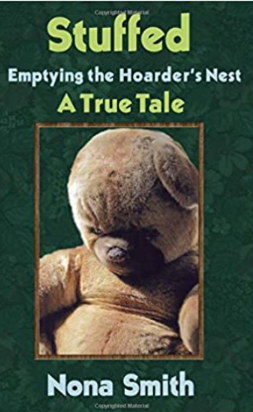
    Today’s guest blogger, Nona Smith, relates her experience about how her book, Stuffed: Emptying the Hoarder’s Nest, came about.

    Eight years after our friend, Al, died, and two weeks after his wife, Linda, was put to rest, my husband, Art, and I stood on their doorstep, key hovering at the lock. As the executor of their estate, Art had every right to be there. But still, we felt like trespassers. He gave a small shrug and turned the key in the lock. We pushed the door open, walked inside, and gazed around at the chaos that greeted us.

    In the living room, twin oak desks stood in front of a window, their drawers exploding with old mail, catalogues, writing implements, and paper. A couch, laden with a mountain of stuffed animals, was sandwiched between two Tiffany floor lamps. On the floor, handwoven rugs were piled on top of handwoven rugs. The dining room had been transformed into a jewelry making studio, and the counters in the kitchen were obscured by apothecary jars filled with mystery liquids, boxes of costume jewelry, and unopened cooking gadgets.

    In Linda’s bedroom, teddy bears ruled the roost. Dressed in elegant attire and jaunty outfits, some wore tutus and some wore nothing more than the fur on their backs. Bears lined the walls, trespassed on the headboard and spilled onto the bedside tables and dresser.

    In the second bedroom, a queen size mattress was propped against a wall, and a daybed held more bears, a brass trumpet, cases of adult diapers, and several folded Navajo rugs. No horizontal surface remained visible.

    Three decades earlier, Art had agreed to be the couple’s executor and now I turned to him.

     “You knew about this?”

    Yes, he nodded somberly. “But I didn’t think they would actually die.”

    And so began our three year undertaking and the beginning of my book Stuffed; Emptying the Hoarder’s Nest.

    I didn’t set out to write a book. But the task we undertook was so unique, troubling, and different than how Art and I live our lives, that I felt compelled to write about it. I found putting down on paper what we discovered, and the profoundly disturbing aggravations we encountered in liquidating this eclectic estate, helped me process the experience.

    I wrote to bring about order. It was therapy . . . and it kept me sane

    We began by choosing one collection at a time and gathering it up, accounting for every item. This part of the process alone was daunting because there was so much scattered over such a large area.

    Al and Linda were well-educated, intelligent, and curious people who were also financially well off. So, not only were they able to acquire things, they had places to store their acquisitions: two houses in southern California, a store in the northern part of the California Bay Area, and a warehouse and apartment building in Berkeley near the UC campus. Stuff was stashed everywhere.

    Once we corralled a collection, we needed to ascertain its value before we could decide whether to sell or donate it. The cartons of never-worn-and-still-in-their-original-wrapping plaid shirts, the used table linens, the mounds of staplers and plyers and cabinets filled with financial papers from businesses Al no longer owned were easy to deal with.

    As the collections became more extraordinary, however, we needed to research and find experts in the field to advise us: What is a merry-go-round calliope worth? Are these gemstones real? What about the fleet of ’57 Plymouths parked tandem in the apartment garage? Are they worth anything? And the hundreds of player piano rolls? How about the profusion of original artwork by a famous botanical printmaker, each signed, dated, and numbered? The Navajo rugs? And, gosh, the teddy bears: are they of any value?

    Dealing with one at a time, we went through the buildings and the collections. Once we knew its value, the entire collection was sold or donated . . . or sent to the dump . . . and I wrote about it.

    I introduced the characters we met along the way and wrote about our frustrations and successes. I began bringing what I wrote to my weekly writing group for editing.

    I didn’t think of them as such, but before long, my writing buddies began referring to these pieces as “chapters.”

    As Art and I neared the end of our journey with this estate, I began to view what I’d written as a book. When we turned what was left over to an estate liquidator, I wrote the final chapter. It came to me as an epilogue, and almost wrote itself.

    Now the question became, what did I want to do with it? Did I want to pursue an agent? Look for an editor? How much more time and energy did I want to spend with Al and Linda and their stuff? The answer came quickly: not much. But out of a desire to honor the time we spent and the education we received, I wanted to create something permanent out of these stories. So, working with a local publisher, Stuffed came into being. I held a small and satisfying book launch at our local independent bookstore, Gallery Bookshop in Mendocino, and sold out of my first two runs.

    The three years Art and I spent dismantling this estate were disturbing and unsettling for me.

    Writing about it as it was happening calmed and comforted me. Putting down on paper how we handled the chaos that surrounded us helped me process the events from the initial sense of overwhelm at the task ahead of us through our frustrations and successes.

    Writing was a gift I cherished.

    Nona Smith has been part of the very active Mendocino Coast writing community since she moved there in 2006.

    Nona is the author of Stuffed: Emptying the Hoarder’s Nest: A True Tale and numerous other published short stories, humorous memoir pieces, and poetry. She is a board member of the Writers of the Mendocino Coast and has been president of the 31-year old Mendocino Coast Writers’ Conference for four years. Nona lives with her patient husband Art and two demanding cats.

    More details about the writing of Stuffed: Emptying the Hoarder’s Nest.

  • Organizing a Writing Project

    Organizing a Writing Project by Guest Blogger Nona Smith, author of Stuffed, Emptying the Hoarder’s Nest,  A True Tale.

    Nona tells the story of writing Stuffed:

    I didn’t start out with the idea of writing a book, but from the get-go, I was aware we were onto a unique experience. In late November of 2010, my husband, Art, became the executor of his friend Linda’s estate. Linda was a hoarder. Not your run-of-the-mill hoarder, but a collector of unique stuff as well as plain ol’ junk.

    We felt it prudent to document what we found because in addition to being the executor, Art was the only on-site heir. So I took photographs of the plethora of original artwork by a famous botanical printmaker, the rare mechanical music machines and closets of musical scrolls, tools and computers and even of the life-size teddy bear reclining in the bathtub. I also photographed the stuff that had no value: old piles of crafting supplies, a jarful of unmarked keys, moldy, outdated textbooks. I saved emails from our friend Dan who helped us clean things out, and I took notes on research we conducted while trying to ascertain the value of one collection or another.

    There was so much of everything I was afraid we might lose track of the details, so I bought an accordion folder and divided it into loosely organized categories. I was in Organization Mode. Writing about this hadn’t yet occurred to me.

    Each time we entered Linda’s apartment and surveyed the chaos, my stomach clenched. Every horizontal surface was littered with things, every room was jam-packed. Stuffed animals were her particular passion and they were everywhere; literally hundreds of teddy bears, rabbits, monkeys, turtles and an occasional pig filled the place to overflowing. Three other apartments in this building plus a computer repair shop, a warehouse and two houses in southern California were similarly stuffed to the rafters.

    The disorder was unsettling, disturbing, and invaded my dreams. I would have liked to simply walk away from the mess. But we needed to deal with it in a methodical manner until it was all disposed of and converted into cash. In the end, it was this disorder–––and the teddy bears–––that drove me to writing. Writing became my therapy and helped me process the experience.

    In order not to get crushed by the telling of the story, I decided three things. First, I wanted to introduce my readers to Linda and her husband Al, also a hoarder, who had died years earlier. I wanted them to be known as people, not simply hoarders. In addition, I wanted my audience to understand the malady called hoarding as I myself learned about it. Second, I didn’t want this tale to be depressing, so I made it a point to look for humor where I could find it. The third decision was strictly an organizational one. I chose to isolate each collection or problem and write about it as we encountered it. That accordion folder helped me follow a single story line and not drift anywhere else.

    The stuffed animals, with their sad, accusatory eyes, had the first story to tell. I stuck with them until they all happily found new homes. Then I introduced our friend Dan who played a major role in assisting us with our responsibilities to this estate. Dependable, loquacious Dan weaves in and out of the tale. Whenever he turns up, there’s food involved, and I was able to make that a kind of repetitive, happy theme. He also writes funny emails, so I saved those in the appropriate accordion file sections.

    If Dan is our “hero,” Mike Em is his evil counterpart. Mike Em’s story-thread involves the mechanical musical instrument collection. He comes into the story early on and he was such an abrasive person from our first encounters with him that I knew intuitively I should keep his email correspondence. It served me well when writing about him later.

    And finally, I never began writing about a problem or a collection until that issue had been settled. As each thing resolved itself, I contained it in a chapter. Sometimes, one chapter spilled into two, such as finding the hidden safe, which turned out to be safes. However, knowing the story line from start to finish was a strategy I believe helped me find the humor I hoped to maintain. Occasionally that humor came from a single adjective, such as Mike Em’s “turd-colored suspenders.” Sometimes I had to search further and exaggerate a bit. But not having to worry about the story’s conclusion freed me to look for the lightness.

    Stuffed. Nona SmithIn the beginning, the teddy bears’ happy endings encouraged me to write on. Toward the end of our adventure, I felt compelled to tell the tale to its finish in order to honor the time we’d spent and the people who’d helped us along the way.

    Note from Marlene:  I read Stuffed and enjoyed every bit of it. What could be a sad story is told in an upbeat, positive way, with a satisfying ending. Well-written and entertaining.

    Nona Smith writes memoir and short stories with a humorous bent that show how life’s foibles connect us to each other. She lives on the Mendocino Coast with her husband Art and two spoiled cats, Missy and Buster.
    Photo by Rosalie Winesuff