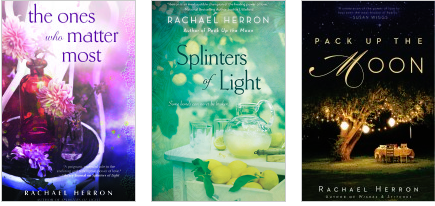
Today’s “Just Write” post is an excerpt of Holly Robinson’s interview of Rachael Herron. (Edited for brevity. Click on Huffpost link below to read entire interview.)
Holly Robinson writes:
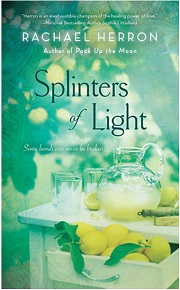
One of my favorite things about being a writer is having the chance to meet other writers whose books I admire. I probably admire few books as much as I do Splinters of Light, my new friend Rachael Herron’s powerful, poignant, and surprisingly comic novel inspired by a People magazine article about the impact of early-onset Alzheimer’s on a woman and her family.
In the hands of another writer, this topic could be dreary and depressing, but Rachael spins a story of resilience and love that leaves you believing in the healing power of family and forgiveness. Splinters of Light is a reading experience you won’t soon forget. Here’s a look at how Rachael works — she’s a prolific author of romance novels, women’s fiction, memoir and essays.
Give us a peek at your workspace. (I’m imagining lots of animals milling about, baskets of yarn, an unfinished sweater.) Do you have any special foods or drinks that keep your butt in the chair as you write?
I recently found the desk of my dreams, a roll top behemoth with cunning pigeon-holes and drawers for everything. I literally have a drawer for lip balm, one for beach glass, one for hair ties (all very important in the writing process, of course). I do have baskets of yarn around and usually have a cat or two on my lap, but what keeps me in my chair is having nothing else in front of my gaze but my computer and a mug of coffee with cream. Moving my desk away from the window was one of the best things I ever did for myself, productivity-wise.
Splinters of Light is both one of the most joyful and one of the most devastating novels I’ve ever read, partly because you do such a wonderful job of tapping into the worst fear we all have as parents: that we will somehow fail our children. What was the inspiration for this novel, and for the brave, wonderful, and touchingly resilient character of Nora Glass?
The inspiration for the novel came from, of all places, a People magazine article about a young teen-aged boy taking care of his mother who’d been diagnosed with early-onset Alzheimer’s. This was before Still Alice, before many of us had ever heard of this disease, and I was transfixed by the thought of a parent having to teach their child how to be an adult so long before it was time. Nora herself comes from a good mix of my sisters and my mother, the strongest, bravest women I’ve known.
You do a stellar job of writing from the point of view of a resentful but loving teenager in Splinters of Light. Was that difficult?
Should I admit it was easy? I’m forty-two, but I was a terrible teenager. When I was turning seventeen, Ellie’s age in the book, I thought I hated my mother. I couldn’t stand to be in her presence. Everything she said grated on my nerves, and I couldn’t understand how we could possibly be related. Of course, when I turned nineteen or twenty, she suddenly “became” much smarter and more interesting (go figure!), and by the time I was twenty-five, she was my best friend and stayed that until the day she died. I really regret what a pain in the ass I was to a phenomenal woman. Ellie is, in a small way, an apology for that (and maybe a beacon of hope to mothers of teen girls—they do snap out of it).
You’re originally from New Zealand. How did you end up living in the U.S.? And what do you think being an “outlander” contributes to the fiction you write set in the U.S.?
Actually, I’ve always been a half-and-halfer. My mom was Kiwi, my dad an Arizonan. I have dual citizenship, and I had the New Zealand accent until I was seven (I still remember embarrassing myself in first grade for asking for the cello-tape). Living on the imaginary border gave me a really good place to stand growing up. My mother never became an American, and national holidays like Thanksgiving were celebrated, of course. But we also pulled the thrippence out of the flaming plum duff on Christmas and I knew more about Maori myth than Native American. My parents let us choose our identity, and I’m happy to say that all three of us girls are proud of both heritages.
Prior to Splinters of Light, you authored a memoir. Was the process of writing nonfiction very different from your fiction writing process? Which do you prefer?
Nonfiction is so much easier! You’re limited to the truth (or as close as you can come to it, years later) so the only big choice is how you frame the storytelling. For that book, I chose to look at my life as seen through the sweaters I’d knitted, from the first one I attempted at eleven in an attempt to bond with my entrepreneurial father to the dress I failed to knit for my wedding. I love creative nonfiction, but I have to confess, while novels are more difficult, I find a bigger sense of satisfaction in their completion.
As a writer who previously wrote a series of successful romance novels as well as a memoir before producing Pack Up the Moon and Splinters of Light, both of which I would describe as “literary” or “women’s fiction” (if I had to use typical publishing categories), how do you describe your work?
Oh, god. I never know what to say. Writing literary women’s fiction has always been my goal—and what I’m probably best at—so I lead with that. But then I usually fade out and mumble something lame like, “I guess I write mainstream? And, um, romance. And um, memoir. Um. Do you need more coffee?”
With all of the different types of writing you’ve done, you must have met some challenges and hurdles along the way. What has kept you going through times of self doubt?
Publishing is not for the faint of heart, that’s for sure. Hard times come fast and often, but two things have kept me going. First, I’ve always known this was what I was meant to do, even before I was actually doing it. I spent my teens and twenties yearning to write and not getting the work done. Writing is the only thing that settles my soul, whether it’s fiction or just a private journal entry. I could never let that part of myself go. Second, my writer friends have been my rock. The most important thing for a new writer to do (besides writing) is to make writer friends who are at the same stage in their careers. Nothing is more valuable.
Did getting an MFA help you on your writing journey? Would you recommend that path to other aspiring writers?
Nope, I rarely recommend it even though I don’t regret getting mine. It was lovely to be in the ivory tower for those two years. But what I needed to learn about writing I didn’t learn there. School can’t teach you how to finish a book. It can’t teach you how to find your core story. It can’t teach you how to get back up and start over after your first publisher drops you. It can’t teach you how to cultivate real, rich relationships with your readers. I only learned how to do this by writing, every day, for many years after I got that MFA.
If you could list three unbreakable rules for writers, what would they be?
Write as much as you can every day. Even if that’s just a sentence. Write.
Read. Read every day, read everything. Don’t be snobby.
Be generous and gracious, giving of yourself, your knowledge, your time, and your words. In this profession, what goes around comes around in an almost insta-karma way. Be good.
Interview originally posted on Huffpost Books 3/3/2015
Novelist, journalist and celebrity ghost writer Holly Robinson is the author of several books, including The Gerbil farmer’s Daughter: A Memoir and the novels Beach Plum Island and Haven Lake. Her articles and essays appear frequently in The Huffington Post, More, Parents, Redbook and dozens of other newspapers and magazines.
Rachael Herron’s Beautiful Book Covers.