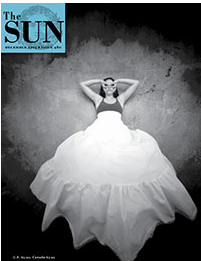
Tag: The Sun magazine

  • The Sun Magazine

    The Sun magazineThe Sun is an independent, ad-free magazine that for more than forty years has used words and photographs to evoke the splendor and heartache of being human. Each monthly issue celebrates life, but not in a way that ignores its complexity. The personal essays, short stories, interviews, poetry, and photographs that appear in The Sun’s pages explore the challenges we face and the moments when we rise to meet them.”

    “We publish essays, interviews, fiction, and poetry. We tend to favor personal writing, but we’re also looking for provocative pieces on political and cultural issues. And we’re open to just about anything. Surprise us; we often don’t know what we’ll like until we read it.

    We pay from $300 to $2,000 for essays and interviews, $300 to $1,500 for fiction, and $100 to $200 for poetry. We also give contributors a complimentary one-year subscription to The Sun. We purchase one-time rights. All other rights revert to the author upon publication.”

    Submission Guidelines

  • The Sun Magazine

    Submissions – The Sun Magazine

    We publish essays, interviews, fiction, and poetry. We tend to favor personal writing, but we’re also looking for thoughtful, well-written essays on political, cultural, and philosophical themes. Please, no journalistic features, academic works, or opinion pieces. Other than that, we’re open to just about anything. Surprise us; we often don’t know what we’ll like until we read it.

    We pay from $300 to $2,000 for essays and interviews, $300 to $1,500 for fiction, and $100 to $500 for poetry, the amount being determined by length and quality. We may pay less for very short works. We also give contributors a complimentary one-year subscription to The Sun. We purchase one-time rights. All other rights revert to the author upon publication.

    We’re willing to read previously published works, though for reprints we pay only half our usual fee. We discourage simultaneous submissions. We rarely run anything longer than seven thousand words; there’s no minimum word length. Don’t bother with a query letter, except perhaps on interviews; the subject matter isn’t as important to us as what you do with it.

    We try to respond within three to six months. With nearly a thousand submissions a month, however, our backlog of unread manuscripts is often substantial. Don’t let a longer wait surprise you.

    Submissions should be typed, double-spaced, and accompanied by a self-addressed, stamped envelope. (Poems may be single-spaced.) Your work will not be returned without sufficient postage, and we cannot respond unless a return envelope is provided. Do not send your only copy. Do not submit work or queries by e-mail or fax. Submissions received this way will not be acknowledged.

    Send submissions to:

    Editorial Department
    The Sun
    107 N. Roberson St.
    Chapel Hill, NC 27516

  • Natalie Goldberg talks about writing practice

    From an interview in The Sun with Natalie Goldberg, November 2003:

    A writing practice is simply picking up a pen — a fast-writing pen, preferably, since the mind is faster than the hand — and doing timed writing exercises. The idea is to keep your hand moving for, say, ten minutes, and don’t cross anything out, because that makes space for your inner editor to come in. You are free to write the worst junk in America. After all, when we get on the tennis courts, we don’t expect to be a champion the first day.

    Writing is an athletic activity; the more you practice, the better you get at it. The reason you keep your hand moving is because there’s often a conflict between the editor and the creator. The editor is always on our shoulder saying, “Oh, you shouldn’t write that. It’s not good.”

    When you keep the hand moving, it’s an opportunity for the creator to have a say. The goal is to allow the written word to connect with your original mind, to write down the first thought that you flash on, before the second and third thoughts come in. That’s where the energy is. That’s where the alive, fresh vision is, before society, which we’ve internalized, takes over and teaches us to be polite and censor ourselves. Another way of putting it is that you need to trust what intuitively comes through you, rather than what you think you should be writing.

    Writing practice teaches you what your obsessions are, what you keep coming back to. Your obsessions have energy, and you can use them. Writing offers you a chance to transform an obsession into a passion, which is a lot better than constantly focusing on the things that are eating you.