Tag: What Have We Here

  • The thing about grief . . . Prompt #754

    Inspired by an email from Susan Bono:

    I was at Dollar Tree the other day and didn’t have quite enough cash to cover my Halloween garlands.

    As I fumbled with my card, the cashier said, “I never carry cash anymore.”

    I said, “I don’t either, but I miss it sometimes.”

    She looked at me full in the face and said, “There are things I miss every single day about the way things used to be.”

    I saw such grief in her face before she smiled and urged me to have a nice day.

    Prompt: Write whatever comes up for you . . .

    Shopping at the Dollar Tree store

    Halloween

    Cash vs credit card

    I miss . . .

    The way things used to be . . .

    The thing about grief is . . .

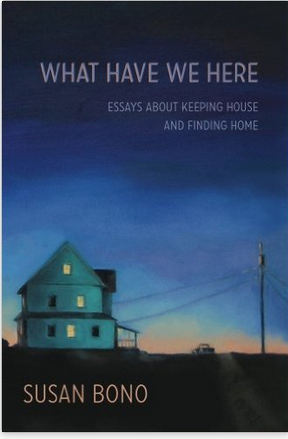
    Susan Bono is the author of “What Have We Here: Essays about Keeping House and Finding Home.” Available on Amazon.

    “The world is full of stories. Mine collect in journals, spill onto postcards and scraps of paper, come to conclusions in computer files, call to me in dreams. I write what I believe is true about my experiences, not just events that happened to me. 

    I’m not sure what’s more important: the raw aliveness of a dashed-off journal entry or the carefully developed and edited essay, finally (one hopes) complete.  I only know that every story is a shard of mirror that shows me pieces of who I am and what it means to be human.” —Susan Bono

  • Personal Essay – Pivotal Event Plus . . .

    A personal essay isn’t your life story. It’s a pivotal event. The narrator has an epiphany, or is changed at the end of the story.

    “Personal essays represent what you think, what you feel . . . your effort to communicate those thoughts and feelings to others . . . What is the point of your essay? Don’t belabor the point too much; let the point grow out of the experience of the essay. It might be true, in fact, that you didn’t even have a point to make when you started writing your essay. Go ahead and write it and see if a point develops.” — The Personal Essay

    More on personal essay:

    How to Write a Personal Essay

    Writing Personal Essays

    Personal Essay is Memoir in Short Form

    Still don’t know how to start? Gather your writing implements: Paper, pen, pencil, writing device, choose a writing prompt and . . . Just Write!

  • Dad

    By Susan Bono

    “That’s quite a sack of rocks you’re carrying, sweetie,” my father’s friend Bruce said more than once during phone calls last year. It was his way of acknowledging how heavily Dad’s poor health, hard-headedness and self-imposed isolation weighed on me. But I also took it as a tribute to Dad’s stubbornness and my strength, too.

    “Dumb as a rock” never made much sense to me, since stone strikes me as having its own unassailable intelligence. Its ability to endure illustrates its genius. I have never believed in the ability to factor equations or compose sonnets was proof of brain power, although I shared with Dad the idea that someone with rocks in his head was lacking in foresight and flexibility. Rocks may be smart, but they are slow. Time measured in stone is something else again.

    There were moments during my dad’s dying that were as slow as serpentine, sandstone, rose quartz, chert. His unseeing eyes were obsidian, and the pauses between breaths were long enough to form fossils. But just after that great wave rolled down from the crown of his head, darkening the air around him so his spirit glowed like a white shell at the bottom of a silty river, a tear slid from beneath his closed eyelids. That’s when the sack of rocks fell empty at my feet and I was surrounded by the tumult of released wings.

    Originally published in The Flashpoints 2008 issue of Tiny Lights. This issue was dedicated to the memory of Susan Bono’s father, Morris N. Zahl (12/24/24-3/22/09), whose light guides Susan.

    Susan Bono, a California-born teacher, freelance editor, and short-form memoirist, has facilitated writing workshops since 1993, helping hundreds of writers find and develop their voices. Her work has appeared online, on stage, in newspapers, on the radio, and in anthologies, including The Write Spot series.

    Susan is the author of “What Have We Here: Essays About Keeping House and Finding Home.”

    From 1995-2015, she edited and published a small press magazine called Tiny Lights: A Journal of Personal Narrative, as well as the online component that included quarterly postings of micro essays and a monthly forum dedicated to craft and process.

    She was on the board of the Mendocino Coast Writers’ Conference for more than a decade and was editor-in-chief of their journal, the Noyo River Review, for eight years. Susan often writes about domestic life set in her small town of Petaluma.

  • Joys and discoveries when re-reading books.

    Do you feel guilty when you re-read a book (on purpose, not because you forgot you previously read it)?

    Juan Vidal wrote a thoughtful essay about the joys and discoveries one makes when re-reading.

    “Returning to a book you’ve read multiple times can feel like drinks with an old friend. There’s a welcome familiarity — but also sometimes a slight suspicion that time has changed you both, and thus the relationship. But books don’t change, people do. And that’s what makes the act of rereading so rich and transformative.

    The beauty of rereading lies in the idea that our engagement with the work is based on our current mental, emotional, and even spiritual register. It’s true, the older I get, the more I feel time has wings. But with reading, it’s all about the present. It’s about the now and what one contributes to the now, because reading is a give and take between author and reader.”

    Excerpted from: “You Can Go Home Again:  The Transformative Joy Of Rereading,” by Juan Vidal, NPR, April  17, 2016 NPR. KQED Public Radio.

    Bono.What Have We Here

    What books have you re-read?

    Note from Marlene:

    I have re-read so many favorites, it would be a long list.

    One of my all-time favorites to re-read is What Have We Here,  by Susan Bono.

  • Good writing comes from your willingness to be vulnerable . . .

    Heart with writing“Good writing comes from your willingness to be vulnerable, to peel back the layers of resistance, to offer up your heart, pulsing and defenseless, on a silver platter.” – Susan Bono, author of What Have We Here.


  • How To Write A Memoir — Part One

    Your Life. You lived it. Surely you can write about it. Right?

    In How To Write A Memoir, Part 1, we’ll discuss methods and ideas about writing personal stories, with links to published memoirs.

    How To Write A Memoir, Part 2, we’ll cover organizing, revising and more.

    You can write in chronological order, or build your story around pivotal events. In the beginning, it doesn’t matter what structure you use. Write in a style that is comfortable for you. Try one way and if isn’t working for you, try something else.

    Memoirs written in chronological order (with back story woven in): To Have Not by Frances Lefkowitz  and Grief Denied by Pauline Laurent.

    Rachael Herron, A Life in Stitches, assembles her stories around her knitting experiences.

    For the first draft, it’s fine to jump around in time. Don’t worry too much about making sense in the early stage of writing. Get your stories written. Organize later.

    Paper or Computer?
    You can write using paper and pen/pencil or on a computer. Or both. For the most part, it doesn’t matter which method you use. The advantage of a computer is it’s (usually) faster. The advantage of paper and pen or pencil is the portability. Some people suggest there are benefits to handwriting for accessing creativity.

    Self-care

    If remembering and writing details about your life is difficult, it’s very important to have a strategy to avoid additional trauma. Create a self-care plan to protect yourself when writing about deeply painful topics.

    Writing Prompts

    You can use writing prompts to jumpstart your freewrites, to trigger memories and to make discoveries. Choose a prompt, write for 15 or 20 minutes. Take a break. Next time, choose another prompt. Good prompts to get started are:

    I remember . . .

    I don’t remember . . .

    In this photo, I . . .

    In this photo, you . . .

    family photosPhotos

    You can use photos to inspire your writing. First, look at the photo. Write all the details that you can see. Write about what happened before and after the photo was taken. Write about feelings you have connected with this photo.

    Photos might remind you about activities, important occasions and details that you may have forgotten. Did Grandpa always wear that hat? Did Grandma wear her apron with the little flower print every day, even on holidays? My Nana did.

    Other Memoirs

    Read memoirs to get an idea of how you want to proceed with your memoir. Some styles will appeal to you. Others aren’t right for you. You can read reviews on both Amazon and Goodreads to research different styles of memoirs.

    Susan Bono, What Have We Here, grouped her personal essays by theme.

    Rayne Wolfe, Toxic Mom Toolkit, braids three strands: her memoir, excerpts from others and toolkits.

    Janice Crow, I Give You My Word, created poems and watercolors to enhance exploring her journey.

    Story Telling

    When writing, think of yourself as a storyteller. In this story, you are the main character. Your family and friends are the supporting cast members. When you write, don’t think of any of these cast members. Write events (scenes) as you remember them, without worries (for now) about accuracy. With the first draft, put on your story-telling hat and write what happened.

    Research

    Interview family members, friends and acquaintances to learn details you may not know. You might realize a broader perspective from hearing other points of view.

    Research news, locally and world-wide, during the time period your story takes place. Tie in events with your story, if appropriate. Fact check details: slang, clothing styles, popular dances, technical gadgetry, geographical, etc.

    Take a few minutes

    After you have written all that you want to say, spend some time reflecting. What compelled you to write these stories?

    Perhaps your writing is a learning tool to understand what happened and to educate others as Piri Thomas does in Down These Mean Streets.

    Maybe your desire is to get these stories off your chest, to vent, to release emotions as well as help others similar to Ellevie by Marcelle Evie Guy.

    Maybe you want to record family stories, to document your family history.

    How To Write A Memoir – Part 2, we explore what to do after you have written your memoir, revision and the business of writing.
    woman writingFinal Comments
    This likely will be an emotional project. Take whatever time you need for breaks. Remember to exercise, go on walks, drink water and find joy, wherever you can.

    Just Write

    There are over 200 prompts on The Write Spot Blog. Use them for your memoir, for personal exploration and for fun!