“With nothing more than a pen and a notebook, nature journaling can help you slow down and create a reference you can call upon to bring your reader into the worlds you build on the page.”
Excerpted from “How Nature Journaling Can Help Your Writing,” by Maria Bengtson. Writer’s Digest, July/August 2024.
Go outside with pen and notebook, get settled, observe, use sensory detail to enhance your writing.
Bengtson suggests using these prompts
I notice . . .
I wonder . . .
It reminds me of . . .
“Your observations will create a reference that will help you transport your reader from their cozy chair to the world on your pages. Sketch a tree or flower or a critter you see.
The work of creating a rough map, schematic, or stick-figure diagram forces you to think about how things are related to one another, and how the environment and the things in it are structured.”
For example: Dave Seter’s poem, “Fox Trot.”
A curtain parted, beaded, of mustard grass.
Fox made an entrance and trotted across
an asphalt stage, expanse of empty parking spaces
stained with motor oil. Without missing a step.
The audience was wind, full of bluster,
phrased with pollen mitigated by a whisper
of unseen lilac. But the fox was seen
despite having gotten scent, or sixth sense,
college was closed, cars and people absent.
The fox’s coat was the color of caramelized sugar.
He/she/they paused like a debutante waiting
to be conferred royal title, the applause of a suitor,
but it was my nose that was in the air.
My heart on my sleeve hid a heart tattoo.
What is happiness, I asked, what sweetness
has been missing? But the fox didn’t answer.
Did the fox want to be seen frozen,
skilled as lawn statuary unmoved by wind?
Or did the fox just not want to give audience
dancing in a coat the color of caramelized sugar?
Dave Seter, civil/environmental engineer, poet, and essayist is the Sonoma County Poet Laureate for 2024-2026.
He is the author of Don’t Sing to Me of Electric Fences (Cherry Grove Collections, 2021) and Night Duty (Main Street Rag, 2010).
He writes about social and environmental issues, including the intersection of the built world and the natural world. He is the recipient of two Pushcart nominations.
His poems, essays, and book reviews have appeared in various publications including Appalachia, Cider Press Review, The Florida Review, The Hopper, The Museum of Americana, Poetry Northwest (forthcoming), and others.
He has been an Affiliate Artist at the Headlands Center for the Arts, and has served on the Board of Directors of Marin Poetry Center.
He earned his undergraduate degree in engineering from Princeton University and his graduate degree in humanities from Dominican University of California.
Made from the cheapest paper available, pulp magazines were among the bestselling fiction publications of their day, with the most popular titles selling hundreds of thousands of copies per month at their height. The pulps paid just a penny or so a word, so writers quickly learned that making a living required a nimble imagination and remarkable speed, with some working on several stories simultaneously.
Contemporary fiction writers can learn from pulp magazines the importance of a tight, character-driven narrative; the necessity of imaginative descriptions and how to immediately grab the reader with an action-filled lead.
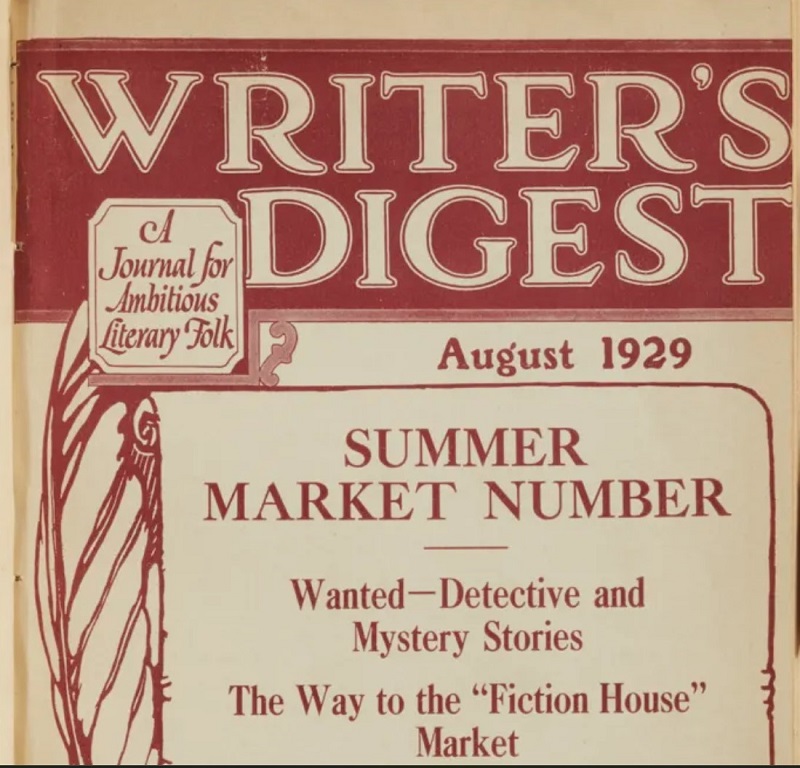
Jack Byrne, managing editor of the pulp magazine publisher fiction House, wrote in an August 1929 Writer’s Digest article detailing the manuscript needs of Fiction House’s 11 magazines:
“We must have a good, fast opening. Smack us within the first paragraph. Get our interest aroused. Don’t tell us about the general geographic situation or the atmospheric conditions.
Don’t describe the hero’s physique or the kind of pants he wears. Start something!”
Readers can find pulps aplenty on eBay, as well as in anthologies such as The Pulps, edited by Tony Goodstone, and The Black Lizard Big Book of Pulps, edited by Otto Penzler.
Excerpted from the May/June 2019 issue of Writer’s Digest magazine, “Back in the Day,” by Don Vaughan.
Do you enter writing contests? If you do, please share your experience here or on the Writers Forum Facebook page.
If you don’t enter writing contests, why not? Share your reasons here or on the Writers Forum Facebook Page.
“Writing contests give me short pieces to concentrate on, in between my bigger works. Contests allow me to write in genres that I never would have otherwise, causing me to do research, which helps me to grow as a writer.
Contests motivate me to write and challenge me to meet a certain word quota. This forces me to pare down my story to its essentials, choosing my adjectives very carefully, and paying close attention to my word choices.” — Jeanne Jusaitis, First Place Winner of The 2016 Steampunk Contest, sponsored by Redwood Writers, a branch of the California Writers Club.
“The value of a relatively long description is that it draws your readers deeper into the scene. The worry is that you’ll bore them. But if you do a good job you’ll engross them. Really getting into a description is one of the most fun things you can do as an author. Here’s the trick: Get going on a description with the attitude of discovering, not informing. In this zone, you’re not writing to tell readers stuff you already know—rather, you are writing to discover and experience the scene right alongside them.”
Sims continues with “Go below the surface.”
“A gateway to describing a person, place or thing in depth is to assign mood or emotion to him/her/it. . . . The Bay Bridge was somber today, its gray girders melding with the fog.”
Alla Crone expertly illustrates what Sims is talking about in her historical novel, Winds Over Manchuria.
Here’s an excerpt from Alla’s book:
“On the cold Sunday of January 9, 1905, the pallid sun hung over the rooftops of St. Petersburg trying to burn its way through a thin layer of clouds. By two o’clock in the afternoon the dull light had done little to warm the thousands of people milling the streets.”
Your turn. Make a list of inanimate objects, perhaps landmarks in your town. Write a few sentences, giving them moods and emotions. Or, use weather to describe and mirror your characters’ emotions. Write a scene and, as Sims says, “take a risk and go long.”
Note: Check back here for Sunday’s book review of Alla Crone’s riveting novel, Captive of Silence.
Today’s prompt inspired by Leigh Anne Jasheway, “Improv/e your writing” in the Nov/Dec issue of Writer’s Digest magazine. Talking about writing and improv: “Write a short description of something physical a person would do — say Stanley tapped his foot while making occasional clicking sounds with his tongue.”
Your turn: Conjure a character, an action and go from there. . . don’t worry about where your writing will take you, be open to where this can go.