What, or who, inspires you?
#amwriting #justwrite #writing freely #creativewriting
#amwriting #justwrite #writing freely #creativewriting
Guest Blogger Nancy Cullen writes:
“I am a rescuer of stories hidden among the ordinary. I give these stories voice as a template to inspire others with untold stories so that they will know the satisfaction of rescuing their own stories.” – Nancy Cullen
My BLOG, THE STONEBRIDGE, began as a place I could record and share stories. Stories stemming from four areas outlined on the BLOG’s “About” page. It is my version of a Sacred Bundle, a practice began by my father.
Capturing, or as I like to say, rescuing, stories from our thoughts, memories, and obscurity is a learned skill. There are processes, template frameworks, and yes, a bit of discipline involved. These are not apparent as one reads a particular post but run in the background like a good operating system in a computer.
Although, not complex, nonetheless they must be identified and adapted to your own style. Once in place, becoming a hero at rescuing stories feels natural.
My Hero Model Template
My father was a quiet example of a story rescuer. His method was quite simple, as were the tools he used:
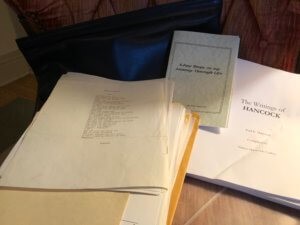
My tools are the same, except I have replaced the typewriter and paper with a laptop and this BLOG.
Dad wrote during quiet hours in the office at “The Shop,” his place of business where he sold new and used auto parts.
He stored his writing in a dark blue vinyl satchel. Occasionally he would let one of us read these musings.
I write in my “vision room,” then store them on this BLOG for the world to read, comment on, and, I hope, receive inspiration.
Find Your Personal Why
How can you become a Hero at Rescuing Your Valuable Stories?
First, define why rescuing stories is important, then why it is important to you. This is a great support in not only getting started, but to remain consistent when life conspires to derail your efforts.
The “why,” for me, comes from either discovering some delightful piece of information previously lost or losing a significant person in my life and realizing how much passed with them.
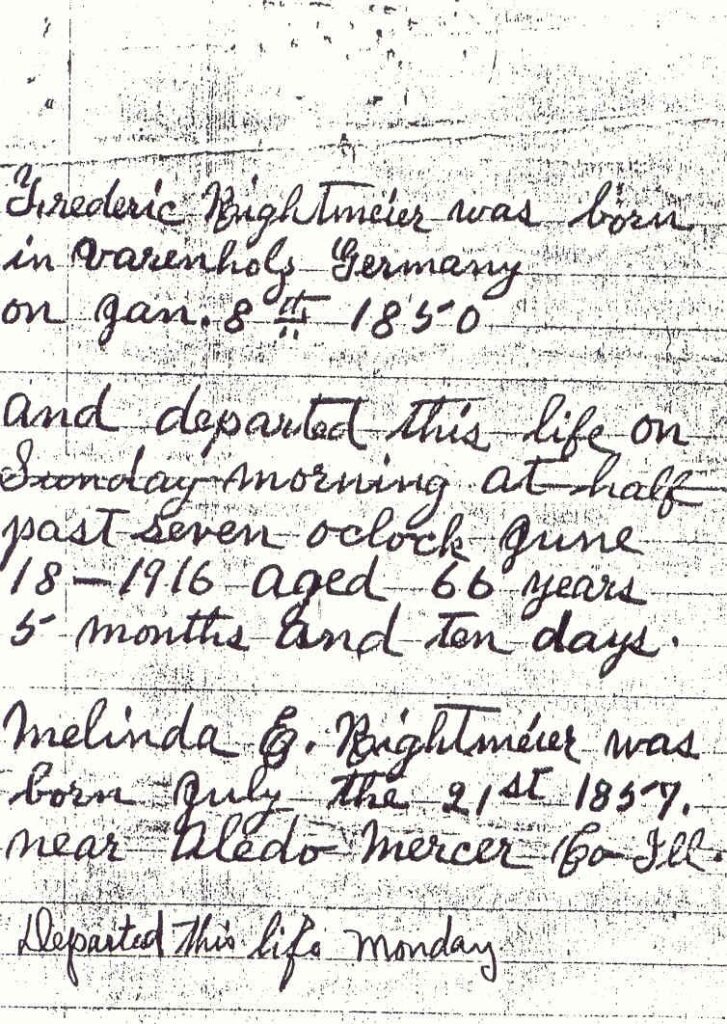
An example of the former was an entry in the Rightmeier family bible about my maternal great-great grandfather’s birthplace in Germany. It was discovering a piece of my own history. That piece of information eventually resulted in me traveling to the German village mentioned in the notation.
Of course, the loss of a person from this earth is sorrowful, but the loss of their stories for lack of recording only compounds that sorrow. Taking the time to write these down is a way to preserve their legacy.
There are many other “whys” for rescuing stories. What is your “why?”
Your Hero Model
Second, what kind of stories do you want to record? Your personal observations of:
For instance, a collection of seashells. Where were they collected? What was the occasion? Who were you with? That painting that was always present, where did it come from?
Third, assemble your own simple tool kit. Decide a time, place, and means where these rescued stories will be recorded and stored. Look for ways to fit “rescuing” into your life routine, for example:
A Place To Start
Below is a template as an aid in deciding what kind of stories to rescue along with some suggested ways to begin “storing” them.
Click here for your free PDF download and start today!
I inherited Dad’s writings and have compiled them into a book. It is an example of what is possible with humble tools. It can be viewed and purchased by clicking on this link.
What kind of story will you rescue this week?
Nancy J. Cullen grew up in Rooks County, Kansas, where she was introduced to aviation by her father. Flying in the same airplane she now owns, her early days of traveling with her dad to rural destinations, landing in pastures, grass airstrips and attending local fly-ins lay vivid in her memory.
What she did not realize was that her father was also cultivating another legacy he would pass on to her: writing. Other than the technical writing she did over her 30+ years as a federal civil servant, an air traffic controller, and air traffic staff support both in the United States and Europe, she had no aspirations to write.
It was not until her father passed on to her his writings, what she called his “sacred bundle” did the desire to rescue stories come to life for her. She has preserved his writings in a self-published book, “The Writings of HANCOCK.”
Since 2013 she has developed her own writing platform through her BLOG, The Stonebridge, where she shares her rescued stories and endeavors to inspire others to begin their own rescue operation.
Nancy holds the Premier Degree in French from the University of Strasbourg, France. She is a private pilot and owner of a 1961 Aircoupe she has restored twice and assists in its annual maintenance. She and her husband of 43 years own a 133-year-old Kansas State Historic Landmark home in Historic Midtown, Wichita, KS which they are in the process of restoring. She serves at the Chairperson of the PBS Kansas Citizens Advisory Board and actively participates in several aviation groups, locally, nationally, and internationally.
She inherited the EAA Biplane project from her father which she is building with the support of the local Experimental Aircraft Association chapter.
#amwriting #justwrite #creativewriting #lifestories #biographies
Memorable writing that sparks imagination. Lean in. Hear the writer’s voice on the page.
The Smell of Old Leather, the Scent of Cigars
Karen FitzGerald
Every so often Georgia would pull out that tin cigar box her Gramps gave her some 75 years ago. Imagine—75 years she’d been hauling that old tin box around, moving it from the family homestead to her college dorm, to that sweet pensione in Italy in her 20’s, to the little garden apartment when she and Gitulio married. Good gosh! And how many other moves in her 85 years had there been?
But, here she was, in Happy Valley Seniors’ Residence with her tin box from Gramps, about to open it for possibly the last time in her life; open it to retrieve the cherished item inside —her very first diary.
Her arthritic hands wrestled with the lid of the container while a thought crossed her weary mind. Surprisingly tight this lid on such a worn-out tin. But it did finally give way to the beaten and battered, leather bound book within.
The gold, etched letters in beautiful cursive writing that spelled out the word “Diary” were pretty much all worn off, but that did not distill the thrill, the wave of emotion that swept over her as she ran her hand across the cover. And that precious lock of gold—OK, only tin, really, but to the ten-year-old Georgia, it was pure gold that lock, and she still had the key! Imagine. And the entire contraption worked! The key and lock and binding all in order, as were the words on the pages that she hastily, excitedly scribbled out 75 years ago.
Not even the urgent screams of sirens penetrated her tender thoughts in lifting the book from the cigar box. Do I smell cigars? The smell of leather? Really? After all these years?
She inhaled deeply, took it all in—the smell drifting through her memories. She thumbed through the first pages of her first diary, the first words of her very first, private thoughts.
When the firemen broke down the door, the smell of gas was overwhelming. There they found an old woman sitting, peacefully, head down, chin to chest, a soft smile on her face, a worn-out book in her hand.
* A wonk is a person who takes an enthusiastic or excessive interest in the specialized details of a particular subject or field, immersing oneself in the subject matter.
Karen FitzGerald, founder of Think I.N.C. (Thinking Innovation, Not Consulting), professional trouble-shooters in business and organizational management, is transitioning from business management wonk to full time writer.
Karen is a prior board member for a variety of organizations: The Sonoma County Public Library Foundation, National Women’s History Project, Living Room Center (a day shelter for homeless women and women with children). She is a Finance Committee Member for Interfaith Shelter Network.
Karen recently dusted off her M.A. in English which she achieved with a Master’s Thesis on language centered theories of human behavior (1994).
Over the last several decades, Karen has been rejected by obscure presses and prestigious publishing houses alike. Ever the optimist, except when not, she moves forward, undaunted, with pen, dictionary, and a sizable inventory of Wite-Out correction fluid in stock.
Scene 1
You are sitting at your kitchen table. The morning sun lights up the room. You wrap your hands around a mug of warm, steaming, fragrant [type of drink]. What are you daydreaming about?
Scene 2
You are sitting on a porch, looking out at [wherever you are]. A movement catches your eye, reminding you of . . .
Scene 3
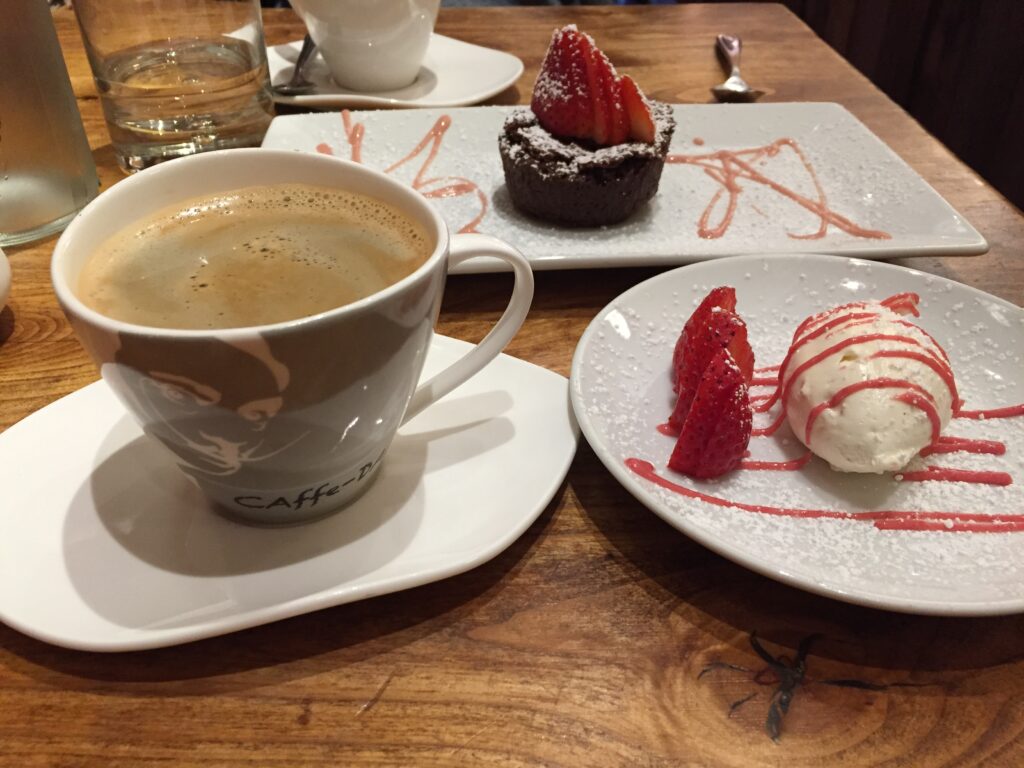
You and (name of dinner partner) are enjoying dessert. You are surprised by . . .
Scene 4
There you are, in the middle of [something]. What are you thinking about?
#amwriting #justwrite #creativewriting

Have you read something that feels “off?”
Or been bored with the sluggish, plodding plot?
Do you wonder why the novel isn’t moving along?
It could be the lack of balance between narration, dialogue, and action.
As a writer you want to keep your story moving and engaging.
Weaving
“We want to balance our scenes using three elements of fiction: dialogue, action and narrative. This is one reason you want to put your character in a scene with other characters as often as possible: Scenes that weave together these three elements engage the reader at an emotional level much more effectively than scenes that are only dialogue, only narrative or only action.” —Gloria Kempton
One at a time
Sometimes you want to focus on one aspect. Use dialogue, for example, to show a character’s personality and motives.
“If you want to highlight a particular character trait in your viewpoint character . . . you don’t want the scene cluttered, the reader distracted or the pace slowed by action or narration.” —Gloria Kempton
Pacing
If your scene involves conflict, dialogue alone can work to show emotions.
Or, you might want to use narration to indicate what the character is thinking and to avoid dialogue that could sound contrived.
Action is best when you want to propel an intense scene forward and when characters wouldn’t be talking during a powerful situation.
What to use and when
Dialogue: Speed things up.
Narration or dialogue or a combination: To provide background information.
Action or narration: When too much dialogue is clumped together.
Ready to experiment?
Choose a scene from your work in progress or write a new scene.
First round: Write scene in dialogue only.
Second round: Write same scene using narration only.
Third round: Write same scene using all action.
Last round: Weave all three styles for a three-dimensional effect.
—Excerpts from “Weave Action, Narrative and Dialogue,” by Gloria Kempton, Nov/Dec 2010 Writer’s Digest
#amwriting #justwrite #dialogue
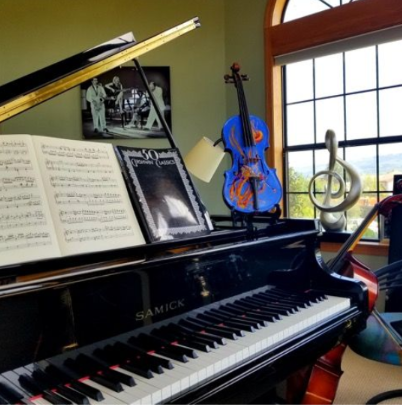
“The goal of description is to create a well-designed set that provides the perfect background for your characters—a setting that stays in the background without overwhelming the scene or interrupting the story.” —Moira Allen
In real life, we explore our surroundings through our actions and experience them through our senses. Create a structure for your characters to do the same.
Craft your descriptions so details unfold as your character moves through the scene.
Know which details your character would notice right away and which details will register more slowly.
Suppose, for example, your heroine is a secretary of humble origins and has just entered the mansion of a millionaire.
Let her notice how soft the rich Persian carpet feels underfoot, how it muffles her footfalls, how she is tempted to remove her shoes.
Don’t mention how soft the sofa is until she sinks into it. Let her smell the leather cushions. Bring in other smells as she scans the room: A bouquet of dahlias, a rich pipe tobacco smell.
Mention the heavy, marble center table your hero has to detour around to look at the bronze statue on the credenza. Show him blinking as he looks at the glittering light reflected from the crystal chandelier.
Do not mention the masterpieces on the walls if your character doesn’t know who Klimt or Vermeer are. Go with what your character would know and notice.
A fisherman would notice different details about the sea and beach than an accountant with limited coastal experiences.
Writing Prompt
Think of a character to write about. This character could be imagined or based on a real person or a based on a fictional character.
Write a scene from that character’s point of view.
Setting could be:
~ A sea coast
~A carnival
~A classroom, perhaps an alma mater
~ Farmer’s market in a villa
~ Cruise ship
~A bustling coffee shop in a big city
~A quiet coffee shop in a small town
~A basement
~A bookstore
Choose a character, choose a setting, and Just Write!
Adapted from “How to Bring Your Settings to Life,” by Moira Allen, The Writer magazine, March 1999
#justwrite #amwriting #scenesetting
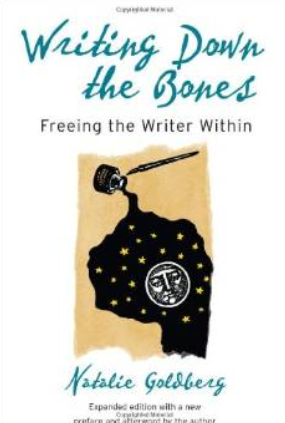
Natalie Goldberg The Art Of Writing Practice:
“By my early twenties, I knew I wanted to write and I knew I couldn’t learn to do it through traditional writing classes. I had to begin with what I knew, something no one could tell me I was wrong about. And so, I studied my mind. As I wrote, I would discover things about my mind, how it would move, wander, settle.
I began teaching writing from the inside out. Usually, writing teachers tell us what good writing is, but not how to get to it . . . in 1986 [when “Writing Down The Bones” was published] people were starving to write, but they didn’t know how, because the way writing was taught didn’t work for them. I think the idea of writing as a practice freed them up. It meant that they could trust their minds, that they were allowed to fail, and this helped them develop confidence in their own abilities. But that wasn’t all, I also told readers, ‘Pick up the pen, take out a watch, and keep your hand moving.’”
— Excerpt from The Sun November 2003, “Keep The Hand Moving,” by Genie Zeiger
More about writing practice from Natalie Goldberg.
Join Writers Forum on Saturday afternoons in October, 2021, to practice. Free on the Zoom platform. October 2, 9, 16, 23, 1-3 pm (PST).
#amwriting #justwrite #nataliegoldberg #practicewriting @freewriting

The prompt: Write about a time you fumbled or stumbled or faltered.
Or: Write about a kindness you have done or would have like to have done.
Here’s the backstory:
December 2016
Occasion: Nobel Prize ceremony, Stockholm, Switzerland.
Patti Smith delivered an emotional rendition of Bob Dylan‘s “A Hard Rain’s A-Gonna Fall” at the Nobel Prize ceremony in Stockholm, Sweden, December 2016.
She sang for a few minutes, faltered, stopped singing, and said, “I’m sorry. I’m so nervous.” Then she continued in her beautiful, transportive way.
We’ve all been there, haven’t we? Awkwardly faltering. But usually, we don’t want to admit what we perceive as a weakness.
January 2017
I’ve had a lot to think about these past few days. Extreme highs: Watching granddaughter perform as rat and a camel in her church Christmas pageant and as a soldier in the Nutcracker. Celebrated with son, his wife, and her family as his term of mayor ended. All in one day!
Came home to a bare fridge. Trudged to the grocery store. Trudged? Oh, such a drama queen. I drove in my comfy, warm car. Picked up a Starbucks Skinny Mocha to fortify myself for a massive grocery shopping. Bought more items than I intended.
Filled my pantry with ingredients for meals over the next few days, reflecting on the news that spewed from my car radio. A young woman in Aleppo described how she didn’t want to leave her country, but there was no choice. A man said, “They gave us two choices only — leave or die. You leave your friends. You leave your house. You leave your history.” People knew they would soon be killed.
I ask, “Why?”
Why do people treat one another horribly based on skin color, religious beliefs, cultural identity, border disputes, and other reasons that make no sense to me. I’m saddened by world events. I have no appetite for dinner. I hate that I have all this food and others have nothing. I would share if I could and feed all those who are hungry, homeless, country-less.
What I can do is continue my small acts of kindness. And appreciate those who give with no expectation of receiving anything in return for their kindness.
Looking at the audience and the orchestra members at the Nobel Prize Ceremony . . . different ethnicities, a variety of countries represented, varied beliefs I’m sure . . . sitting together. That sense of togetherness, in the same room, watching the same performance. Hope for tomorrow.
There’s always hope.
Maybe tomorrow I’ll have an appetite.
Memorable writing that sparks imagination. Lean in. Hear the writer’s voice on the page.
Water
By Susie Moses
All summer long I yearn to be in water.
First choice – A freshwater lake, cool and clear, minerally, soothing to the skin. Quiet, still. Maybe at times a whitecap or two, but no big waves, just gentle undulations, giving the swimmer a sense of massage. A tickle of weedy underwater growth against a foot, a small fish swishing by a shin. Avoiding the mucky bottom.
Second choice – An East Coast ocean, edged by wide white sandy beach stretching for miles along the shoreline. Sweet breezes, bright white pelicans in formation against the stunningly azure sky. Watching them drop like stones into the waves to spear a fish each had been keeping an eye out for.
Venturing into the water as it laps onto the hard sand, toes tickled by the searching wavelets propelled by the incoming tide. The zing of the chill, a thought of recoiling immediately overcome by the desire for immersion, the feel of the briny liquid fully enveloping the cranium.
Muffled underwater sounds create a sense of otherworldliness, a retreat from the cacophony of life above the surface—squealing toddlers, mothers’ warnings: “That’s far enough!” Squawking seagulls, shouting teens as they hurl frisbees at one another. Momentary peace—but only for as long as a breath can be held.
Third choice – A small river, where I found myself last weekend, immersed in green water flowing between old beech trees, tulip poplars and sycamore arching above the waterway, gnarled ancient roots exposed along the eroding muddy bank.
I lie prone in the water above the massive rocks that pave the river bottom, face skyward, reveling in the flight of the great blue heron soaring overhead as it traces the path of the flow. I hang on to a silty stone to keep from being swept downriver as I feel the steady pull of the moving stream. The shore is rocky where we emerge and retrieve our beach chairs, wedging them amongst stones, a bit of a wobble inevitable as we balance them on the uneven surface as best we can, and splay ourselves out to dry off in the sun’s strong rays.
Did I say this was number 3? At that point, lying in the bracing liquid caressing my body, hot sun warming my upturned face, my hair pulsating with the water’s movement, taking in the wonder of the great blue making its way upriver, I think it simply can’t get any better than this.
Summer at its finest.
Nestled in a body of water far from human development, noticing an iridescent blue dragonfly waft about. Noting a doe and her fawn far downstream crossing to the other side. No sign of another person for miles, save the one dear friend who floats nearby.
This is nirvana. Cool water, clear light, brilliant sky.
Nature. Respite. Peace.
Susie Moses is a generative writing junkie, enjoying the process and dreaming of actually doing something constructive one day with the piles of papers and notebooks she has accrued, that are spilling out of closets and off shelves and out of drawers.
But for now, just getting words down on the page is an accomplishment and a delight. She spent the year of Covid in Marin County to be near her daughters, but has returned to her beloved Blue Ridge Mountains in Virginia, at least for a while.
You can read Susie’s dream of living in a cabin in a forest, by the edge of a lake here.
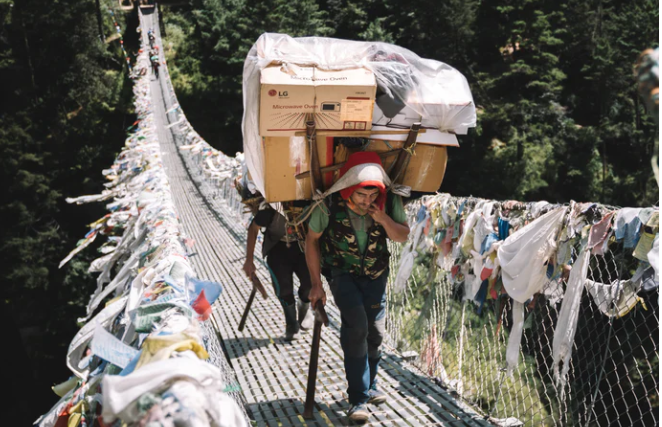
Writing Prompt. Choose one and Just Write.
I could never get rid of . . .
I could never like . . .
I could never go to . . .
I could never eat . . .
I could never get over feeling guilty about . . .
I could never forget . . .
Pick one or make up your own:
I could never . . .
This writing prompt is from “The Write Spot to Jumpstart Your Writing: Discoveries” along with 57 other writing prompts. Discoveries is on sale for $6.99 at Amazon for a limited time. ereader is $2.99 or free on Kindle Unlimited.