Author: mcullen

  • Guest Blogger Susan Hagen: What I want to tell you…

    Guest Blogger Susan Hagen wants to tell you something…

    After a long weekend together, I wrote this to honor the courage and heart of the students at my fall writing retreat. I offer it again here to all of you:

    What I want to tell you is that you are not like most people.

    Most people would not be awakened at dawn by the beating of a drum and feel happy about it. Most people would not hurry through their yogurt and bacon to climb a hill and sit all day on a threadbare couch. Most people would not spend four days putting words in a notebook or listening deeply to the words other people spent four days putting in a notebook – and pay for the privilege.

    They would not weep in front of strangers, or talk about their sex lives, or say truth be told, I’m glad my parents are dead. They would not slow down enough to imagine rivers running beneath their skin, or their outbreath a ribbon of air that gives lift to the raven, or their bones redwood trees, or their heartbeats the container for love.

    Who would say I dropped acid and galloped around the neighborhood as a horse spirit?  Who would say I asked the ocean to make love to me and she did? Who thinks about collagen as peach juice, or allows talkback from a spider, or cares about a certain tree only because it’s important to an owl? Who loves water so much it falls from her eyes when she speaks of it?

    Most people would not cry because they feel sorry for a character they’ve just made up. They would not care so much about a pretend Indian on a pretend horse that they cannot move them forward for fear of what might befall them.

    Who loves like that over what most would perceive as nothing? Who loves over nothing so much it hurts?

    Writers do. Writers love like that.

    So this is what I want to tell you. You are not like most people. No one speaks the ceremony of life the way you do. It’s the way you see things, the way you turn them over in your hand, that one silky line that comes with the afternoon rain: “A drop falls, and I am born.”

    I know you are no stranger to this. The stories are in your bones and your blood and your breath. This is who you are. It’s the gift you have been given and the gift you give away. You are not like most people. You are the living story coming through.

    Susan Hagen is an award-winning nonfiction writer, writing teacher, and co-author of Women at Ground Zero: Stories of Courage and Compassion. Her writing programs are inspired by the vision quest, an annual journey into the wilderness that informs her life and work. As a writing guide, Susan combines meditation and nature-based practices to help clear a path to the deeper writing life. She offers writing retreats for women twice a year, and Saturday writing circles at her cottage in Occidental. Upcoming dates are January 18, February 22, March 15, and April 26. Contact Susan at suzhagen@sonic.net or 707-874-9223
  • Your story is buried treasure.

    Writing is therapeutic. It saves lives. Your truths are eager to come out. Let them spill onto the page, and see what doors writing opens for you. Your story is buried treasure. — B. Lynn Goodwin:

    B. Lynn Goodwin is the owner of Writer Advice, and the author of You Want Me to Do WHAT? Journaling for Caregivers, available on Amazon. A former teacher, she conducts workshops and writes reviews for Story Circle Network, www.storycircle.org and InspireMeToday, www.inspiremetoday.com/. She’s working on a YA novel and brainstorming a memoir.

    Note from Marlene: Today’s post is dedicated to Don Riley. A brilliant man, loving husband, devoted father, and adoring grandfather . . . family man and wonderful friend to many.  His writing was deep, powerful, insightful and inspiring. His truth did indeed spill onto the page. He will be missed.

  • Focusing the camera. . . Prompt #37

    Write about an incident that happened between you and another person from your point of view. Write for about 20 minutes.

    Move the camera lens, focusing on the other person, write about this same incident from the other person’s point of view.

  • POV is like a photographer’s lens

    POV – choosing a point of view is one of the first things to decide when writing your story. In “Fiction in Focus,” January 2014 issue of Writer’s Digest magazine, Tanya Egan Gibson compares pov with how photographers frame their subjects.  She writes, “frame your story, focusing readers’ attention and leading them through the storytelling picture you’ve created, scene by scene.”

    Gibson writes that using pov as a lens allows you to you to go deep in describing your characters and their actions, making your manuscript stronger.  For example, “the way a character sees the world tells the reader a great deal about them. If your protagonist sees rainbows, puppies and waterfalls as gloomy, menacing and boring, your reader will come to the conclusion that the character is  depressed, without you having to come out and say so. This follows the old adage of showing, rather than telling.”

    You have probably heard what Gibson says about scene, “Every scene in your novel needs to be moving the story forward. Characterization and description can take you only so far before your reader will grow restless, it’s how your character’s observations and interactions cause her to act that will propel the reader through your scenes.”

    Here’s a part of the article I especially like, “. . . your character should be doing more than reacting. . . once your protagonist has stumbled onto the coven of vampires in her basement, we want to see her scanning the room and figuring out what to do next instead of just idly thinking about how sparkly their capes are.”

    Gibson’s article ends with, “Using pov as a lens through which to craft your scenes makes your resulting novel draft tight, coherent and engaging. . . . the sensory details in a scene function as far more than decoration. Your readers will be engaged because they will assume, correctly, that every component of your literary ‘photo’ has been included in the frame for a reason.”

    Tanya Egan Gibson is the author of How to Buy a Love of ReadingVisit Tanya’s interactive website, and discover how reading has inspired folks to write their “reading love stories.” You can send Tanya your response to the question, “How has reading saved you?”

    Your turn:  Write  a scene in first person point of view. Something simple like a picnic in the park.  Then step back, frame the picture with a wider lens. Write the same scene from a third person point of view.

  • What happened, from your point of view. . . Prompt #36

    Today’s writing prompt was inspired from the January 2003 issue of The Writer magazine, ”On Writing Personal Essays,” by Barbra Abercrombie.

    Make a list of issues and experiences, important and trivial in your life right now.

    What frustrated you in the past month?

    What made you laugh or cry?

    What made you lose your temper?

    What was the worst thing that happened?

    The best?

    The most disturbing and weird?

    Write:  Choose one thing from your list and write about it. Write whatever comes to mind. Write what you would really like to say to the other people involved.

    Write what happened from your point of view.

  • Hook ’em with the lead. . . — Erma Bombeck

    “Hook ’em with the lead. Hold ’em with laughter. Exit with a quip they won’t forget.”   — Erma Bombeck

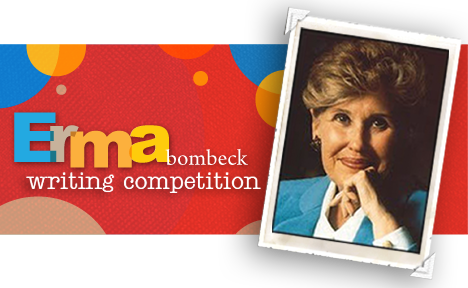
  • Erma Bombeck Writing Competition

    Erma Bombeck Writing Competition is now open!  
    Competition closes February 17, 2014 at 8 A.M. (EST)

     Capture the essence of Erma’s writings and you could win $500 and a free registration to the Erma Bombeck Writers Workshop!

    Personal essay must be 450 words or less.   Submission guidelines click here.

    erma_hdrlogo


  • Guest Blogger Amanda Socci: Getting Inspired by Food Boxes!

    Guest Blogger Amanda Socci: Getting Inspired by Food Boxes!

    If there is one thing that writers thirst for, it is inspiration. We have a constant need for things to speak to us, create magic for us, and fill our souls with ideas and information that will make us burst out of our skin and onto the paper. Inspiration is everywhere, but sometimes, writers tend to overlook the obvious, hoping to find deeper meanings in things.

    Today, I’d like to take this opportunity to lighten things up a bit by talking to you about an unlikely source of inspiration that appears to be boring or meaningless, but really, is just the opposite. That’s right, I’m here to tell you that food packaging is a friend to writers. All kinds of food packaging is interesting, but most specifically, I’d like to chat about cereal boxes.

    When you go grocery shopping, are you the functional, anal-retentive type who makes a list, sticks to it, and escapes the store quickly in order to run 35 other errands before the day runs out? If that sounds like you, you may wish to alter your strategy and get lazier, creative, and definitely more curious at the supermarket.

    Take a leisurely walk in the cereal box aisle. What are some of the things you might notice? Brand names? Varieties of cereals? Logos? Graphics? All those are good, but I need you to look further. Take the time to really read and pay attention to the writing that is on the cereal boxes. What kinds of things do you notice?

    Here are some of the things that should interest you:

    (1)  Seasonal flavors. Are you familiar with the styles of cereals and their turnover rate? Do you notice how different seasons bring about changes in the style and appearance of cereals or cereal boxes?

    (2)  Marketing promotions. This is a big one. Writers who are pop culture enthusiasts like me will particularly enjoy this one. Did you know that movies, television, and music offer tie-ins with cereals? Did you know you can collect boxtops and earn branded merchandise?

    (3)  Loyalty programs. Here is another big one that should be right up everyone’s alley. Are you familiar with the concept of loyalty programs? What are they? What are the benefits? Why should you participate?

    You may be asking yourself why you should care about cereal boxes so much if you don’t eat cereal. The real point is not to care about cereal or to have a desire to eat it, but rather, to look at cereal boxes with a different perspective. I encourage you to view cereal boxes, and really, all food packaging, as an easy source of inspiration.

    By taking the time to observe, look at the cereal boxes carefully, and read the boxes with a sincere interest and a natural curiosity, you’ll be doing more than turning into an expert-in-training. You’ll be investing in your career as a writer by giving yourself quick sources of inspiration that will get you motivated to write some really goof nonfiction pieces.

    What are you waiting for? Get ye to a supermarket today and start checking out those cereal boxes! One thing always leads to another and before you know it, you’ll have at least ten ideas for future blog posts, freelance articles, or other writing.

    Note from Marlene: Although Amanda’s post specifies cereal boxes as inspiration for writing, I couldn’t help add a photo from one of my favorite good groups:  Chocolate!  Now . . . go for it. . . get something from your pantry and do a 15 minute freewrite.

    Lindt2                              cereal2


    Amanda M. Socci is a freelance writer and blogger who affectionately describes herself as the Creative Idea Gal for her uncanny ability to come up with 1,000 ideas about any topic. Amanda eats, breathes, and lives all things creative. Easily inspired, Amanda also loves cooking, baking, crafting, photography, recycling, and line dancing when not busy caring for her two precious girls.

  • Fantasize for a moment. . . Prompt #35

    Fantasize for a moment. Money is no object. Time and place are no object. Give yourself an imaginary gift. What would it be?

  • WRITER ADVICE – 9th FLASH PROSE CONTEST

    B. Lynn Goodwin’s Writer Advice seeks flash fiction, memoir and creative non-fiction running 750 words or less. Enlighten, dazzle, and delight us. Finalists receive responses from all judges.

    DEADLINE:  April 18, 2014.