As we go through life, interacting with people, we learn ways of being in the world. We learn coping strategies.
Sometimes we find that what used to work, no longer works.
Writing Prompt
Write about you then and you now. “Then” is whenever you want it to be.
Write about how you used to react to people and certain situations.
Write about how you now react in the same situations.
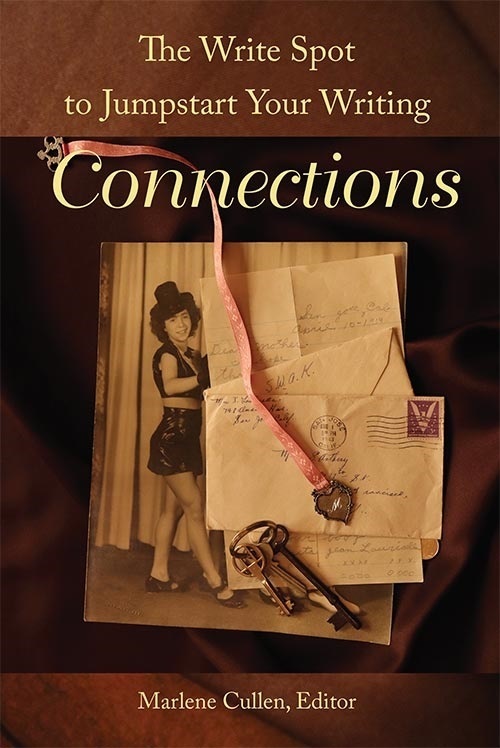
Cover of “The Write Spot to Jumpstart Your Writing: Connections” features Marlene’s mother ~1945 and letters from her to her mother.
Connectionsis a collection of writing from mothers and their adult children, using story-telling as a technique to ignite imagination and to inspire writing.
Connections is available from your local bookseller and as an ebook (and print) at Amazon.
What is the first thing you do when you cook a new recipe? Read the directions to determine if you have the necessary ingredients. What is the first thing you do when you assemble a piece of Ikea furniture? Read the directions. So why do so many writers seem unable to read and follow the directions when submitting to a journal or contest?
I’ve judged a lot of writing from independently published books to high school writing contests. I was an editor of the 2019 CWC Literary Review with responsibility submission intake as well as judging. What I’ve learned is how few supposedly literate people read and follow the submission directions. Maybe because they are called “guidelines” people consider them optional. Or perhaps the requirements seem overly picky or silly. Take fonts. Why use Courier as requested when your work will stand out from the crowd in Verdana? Well, one reason for a specified font is that all fonts are not equal. New Times Roman, for example, is proportional. Each letter takes up a different amount of space depending on its shape. Some fonts like Courier are nonproportional, meaning that each letter, like an “i” and an “m,” take up the same amount of space. Using the requested font helps the journal editor figure out how much space the work will take up on the page.
Names are another issue. Some contests request the name only in the body of the email, not on the submission itself. Apparently many writers either 1) don’t read the directions; 2) forget to remove their name from the piece; or 3) are afraid the submission editor is incapable of keeping straight which submission goes with which person, so to feel secure, they include their name.
Exceeding word lengths, block paragraphing rather than indenting (or vice versa as requested), using another person’s copyrighted song lyrics, subject matter inappropriate to the journal or contest, failing to observe the deadline or contest limitations such as age, or state/country of residence—all these will get your submission sent to the trash without being read, and as a judge evaluating a hundred or more submissions, less work is always welcome.
Read and follow submission guidelines Don’t sabotage your work.
Tish Davidson has published ten nonfiction books for children with Scholastic and Mason Crest and eight for adults published by Bloomsbury. Her creative nonfiction has appeared in collections published by Harlequin, Adams Media, and Scribe Press. She is a member of the Fremont branch of California Writers Club and was on the editorial team of the 2019 CWC Literary Review.
Use a pivotal event as a way into writing a personal essay, or a slice of your life . . . a memoir, or creative non-fiction.
A pivotal event is something happened and you weren’t the same after.
Obvious pivotal events are graduating from school, first job, getting married, having a baby, retiring.
There are more subtle events that, at the time, you didn’t know would be a pivotal event. Those are the events that could result in a riveting essay, or give you closure.
Prompt 1
Make a list of things, events, people that you carry in your mind. These are events that you can’t forget. People who haunt you. Memories that you can’t seem to let go.
These are things you think about over and over, events that are on repeat in your brain. Things that happened that you can’t stop thinking about, maybe things you lose sleep over.
Just a list.
Visualization
As you go through this visualization, if you experience anxiety or stress, tap on your sternum with the tips of your fingers. This is a calming and centering activity.
Stretch. Breathe in. Let go.
As you go through this visualization, when you get a feeling jot it down.
Note what the feeling is.
Note where you feel it in your body.
And note what caused this feeling.
If you can, put your hand on where the feeling is and breathe into that space. If you can’t put your hand there, put your thoughts there.
Go back in in time to when you were 3 or 4 years old.
See the people surrounding you. Perhaps your parents . . . siblings . . . grandparents.
Is there something about these people that stand out? Jot down thoughts or ideas that come to you while going through this visualization.
Make a note where there is energy, perhaps an exciting or an uncomfortable feeling.
Picture yourself at age 5 or 8. See your aunts . . . uncles . . . cousins. People you spent time with.
Go to age 9 . . . 10 . . . 11. Who did you play with? Go to school with?
Teenage years. What did you do? Who did you hang out with?
Let a montage of pictures roll by of dating and college years.
Remember to tap on your chest if you are feeling uneasy or uncomfortable.
Early married or living together years. See your children, or nieces/nephews as babies, little children.
Take a deep breath and release.
Prompt 2
Choose one thing from your list. Write what happened. Include as many details as you can.
Excerpt from Brad Yates, Guest Blogger on The Write Spot Blog:
Memorable writing that sparks imagination. Lean in. Hear the writer’s voice on the page.
My Pen Tonight
By Cheryl Moore
My pen seems to have run out of words.
Minutes tick by—tick, tick, tick
But no matter how hard I try
All starts dry up and say good-bye.
When Cheryl Moore came to California in the early 1960’s, she realized she’d found her home. Moving to Petaluma in the 70’s, she was as close to paradise as she’d ever get.
Travel has taken her to Europe and the Middle East. She has written on these memories as well as on the flora and fauna of the local river and her own garden.
Chery’s writing has been published in“The Write Spot to Jumpstart Your Writing: Discoveries,” available from your local bookseller. Print and ebook available through Amazon. Also available through the Sonoma County Library system.
Memorable writing that sparks imagination. Lean in. Hear the writer’s voice on the page.
Jumpstart in Meter
By Ken Delpit
I wonder if it makes good sense, to do Jumpstart in meter. I mean, what’s the point, masking oneself, like a blindfolded trick-or-treater? It all depends, I suppose, on the prompts that we are given. It could turn out to be mere folly, or crazier still, madness-driven.
Marlene always says, “Just write,” so just write is what we will do. We will contemplate the prompts, one at a time, and stir them into our stew. Time will tell us, as our words spill out, no need to pre-distress. We’ll know soon enough if we’ve got a yummy meal, or just some metered mess.
Prompt one says: What bothers me…, I don’t care…, I’m tired of dot-dot-dot. So, right away, we must gaze inward, and put ourselves on the spot-spot-spot. One thing that can be tiresome is overuse of ellipses. But truth be told, I’m as guilty as most, oft’ with the “and so on” tipsies…
Or, maybe I can find a rhyme in things I care not about. But then again, who wants to take in some testy writer’s careless blowout? Or perhaps, fluency may lie in what bothers me the most. Though, it surely would confuse, were I to make a bouncy meter morose.
Prompt two asks, innocently enough, what it is that’s nagging. It’s hard to answer, when there is so much, but might I be humble-bragging? Or, what I really want to do might spark a burst quite wordy. Though, honestly, I’m just plugging away, trying to get to ten-thirty.
Prompt three wants to know about those who might be my role models. It’s a marvelous idea to ponder, but a thorny prompt to coddle. For, were I to list those who’ve inspired, and cite them in report, I could not possibly do them justice, and I would come up stupid short.
So, what am I to make of this, this Jumpstart done in meter? Well, if I’m real, I’m surely no Ogden Nash, but more like Walmart greeter.
Ken Delpit is, in chronological order, a son, a brother, an Argonaut, a Bruin, a software engineer, a husband, a father, a technical writer, and, Ta-Da!, a grandpa (aka “Poppy”). But hold the phone: Now that he is retired and freed from the odious burden of doing real work and being responsible, he has embarked into the wide-open adventures of creative writing. Ken welcomes the freedom and spontaneity of Jumpstart workshops, the inspirations that they inevitability evoke in participating writers, and the warm camaraderie of all.
Guest Blogger Mary Kole writes about the creative journey:
As much as I wish this wasn’t the case, the creative life is full of ebbs and flows, highs and lows, and any other image you want to ascribe to the push and pull of the artistic temperament. Whether you admit or not, you are a writer, a creative, and an artist, whatever that means to you.
If you find yourself grappling with writer’s block or struggling to reignite your passion for writing, fear not. This is perfectly normal, and every writer faces these challenges at some point in their creative journey. And it is a journey. Some writers are only interested in publication, and I can absolutely see where they’re coming from. But they will be in for a long and disappointing ride if they can’t derive pleasure, satisfaction, and fulfillment from the act of writing and the artistic state of being that writers sometimes occupy.
But what if “the act of writing” and the “artistic state of being that writers sometimes occupy” isn’t happening for you right now? What if this is one of those ebbs? Those lows? In this article, I’ll suggest some ways to keep your creative spirit alive and thriving, even during dry spells. By reading, embracing some creativity development frameworks, freeing up a sense of play and inspiration, observing life through a writer’s lens, writing anything, and switching projects when needed, you can weather the ups and downs of the writing life with resilience and determination.
Here are some suggestions, offered in no particular order:
ReadLike a Writer: When you aren’t writing, you could be reading. There’s nothing quite like reading like a writer, and seeing what your potential future peers are doing when they’re at the top of their game. Read inside your genre, category, and target audience, and also outside of it. Take note of techniques you find interesting, writing styles that appeal to you, and also those things you wouldn’t necessarily do. Sometimes negative inspiration—“I’d never do it like this!”—can be powerful, too. You can also read nonfiction about writing-related topics like creativity, habit formation, sociology, and psychology. These nonfiction fields have all taken off in the last few decades, with a lot of complicated concepts broken down to appeal to lay readers. Writers tend to collect information and seek to understand the human experience. Reading is a powerful way of doing so, even when you’re not currently creating.
Revisit The Artist’s Way by Julia Cameron: The Artist’s Way is a renowned book that serves as a guide to unlocking creativity and overcoming artistic blocks. Through practices such as morning pages and artist dates, Cameron encourages writers to nurture their inner artist and establish a consistent creative routine. By incorporating these exercises into your daily life, you can cultivate a supportive environment for your creativity to flourish. The book acts like a guide and offers structure. If you haven’t read it before, it’s worth your while. If you haven’t read it in a while, you might find that you love slipping back into this warm and encouraging resource.
Embrace Play and Inspiration: If you get into The Artist’s Way, you will be reminded that the state of being a writer isn’t just one you access while writing. You can take time to nurture yourself and seek inspiration off the page. Take yourself out on solo excursions to explore new environments, art galleries, museums, or nature spots—this is the “artist date” suggestion, described above. Engaging in activities that inspire and rejuvenate your spirit can spark fresh ideas and perspectives. If you invest in yourself, and make valuable time for self-reflection, you might find that this will allow you to connect with your inner muse. Seeking inspiration also divorces creativity from its product—you might not actively create anything when you take time to seek inspiration, but you also never know how your experiences will pay off. Creativity is like a well that needs constant replenishment. Seek out ideas and experiences that resonate with you—whether it’s listening to music, watching films, or engaging in hobbies and meeting new people. Surround yourself with beauty and ideas that stimulate your imagination.
Observe Life as Writers Do: Writers are keen observers of the world around them. Pay attention to details, emotions, conversations, and experiences that unfold in your daily life. You could notice a snippet of dialogue, or be captivated by an interesting person at the grocery store. No wonder we call these individuals “characters,” they might be fodder for a piece of writing. By honing your observational skills, you can draw inspiration from seemingly mundane moments and infuse authenticity into your creative self-expression. After all, readers want to relate, and they want to recognize ideas and details from their own lives in the stories they consume. You need to live with your eyes and ears open to stock up on these potentially resonant nuggets.
Write Anything: Even if you’re not writing the book of your heart at the moment, you can still keep up with writing anything to keep your engine block warm. Freewriting, poetry, journal entries, a “letter to the editor” that you don’t plan to send, a long caption for an Instagram post—all of these are valid outlets of written self-expression. Keep your creativity churning by writing, no matter what. It’s fine to skip days or weeks or even months, but if you’re doing the things on this list, you will feel like you’re making progress, even if you take your eyes off of your magnum opus for a bit.
Switch Projects or Take a Break: Dovetailing with the above, if you’re feeling stuck on a particular project, don’t be afraid to set it aside temporarily or switch gears and work on something else. Sometimes shifting focus can reignite your passion for writing and bring fresh energy to your creative process. Remember that taking breaks or focusing on something else for a while is essential for recharging your creativity and preventing burnout, so don’t feel bad if you’re called to work on a different idea. (There’s obviously a balance to be struck between persevering with a project when the going gets tough and avoiding “shiny object syndrome,” which see you following a bunch of distractions.) The more you write and create, the better you’ll know yourself and can understand your behaviors and motives.
As an aspiring writer navigating the highs and lows of the creative journey, you will want to prioritize self-care and balance, especially when things get tough. By implementing strategies like the above, you can nurture your creative spirit, no matter what else is going on in your life and work. Remember that creativity thrives when you’re able to offer yourself grace, resilience, and patience. If you can claim your identity as an artist, that’s one big step toward figuring out how to nurture yourself and take your dreams and passions seriously.
Mary Kole As a former literary agent, I know all about the ins and outs of the publishing industry. But my favorite part has always been working directly with writers, so I founded Mary Kole Editorial in 2013 to provide consulting and developmental editing services to clients of all categories and genre
Then I founded Good Story Company in 2019 with the aim of creating valuable content—like the Good Story Podcast, YouTube channel, and Good Story Learning classes and resources. My Story Mastermind small group workshop intensives helps writers level up their craft, and I offer done-for-you writing and ghostwriting at Manuscript Studio and marketing services with Good Story Marketing. I also develop unique and commercial intellectual property for middle grade, young adult, and adult readers with Upswell Media and Bittersweet Books (website forthcoming).
I hold an MFA in Creative Writing and have worked at Chronicle Books, the Andrea Brown Literary Agency, and Movable Type Management. My blog, Kidlit.com has been going since 2009, and my book, Writing Irresistible Kidlit, a writing reference guide for middle grade and young adult writers, is available from Writer’s Digest Books/Penguin Random House.