Blog
-
“At the Ice Rink” by Alison Luterman . . . Prompt #349

Today’s writing prompt is a poem by Alison Luterman. When the prompt is a poem, you can write on the theme or the mood of the poem. Or use a stanza, a line, or a word to inspire your writing. Just Write!
At the Ice Rink
I came here to fail
and to fall
but not so well
as that man careening over the ice
sliding into the wall
as if into second base
shambling up, grinning, like a great bear,
and taking off again,saying, over his shoulder,
“You’ve got it backwards.
Learn to fall first,
then skate.”I end up clinging
barnacle-like to the sides,
inching around the perimeter like a caterpillar.
Wall-hugger. Nothing has changed since I was eight
and my parents paid for skating lessons
in hopes I would become more balanced.Now as then I am wobbling, terrified,
feet frozen like blocks of wood at the ankles.
Not loose-limbed and easy like Hilary
who rides the ice like a North wind scouring the plains,
nor deft and graceful like Ruth
picking up her feet and kick-gliding
in time to the ’70’s pop muzak.But what can we do
when fear throws its rustiest pickaxe
dead ahead in our path?Mince. Inch. Stumble. Pray
for the grace to fall
and not be rescued, pray for the scramble-upfor the liberating laughter that knowsit is not in our control.
There is the center, gleaming like a fish-eye.
Little girls spin on it, twirling their bright skirts.
It shines under its white scars like a destiny.—Alison Luterman As a child, I used to creep onto the stairs when my parents had guests over and eavesdrop on the grown-ups. A creak of the stairs would invariably give away my position and I’d be chased back to bed, only to reappear at the next opportunity, hiding and listening. I wanted to be where the interesting conversations were happening. I still want that. Only now the conversations happen all over the country, all over the world, with friends, friends of friends, and complete strangers. Our stories rub up against each other and expand and change in ways I could never have imagined when I was young, and they now include rocks, weeds, fruit trees, cats, stars, and myths from all over the world, as well as all kinds of people.
-
Alison Luterman and Patience
Guest Blogger Alison Luterman writes: 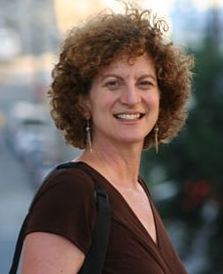 January 2018
Happy New Year! A few weeks ago I read something on-line about the concept of a “word for the year” and being a sucker for all things woo, decided to try it. Someone had used the word “Delight” and her career exploded into a lovely confetti burst of rainbows and candy canes.
Sounds good, I thought. I’ll take “Delight” too. But wait! It turns out that you can’t just choose a word willy-nilly. It’s more like the word chooses you. The next day as I sat scribbling morning pages it came to me in a sickening flash of insight: my word is Patience; unsexy, old-fashioned Patience. Not the ever-popular Abundance or Adventure or Sex Goddess, (even those are all very good words and you’re welcome to them). But as soon as I saw my pen writing “Patience,” I knew: It’s what I need most.
Like most writers I tend to live in my head where conception occurs simultaneously with the fantasy of fulfillment. Meaning, I can get a Big Idea for a new play or musical or book of poems and at the same time imagine the finished product, and the opening night party. Even knowing that somewhere between the germ of an idea and whenever a production actually sees the light of day lies an ocean of work, much dumb luck, and the budgeting of time and work and money to live on while doing the work—and I know all this—still, each time I get swept off my feet by the next entrancing vision.
So the only way to move forward is step by step. Much as I would have liked to instantaneously undo the last election, and much as I’d like to wave a magic wand and have all my creative babies realized and successful, the reality remains a lot of work, some of it tedious, much of it invisible. Hence, Patience.
And then there’s teaching, which is my spiritual path, but like all spiritual paths, in addition to being rewarding and fulfilling, also lights up my growing edges, as we charitably call them in California, with painful clarity.
Here’s what I learned in teaching and coaching this past year: I’m great at seeing what’s missing, which is sometimes a useful superpower. With one client, I read her wonderful memoir-in-progress and said, “I love all these vivid tales from your youth, but I’m not getting the turning-point. When and how did you turn your life around?”
“Oh, I wasn’t sure if I should include that,” she said, before telling me the story of an important relationship whose demise signaled her awakening. We both saw immediately that this was where the plot pivoted and she went away inspired, knowing what to write next. This client and I work well together; she’s a lot like me, driven and fierce in her process.
But there are other students whose growth depends on gentle spacious encouragement. What would it be like to practice radical patience, not only in politics and writing, but also with beginning students, and in my personal life, with my husband and friends and family, and most of all with myself?
I think it’s an Indonesian proverb that says, “Go slowly, we’re in a hurry.” Patience doesn’t always come easily to me. But seeing as how the world is at stake I’m willing to take it on.
Alison Luterman is a poet, essayist and playwright. Her books include the poetry collections Desire Zoo (Tia Chucha Press), The Largest Possible Life (Cleveland State University Press) and See How We Almost Fly (Pearl Editions) and a collection of essays, Feral City (SheBooks). Luterman’s plays include Saying Kaddish With My Sister, Hot Water, Glitter and Spew, Oasis, and The Recruiter and the musical, The Chain.
Her writings have been published in The Sun, The New York Times, The Boston Phoenix, Rattle, The Brooklyn Review, Oberon, Tattoo Highway, Ping Pong, Kalliope, Poetry East, Poet Lore, Poetry 180, Slipstream, and other journals and anthologies.
Alison has taught at The Writing Salon in Berkeley, the Esalen Institute, and the Omega Institute, as well as at high schools, juvenile halls, and poetry festivals.
-
What’s the latest? Prompt #348
Things are settling down at Cullen Corner after the Holidaze. I hope everything is going well for you.
It’s been quiet here on The Write Spot Blog on account of the holidays: Decorating, undecorating, traveling to be with family, having family here, watching Hallmark holiday movies, watching Doc Martin and The Amazing Mrs. Maisel ( highly recommend), the usual December-January busyness.
Since I last posted, I changed the title on the recently published The Write Spot: Discoveries to better reflect the contents.
New title, same contents: The Write Spot to Jumpstart Your Writing: Discoveries.
Now, I’m working on the next anthology. I hope you are active with a project that you enjoy.
Today’s prompt: What’s the latest?
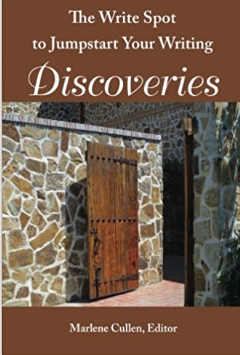 I’m loving all the wonderful reviews of Discoveries. Here’s the latest review of Discoveries.
Review by Diana McCurdy in The Sonoma County Gazette, founded by Vesta Copestakes.
Book Review: The Write Spot to Jumpstart Your Writing: Discoveries
Book groups proliferate so why not writing groups? That old beatnik, pre-hippie poet, Kenneth Rexroth said, “Against the ruin of the world, there is only one defense: the creative act.” And with so much unease in our society, with threats of war, polarization of political ideologies, hurricanes and fires why not diffuse some of that negativity by creating? Let us write stories, and poems, and essays, perhaps to stave off some ruin and stay semi-sane at least.
Marlene Cullen is the creator of Jumpstart Writing Workshop. In a comfortable, non-threatening atmosphere, participants write and write and write. Their products turned out be so compelling that she wanted to share them with all of us. She has assembled a charming anthology entitled Discoveries. Discoveries is a compendium of all different kinds of creative acts and for each selection the creative process is described in detail.
Writers are given a “prompt.” At the end of each piece we are told exactly what the inspiration was. For example, one writer recounts a comic interlude with a recalcitrant Weber BBQ. The impetus for this was, “write about a leap you have taken.” At the end of each author’s section there is a mini-biography and some words of encouragement that describes their process.
Part of the delight elicited by this collection is the disparate range of topics. This little book includes something for everyone’s preferences. Subjects include old-fashioned laundry rituals, the great hot lunch, cold lunch school dilemma, hormones, romance, gloves and soap.
The ending segment reads like a lesson plan to start a writing group of one’s own. There are hints on what to do if your creative juices are stuck, a list of prompts and a generous bibliography. Entries are short and in our busy, very busy lives it is easy to pick up the book and read a few inclusive selections and then put it down for another day to discover a different author’s work. Available on Amazon.com,
Diane McCurdy was born in Santa Rosa. Her dad had ranches so she learned the value of hard work at an early age. She has a BA from SF State and an MA from SSU in English Literature and several teaching credentials, two grown children and three cats. She’s been all over Europe, Mexico, Hawaii and visited schools in Japan and China and stayed with relatives in Brazil. Diane has a lifelong interest in film. Her mother met her father when she was selling tickets at the box office of her father’s theater, the first motion picture house in Sonoma County.
-
Corral your best time of day for maximum creativity
 Rebecca Lawton posted “Ring-fence” on her blog in August 2013. If you are struggling with your writing, or finding a routine that works for you, this might help.
Ring-fence
What is this malaise? This lack of focus and ennui combined with a skimming restlessness? My mind won’t settle on anything for more than an instant. The piles of paper around me are growing, escaping my recycle bin. I can’t seem to force myself to get to work on them or anything else. Those short stories I was revising religiously every morning? Not today.
Today my mind is a cloud pushed by the wind.
It could have been a regular workday with a schedule I knew from experience to be effective. Usually I rise between 5:30 and 6:30 AM, head for the meditation chair, sit for 20 minutes, then concoct morning chai for the household. Next I’m off to my writing desk. I work for two hours on my latest manuscript (these days, it’s that collection of short stories), after which I stop for breakfast. Later I’m on to returning phone calls, making progress on consulting work, emailing friends and clients, or blogging. Somewhere in the day will be a swim, walk, or bike ride. Then I’ll go back to writing, especially if I’m on deadline.
Today I broke that pattern. I thought taking a shortcut past the meditation and morning writing and getting directly to business and accounts meant I was being responsible. I could return to the short stories in the evening, I told myself. I’d be efficient and effective, putting important, earning work first.
How wrong I was. Without that morning ritual, as well as the critical, concentrated creative time, I was like a ship with no compass. The usual landmarks I look to for guidance weren’t there. Not only did I not accomplish my non-writing tasks more efficiently or quickly, I found them curiously evading my prized problem-solving ability. In short I didn’t get anything done before breakfast and very little after.
I had missed my most creative time, when my circadian rhythms allow me to sink most deeply into the world of make-believe. By not stopping in at the usual checkpoints, I scuttled the well-honed craft of my general working life.
Mark McGinnis, poet and business coach, puts it this way: “Ring-fence your most creative time.” He advises that we pick our rich, creative time of day and separate it from the rest for our lives.
Apart from the lack of external interruptions, I write first thing in the morning because (once I’m up) that’s the time of day when I’m most focused and alert. I experience a greater mental clarity in the first couple of hours of the working day than any other time. As a writer, that quality of attention is my most valuable asset, so I’ve learned to guard it carefully. If I start plowing into emails, reading blog feeds, or doing mundane tasks such as accounts, then I’m squandering my most precious resource.
Mark admits that, for him, finding extra hours in the morning means rising earlier than he would if writing weren’t his heart’s desire. It’s the same for me. Without those morning hours I carve out (which might be afternoon hours for you, or after dinner, whatever you can “ring-fence”) I wouldn’t have a writing practice, which is the core of my work. I wouldn’t feel authentic passing myself off as a writing instructor or as speaker at a community writer’s night. I wouldn’t rest easy selling copies of my novel or proposing a new book to my agent or filling in a grant application to support a new project. The creative practice makes up the core of my writing identity. From that ring-fenced time also comes, apparently, my ability to do other work.
It’s true there are other aspects to my life and me, but for that part wearing the author hat, the ring-fence is as mighty as the pen. Mightier.
Rebecca Lawton’s books and articles are available through her website, www.beccalawton.com
Note from Marlene: Reading Water is one of my all-time favorite books for writing prompts. I highly recommend it.
-
Five on the Fifth

~ Online literary magazine
~ Publishes five short stories on the fifth of each month:
Horror
Fantasy/Science Fiction
General Fiction
Non-fiction
Flash Fiction
-
Literary Juice
Sara Rajan founded Literary Juice as an outlet for authors to share their most honest works without having to conform to conventional narrative guidelines.
LJ encourages writers to break all ties with convention and free their inner weird-sad-happy-freaky-romantic selves!
“We accept all genres of prose, poetry, and, more recently, art. Lately, we’ve done away with all artistic boundaries. There are no rules here. We have no direction. Sometimes we don’t even know where we’re going. We go up. Down. Sideways. All over the place. Welcome to the Mad Hatter’s literary circle.”
-
Strongly affected. . . Prompt #347
 Today’s writing prompt is a visualization . . . then the prompt. Set yourself up for an uninterrupted twenty minutes. Get comfortable. Have your writing implements nearby . . . paper and pen or computer.
Settle into your chair. Feet flat on floor. Hands relaxed.
Rotate shoulders in a circle. Reverse direction.
Stretch arms out in front. Arms overhead. Arms to the side.
Take a deep breath in. Hold. Let go.
Feel your feet connected to the floor. And that connection goes down into the earth, way down, deep down, to the center of the earth.
Firmly planted, deeply rooted.
Feel the connection up your legs, through your calves, into your knees.
Feeling connected up into your thighs.
Completely relax into your chair, letting go of all tension that might be in your legs and thighs.
Just let go.
Deep breath in. Deep breath out.
Let your hands go limp. Feel the relaxation travel up your arms and into your shoulders.
Take a nice deep breath in and bring your shoulders up to your ears. And then let them down with a loud hrumph sound. Another deep breath in, shoulders up and down with the outward breath.
Relax deeper into your chair. Let your stomach muscles relax. Let your shoulder relax.
Feeling completely supported in your chair, feel the connection to the earth. Feeling connected to the center . . . the core of the earth. Your connection goes deep.
Relax your neck muscles. Loosen your jaw. Just hang loose.
Let your head drop forward on your chest. Just rest there a moment.
Rotate your head in a circle. Opposite direction.
Deep breath in. And deep breath out.
We’re going to do a bit of exploration now . . . scanning memories.
Sitting comfortably in your chair, scan your relatives for the person who affected you the least.
Next, a relative who affected you the most.
Now, a friend who strongly affected you.
What are some of the emotions that came up for you?
Go a level deeper.
Which friend or relative affected you in a way that surprised you?
Prompt: Write about that time.
-
Family Motto . . . Prompt #346
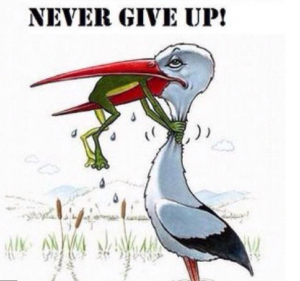 If you had a family motto, what would it be?
 -
Flyway Magazine
Flyway: Journal of Writing & Environment is an online journal publishing poetry, fiction, nonfiction, and visual art that explores the many complicated facets of the word environment – whether rural, urban, or suburban; whether built or wild – and all its social and political implications.
Submission Period: October 1 to May 1. Visual art: year-round.
In addition to publishing issues on a rolling schedule, Flyway sponsors a yearly Sweet Corn Prize in Poetry and Fiction and a Notes from the Field Nonfiction Award.
“We are interested in work that explores the intersection of human experience and the environment, broadly interpreted: work that focuses on ecology, science and the environmental imagination, certainly, but also work that focuses on place, on natural and built environments, and on the ways that people interact with their environments. We are looking for work that surprises, moves, haunts, or affects the reader in some significant way.”
Authors of all walks of life should feel encouraged to send us stories, poems, essays, and art celebrating the diverse characters and settings all around us.