What makes you feel all is right with the world?
Play around with different ways to describe characters in stories.
Here are examples of how to make characters real and likable and how to capture readers’ interest.
 What We Keep by Elizabeth Berg
“My mother was dressed in her beautiful yellow summer robe, the tie cinched evenly into a bow at the exact center of her waist, but her auburn hair was sticking up in the back, an occasional occurrence that I always hated seeing, since in my mind it suggested a kind of incompetence. It was an unruly cowlick, nearly impossible to tame — I knew this, having an identical cowlick of my own — but I did not forgive its presence on my mother. It did not go with the rest of her looks: her deep blue eyes, her thin, sculptured nose, her high cheekbones, her white, white skin — all signs, I was certain, of some distant link to royalty.”
 Splinters of Light by Rachael Herron
“When my daughter kissed me at midnight that year, I missed my old life a tiny bit less than I had the previous New Year’s. Paul was becoming more and more adept at dodging phone calls from his first daughter as he busied himself with his new family, but his leaving us meant I got this little girl all to myself. A girl with his blonde eyebrows and my concern for wrongs to be righted. A little girl who liked to suck the rinds of our homegrown lemons (making faces all the while) as much as she liked to lick the honey spoon I handed her in the kitchen.”
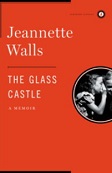 Glass Castle by Jeannette Walls
“I was sitting in a taxi, wondering if I had overdressed for the evening, when I looked out the window and saw Mom rooting through a dumpster. It was just after dark . . . I was stuck in traffic two blocks from the party where I was heading.
Mom stood fifteen feet away. She had tied rags around her shoulders to keep out the spring chill and was picking through the trash while her dog, a black-and-white terrier mix, played at her feet. Mom’s gestures were all familiar—the way she tilted her head and thrust out her lower lip when studying items of potential value that she’d hoisted out of the Dumpster, the way her eyes widened with childish glee when she found something she liked. Her long hair was streaked with gray, tangled and matted, and her eyes had sunk deep into their sockets, but still she reminded me of the mom she’d been when I was a kid, swan-diving off cliffs and painting in the desert and reading Shakespeare aloud. Her cheekbones were still high and strong, but the skin was parched, and ruddy from all those winters and summers exposed to the elements. To the people walking by, she probably looked like any of the thousands of homeless people in New York City.”
Note from Marlene: It occurs to me that this might be what it’s like for an actor to get into character: inhabit another personna. . . make that character alive.
Your Turn . . . think of a real person. . . write about his or her mannerisms, quirks, habits, weave in physical description. Bring this person to life on the page. Just Write!
About: Zoetrope: All-Story is a staff of two, assisted by a small team of brilliant and generous volunteers, who are collectively dedicated to reading and responding to the 12,000 submissions All-Story receives annually. To aid in this commitment, writers should submit only one story at a time and no more than two stories a year.
 Submit: Before submitting, non-subscribers should read several issues of the magazine to determine if their works fit with All-Story. Electronic versions of the magazine are available to read, in part, at the website; and print versions are available for purchase by single-issue order and subscription. http://www.all-story.com/
Zoetrope: All-Story considers unsolicited submissions of short stories and one-act plays no longer than 7,000 words. Simultaneous submissions are accepted. First serial rights and a one-year film option are required.
All-Story does not accept submissions via e-mail. Mail manuscripts to:
Zoetrope: All-Story
Attn: Fiction Editor
916 Kearny St.
San Francisco, CA 94133
Zoetrope: All-Story invites writers to take advantage of the Virtual Studio, a free online writers’ workshop sponsored by All-Story and its publisher, Francis Coppola. Writers are encouraged to support the small and independent publications to which they submit; magazines such as All-Story depend on subscriptions to survive, ensuring forums for publication of new and emerging writers.
Start your engines now: The Zoetrope: All-Story 2015 Short Fiction Contest opens July 1, 2015; for details, please visit the website this summer.
Guest Blogger Frances Lefkowitz writes:
The life of a freelance writer is full of the uncertain (“where will my next assignment come from?”) and the mundane (“did I spell that source’s name right?”), coupled with high deadline pressure and middling compensation. But every once in a while, I get to track down fascinating regular people and ask them to tell me stories. That’s what I did for a recent article for Good Housekeeping on the power of storytelling. The assignment was to write about the new evidence that storytelling has benefits for the health and wellness of individuals, families, and communities, and I had to read my fair share of academic research journals and talk to my fair share of M.D.s and Ph.Ds. But I also got to sit back, relax, and listen to tall tales.
The best, most enduring stories, it turns out, are those that contain both hardship and humor. Like the one Evelyn Karozos, who comes from a large Greek family in the Midwest, told me about how the whole family used to eat dinner in the parents’ bedroom on sticky summer nights—because that was the only room with an air conditioner. Or the one a southern grandmother—and who can beat Southerners for storytelling—told me the one about her great grandpa, who once wooed a wealthy widow by wrapping the few dollar bills he had around a wad of newspaper, then casually letting it drop from his pocket, leaving the impression that he was rolling in money.
And then there was the one from Emily Pickle, a young mother from Florida, who recounted a bittersweet story about the time her grandmother was going through a health crisis in which she suffered temporary dementia-like symptoms. “This was the year the Gators won the championship, and the quarterback was Danny Wuerffel,” she told me, adding, “Football is a very big deal where we come from.” When her mother and uncle went to visit Grannie in the hospital, they found her repeating, “Danny Wuerffel, Danny Wuerffel” over and over, as if she were reciting a prayer. When Pickle’s Uncle Jay shared the anecdote with the rest of the family, he mimicked Grannie’s reverence, rocking back and forth, repeating the beloved QB’s name, eliciting laughter and tears in his audience. “It was awful, but it was funny, too, the way he told us,” she pointed out. And beneath the laughter and the tears, Uncle Jay was sending an important message to the rest of the family, that “Grannie’s going to recover from this; she’s going to laugh, we’re going to laugh, and this will be one more family story — not a family tragedy.” And he was right.
Psychologists call these “redemptive stories,” because they “redeem” a negative experience, finding some silver lining in a bad event. The point is NOT to be a pollyanna and sugarcoat the fear, danger, or difficulty. The point is to acknowledge the negativity, and also find some kind of lesson or benefit in it—even if that benefit is simply that the family came together to overcome a challenge. When people hear these stories, they get a laugh, a release of tension, a sense of belonging, and a signal that together, we can find ways to carry on.
I tell you all this because, as writers, we deal in stories. We distill them and write them down and spruce them up and pass them on. And by doing so, we are not only making a livelihood; we are contributing to the health and well being of the people who read us.
Click here to read the Good Housekeeping article.
 Frances Lefkowitz is the former Senior Editor of Body+Soul (aka Martha Stewart’s Whole Living) and Book Reviewer for Good Housekeeping, as well as the author of the memoir To Have Not. She writes and edits fiction and nonfiction, and teaches for The Sun magazine’s writing workshops, the Omega Institute’s Memoir Festival (with Cheryl Strayed), Catamaran Literary Review’s August 2015 retreat, and other events.
Frances blogs about writing, publishing and footwear at PaperInMyShoe.com
Photo by Giacco Yanez
Frances will join other editors at Writers Forum on May 21. 2015 in Petaluma . . . meet editors, chat with editors, find an editor to help polish your manuscript.
The Lorian Hemingway Short Story Competition invites writers of short fiction to enter the 2015 contest.
“The competition has a thirty-five year history of literary excellence, and its organizers are dedicated to enthusiastically supporting the efforts and talent of emerging writers of short fiction whose voices have yet to be heard.”
Prizes and Publication:
The first-place winner will receive $1,500 and publication of his or her winning story in Cutthroat: A Journal of the Arts. The second – and third-place winners will receive $500 each. Honorable mentions will also be awarded to entrants whose work demonstrates promise.
Eligibility requirements:
Submission requirements:
Deadlines and Entry Fees:
The entry fee is $15 for each story postmarked by May 1, 2015 and $20 for each story postmarked by May 15, 2015.  Photo by Breana Marie
 Write whatever comes up for you!
Save in a word document. Post on The Write Spot Blog. Let’s see what you come up with for this prompt. Just Write!
Submission Deadline for the 2015 Redwood Anthology: March 1, 2015
Theme: Journeys
Eligibility: Members of the Redwood Writers Branch of the California Writers Club. You can join Redwood Writers Branch, no matter where you live. Click here for membership information.
 This year marks the 10th anniversary of Redwood Writers anthologies. The theme is Journeys. There are many types of journeys: travel adventures, life passages, heroes’ journeys, pilgrimages, odysseys, and flights of fancy. All journeys begin in one place and end in another, having elements of challenge, change, and transformation.
Note: Submissions are required to reflect the theme, which may be interpreted broadly.
If your piece is selected, you will be assigned an editor to work with you through the publication revision/editing process.
Submission Method
We will not be accepting submissions by email. Instead, we will utilize a new, easy-to-use online submission form.
If you have any questions about the theme, submission guidelines, or submission method, please contact Amber Lea Starfire at amber – at – writingthroughlife.com.