Blog

  • What killed it for me. — Becca Puglisi

    Guest Blogger Becca Puglisi, co-founder of Writers Helping Writers,  talks about clichéd characters.

    It’s hard to come up with characters who are believable yet don’t sound like every other character out there. It’s especially easy to fall into this trap with certain archetypes, like witty sidekicks or wise old mentors. Unfortunately, a recent book that I started had a whole cast of clichés: the jaded, super-sarcastic teen girl hero; the loving but confused single parent; a villain in the form of a Queen Bee Mean Girl. As for the love interest and sidekick…I didn’t stick around long enough to meet them.

    But even one clichéd character may be too much; you don’t want to give readers a reason to lose interest or roll their eyes when they’re introduced to a character they’ve seen a dozen times. Character creation is one of our passions at Writers Helping Writers, thanks to the research and practice we put in while writing our negative trait and positive trait thesaurus books. Here are some tips we’ve learned on how to write believable and interesting characters without repeating the stereotypes:

    Explore the character’s backstory to discover her wounds. It’s easy to throw together a bunch of attributes and flaws when creating characters. But traits develop organically out of a combination of factors: upbringing, environment, basic needs, morals, past wounds, personal values, etc. It is this unique combination of elements that results in a truly unique character. To avoid recreating a character who already exists, delve deeply into her backstory. Doing so will give you the information you need to figure out exactly who she is today.

    Once you’ve explored the character’s backstory, use that information to choose a combination of flaws and attributes that make sense, but are unique. For example, it makes sense for a character who was once the victim of a home invasion to be over-protective and paranoid. For me, the mention of those flaws instantly brings to mind an image—a stereotype that I’ve seen a million times. Paranoia is a logical result of this kind of traumatizing experience, but what if you combined it with other flaws or attributes to turn the stereotype on its ear? Maybe your character was raised in a very proper household where any kind of emotional extreme was taboo. So now you’ve got a genteel, mannerly character who’s scared of her own shadow—but has to hide her fears out of a desire to maintain the right image.

    Creating unique characters is really just a matter of digging into their history and coming up with traits that make sense for them. For help in this area, we created a number of related resources on our Tools for Writers page, including the Reverse Backstory Tool, the Attribute Target Tool, and the Character Pyramid Tool.

    Explore the positive side of negative traits, and vice versa. Clichéd characters are seen as clichés because they’re easy to read. They’re cardboard. One-dimensional. Which is ironic because character traits are anything but.

    Look at John Bender, from the movie The Breakfast Club. He’s hostile, and embodies many of the expected negative associations that go with that trait: he’s volatile, verbally abusive, and has trouble connecting with others. But hostility also has some positive aspects that John exhibits. He’s fearless and uninhibited, often saying what other people are too timid to say themselves. The positive sides of this flaw make him more than just an angry character. They make him interesting and somewhat endearing because people value fearlessness and admire those who speak their minds. We want to evoke those endearing feelings in our readers, so make sure to explore both sides of your character’s defining traits and you’re sure to come up with someone unique and compelling.

    Don’t forget the quirks and idiosyncrasies. Certain character types—like adventure heroes and detectives—easily fall into stereotypes. If you want your hero to be different, give him something interesting that will make him stand out from the crowd. Indiana Jones? Afraid of snakes. Captain Jack Sparrow is a cowardly pirate. And for those of you who remember Kojak, what comes to mind when you hear that name? Bald guys and lollipops, right? Mission accomplished.

    A word of caution regarding quirks, though: if they’re thrown in off-handedly, they can feel clumsy and contrived. Find something that makes sense for your character based on his backstory and personality and you’ll have something that is believable rather than gimmicky.

    Add an inner goal. Another reason detectives and adventurers tend to resemble each other is because they all have the same goal: to find the treasure or solve the case. But what if your character also has an internal goal—something he needs to overcome or wants to achieve that will result in personal growth?

    In The Bone Collector, Lincoln Rhyme is an ex-forensics specialist on the trail of a serial killer in New York City. This is his outer goal: to find the killer. Just like any other detective story, eh? Except that Lincoln Rhyme is a paraplegic. That’s enough to make him interesting, but there’s more: it’s made clear from the beginning of the story that the thing Rhyme wants more than anything is to die. He’s made plans for his “final transition” and is seemingly at peace with it because he thinks this will make him more happy and fulfilled.

    By adding an internal goal, Deaver adds a dimension to his main character that makes him different from other detectives. Keep this in mind for your own heroes. For more information about internal goals and motivations, check out Michael Hauge’s Writing Screenplays That Sell.

    Becca PuglisiCharacter creation is tricky, but with a little extra backstory digging and these tips, there’s no limit to the number of unique and resonant characters that we can create. Happy writing!

    This post is the fourth in a series entitled “What Killed It For Me,” where Becca explores the reasons she stopped reading certain books and shares techniques to help writers avoid these pitfalls. The rest of the series can be found here.

    Becca Puglisi is passionate about learning and sharing her knowledge with others. This is one of her reasons for writing The Emotion Thesaurus, The Positive Trait Thesaurus, and The Negative Trait Thesaurus. A member of SCBWI, she leads regional and online workshops and can be found at Writers Helping Writers.
     

  • Doo-dee-da-dee-dum-dee . . .

    “Caryl Pagel’s poems float and drift and alight in just the right places.” From “How I Write” in The October 2014 issue of The Writer magazine.

    Caryl says, “I start with a doo-dee-da-de-dee-dum-dee in mind and rhyme it with a bloop-bee-doop-bee, or something like that. A clearing of the throat. A hum.”

    LolaMarlene’s Musings: Sounds like a good way to write just about anything. I love watching words fall into place and enjoy the sounds and rhythm of words . . . this goes for prose as well as poetry.

    How do you feel about words and sounds and rhythm? Tell us, we want to know.

  • Create a pantoum. Prompt #107

    So far, on The Write Spot Blog, the prompts have been nice and easy. How about challenging yourself with a pantoum?

    Pantoum is the Western word for the Malayan pantun, a poetic form that first appeared in the fifteenth century, in Malayan literature. It existed orally before then.

    The Western version of the pantoum is a poem of indefinite length made up of stanzas whose four lines are repeated in a pattern: lines 2 and 4 of each stanza are repeated as lines 1 and 3 of the next stanza.

    ___________________________________________________________  line 1

    ___________________________________________________________  line 2

    ___________________________________________________________  line 3

    ___________________________________________________________  line 4

    ___________________________________________________________  line 5 – same as line 2

    ___________________________________________________________   line 6

    ___________________________________________________________   line 7 – same as line 4

    ___________________________________________________________   line 8

    ___________________________________________________________   line 9 – same as line 6

    ___________________________________________________________   line 10 – same as line 3

    ___________________________________________________________   line 11 – same as line 8

    ___________________________________________________________   line 12 – same as line 1

    PatternThe final stanza has a twist: The second and fourth lines are the same as the third and first lines of the first stanza. The first line of the poem is the same as the last. This way, every line is used twice.

    Click on comments below to see samples of pantoums.

  • Writing can offer solace and salvation.

    From the October 2014 issue of Writer Magazine, “Writers on Writing,” Roxane Gay:

    “Writing, at its best and truest, can offer solace and salvation for both readers and writers.”

    Vivien .book. 2011Marlene’s Musings: Sometimes we want to read something good, just like we want comfort food. We need you, Writers, to do your best to create those words that soothe and settle us.

    Use the prompts sprinkled throughout The Write Spot Blog and Just Write!


  • Fireside Fiction publishes great storytelling

    Fireside Fiction Company publishes original, previously unpublished flash fiction of 1,000 words and short stories of 1,000 to 4,000 words. Fireside’s goal is to publish great storytelling, regardless of genre . . . stories that go somewhere. Fireside pays 12.5 cents per word.

    Fireside will be open to submissions in October 2014.

    Fireside

  • Organizing a Writing Project

    Organizing a Writing Project by Guest Blogger Nona Smith, author of Stuffed, Emptying the Hoarder’s Nest,  A True Tale.

    Nona tells the story of writing Stuffed:

    I didn’t start out with the idea of writing a book, but from the get-go, I was aware we were onto a unique experience. In late November of 2010, my husband, Art, became the executor of his friend Linda’s estate. Linda was a hoarder. Not your run-of-the-mill hoarder, but a collector of unique stuff as well as plain ol’ junk.

    We felt it prudent to document what we found because in addition to being the executor, Art was the only on-site heir. So I took photographs of the plethora of original artwork by a famous botanical printmaker, the rare mechanical music machines and closets of musical scrolls, tools and computers and even of the life-size teddy bear reclining in the bathtub. I also photographed the stuff that had no value: old piles of crafting supplies, a jarful of unmarked keys, moldy, outdated textbooks. I saved emails from our friend Dan who helped us clean things out, and I took notes on research we conducted while trying to ascertain the value of one collection or another.

    There was so much of everything I was afraid we might lose track of the details, so I bought an accordion folder and divided it into loosely organized categories. I was in Organization Mode. Writing about this hadn’t yet occurred to me.

    Each time we entered Linda’s apartment and surveyed the chaos, my stomach clenched. Every horizontal surface was littered with things, every room was jam-packed. Stuffed animals were her particular passion and they were everywhere; literally hundreds of teddy bears, rabbits, monkeys, turtles and an occasional pig filled the place to overflowing. Three other apartments in this building plus a computer repair shop, a warehouse and two houses in southern California were similarly stuffed to the rafters.

    The disorder was unsettling, disturbing, and invaded my dreams. I would have liked to simply walk away from the mess. But we needed to deal with it in a methodical manner until it was all disposed of and converted into cash. In the end, it was this disorder–––and the teddy bears–––that drove me to writing. Writing became my therapy and helped me process the experience.

    In order not to get crushed by the telling of the story, I decided three things. First, I wanted to introduce my readers to Linda and her husband Al, also a hoarder, who had died years earlier. I wanted them to be known as people, not simply hoarders. In addition, I wanted my audience to understand the malady called hoarding as I myself learned about it. Second, I didn’t want this tale to be depressing, so I made it a point to look for humor where I could find it. The third decision was strictly an organizational one. I chose to isolate each collection or problem and write about it as we encountered it. That accordion folder helped me follow a single story line and not drift anywhere else.

    The stuffed animals, with their sad, accusatory eyes, had the first story to tell. I stuck with them until they all happily found new homes. Then I introduced our friend Dan who played a major role in assisting us with our responsibilities to this estate. Dependable, loquacious Dan weaves in and out of the tale. Whenever he turns up, there’s food involved, and I was able to make that a kind of repetitive, happy theme. He also writes funny emails, so I saved those in the appropriate accordion file sections.

    If Dan is our “hero,” Mike Em is his evil counterpart. Mike Em’s story-thread involves the mechanical musical instrument collection. He comes into the story early on and he was such an abrasive person from our first encounters with him that I knew intuitively I should keep his email correspondence. It served me well when writing about him later.

    And finally, I never began writing about a problem or a collection until that issue had been settled. As each thing resolved itself, I contained it in a chapter. Sometimes, one chapter spilled into two, such as finding the hidden safe, which turned out to be safes. However, knowing the story line from start to finish was a strategy I believe helped me find the humor I hoped to maintain. Occasionally that humor came from a single adjective, such as Mike Em’s “turd-colored suspenders.” Sometimes I had to search further and exaggerate a bit. But not having to worry about the story’s conclusion freed me to look for the lightness.

    Stuffed. Nona SmithIn the beginning, the teddy bears’ happy endings encouraged me to write on. Toward the end of our adventure, I felt compelled to tell the tale to its finish in order to honor the time we’d spent and the people who’d helped us along the way.

    Note from Marlene:  I read Stuffed and enjoyed every bit of it. What could be a sad story is told in an upbeat, positive way, with a satisfying ending. Well-written and entertaining.

    Nona Smith writes memoir and short stories with a humorous bent that show how life’s foibles connect us to each other. She lives on the Mendocino Coast with her husband Art and two spoiled cats, Missy and Buster.
    Photo by Rosalie Winesuff


  • “Magic happens in rewriting.”

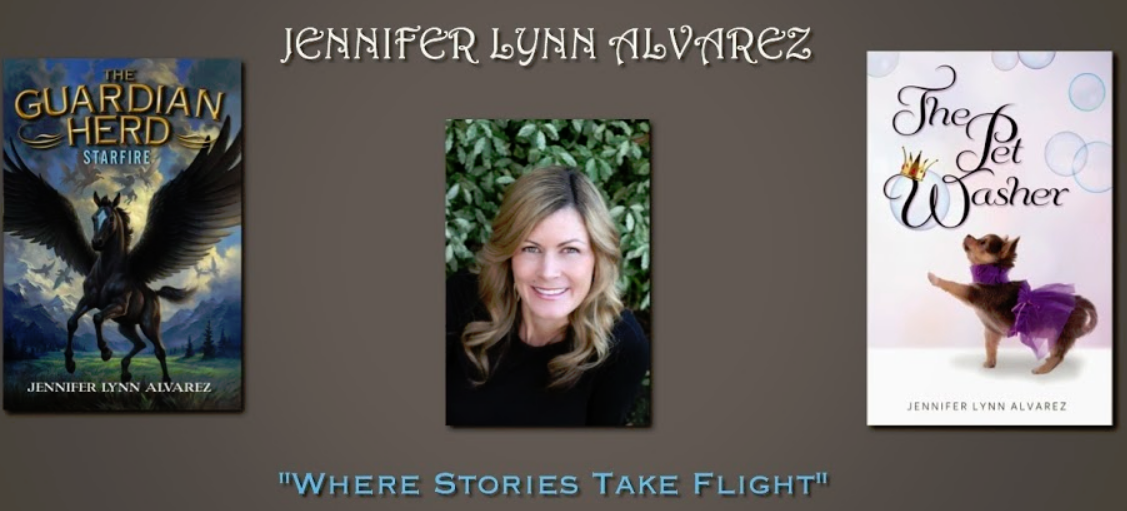
    “Muse still comes in a rewrite. Magic happens in rewriting. As you chip away, themes appear. Start the story on the day the character’s life changes. Use your first draft to explore characters.” — Jennifer Lynn Alvarez, author of The Pet Washer and Guardian Herd – Starfire

    Jennifer says this about Starfire:

    “It wrote me. I did not come up for air until the first draft was finished. I’d always been warned not to write ‘talking animal’ books — that publishers don’t like them — but as I edited STARFIRE, I realized it was the book I’d always wanted to read as a kid.”

    “In hindsight, I’m grateful STARFIRE is the book that broke through because this book, my fifth, is the book I was born to write. It is the sum of me and my interests—flying horses and underdogs, heroes and bullies, and a special colt watching his herd, wishing he was not an outsider. It’s the story for anyone who’s ever felt left out, or different, or alone, but who believes in their heart they can belong and, perhaps, make a difference. It’s my story, and now—thanks to my agent and HarperCollins—it can be your story too.”

    Note from Marlene: Is there a story you have always wanted to write?   Use any of the prompts on The Write Spot Blog to jumpstart your writing. Just Write!

    Jennifer.2books

  • What work would you do if you could do anything? Prompt #105

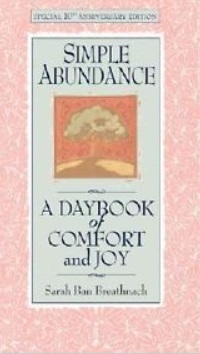
    The following excerpt is from Simple Abundance by Sarah Ban Breathnach.

    Simple Abundance“Some of us hear our passion calling when we’re very young, but most of us do not because we’re too busy listening to what other people, especially our parents, are telling us. So we embark on a vocational path, trying on different lives for size until we find one we can wear even if it doesn’t necessarily fit.

    Perhaps you’re conflicted about continuing the journey you started twenty-five years ago but have outgrown. You know you’re not heading in the direction you want to go, but at least your daily motions are familiar. And familiar feels safe. In today’s uncertain world, feeling safe and secure seems the emotional definition of sanity.

    Perhaps you’re skilled in one occupation but not thrilled about using those skills anymore. Some other work does secretly thrill you. But the stakes seem too high. perhaps you’re dismayed, even embarrassed, by the thought that you don’t know what Great Work waits you.”

    Prompt: Write whatever comes up for you when reading this. Or write about the work that secretly thrills you. Or write about feeling safe and secure. Or, what would you do if you could do anything? Just write!

  • Writing is vital . . .

    Poets & WritersKevin Larimer, editor of Poets & Writers magazine, in the Sept.-Oct issue:

    “Writing is vital; it’s important to more people than you can imagine.”

                                  Just write!