Blog

  • YWCA invites writers to address the issue of domestic violence

    The YWCA invites Sonoma County writers to address the issue of domestic violence through poetry, flash fiction and memoir for October 2014’s Domestic Violence Awareness Month.

    Authors and poets are free to explore the topic from many perspectives, focusing on a more personal approach, a social level, the viewpoint from victims, children, loved ones, those who witness the violence, or those who work in the field, such as doctors, police, therapists.

    The YWCA defines domestic violence as threatening behavior that seeks to control and exercise power over another. This behavior can include one or all of the following: emotional abuse, psychological abuse, sexual abuse, verbal abuse, physical abuse, financial abuse, and/or threats of abuse or violence to a partner’s children or pets.

    Short fiction and personal narrative pieces should not exceed 1000 words. Up to three poems may be submitted, but the total number of pages of poetry shall not exceed three.

    Entries should be in Times New Roman, 12 point, double-spaced. Poetry may be single spaced. Please submit electronically in a Word document, sending to the following address:        wingpoet@gmail.com

    Include author’s name, address, phone number, and e-mail address, as well as a 50-word writer’s autobiographical statement.

    The deadline is Sept. 10, 2014.

    For any questions, please contact Michelle Wing at (707) 478-1460 or wingpoet@gmail.com, or Misty Bastoni, Volunteer Coordinator at the YWCA, (707) 303-8401.

    The YWCA will host four separate nights of author readings in Sebastopol, Santa Rosa, Sonoma and Cloverdale in October, as part of Domestic Violence Awareness Month.

    The YWCA is dedicated to eliminating racism, empowering women and promoting peace, justice, freedom and dignity for all.  

    For more information on the YWCA Sonoma County, YWCA USA and YWCA World, please visit our website .

    YWCA

  • The Miracle of Language: Reminders from 50,000 Feet by Daniel Ari

    Guest Blogger Daniel Ari talks about The Miracle of Language: Reminders from 50,000 Feet

    Chin.

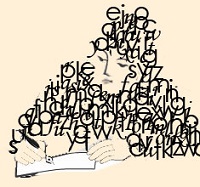
    An alien from another galaxy encountering those four written characters or the sound we as English speakers make reading them would have no idea what we were writing or talking about. The markings or sounds alone would give the alien no inkling that they even possess a corresponding meaning in the physical world.

    We write using a complex system of symbols that are almost entirely abstracted from the physical phenomena they indicate. The alien might stand a chance at understanding spoken onomatopoeias, perhaps fetching a connection between the shouted words bang, boom or screech with the aural phenomena they represent. And perhaps the written article a might indicate to the alien the spirit of its meaning as something singular. Yet wouldn’t you be impressed with an alien that could intuit even those connections from our abstract language? I would.

    The miracle is that we learn to associate a huge range of phenomena with a huge range of symbols. For example, you can read the word candy as it appears here on screen and know it’s the same word as the one built out of plastic, foot-tall, block letters above the entryway of a candy store. The two symbol sets are vastly different in appearance, yet we decode and access related bodies of meaning from both.

    At the same time, the range of meanings we associate with the symbols is enormous. Where does your mind go when you read candy? Cellophane-wrapped hard candies? A bag of Halloween spoils? Or a sudden, unspecific craving? Or that song “I Want Candy” by Bow Wow Wow?

    It awes me that I can write chin—never mind the font—and you can visualize the chin that makes the most sense for you. If I want to guide your mind, then I can add prominent, clean-shaven, Caucasian, famous. Or I can write about meeting Jay Leno backstage before a live concert a few months before he took over The Tonight Show from Johnny Carson.

    My brother Phil was one of three comedians opening for Jay that night. I went backstage to meet Leno, and he joked amiably with my brother and I and about five others from the campus comedy club, including our friend Mike Chin. I could see Mike was thinking about cracking his joke about also being a “chin” comedian, but before he could, Leno handed me a Coke from the table of refreshments—cubes of cheese, cut vegetables, a bowl of M&Ms candy, green ones included—and Mike’s moment was lost. I recall feeling jealous of my brother and the other two comics who had opening slots that night. I also had mixed feelings about Leno beneath my celebrity-awe. In the comedy club at that time, we regarded David Letterman as the better comic, the one who should have taken Carson’s throne.

    I think it’s a miracle that you can make sense of what I’ve written. And to honor the miracle, I’ve done my best to aid your understanding by choosing my words consciously, with the intention of making my meanings clear—even the unspoken ones.

    I like to assume an atmospheric view of language sometimes because it reminds me of the magnitude of the project and helps me accept the processes of writing as gradual and incredibly grand. It helps me remember that it’s taken me 47 years—and counting—to learn the abstract symbolic system of contemporary North American English.

    When you interpret the rows of abstracted symbols I have chosen, you get an indication of my experience. That’s why I revisit and rework my strings of symbols so meticulously—adding, subtracting and swapping; changing handwritten to digital to printed; translating writing into voice.

    We attempt to share experience. Remembering that writing means communicating through a complex system of abstraction reminds me that results are guaranteed to be inexact. But if perfection is impossible, connection isn’t. That’s what we as writers strive toward, and when we experience that others are moved by what we’ve strung together, that is the greatest satisfaction a writer can feel. Do you know what I mean?

    DANIEL ARI writes, teaches and publishes poetry. He lives in Richmond, California, where he leads a monthly writing jam, thriving since 2011; and he has taught and led writing sessions and workshops since the 1980s. Daniel has recently placed creative work in Poet’s Market (2014 and 2015 editions), Writer’s Digest, carte blanche, Cardinal Sins, Flapperhouse, Gold Dust Magazine and McSweeney’s. Daniel also works as a professional copywriter and performs improvisation with the troupe Wing It in Oakland, CA. His blogs are Fights with poems and IMUNRI = I am you and you are I.

    Daniel AriRead Daniel’s tongue-in-cheek, “Reject A Hit” about e.e. cummings in the July/August 2014 issue of Writer’s Digest magazine.

    Daniel will be the July 17, 2014 Writers Forum Presenter in Petaluma, California


  • It doesn’t matter whether the story is set in the present day, 100 years ago hence, or . . .

    “It doesn’t matter whether the story is set in the present day, 100 years ago hence, or in a place that has never and could never exist outside the pages of a book: The writer’s job is to present an utterly convincing and wholly seamless world,” Simon Morden, author of fantasy novel Arcanum. — The Writer Magazine, July 2014

    Ireland Countryside. Jim C. March


    Photo by Jim C. March

  • Three-part prompt . . . Prompt #87

    Today’s prompt is three parts. Take about 20 minutes, or as much time as you need, for each section.

    Part One: Write a list of events from this past month:

    What aggravated you?

    What frustrated you?

    What made you laugh or cry?

    pin

    What made you lose your temper?

    What was the worst thing that happened?

    The best?

    The most disturbing or weird?

    Part Two:  Choose one thing from your list and write about it. Write whatever comes to mind. Write what you would really like to say to the other people involved.  Take your time with this. Write until you have no more to say on the subject.

    Write what happened from your point of view.  Lola.200

    Part Three: Only do this after you have done Part Two — If another person was involved, step into his or her shoes. Write what happened from the other person’s point of view.

    shoes.women                                                    shoes.men

    Just Write!

  • “I just want to stay authentic and keep dreaming my dreams.” — Katy Perry

    “A lot of times I write these songs because I need to reinspire myself,” Katy Perry, in the July14, 2014 issue of People magazine.

    “I need to find my voice again. I need to be heard.”

    How about you? Are you writing to be heard? Is anyone paying attention? We are. . . here at The Write Spot Blog.

    Choose a prompt and then write. Post your writing on The Write Spot Blog. Maybe the person who most needs to hear what you have to say will be reading.

    Katy Perry“I just want to stay authentic and keep dreaming my dreams.” — Katy Perry

    Me too, Katy, me too~!

    Let’s gather ’round the table, put pen to paper or fingers on keyboard and Just Write!

  • What should you throw away but just can’t? Prompt #86

    Write about something you should throw away but just can’t.

    IMG_1650

  • Reject A Hit. . . Have you seen this?

    Reject A Hit . . . Writer’s Digest Magazine, Rejection Letter column is a hit with local writers.

    Sonoma County Writer Amy Marincik’s spoof rejection on Great Expectations was selected for the March/April 2013 issue of Writer’s Digest magazine.

    Writers Forum presenter, Daniel Ari, wrote a pithy rejection letter to e.e. cummings, published in the July/August 2014 issue of the magazine.

    Reject A Hit.Daniel Ari

    You, too, can be featured on the last page of Writer’s Digest magazine’s, Reject A Hit column.

    300 words or fewer. Submit via email to wdsubmissions@fwmedia.com with “Reject a hit” in the subject line.

    Go for it!

    Here is a list of books that have been spoofed rejected.

    2012

    September       The Godfather by Mario Puzo

    October           Breakfast at Tiffany’s by Truman Capote

    Nov/Dec          How the Grinch Stole Christmas! by Dr. Seuss

     2013

    January           Charlie and the Chocolate Factory by Roald Dahl

    March/April    Great Expectations by Charles Dickens, spoofed by Amy Marincik

    May/June        Burning Down My Masters’ House: My Life at the NY Times Jayson Blair

    July/August    The Exorcist by William Peter Blatty

    October           The Lorax by Dr. Seuss

    Nov/Dec          The Hobbit by J.R.R. Tolkien

    2014

    January           The Road by Cormac McCarthy

    February         The Old Man and The Sea by Ernest Hemingway

    March/April    Good Night Moon by Margaret Wise Brown

    May/June        Tess of the D’Urbevilles

    July/Aug         Tulips & Chimmeys by e.e. cummings, spoofed by Daniel Ari

    Your Turn!  Write your 300 word Spoof Rejection and submit to Reject A Hit, Writer’s Digest magazine.


  • Guest Blogger Marjorie Richardson corrals the chatter and invites creativity.

    Guest Blogger Marjorie Richardson writes about waking our consciousness through gentle yoga.

    Want to calm your nerves, quiet your mind, decrease anxiety and heighten immunity? How about having more comfort and ease in your body? Developing a feeling of fluidity in your body? Accessing your creativity? All these things can and do take place through slow and gentle movement accompanied by focused rhythmic breathing. Gentle yoga enhances our ability to hear ourselves, to listen to the inner cues we are constantly being given. In deeply concentrated states of mind, restlessness calms down. Synchronizing breath and movement train the mind to sense the subtle layers of well-being below all the surface chatter.

    Hatha Yoga is a tool discovered thousands of years ago to be used to awaken consciousness and unite with all the levels of our being. When attention is directed inward, your body receives messages that you are safe and secure; your self is being looked after. Muscles relax, blood pressure drops, the nerves calm, the mind quiets, anxiety decreases and immunity heightens.. Our fast-paced busy lives tend to stimulate a high level of stress that runs our immune systems down as they try to cope. A Yoga practice is a counter pose to that life style.

    The gift of yoga is multifaceted. Through our yoga practice we break through and loosen old patterns of feeling and being. We develop a new relationship with ourselves physically, mentally, emotionally and spiritually. Yoga deepens our understanding of who we are and how we choose to be in the world. Yoga expands us, opens us to new territory, releases stuck places that were previously unavailable. Through our yoga practice we attune to our alignment at the core of our being. We increase physical strength, flexibility and balance. We develop non-judging acceptance and open heartedness. And through all of this we experience a calmer and more peaceful state of mind. We cultivate an ability to listen to our body, to hear what it really needs for well-being. We begin to move away from the push and the struggle and breathe into the little releases and insights that are revealed to us through our body as we learn to listen with curiosity and trust. In this way, yoga can enhance our writing.

    The body, mind and spirit responds to and loves the oxygenating benefits of deep rhythmic breathing and the balancing of all the body systems through the gentle stretching and relaxing into the poses. The true work of our yoga practice is cultivating self acceptance, kindness and patience, developing and integrating body mind and spirit. Our physical need is health, our psychological need is knowledge and our spiritual need is inner peace. Cultivating all three produces harmony and who the heck doesn’t want that?

    Marjorie Richardson.1Marjorie Richardson is a certified Integrative Yoga Instructor & Massage Therapist who has been teaching yoga in Petaluma, California since 1997. Her gentle style supports the process of letting go of tensions, worries and habits by using breath and movement synchronized together.

    Note from Marlene:  I just love serendipity. I’ve had this post ready for awhile, waiting for an “open spot” on the guest blogger calendar.  Today is The Day. There is a good article about “Yin yoga: A fascia-nating practice,” by Hana Medina in the July 2014 issue of The Costco Connection. Don’t you just love it when serendipity happens?

  • Follow your heart and intuition . . . Steve Jobs

    “Your time is limited, so don’t waste it living someone else’s life. Don’t be trapped by dogma – which is living with the results of other people’s thinking. Don’t let the noise of others’ opinions drown out your own inner voice. And most important, have the courage to follow your heart and intuition.” — Steve Jobs
    Click here for more Steve Jobs quotes.
    Map by Romain.Steve Jobs PlacesMap of “Steve’s Places” by  Romain Moisescot, Webmaster, all about Steve Jobs.com

    I love what Romain has done with his blog, especially the January 26, 2013 post, since I love catching movie gaffes.
    And being a writer, of course I love stories. Here’s the story behind all about Steve Jobs.com:

    “My name is Romain Moisescot and I am the webmaster of all about Steve Jobs.com. By webmaster I mean the owner, designer, developer and editor of the website, which is a one-man operation. I started it on February 24, 2006, Steve Jobs’s 51st birthday… and my 19th.

    The website was named all about Steve back then, but its objective was the same as today’s: to bring you (and me) the most complete online resource about Steve Jobs. Although I had been an avid Mac user since my early teens, I had become a huge fan of the man after reading his biography by Alan Deutschman, The Second Coming of Steve Jobs, in 2004. After trying to gather more information about him, I was desperate to see that no good website was dedicated to him: so I decided to build one.”

    Note from Marlene:  I love this. . . love Romain’s Can-do attitude.  Create and build what your heart desires.


  • Your intangible treasure. Prompt #85

    What is the one intangible thing you treasure above all else?

    Intangible, meaning: you can’t touch it, feel it, smell it, hold it, see it . . . it may be a character trait, a personality trait, a quirk. . . a feeling. . . .

    Prompt:  Write about something intangible that you treasure.

    LifeJanePhoto by Jane Person