Today’s writing prompt is inspired by Poetic Medicine by John Fox, Infusing our poems with what nature teaches us:
A forest fire is awesome and frightening but clears the forest floor for new growth.
Metaphors and poetic images of earth can often express such feelings better than plain descriptive words, which seem to crack under the pressure of deep feeling. Feelings of grief might bring to mind images of winter’s coldness. Pablo Neruda crystalizes a wintry grief image:
Yes:
seed germs, and grief, and everything that throbs
frightened
in the crackling January light
will ripen, will burn, as the fruit burned ripe.
The
insights we gain by observing nature, and the poems we make which include these
insights, help us cope with our rage, grief and pain.
The poetry of earth offers us a chance to experience something more about life than our self-definition and ordinary language usually permit. Like the forest after the fire, this something more is full of new growth and unknown potential.
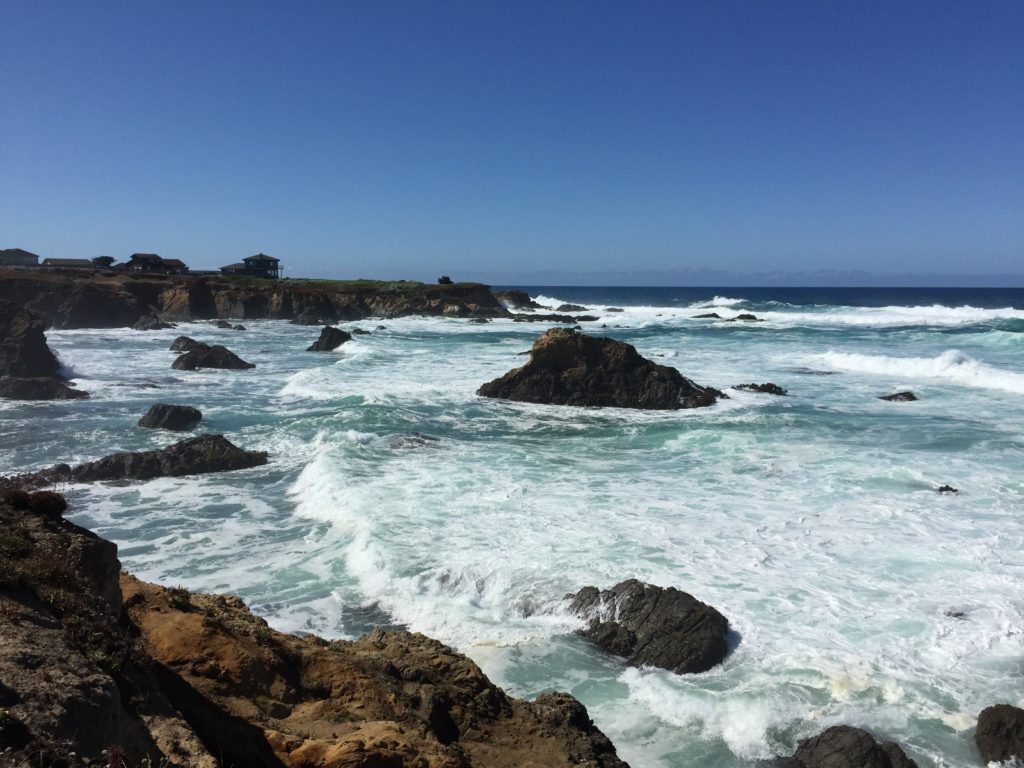
Writing Prompt: Choose an aspect of the natural world which you feel has something to teach you. It could be an animal, plant, or mineral. What specific quality does it express that speaks to you about your own life?
Or write about an experience in nature that had a profound effect on you.
In Manifestation 101 (& Taking Likely Action) Brad talks about a five-step process for manifesting what you really want.
1. Create It
2. Clear It
3. Live It
4. Let Go
5. Likely Action
Step One: Create It
Decide what you really want. Write it down. Start with something like:
“I am so happy! I have . . .”
Then list the qualities and features of what it is you want (as if you already have them).
It’s important that you write it in the present. If you write “I want this,” then you are vibrating at a frequency of want – and the wanting of it is what you will continue to attract. You want to be vibrating in harmony with already having it.
Write positive things, stating the positive aspect (what it has), rather than what it doesn’t have. If you write, “My new boyfriend isn’t a loser,” you are putting “loser” vibrations into the ether.
Rather than asking for money, focus on what you want to have. I focused on a trip I wanted to take, which I estimated to cost about $1,200. [And this is what Brad received.]
Don’t limit the Universe by saying it has to be paid for in cash. If you want a new car – focus on the car. The money might show up, but you might also win the car.
Once you’ve given the parameters of what you want, write at the end, “This, or something better – for the highest good of all concerned.” Give the Universe an opportunity to give you something better and/or more appropriate – it knows better than we do.
Step Two: Clear It
Here’s where Emotional Freedom Technique (EFT) comes into play. Too often we send contradictory energy, keeping what we consciously say we want at a distance from ourselves.
Clear any contradictory thoughts. The Universe picks up on them all. The biggest, in my experience, is: “I don’t deserve to have this.” Tap on it, or use whatever other tools you might have for releasing blocks to your success.
You also want to be clear on your intentions. If you have doubts about your motives, you will either block the attainment of your objective, or limit your ability to receive it in a joyful manner. Make sure you want it for the right reasons (and only you can decide what is right for you.)
Keep at this until you can think about the successful attainment of your objective without feeling any resistance.
Step Three: Live It
Now that you can think about the successful attainment of your objective without feeling any resistance – do so. Really think about having it – and allow yourself to enjoy that.
Indulge in all the positive feelings you expect to experience while enjoying this thing in your life. Really feel how good it feels.
Now would be a good time to tap yourself into trance and visualize yourself really enjoying your objective. As you do so, allow the positive feelings to wash over you and through you – feeling good in every muscle, nerve, fiber, tissue, cell and atom of your body. Do this once a day – a daily reminder of what you are up to.
Step Four: Let Go
I also call this “Let Go and Let God.”
You need to be unattached to the outcome. Otherwise, you might start clenching your energy, asking “Where is it?”
Not great attracting energy.
A farmer doesn’t plant a seed, then stare at it in frustration hoping for it to grow. He does what he can to nurture it, but otherwise leaves it to nature to do what it does.
Also, you don’t want to be attached to how it happens. You might be staring at a door waiting for that someone to walk in, and completely miss them because they came through the side door.
Now, this doesn’t mean you don’t take action. Do what you can – let the Universe know you are serious about making things happen. Just don’t be surprised if the manifestation comes in a way that doesn’t seem to be directly related to what you are doing.
Tapping can be very helpful with this step, too. “Even though I feel I HAVE TO HAVE THIS NOW!!!.” Let that go.
If you’ve created your vision, cleared all internal objections to it, allowed yourself to experience living it and really feel how great it would be to have it – and it still isn’t showing up – then you need to trust that maybe it really isn’t in your best interest to have this objective at present.
But, “God’s delays are not God’s denials.”
More often than not, there’s more clearing work to do. Abundance just is. It is all around. The extent to which we are not experiencing it is the extent to which we are resisting it.
Stop resisting it.
Manifest it.
You deserve it.
Step Five: Likely Action
The Universe has many ways of making something happen – and yet we routinely limit ourselves to what we can think up on our own.
Our job is to decide what we want, and focus on that in a positive way. Not to figure out how it is going to happen.
That’s the Universe’s job.
Instead of waiting until you know the right action, take a likely action, an action that is likely to move you toward your goal.
Come up with lots of likely plans of action. Act on one of them.
When thinking of your goal, ask yourself: “What could I do that might get me there?” No need to censor yourself – let the ideas flow, and ask of each, “Is this likely to move me in the right direction?” Then choose one and begin.
Sure – you might make a mistake, and there may be consequences for that. You don’t have to be married to an idea – you can change strategies along the way. But there is a definite consequence for not taking action: you stay stuck.
Decide what you want. Be clear. Then take likely action.
That’s how the Universe knows you are serious about your intention. If you aren’t willing to move on it, the Universe may consider it just one of your countless whims. Show your commitment to your objective by getting going.
And don’t be surprised as better ways to do it “magically” show up along the way.
Now…what are you waiting for…? Get going! Do something now!
Brad Yates is one of the top teachers of Emotional Freedom Techniques® (EFT), a quick, simple, effective method for overcoming fear and relieving stress. EFT, also sometimes referred to as Tapping, can help just about anyone dealing with anxiety and negative emotions.
Mudlark was founded in 1995 as an electronic journal of poetry & poetics. It has an ISSN (International Standard Serial Number) from the Library of Congress; is refereed, copyrighted, and archived. Mudlark is “never in and never out of print.”
To submit or not to submit? Take a good look at Mudlark. Spend some time on the Mudlark website. Find out what issues, posters, and flashes are. Then make your decision.
As our full name, Mudlark: An Electronic Journal of
Poetry & Poetics, suggests, we will consider accomplished work
that locates itself anywhere on the spectrum of contemporary practice. We want
poems, of course, but we want essays, too, that make us read poems (and write
them?) differently somehow. Although we are not innocent, we do imagine
ourselves capable of surprise.
Mudlark publishes in three formats:
“issues” are the electronic equivalent of print chapbooks; “posters” are the
electronic equivalent of print broadsides; and “flashes” are poems that have
news in them, poems that feel like current events. The acceptance rate at Mudlark is
low, very low; the rejection rate is comparably high. The work of hobbyists and
lobbyists is not for us. The poem is the thing at Mudlark… and
the essay about it.
In Mudlark poetry is free. Our authors give us their work and we, in turn, give it to our readers. What is the coin of poetry’s realm? Poetry is a gift economy. One of the things we can do at Mudlark to “pay” our authors for their work is point to it here and there, wherever else it is. We can tell our readers how to find it, how to subscribe to it, and how to buy it… if it is for sale. Toward that end, we maintain A-Notes (on the Authors) we publish. We call attention to their work.
Today’s guest blogger is Nancy Julien Kopp. Her blog, Writer Granny’s World features tips and treats about writing.
Her brilliant August 20, 2019 post (excerpt below) focused on how to use action with dialogue.
Fingers flying across keyboard, Marlene types, “On with the show, Nancy.”
How to show action when writing dialogue.
I see writers putting action after dialogue. That’s backwards.
Examples of action with dialogue.
A. “Stop that!” Sally slapped his hand from
her arm.
B. Sally slapped his hand from her arm. “Stop
that!”
C. “Stop that!” Sally said. Sally slapped his hand
from her arm.
Which is the best? The worst?
I think B is best.
And C is the worst.
In B, we see the action, then hear the words that go with
it.
In A, would Sally say the words, then slap his hand away?
Note from Marlene: This would be a “delayed reaction.” Sally says “Stop that.” THEN slaps his hand away. In real life, of course, it would happen at the same time.
Although it’s hard to show action and dialogue that happens
simultaneously, I think B does that.
Back to Nancy’s post:
Your mind sees the action in Example B, then absorbs the
words.
And C? Adding the tag is unnecessary as the action tells you
who is speaking.
Another example but this time adding feeling (or thought)
prior to the action and dialogue. It’s called the FAD Principle. Feeling-Action-Dialogue
“Susan knew Mary would take the biggest piece of cake. She
stepped between her friend and the table full of cake slices. ‘I’ll take
this one.’”
Feeling-Action-Dialogue:
“Susan knew Mary would take the biggest piece of cake. (Feeling/thought)
She stepped between her friend and the table full of cake slices. (Action)
‘I’ll take this one.’” (Dialogue)
Excerpt from Poetic Medicine, by John Fox, “Giving Yourself Permission to be Wild and Magnificent”
Earth offers us powerful images and metaphors with which to tell our stories. Rather than thinking of the earth’s resources as commodities like oil and wood . . . consider the more intangible qualities which nature offers us, such as beauty and spectacle, turmoil and order, mystery and predictability.
A sense of beauty – wild and terrible or lovely and breathtaking – can be healing.
Infusing your writing with earth imagery will help reveal your unique voice and imagination. The stories of earth – and our stories – are interwoven, constantly changing in the cyclic process of birth, growth and death. A language for expressing these deep changes in your life can be found by tuning to the language of the earth.
Poem-making
and the natural world give you permission to be wild and magnificent. Your poetic musings of connection with the earth can take you beyond conventional ways of looking at yourself.
We are often so busy conforming to traditional notions of success that we miss this joyful opportunity to cut loose and feel our lives – to express our highest potential and explore our true legacy.
Prompt: Using inspiration from the natural world present an outrageous, yet honest, picture of yourself . . . or paint a word picture about anything you want, perhaps something that happened over the weekend, or during this past week.
I recommend the blogs and books mentioned below. And of course there are many other blogs, books, and information about blogging on the world wide web.
Highlights from my talk on “Myths and Realities of Blogging”
If you don’t have a blog, but think you
should, something to think about is why?
Why should you have an author blog?
“Blogging is simply a medium that allows you to connect with people who love the same books, hobbies and activities you do.” — Gabriela Pereira, May/June 2018, Writer’s Digest magazine
Author Blog
Find Your Target Audience: Read the reviews of
books in your genre on Amazon or Goodreads. Use words from the reviews for your
headlines and tags in your posts.
What to Post
Stories about you: Your interests, hobbies,
pets, hometown. Interviews.
Platform
One way to build your platform is to be a guest blogger. I welcome your essays about encouraging writers and writing tips on The Write Spot Blog. Go to “Guest Bloggers” to see what others have done (800-1200 words).
Book reviews are also welcome on The Write
Spot Blog.
The Benefits of Blogging for Writers by Nancy
Julien Kopp
Name recognition in the Writing World
Helps promote your books
Connections with other writers
Can exchange guest posts with other bloggers
Makes you write regularly/inspires other forms
of writing
The Write Spot to Jumpstart Your Writing:
Discoveries
The Write Spot to Jumpstart Your Writing:
Connections
The Write Spot: Reflections
The Write Spot: Memories
Should you host an author’s blog to build your platform? You don’t have to, but it’s a good idea . . . as long as you stay focused on your “main” writing . . . your fiction, non-fiction, poetry, memoir. And if you love posting on your blog . . . do it! Just write!
By pacing your scenes well and choosing the proper length for
each scene, you can control the kinds of emotional effects your scenes have,
leaving the reader with the feeling of having taken a satisfying journey.
Pace should match the emotional content of your scene. First
scenes should get going with an emotional bang—start big or dramatic, ratchet
up the suspense or lay in the fear, since you’re capturing the reader here.
Your first scene is like a cold pool—the reader needs to dive
in and get moving fast, or he’ll be too cold to stay in the water for very
long. In other scene types, you’ll have more leeway with pacing. In the first
scene, however, a quick pace—with more action and less reflection or exposition—will
be a better sell.
Dramatic scenes – Start slow, speed up pace to match
emotional intensity, slow down for reflection.
Speed up pace: Strip away exposition, use dialogue, quick
action, and hot emotional content to build intensity.
When and how to slow the pace
After a lot of action or intense dialogue give the reader time
to digest what happened.
Use description, narration, details and interior monologues
to slow the pace.
When a character is contemplative, time slows down.
During these contemplative scenes you can weave in details. Be
specific and descriptive. Give your character something to observe or something
to do, more than hair twirling.
Your turn:
Do a freewrite about pacing.
Here’s mine, thinking about Mairzy Doats. This was a quickly written spontaneous
type of writing, just for fun.
Go too fast and we get frantic and hear garble versus calm,
steady breaths and an even, gentle flow.
Calm is water caressing rocks, dark green moss going with the
flow.
No rough and tumble white water rapids. No gurgling over
brooks, no water cascading over boulders.
Rather, when we slow our writing, we achieve a calm, quiet,
graceful feeling.
Pace yourself. Eat watermelon slowly. Savor the juices.
Pace yourself.
Write fast let you lose that thought.
To slow down, think about the poppy scene in Wizard of Oz.
Slower, slower, snail’s pace slow.
Meditate. Ommmmmmm.
To pick up the pace, think caffeine and the energy of a
toddler/child, always on the go. Child knows no pacing. Always running,
talking, doing.
Challenge self: No
such thing as Writer’s Block. Just keep writing.