Tag: Daniel Ari

  • Guest Blogger Daniel Ari: Sense And Specificity . . .

    Daniel AriGuest Blogger Daniel Ari writes about Sense And Specificity: The Soul of Great Writing

    Great art is about balance. Okay, great art is about a heck of a lot of things. But one thing that makes great writing stand out from the superfluity of all writing is that it strikes a balance between emotional abstraction and concrete specificity.

    We want to read about things like devotion, honor and transformation. But the actual words devotion, honor and transformation aren’t concrete enough to sweep a reader away. As I discussed in “How to Make Your Poems Stand Out: Advice From a Reader” for Writer’s Digest online,  abstract nouns can’t be grabbed, and they don’t grab readers. And what’s worse, they tend to come in flocks. Once a writer writes honor, then love and respect want to come in. Then deep, forever, and mutual are at the door, having chased away all the beautiful specifics like moonstone, cardamom, and foxtrot.

    But luckily, concrete nouns also come in flocks. That’s because when you tell a story or describe a moment, either remembered or imagined, the telling includes all the specific things that make the moment unique and moving. If you want to test whether your writing is too abstract, imagine illustrating it. Could you? If there aren’t enough nouns and verbs to make into a drawing or painting, then your writing may be too abstract to interest most readers.

    Allen Ginsberg put it well: “You can’t write about ‘The Stars.’ You can go out one night and see a glitter in Orion’s belt, or see a constellation hanging over Nebraska, and that’s universal. But it’s got to be over Nebraska—particular—otherwise it isn’t universal. If it’s just the stars in the abstract you don’t even see them, so it’s not a living experience. It’s not an instant in time actually observed, and only instants in time are universal.

    What’s universal is the sense of being human that we translate into language as writers and that readers translate back into thought. That’s why concrete sense imagery is so crucial. That’s how the abstract system of language is able to relate living humans to one another—though memory and imagination of sensed experience.

    Here are two poems that I think do a good job of being relatable by being specific. The first is one of my own, a draft in a series about a legendary backwoods character named Starlight. The second is by Rebecca Auerbach, and I think it’s wonderful how her imagery isn’t just visual, but also auditory, and even more interesting how the sensation she describes is often the absence of sensation and hunger for it.

    “To build a supper”

    by Daniel Ari

    Without matches, I’m sure I could build a fire.
    I may be city, but I’m not dumb. I would
    just use a lighter. No lighter either? Hm.
    Then I’d use friction between two bits of wood
    to weave threads of smoke into a baby spark
     
    then huff and puff the infant in a hoodie
    of soft, dry bark or needles. I’d be famished
    by the time the contained blaze could be called good.
    Then I’d have to start the hunting or fishing
    or just eat miner’s lettuce and blackberries.
     
    I wonder how much hungry equals finished.
    Lost in the woods, I’d be grateful for Starlight.
    She knows a thousand growing things that furnish
    sustenance and comfort. She could catch a trout
    with a thorn hook—or we could stalk the shoulder
     
    of Tyler-Foote Road for fresh (truck-)grilled meat,
    a bumper crop of headlight venison.
    

    **********************************************

     untitled

    by Rebecca Auerbach

    We used to start with eyes meeting,

    exchanging a smile,

    then voices,

    speaking, sharing names.

    Now we start with a photograph & a profile.

    If you like the way a man smiles

    when he isn’t smiling at you,

    the way he introduces himself

    when he isn’t meeting you,

    you might exchange words without voices,

    & if you like what he says when you can’t hear him,

    you might consent to speak aloud by phone,

    & if you like how he speaks to you

    when he has never seen you,

    you might

    maybe

    consent to look into his eyes.

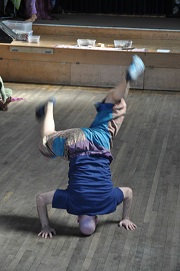
     Daniel Ari began dancing to Freeze Frame” by The J. Geils Band at an 8th grade dance in 1981. He hasn’t stopped. About five years later, he began courting poetry as a practice, and that, too has stuck. As a poet and professional writer these days, movement remains key to his creativity.  Daniel recently won Grand Prize in the Dancing Poetry Festival, and his poem about swing will be set to choreography and performed at the Legion of Honor in September. His forthcoming book One Way To Ask from Zoetic Press, pairs poems in an original form called queron, with artwork by 67 artists including Roz Chast, Tony Millionaire, Bill Griffith and R. Crumb.

    Daniel Ari will be the August 20, 2015 Writers Forum Presenter in Petaluma, CA

  • The Miracle of Language: Reminders from 50,000 Feet by Daniel Ari

    Guest Blogger Daniel Ari talks about The Miracle of Language: Reminders from 50,000 Feet

    Chin.

    An alien from another galaxy encountering those four written characters or the sound we as English speakers make reading them would have no idea what we were writing or talking about. The markings or sounds alone would give the alien no inkling that they even possess a corresponding meaning in the physical world.

    We write using a complex system of symbols that are almost entirely abstracted from the physical phenomena they indicate. The alien might stand a chance at understanding spoken onomatopoeias, perhaps fetching a connection between the shouted words bang, boom or screech with the aural phenomena they represent. And perhaps the written article a might indicate to the alien the spirit of its meaning as something singular. Yet wouldn’t you be impressed with an alien that could intuit even those connections from our abstract language? I would.

    The miracle is that we learn to associate a huge range of phenomena with a huge range of symbols. For example, you can read the word candy as it appears here on screen and know it’s the same word as the one built out of plastic, foot-tall, block letters above the entryway of a candy store. The two symbol sets are vastly different in appearance, yet we decode and access related bodies of meaning from both.

    At the same time, the range of meanings we associate with the symbols is enormous. Where does your mind go when you read candy? Cellophane-wrapped hard candies? A bag of Halloween spoils? Or a sudden, unspecific craving? Or that song “I Want Candy” by Bow Wow Wow?

    It awes me that I can write chin—never mind the font—and you can visualize the chin that makes the most sense for you. If I want to guide your mind, then I can add prominent, clean-shaven, Caucasian, famous. Or I can write about meeting Jay Leno backstage before a live concert a few months before he took over The Tonight Show from Johnny Carson.

    My brother Phil was one of three comedians opening for Jay that night. I went backstage to meet Leno, and he joked amiably with my brother and I and about five others from the campus comedy club, including our friend Mike Chin. I could see Mike was thinking about cracking his joke about also being a “chin” comedian, but before he could, Leno handed me a Coke from the table of refreshments—cubes of cheese, cut vegetables, a bowl of M&Ms candy, green ones included—and Mike’s moment was lost. I recall feeling jealous of my brother and the other two comics who had opening slots that night. I also had mixed feelings about Leno beneath my celebrity-awe. In the comedy club at that time, we regarded David Letterman as the better comic, the one who should have taken Carson’s throne.

    I think it’s a miracle that you can make sense of what I’ve written. And to honor the miracle, I’ve done my best to aid your understanding by choosing my words consciously, with the intention of making my meanings clear—even the unspoken ones.

    I like to assume an atmospheric view of language sometimes because it reminds me of the magnitude of the project and helps me accept the processes of writing as gradual and incredibly grand. It helps me remember that it’s taken me 47 years—and counting—to learn the abstract symbolic system of contemporary North American English.

    When you interpret the rows of abstracted symbols I have chosen, you get an indication of my experience. That’s why I revisit and rework my strings of symbols so meticulously—adding, subtracting and swapping; changing handwritten to digital to printed; translating writing into voice.

    We attempt to share experience. Remembering that writing means communicating through a complex system of abstraction reminds me that results are guaranteed to be inexact. But if perfection is impossible, connection isn’t. That’s what we as writers strive toward, and when we experience that others are moved by what we’ve strung together, that is the greatest satisfaction a writer can feel. Do you know what I mean?

    DANIEL ARI writes, teaches and publishes poetry. He lives in Richmond, California, where he leads a monthly writing jam, thriving since 2011; and he has taught and led writing sessions and workshops since the 1980s. Daniel has recently placed creative work in Poet’s Market (2014 and 2015 editions), Writer’s Digest, carte blanche, Cardinal Sins, Flapperhouse, Gold Dust Magazine and McSweeney’s. Daniel also works as a professional copywriter and performs improvisation with the troupe Wing It in Oakland, CA. His blogs are Fights with poems and IMUNRI = I am you and you are I.

    Daniel AriRead Daniel’s tongue-in-cheek, “Reject A Hit” about e.e. cummings in the July/August 2014 issue of Writer’s Digest magazine.

    Daniel will be the July 17, 2014 Writers Forum Presenter in Petaluma, California


  • Reject A Hit. . . Have you seen this?

    Reject A Hit . . . Writer’s Digest Magazine, Rejection Letter column is a hit with local writers.

    Sonoma County Writer Amy Marincik’s spoof rejection on Great Expectations was selected for the March/April 2013 issue of Writer’s Digest magazine.

    Writers Forum presenter, Daniel Ari, wrote a pithy rejection letter to e.e. cummings, published in the July/August 2014 issue of the magazine.

    Reject A Hit.Daniel Ari

    You, too, can be featured on the last page of Writer’s Digest magazine’s, Reject A Hit column.

    300 words or fewer. Submit via email to wdsubmissions@fwmedia.com with “Reject a hit” in the subject line.

    Go for it!

    Here is a list of books that have been spoofed rejected.

    2012

    September       The Godfather by Mario Puzo

    October           Breakfast at Tiffany’s by Truman Capote

    Nov/Dec          How the Grinch Stole Christmas! by Dr. Seuss

     2013

    January           Charlie and the Chocolate Factory by Roald Dahl

    March/April    Great Expectations by Charles Dickens, spoofed by Amy Marincik

    May/June        Burning Down My Masters’ House: My Life at the NY Times Jayson Blair

    July/August    The Exorcist by William Peter Blatty

    October           The Lorax by Dr. Seuss

    Nov/Dec          The Hobbit by J.R.R. Tolkien

    2014

    January           The Road by Cormac McCarthy

    February         The Old Man and The Sea by Ernest Hemingway

    March/April    Good Night Moon by Margaret Wise Brown

    May/June        Tess of the D’Urbevilles

    July/Aug         Tulips & Chimmeys by e.e. cummings, spoofed by Daniel Ari

    Your Turn!  Write your 300 word Spoof Rejection and submit to Reject A Hit, Writer’s Digest magazine.