Tag: Miss Desert Inn

  • Suicide Doors . . . Prompt #200

    Today’s writing prompt is a poem by Ron Salisbury. You can write on the theme of the poem or the mood. You can use a line or a word for the writing prompt. Ready? Read and write. Just write, without  worrying how your writing will sound.

    Suicide Doors

    Don’t put that in a poem, she said.

    What? Don’t put what I said in a poem.

    We talk and a week later I find what I said

    in one of your poems. What’s the matter

    with that? He’ll find out. He doesn’t read

    poems. His friends will tell him. His friends

    don’t read poems. Just don’t put me in your poems.

    How about I make it in the 1960’s

    and it happens in my 1951 Merc with suicide

    doors, I got a D.A. haircut, smell of Bay Rum

    and your angora sweater comes off on my sport coat.

    Then what happens. Well, we could be in love.

    We already are. I mean the crazy 60’s love

    before birth control pills and we both smoke

    and sneak bourbon from your father’s liquor cabinet

    and try to figure out how to get some Trojans

    because they’re not in every grocery store

    and you have to ask the druggist for them

    because they’re kept behind the counter

    like cigarettes are now and because

    he knows everyone in town, it’ll get around

    so we drive all the way to Dexter on Saturday

    night and I’ll try to be cool and see if

    I can buy some and if I can’t we’ll take

    our chances anyways. Do we do it in the

    back seat? Yeah, the Merc had a giant

    back seat. And you won’t use any thing

    I said in the poem. Sure. Ok, but

    bring a blanket and you have to go slow

    and give me time to hang my sweater

    over the seat so it won’t get ruined.

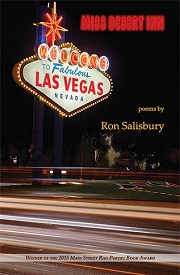
    Ron SalisburyRon Salisbury, author of Miss Desert Inn, (Main Street Rag Publications) lives in San Diego, CA, where he continues to publish, write and study in San Diego State University’s Master of Fine Arts program, Creative writing. Publications and awards include: Eclipse, The Cape Reader, Serving House Journal, Alaska Quarterly Review, Spitball, Soundings East, The Briar Cliff Review, Hiram Poetry Review, A Year in Ink, etc; Semi Finalist for the Anthony Hecht Poetry Prize – 2012, Finalist for the ABZ First Book Contest – 2014, First Runner-up for the Brittingham and Pollak Prize in Poetry – 2014, Winner of Main Street Rag’s 2015 Poetry Prize.
  • So you’ve earned that MFA, now what?

    Guest Blogger Ron Salisbury talks about MFA – Master of Fine Arts writing programs.

    Everywhere I go, I’m asked if I think the universities stifle writers. My opinion is that they don’t stifle enough of them. There’s many a best seller that could have been prevented by a good teacher.”–Flannery O’Connor

    Flannery may be a little tough but not far wrong. What will you do with your MFA in poetry or fiction or non-fiction or children’s literature? Is it different from what you thought you would do before you started that MFA program?

    The proliferation of Master of Fine Arts Writing Programs in the United States (some 200 as of this writing) requires new crops of students every year; cannon fodder, inductees to charge over the lip of the trench into the guns of Admission Departments and Student Loans without much chance of becoming that famous author, a goal which is implied but never stated by these programs. (Is that what you thought you’d learn at that program?)

    When I started my MFA – Poetry program in 2013, I had few of those allusions given my age (70) and narrative style of poetry. I was not going to be offered that tenure track teaching position in some MFA program. At best, I would get some adjunct position. (the typical pay for a semester class as an adjunct is $2000 to $3000 with no guarantee of any future work) And would hope to worm my way into the hearts and pockets of the program directors and students. Last year the United States graduated approximately 2,000 poetry MFAs, 2,000 fiction and between 500 to 1,000 non-fiction and other. And there were less than forty tenure tract creative writing positions available in those universities and colleges. But, I did naively expect that in my program I would be among poets striving to become better poets. What I have mostly found is a cadre of wonderful people learning “how” to write poetry. My observations have been generally supported by other writers in other programs throughout the United States.

    To  satisfy the body count necessary for these 200+ programs, the threshold has been considerably lowered. If your goal is to teach in an MFA program, anecdotally, minimal requirements today are the MFA degree and two published books at least. If one or both books were contest winners, so much the better. Given the proliferation of book publishing options today such as high quality appearing print-on-demand and self-published, the vetting process for MFA instructors—ones skilled and with enough notoriety to attract students—has become more difficult for universities. It used to be just a book from a good publisher and you could be considered, then it became the book and the MFA. Now the field is murky. Which has led to an entirely new phenomenon, the PhD in Creative Writing which has begun to propagate much as the MFA programs did fifteen-twenty years ago (today, about 32 programs). It would not be a surprise to discover in less than ten years that the minimum requirement to be considered as an instructor in an MFA program is the book or two and the Creative Writing PhD. So, if you have a goal to obtain an MFA in Creative Writing and do more with it than hang it on your wall, continue to work at Starbucks or teach two classes of freshman composition at some Junior College, hurry.

    Your Turn: Should you or shouldn’t you join an MFA program? Have you done it? What do you think? Weigh in. Post your writing on The Write Spot Blog.

    Miss Desert Inn. Salisbury.180Ron Salisbury lives in  San Diego, CA where he continues to publish, write and study in San Diego State University’s Master of Fine Arts program, Creative Writing. Publications and awards include: Eclipse, The Cape Reader, Serving House Journal, Alaska Quarterly Review, Spitball, Soundings East, The Briar Cliff Review, Hiram Poetry Review, A Year in Ink, etc; Semi Finalist for the Anthony Hecht Poetry Prize – 2012, Finalist for the ABZ First Book Contest – 2014, First Runner-up for the Brittingham and Pollak Prize in Poetry – 2014, Winner of Main Street Rag’s 2015 Poetry Prize

    Miss Desert Inn published November 2015.


  • The Sadness of Ice Cream . . . . Prompt #175

    Today’s writing prompt is a poem. You can write on the theme or mood of the poem, or a line, or a word. Write whatever comes up for you.

    The Sadness of Ice Cream by Ron Salisbury

    The emperor had his and  I’ve had mine,  home churned

    on the fourth of July, spoon after spoon after she called,

    gelato in Ravenna, Neapolitan–chocolate was the best–

    pints, bars,  Liz  Topps  said next summer let’s eat lots,

    plopped  a  spoonful  of  Rocky  Road  on her bare belly.

    No more, my doctor says.   Cholesterol, blood pressure.

    Besides, right at the beginning, first cone, bite, spoonful

    licked off the belly,  we  begin  to measure how much is

    left not how much there was. The sadness of ice cream.

    Miss Desert Inn. Salisbury.180Ron Salisbury is a writer who has integrated his poetry with his business life for decades.

    Now, three wives deep, four children long, and assorted careers past, he continues to study, publish and write in San Diego.  His new book, Miss Desert Inn. is being published this fall by Main Street Press, Charlotte, NC