Tag: Recovery Writing of Idaho

  • Crafting Short Fiction

    “If I had more time, I’d write a shorter story.”— Mark Twain

    Today’s Guest Blogger, Guy Biederman, talks about crafting short fiction.

    I’ve always been intrigued by the challenge of creating something small that has big power. Giacometti said he wanted to make a sculpture the size of a matchbox, but so dense no one could lift it.

    The first micro story I remember reading was “Coup de Grace” by Ambrose Bierce, with a gotcha ending. O. Henry’s “Gift of the Magi used” a similar technique. I was astonished by the wallop a short piece could pack.

    As a young writer, I cut my teeth on Raymond Carver’s work. Carver’s stories weren’t always short, but they were spare and vivid, conveyed feeling, empathy and understanding, and explained very little. I didn’t know what he was doing or how he did it. I only knew that reading his work was like glimpsing beautiful pebbles through clear water on the bottom of a lake. And I wanted to write like that.

    I began to practice, and later teach what I called low fat fiction, the art of expressing more with less. And I began to apply what I learned to the short form.

    As a gardener, I became fascinated by bonsai—how a miniature plant in a pot evoked the grace, power, and wonder of an ancient tree; how pruning created space between leaves and branches that defined what remained. But how to create that empty space, that room between the sentences in fiction?

    What I learned from reading Carver and others, was the compelling power of evocation. To evoke rather than explain is a strong and efficient style of craft that creates room for readers who bring their imaginations to the page and make the experience their own. I call this practicing the reader’s art. By providing opportunities for them to have their own aha moments, readers can sync with a story and make profound connections, and in this way, writer and reader together create something new that may or may not even be on the page.

    In the 80’s this genre of very short stories went by many names including short shorts, palm-of-the-hand stories, and smoke-long-stories (short enough to be read in the time it takes to smoke a cigarette).   

    Today we know them as micro and flash fiction, defined by word counts which vary from publisher to publisher; generally, micros are under 400 words, and flash runs up to 1,000.

    Subgenres include the well-known six-word stories, 100-word stories, and even six sentence stories.

    It’s tricky business—what to include, what to leave out, how much to reveal, how much to distill, and that’s part of the craft. Micro fiction and prose poetry are close cousins. Both are spare, rely on metaphor, vivid language, and lyrical rhythms.

    And they don’t always have conventional story endings. No-doubt-about-it endings can be satisfying and pack a punch. But there’s also something exquisite and expanding about not so much ending a story, but landing it, finding a place to bring it down (and walk away in one piece!); the way a painting extends beyond the frame, a story beyond the page.

    Artful ambiguity is a useful, streamlining technique that creates possibilities, while using sharp, clear, specific language to conjure distinct images and pictures. And it’s not the same as vagueness.

    When I read fiction, I don’t look for answers.

    I look for understanding. Astonishment. A turning of the corner.

    Ambiguity can make way for those moments without reducing big picture questions or enigmatic milieus to narrow explanations with neatly wrapped answers that risk draining the juice from a complex, dynamic story.

    Imagine turning all the lights on in your house and walking across the street to see how you live. That’s how I look at fiction. It may not be my life, my house. But I know it, understand it, and feel it. As Fellini said, “All art is autobiographical, the pearl is the oyster’s autobiography.”  Truth.

    I tend to riff within limits in my rough drafts, say for ten minutes or a single page. Surface limits can provide helpful containment. Try writing on the back of an envelope, or an ATM receipt with a negative balance. Space dictates what you include, like living on a boat. So does balance.

    In the rewrite, I check for pace and flow, removing the scaffolding of excessive adjectives and adverbs, compressing, and distilling the prose, trying to get to the essence of what I began. Hemingway believed you could take out what you know, once written, and the reader will feel it as if it is still on the page. But if you leave out something that you don’t know, it creates a hole in the story.

    This is one of the mysteries of craft, a discovery we make along the way, in what for me is a lifelong apprenticeship in the astonishing, compelling genre-bending form of very short fiction. What I know is this: if you’re feeling it when you write it, the reader will feel it too. That’s a beautiful way to create a small story with big power while expressing more with less and allowing a story to linger long after the book has been closed. That’s good fiction. The shorter the better, the finer the craft.

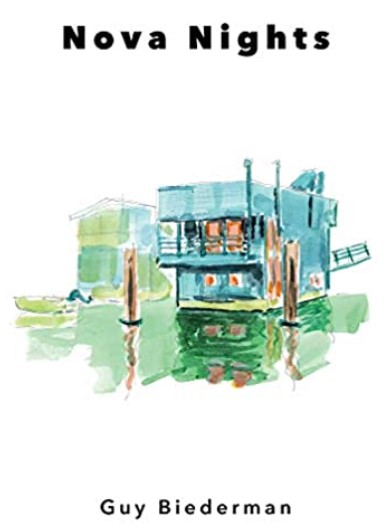
    Guy Biederman teaches short fiction and is the author of five collections of short work, including Nova Nights (Nomadic Pres,), Edible Grace (KYSO Flash Press), and Soundings and Fathoms, stories (Finishing Line Press).  

    His work has appeared in many journals including Carve, Flashback Fiction, MacQueen’s Quinterly, Bull, great weather for Media, Riddled with Arrows, The Disappointed Housewife, and Exposition Review.

    He’s been a creative-writing midwife since 1991. His collection of short work, Translated From The Original: one-inch-punch fiction will be published by Nomadic Press in 2022.

    You can purchase a copy of Nova Nights (and support a really great independent publisher).

    Note From Marlene: Right before I read “Crafting Short Fiction,” I sent off a submission to a contest with the theme of “imagine.” After reading “Crafting Short Fiction,” I was surprise to realize I created “room for readers who bring their imaginations to the page and make the experience their own.” At least, I hope that’s what I did.

    But when I wrote it, I didn’t know I was doing that. So, yay, for playing with words, making changes bonsai style for writing that opens the door for possibilities and also respects the reader.
    I like to think that’s what I did with my contest entry. And, maybe I did~!

    Your turn: Just write!
  • Pull

    Memorable writing that sparks imagination. Lean in. Hear the writer’s voice on the page.

    Pull

    By Guy Biederman

    Writing backwards, I row toward home.

    Note from Marlene:  Your turn. Write a story in six words.

    Guy Biederman teaches short fiction and is the author of five collections of short work, including Nova Nights (Nomadic Press,), Edible Grace (KYSO Flash Press), and Soundings and Fathoms, stories (Finishing Line Press).  His work has appeared in many journals including Carve, Flashback Fiction, MacQueen’s Quinterly, Bull, great weather for Media, Riddled with Arrows, The Disappointed Housewife, and Exposition Review, where he was twice a Flash 405 winner. Guy’s stories, prose, and poems have also won a Publisher’s Choice Award, an Editor’s choice Award, and been nominated for the Best of the Net.

    Born in the Chihuahuan Desert near the Mexican border, Guy grew up on a Sting-Ray in Ventura, learned to write in the Peace Corps during a civil war in Guatemala, honed his craft pulling weeds and planting flowers as a gardener in San Francisco, and later received his M.A. from San Francisco State, where his teaching career began.

    Guy has been a creative-writing midwife since 1991. His collection of short work, Translated From The Original: one-inch-punch fiction will be published by Nomadic Press in 2022.

    You can purchase a copy of Nova Nights here (and also support a really great independent publisher).

    #guybiederman #nomadicpress #unityinthecommunity #poetryislife #nationalpoetrymonth

    Meet Guy in [Zoom] person:

    May 5 and May 19, 2022: Guy will teach flash fiction writing. Free on Zoom through Recovery Writing of Idaho.

  • The Disappointed Housewife

    Notes from The Disappointed Housewife editor Kevin Brennan:

    “The Disappointed Housewife is a literary journal for writers, and readers, who are seeking something different. We like the idiosyncratic, the iconoclastic, the offbeat, the hard-to-categorize. Out of the universe of fiction, poetry, and creative nonfiction, we want to attract work that plays with form and presentation. Work that’s not just outside the box but turns the box inside out.”

    Excerpt from Mission Statement

    I took a long time debating whether to launch this literary journal. I wondered whether there’s really a need for another online gazette of literature and image, when readers hardly have time to read their friends’ Facebook pages much less an actual book now and then.

    But I got to thinking, there are an awful lot of writers out there, looking for places to share their work. And while blogs offer a kind of outlet for works of fiction, creative nonfiction, and poetry, they are generally personal, a lot like online diaries in many ways, and most of all they aren’t curated.

    I’ve also found, as a consumer of writing on the web, that I have a hard time finding much of the kind of material I’m really interested in. After a lifetime of reading, I have a taste now for something different. Stories that are made differently, that play with form and presentation.

    Publishing, as a business, tends to incentivize writers to produce what they think will sell.

    Yet there is a place for “high risk” writing, fresh, creative, experimental, idiosyncratic, idiomatic, iconoclastic writing. Writers should be allowed to have their quirks.

    So I decided to forge ahead with this project, to see what comes in over the transom when writers are given the flexibility to “think different,” as Apple used to say.

    I’m afraid that many writers will be disappointed that The Disappointed Housewife declines their work. But it will only be because the editors envision another way the piece could be a better fit, a way that better conforms with the journal’s proclivities. It’s not you, it’s us. Don’t be discouraged. We might suggest some possibilities to you, or you can try again with something that you write with us in mind.

    Just remember, this is the place to find writing (in all its manifestations) that you can’t find anyplace else.

    Submission Guidelines

    Thank you, Guy Biederman, for posting about The Disappointed Housewife on Facebook.

     Guy’s “Language of Lies” posted in The Disappointed Housewife.

    Meet Guy in [Zoom] person:

    May 5 and May 19, 2022: Guy will teach flash fiction writing. Free on Zoom through Recovery Writing of Idaho.

    #amwriting #justwrite #iamawriter

  • The Ekphrastic Review

    The Ekphrastic Review

    “We only publish literature inspired by or responding to visual art in some way. Our definition is flexible, but we are a niche journal and an ekphrastic writing archive and do not consider or publish non-ekphrastic work. Submissions that are not connected in some way to visual art will be deleted without response.” 

    Ekphrastic Mission

    The Ekphrastic Review is committed to the growth, expansion, and practice of the art form of creative writing inspired or prompted by visual art. 

    We define ekphrastic writing simply as “creative writing inspired by art.” The piece can be an in-depth experience of the art work, or it can use the art as a starting point for expression. The connection to the artwork or artist can be subtle, or it can be central to the work.

    Best Chances of Publication

    1. Ekphrastic translations. We are hungry for ekphrastic work from all over the world, in its original language, and translated into English.

    2. Stellar flash fiction, microfiction, small fictions: fiction from 50 to 1000 words.

    We have naturally evolved as a poetry-centric publication.

    We love poetry and always will, but we do receive a constant deluge of poetry, much of it stellar.

    We want to grow with great fiction. We like beautiful fiction that reads like poetry. We like interesting fiction. We like fiction that packs an emotional punch. We like fiction with language that stabs you in the heart, that you want to tape onto your fridge. We like fiction that shows us something new about art.

    Since we receive only a small fraction of fiction as we do poetry, and want to publish more, your story might stand a greater chance. Send your best!

    3. Ekphrastic Writing Challenges. Our biweekly prompt series is your best chance overall, as they are ongoing throughout the year. We have received as few entries as 10 and as many as 300, but we do publish multiple responses for each painting in one post, which gives you higher odds.

    Submission Guidelines

    Thanks to Guy Biederman for recommending The Ekphrastic Review. His piece, “Together Alone”, was accepted by The Ekphrastic Review

    #amwriting #justwrite #iamawriter

  • MacQueen’s Quinterly

    MacQueen’s Quinterly : Knock-your-socks-off Art and Literature publishes writing of a thousand words or less.

    “Short forms are deceptively difficult to write well, and although they take only a few minutes to read, the best resonate far longer than that. Perhaps for a lifetime. We’re dedicated to publishing such gems—please dive in to see the latest we’ve found for you.”

    Submission Guidelines

    Bonus Info:

    Guy Biederman is a successful contributor to MacQueen’s Quinterly.