The last Just Write post talked about writing a messy first draft.
Ready to start that messy project?
Or continue with something you are working on.
Here is a writing prompts to start the messy project:
Writing Prompt: Imagine you (or your fictional
character) received a greeting card in the mail. It can be from someone you
know or a character you create.
It can be from a celebrity.
It can be sent to the wrong address.
What does the card say?
How does the narrator react when reading the card?
Today’s guest blogger is Nancy Julien Kopp. Her blog, Writer Granny’s World features tips and treats about writing.
Her brilliant August 20, 2019 post (excerpt below) focused on how to use action with dialogue.
Fingers flying across keyboard, Marlene types, “On with the show, Nancy.”
How to show action when writing dialogue.
I see writers putting action after dialogue. That’s backwards.
Examples of action with dialogue.
A. “Stop that!” Sally slapped his hand from
her arm.
B. Sally slapped his hand from her arm. “Stop
that!”
C. “Stop that!” Sally said. Sally slapped his hand
from her arm.
Which is the best? The worst?
I think B is best.
And C is the worst.
In B, we see the action, then hear the words that go with
it.
In A, would Sally say the words, then slap his hand away?
Note from Marlene: This would be a “delayed reaction.” Sally says “Stop that.” THEN slaps his hand away. In real life, of course, it would happen at the same time.
Although it’s hard to show action and dialogue that happens
simultaneously, I think B does that.
Back to Nancy’s post:
Your mind sees the action in Example B, then absorbs the
words.
And C? Adding the tag is unnecessary as the action tells you
who is speaking.
Another example but this time adding feeling (or thought)
prior to the action and dialogue. It’s called the FAD Principle. Feeling-Action-Dialogue
“Susan knew Mary would take the biggest piece of cake. She
stepped between her friend and the table full of cake slices. ‘I’ll take
this one.’”
Feeling-Action-Dialogue:
“Susan knew Mary would take the biggest piece of cake. (Feeling/thought)
She stepped between her friend and the table full of cake slices. (Action)
‘I’ll take this one.’” (Dialogue)
In “The Art of Fiction,” John Gardener describes “the
fictional dream.” This is when the author has described a scene so viscerally,
the reader can see, feel, hear, taste, or smell what’s going on in the scene. Sensory
detail is important in writing, but how to achieve it?
Practice!
Try this:
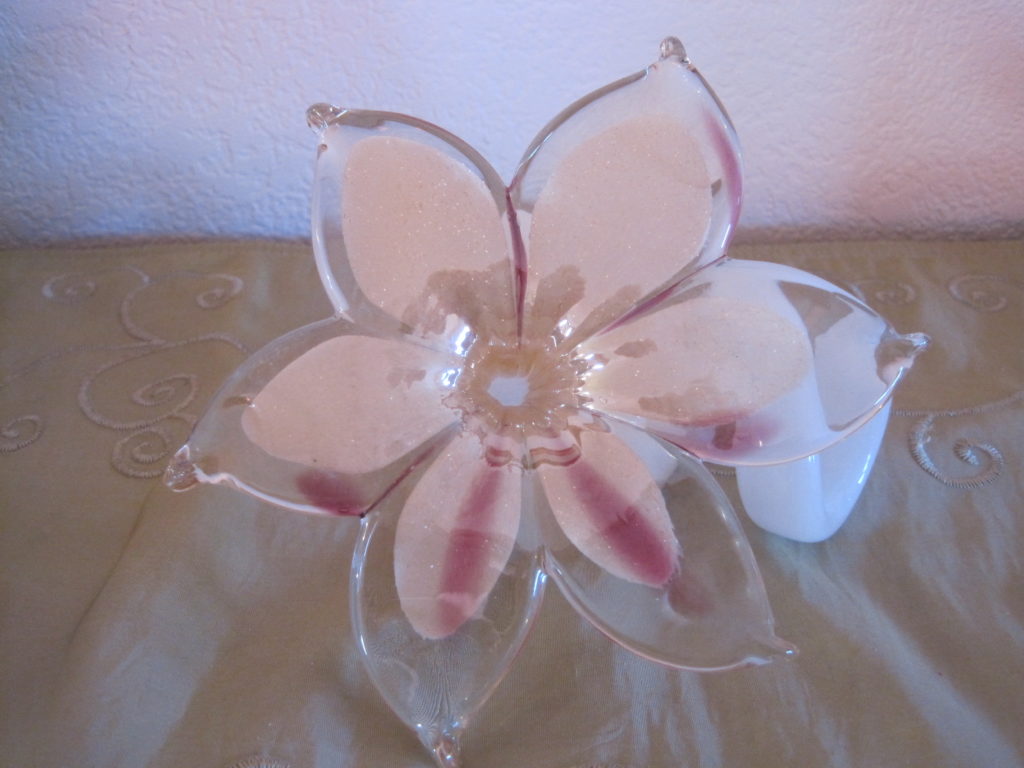
Study an object for ten minutes. It can be something you are wearing, an item on your desk or on a kitchen shelf. It can be something you use every day or a special item put away to keep it safe. You can describe the glass flower decoration above.
Notice the details of the object — the shape and texture.
Explore the pieces that make up the whole. Hold or touch the item. Notice the texture,
the heft. How does it feel? Does it have a smell? Look at the object from all
angles.
After ten minutes, write a description of the item so
thorough that a reader can imagine, see, feel, smell this object.
Next, if appropriate, write about a memory associated with
this object.
That’s it. This is great practice for writing details that enrich your stories with visceral elements.
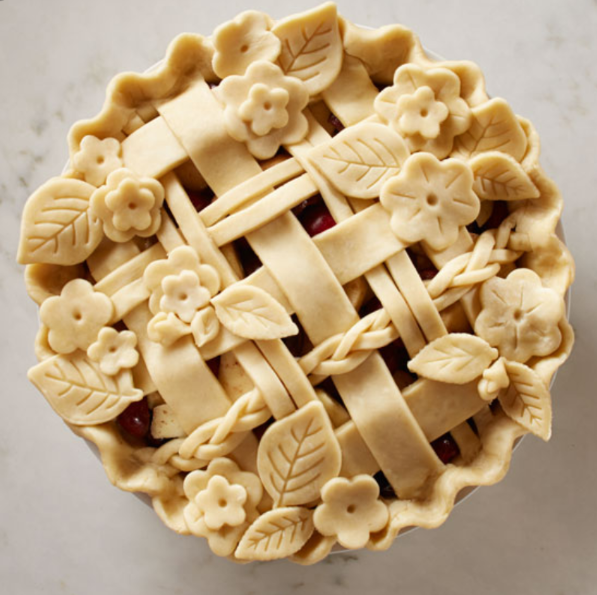
Like a pie crust, balance is sometimes tender and light, and
sometimes fails.
Sometimes we find balance. Then we totter. Then we regain balance. And totter again. And find balance once more.
Write about finding balance.
You can use any of these phrases for your writing prompt or use the image. Isn’t this a beautiful pie crust topping? Not something I made. But something I would enjoy eating!