
Armando Garcia-Dávila’s Youtube Talk inspired this prompt:
We don’t talk about that . . .
Just Write!
#justwrite #iamwriting #iamawriter
Armando Garcia-Dávila’s Youtube Talk inspired this prompt:
We don’t talk about that . . .
Just Write!
#justwrite #iamwriting #iamawriter

Note from Marlene:
Grant Faulkner’s musings on his Substack page are golden comfort to a writer’s soul, offering unique perspectives that inspire writing.
For example, his essay on “Surrender as Action Verb.”
“When we surrender ourselves to our art, we allow ourselves to soften. Surrender invites us to give ourselves up to something larger, to meld with wonder and awe. Surrender creates intimacy and expansiveness at the same time. It sparks curiosity, exploration. It’s the equivalent of going to sleep: by sinking into an unconscious state, we allow dreams to fill us. We give up trying to change and control things. The rigidities of expectations, desires, and aspirations melt away.
Think what would change if you allowed yourself to surrender in a conversation. What if you committed to listening, to let another’s words and spirit rise up and take you instead of focusing on your point of view, your needs. What if you decided not to try to win the next argument you find yourself in? What if you decide not to be the star of the conversation?”
Excerpted from “Surrender as Action Verb” on Grant Faulkner’s August 18, 2024 Substack: Intimations: A Writer’s Discourse.
More quotes from Grant Faulkner on The Write Spot Blog:
Writers: Open doors to flights of imagination
Just Write!

Birds & Blooms is a bimonthly magazine focused on the beauty in your backyard.
“Our magazine coves a wide range of topics such as attracting hummingbirds, building birdhouses, gardening for butterflies, growing veggies, plus a lot more.”
Good Luck!
“Alternate versions of past events are common, because it is human nature, especially where childhood memories are concerned, to move ourselves—over time—to the center of a story. We are hardwired to see the world through our own points of view, and increasingly so with the passage of time. Memory is a river, not a block of cement.” — “But My Sister Remembers It Differently: On Working with Contested Memories,” by Dinty Moore, Aug. 15, 2024 Brevity Blog.

Note from Marlene: I am very excited to share Jennifer’s post with you. Since my passion is how to write about difficult subjects without adding trauma, I am especially grateful to Jennifer for addressing this topic.
Jennifer’s eloquent writing on what she doesn’t know about her father is outstanding and an example of how you can write about “what you don’t know.”
Guest Blogger Jennifer Leigh Selig:
When I lead memoir writing retreats, I like to kickstart the mornings with writing prompts. One of the tricks of my trade is a manilla envelope stuffed with images I’ve printed out of vintage and iconic toys and games from across the decades. It’s a ritual I cherish—spreading these images out on the long conference room tables, imagining my students’ delight as they light upon a special toy or game that brings back fond memories, and then watching them begin to furiously write.
This last retreat was different. I found myself tearing up as I laid out the pictures of the Kewpie doll and the troll. I found those tears falling as I laid out the pictures of Clue and Yahtzee. So many of the toys and games took me back to my beloved grandmother’s house. This was the first retreat I led since her death at 102 years old. I was blessed with 60 years of my life with her. And now no more.
I wiped my tears away before anyone entered the room. Sitting alone in the circle, I wondered if there was any writing prompt I could give that wouldn’t trigger someone. Even asking: “Write a happy memory about your mother” is fraught with danger. What if someone has no happy memories of their mother? What if someone’s mother has just been diagnosed with a terminal disease? What if someone has no mother?
Then I remembered a writing prompt a teacher gave me that triggered a torrent of furious writing. I shared that piece with my students, to acknowledge that any prompt, no matter how seemingly innocuous, can stir something deep within.
For fifteen minutes, write about your father’s eating habits. Remember the journalistic imperative to include what, how, where, when, and why, all aiming to flesh out a deeper sense of who your father is. Follow the writer’s adage to write what you know.
I don’t know a thing about what my father eats. I don’t know if he peppers everything he eats with tons of salt or if sugar is his road to ruin. I don’t know if he frequents farmers’ markets for the freshest produce or if he stockpiles boxes of frozen food in his grocery store cart. I don’t know if he goes to the grocery store or if that’s the province of his wife. (I don’t know if my father even has a wife.)
I don’t know a thing about how my father eats. I don’t know if he’s a gentleman who savors each bite or a feral animal who wolfs down his plate. I don’t know if he smacks his food with relish, if he rests his elbows on the table, if he licks his fingers or knows to use a napkin. I don’t know whether he dives straight into a meal, or if he stops to thank God first. (I don’t know if my father even believes in God.)
I don’t know a thing about where my father eats. I don’t know if he eats standing up in the kitchen or if he takes a plate to the sofa where he can watch sports on TV. I don’t know if his taste skews toward fine dining establishments or all-you-can-eat buffets or if he prefers eating at home. (I don’t know where my father’s home even is.)
I don’t know a thing about when my father eats. I don’t know if he’s a creature of habit or if he eats when he’s hungry, regardless of the hour. I don’t know if he eats after smoking or smokes after eating, or if a happy-hour cocktail always precedes dinner. I don’t know if his children nag him for skipping a meal, or scold him for snacking all day. (I don’t know if my father even has other children.)
I don’t know a thing about why my father eats. I don’t know if he’s trying to gain or lose weight, to lower his cholesterol, to control his diabetes, or to stave off cancer. I don’t know if he eats when he’s stressed or he eats when he’s bored. I don’t know if he eats for pure pleasure or whether he eats to stay alive. (I don’t know if my father is even alive.)
If my father is no longer alive, I don’t know where he died, when he died, or why he died. I don’t know how he died, or what he was doing when he died. I don’t know whether he is interred in a tomb where coffin flies feast on his corpse or if he was buried at sea where fish nibble on his flesh or if they bled him out before they burned him to ashes and scattered him.
I cannot flesh out my father, Teacher. I cannot write what I know, because I do not know the flesh and the blood of my father.
___
As a writer, I was seething. Not seething at my teacher, though the prompt did seem presumptuous. But in the end, I’m glad I wrote to it. It was good to see how bad I still feel that half of who I came from is a ghost. This is the raw power of writing prompts crafted by others—when we open our memory bank, we have no idea if the coins will fall out heads or tails, or which is best for us.
So I tell my students—I’m going to give you writing prompts this week. Even if I don’t mean it to, any prompt may trigger distressful or traumatic memories. If you go there, it may hurt. If you go there, it may help.
It’s a coin toss, really.
Consider this your warning.
Originally published as “Should All Writing Prompts Come With a Trigger Warning?” By Jennifer Leigh Selig on the September 2 Brevity Blog.
Jennifer Leigh Selig is an LBGTQ+ teacher, book publisher, and author whose writing career spans nearly four decades. Her most recent book is Deep Memoir: An Archetypal Approach to Deepen Your Story and Broaden Its Appeal, a companion to her co-written Nautilus Gold award-winning book, Deep Creativity: Seven Ways to Spark Your Creative Spirit. Learn more about Jennifer and her writing classes and her publishing companies.
Your turn: I don’t know . . .
Choose a prompt from The Write Spot Blog and Just Write!
If the topic is difficult, please take care while writing.

What would you like to do when you get a chance?
What will it take to get that chance?
Should you leave it up to chance?
Or, can you make it happen?
Imagine. For a moment. That thing happened.
How would you feel?
What is the first step you can take to make it happen?
What would you need to change to make “it” happen?
If you can’t actually make it happen, can you write about it?
Can you write around it, over it, under it, through it?
Just write!
And maybe it will manifest. Whatever “it” is.
Prompt inspired by a line in Writing Your Parents’ Stories.

Balancing Facts With Narrative
“Fact-packed prose might feed the mind, but stories stir the soul. This is where structuring your narrative to build interest comes into play. The goal is to weave your facts into a story arc that escalates the wonder, making each page a gateway to the next surprise.
By balancing detailed factual content with engaging narrative structures and vivid scene-setting, you transform your nonfiction into a compelling story. This isn’t just information, it’s an experience, a journey through the phenomenal world of your subject that educates and enchants.”
— “From Ordinary to Extraordinary,” Ryan G. Van Cleave, Writer’s Digest Sept/Oct 2024

Rather than using a tired cliché, create your own phrases that might become popular and memorable. Like this one:
“ . . Maureen Seaton wrote beautiful poems the way some people eat potato chips.” — Mario Alejandro Ariza, “Writers on Writing,” Writer’s Digest, July/August, 2024
#justwrite #amwriting #iamawriter
Memorable writing that sparks imagination. Lean in. Hear the writer’s voice on the page.
Do Not Be Afraid to Write What You Know
By Mashaw McGuinnis
An acquaintance of mine texted after reading some of my novel-in-progress. “Don’t try so hard with stereotypical language and trailer park folks . . . I don’t buy it.” I wanted to disappear into the furniture, but instead I texted back a bumbling explanation that I wasn’t trying too hard, that the people in my stories are the people that I know, and I know them well.
I always dread sharing my work because my middle-class friends never believe me when I say my characters, experiences, and vernacular come directly from my own dysfunctional, lower-class upbringing.
By “lower class,” I mean more than low income or under-educated. I was raised by Dust Bowl migrant grandparents. Two generations back, only one had more than a seventh-grade education. Californians called them “Arkies” when they’d arrived hungry from Arkansas in the late 30s, searching for work. Like Steinbeck’s Joads, they picked fruit and cotton and slept in government camps in the Central Valley.
Eventually, my grandfather secured a union factory job, but their hardscrabble roots ran deep. My clan put the “hard” in hardscrabble. One aunt died from an overdose, leaving eight kids behind—two came to live with us. My spitfire grandmother went to jail for shooting three neighbors, and one Sunday fried chicken supper was interrupted with a drug-withdrawal seizure requiring an ambulance. When my grandparents died, they left nothing but a family tradition of grit.
These experiences—not unusual in my family—made for a wealth of material once I learned to write. But nothing prepared me for the responses I received from my fellow writers.
Over and over, I heard “you’re exaggerating” or “your characters are hyperboles.” (The first time I heard that I was too ashamed to ask what “hyperbole” meant.) In critique groups, workshops and conferences, I think of those people as “normies”—middle-class people, or often, upper-middle class people, who grew up wearing braces and taking college prep classes in high school, raised by parents who never threatened to kill each other or send the kids to foster homes. Their parents were either college-educated professionals, or they raised their kids to become that.
Normies in my workshops didn’t know the person sitting next to them resorted to winning TV game shows to pay for teeth that looked like theirs. Most would never suspect she’d barely squeaked by in high school with a “C” average or understand why she stumbled over the pronunciation of “cacophony.”
Writers like me—blue collar, less-educated, rough around the edges—whatever category we claim, we learn by reading. We may understand definitions, but don’t hear the words pronounced in a real-world scenario. If I ever used “cacophony” in a conversation with my relatives they’d assume I was playing a prank. I wouldn’t attempt to work these terms into conversations at conferences or workshops, lest I mispronounce them to people who tout their MFAs and Pushcart nominations. If only conferences could offer workshops in how to navigate through a roomful of educated, middle-class writers.
The normies’ families I most admired were upper-middle class—they went on vacations instead of parole. Their homes had real art. Their parents threw dinner parties. Mine had real guns and threw dinner plates. My scrappy upbringing was one of constant chaos. We didn’t have music or literature or own our homes, and we sure didn’t dream of college. We worried the next fist in the wall would get us evicted. Each family member used whatever tools we could to eat, sleep and keep working. Arkies were programed to survive, nothing more.
Recently, I finally came out in a private Facebook group for women writers. After reading for years about the other members’ publications, fellowships, and acceptance into acclaimed retreats like Hedgebrook, I fessed up. I asked if there were other lower-class writers, like me, who lurked in the shadows of the FB group, feeling like they don’t belong but not wanting to reveal their true roots.
Many members responded with their own versions of my story. Yes, their “normie” counterparts accused them of hyperbolizing their characters’ vernacular, confronted them on their described scenes, even settings. One woman said her critique group didn’t believe a trailer park would really have so much grass. The acquaintance who’d texted me her opinion of my chapter (and who assumed I was middle-class) once said to me that Pulitzer-Prize winner Barbara Kingsolver did a much better job of writing lower-class characters than I had done.
Where are the under-educated, lower-class writers with generational trauma supposed to fit? Like transplants from other countries, or people from mixed cultures, we don’t feel at home in either world. I can masquerade as a normie for the short term, but when you’re raised in a family that racks up jail terms like frequent flier miles, others eventually spot the squalor seeping through the cracks.
When I employed the help of a writing coach to help me craft an entry to a regional contest, he said, “That’s great, but it’s not the kind of award that will change your life.” I cobbled together the courage to respond, while fearing I’d sound like a character from Hee Haw to someone with his background. The coach taught MFA students, he’d won awards, and he was a fellow at some mucky-muck writer place. I struggled to explain how, for someone like me, a regional award felt life changing. (I omitted the part about how much I needed the $900 prize money.)
Someone in my Facebook discussion offered, “One thing working-class writers have over everyone else is a work ethic.” Now at 61, I realize what I concealed for so long is actually my biggest asset. More than anything to succeed, a writer needs tenacity. And as my tough-as-leather grandma once told me, “You want something bad enough, you’ll fight like a rabid dog to get it.”
I’m trying, Granny.
Originally posted as “Blue Collar, Less-Educated, Rough Around the Edges: The Other Marginalized Writers,” Brevity, August 19. 2024.
Mashaw McGuinnis started writing from bed while fighting chronic Lyme Disease. Her work has appeared in Good Housekeeping, The Sun magazine, and other publications. The opening chapter to her novel-in-progress won first place in women’s fiction at the Pacific Northwest Writer’s Association’s writing contest, and her flash memoir, “Taft, Ca.” was a recent winner in Writing by Writers Short Short contest. She has a high school diploma from Hueneme High School. Learn more about her work at Mashaw McGuinniss, Writer.
Before writing: Stretch.
Get comfortable in your chair.
Take some deep breaths in and release.
When you are ready:
List 3 things you don’t want to write about. Just a list.
List 3 things that happened a long time ago that you are still angry, resentful or hold a grudge about. Just a list.
List 3 things that happened this past week that made you mad. Just a list.
Prompt #2
Write: Choose one of those experiences. Write about it. Be as detailed and as explicit as you can.
When did it happen? Day of week? Time of day?
Where did it happen? Who was involved?
What were you wearing?
Remember to look up and breathe if the writing is difficult.
Write for 15-20 minutes.
When you are finished with this writing, shake out your hands. Breathe.
Intro to Prompt #3
You can use writing to shift your perspective. Sometimes you can’t change the situation that’s causing you pain.
You can change how you look at it.
Take a few minutes to rethink your experience that you just wrote about and see if you can find something hopeful about your encounter.
Even though you were affected in a negative way, maybe you can find something positive that came from it.
Even if your event was traumatic and extremely unpleasant, is there anything positive you can add?
Maybe after the difficulty you noticed that you changed your attitude, your way of thinking.
Maybe you learned something that was helpful. Or you saw things differently.
Or, maybe you regret what happened and think, “If only . . .”
Sometimes thinking “If only . . .” can help by learning from our actions or inactions.
Other times, thinking “If only,” can make us feel worse, we feel we should have done things differently. It feels like it was our fault. We blame ourselves.
Something that could help: Change to thinking “At least.”
Prompt #3
The “at least” idea comes from “The Power of Regret” by Daniel H. Pink.
Take a few minutes to write about something good —anything —that came from the experience you wrote about.
What did you learn that helped you?
Start by writing . . .
I learned . . .
Or: I realized . . .
Or: At least . . .
Prompt #4
Check in with your emotions. Take a few minutes to write about how you are feeling right now.
End on a positive note:
See yourself as a little child. Look deeply into this little child’s eyes. See the longing that is there and realize there is only thing this little child wants, and that is love.
Reach out with your arms and embrace this child.
Hold her or him with love and tenderness. Tell her how much you love her, how much you care. Admire everything about this child and say that it’s okay to make mistakes.
Now, let this little child get very small, until he or she is the size to fit into your heart. Put her or him there so whenever you look down, you can see this little face looking up at you, and you can give it lots of love.
Feel a warmth beginning to glow in your heart center, a softness, a gentleness. Let this feeling begin to change the way you think and talk about yourself.
Note: You can use these prompts over and over.
Make a date with yourself to continue writing. Choose a day and time to write Treat it like a doctor’s appointment.
For more information on writing about difficult subjects:
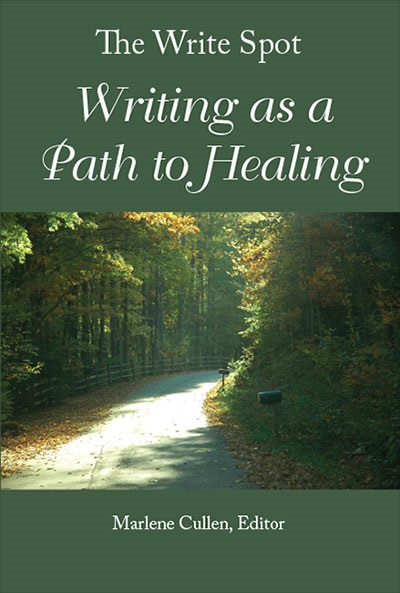
The Write Spot: Writing as a Path to Healing
Just write. No matter what!