Author: mcullen

  • You just have to fight your way through. — Ira Glass

    Ira Glass is host and producer of This American Life.

    David Shiyang Liu recorded Ira talking about storytelling.  In Part One of the interview, you can watch Ira in the recording studio. You can also read about parts two, three and four in the caption.

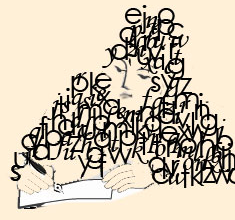
    In Part Three Ira talks about the creative process. Watch Ira’s words unfold in a whimsical way.

    Ira Glass, the art of storytelling (typed with minor modifications):

    Nobody tells people who are beginners, and I really wish somebody had told this to me, is that all of us who do creative work . . . we get into it, and we get into it because we have good taste, but it’s like there’s a gap.

    For the first couple of years that you’re making stuff, what you’re making isn’t so good; it’s not that great. It’s trying to be good, it has ambition to be good, but it’s not quite that good.

    But your taste, the thing that got you into the game, your taste is still killer and your taste is good enough that you can tell that what you’re making is kind of a disappointment to you.

    A lot of people never get past that phase. A lot of people at that point, they quit.

    The thing I would like to say to you, with all my heart, is that most everybody I know who does interesting, creative work . . . they went through a phase of years where they had really good taste. They could tell what they were making wasn’t as good as they wanted it to be. They knew it felt short. It didn’t have this special thing that they wanted it to have.

    Everybody goes through that. And for you to go through it, if you are going through it right now, if you’re just getting out of that phase . . . it’s totally normal.

    The most important possible thing you can do is do a lot of work.  Do a huge volume of work.

    Put yourself on a deadline so that every week, every month, you know you’re going to finish one story. It’s only by actually going through a volume of work that you’re going to catch up and close that gap. The work you’re making will be as good as your ambitions.

    Ira Glass

    In my case, I took longer to figure out how to do this than anybody I’ve ever met.

    It takes awhile, it’s going to take you awhile, it’s normal to take awhile.

    You just have to fight your way through that.


    Thank you, Janet Ciel, for originally calling this to my attention.

  • How are you? No, really . . . Prompt #61

    How are you?    No, really . . . How. Are. You.

    Not the usual, “I’m fine. Thank you.”  That just won’t do right now.

    Take a deep breath . . . in through your nose. Exhale through your mouth.

    A couple more deep breaths.

    Now, how are you?  Scan your body. .  . start with your head. How is your hair? How are your eyes?  How is your throat?  Your stomach?  Anything talking to you?  Any body part want attention?

    Write how you are. How you really are. Go deep. Take a big breath. Go deeper. Excavate. Dig in and grab those shadowy feelings. Give them words.  Give them names. Translate the murky feelings into words.

    Let your inner self guide you through new doorways.doorway.Breana

    Now, really. How are you?


    Photo by Breana Marie


  • Short may be the new long game.

    Jessica Strawser, editor of The Writer’s Digest magazine, writes about the benefits of writing short pieces in the March/April 2014 issue of the Writer’s Digest magazine.

    “Writing short is a too-often overlooked way to break out in any field of writing. Even if —perhaps especially if —your ultimate goal is to publish a book one day.”

    She continues, “. . . a diverse approach to getting your name ‘out there’ —whether through personal essays on popular websites, feature articles in leading glossies, or short stories in respected literary journals—is far smarter than focusing your efforts in one place.”

    So, if you want to write short pieces . . . go ahead!  Follow the prompts in this blog and post your writing here!

    Lola

  • Wordrunner eChapbooks now accepting submissions.

    Wordrunner eChapbooks: Small Fiction Collection

    Submissions for this fiction collection, to be published online in June 2014, will be accepted until May 31, 2014.

    Stories may be flash or longer, from 750 up to 4,000 words each, totaling a minimum of approximately 8,000 and a maximum of 18,000 words for the collection. We would like at least five stories, but no more than 20 (if flash fiction). They need not be linked, but it would be a plus if they belong together for some reason, be it theme, location or character/s. We will also consider novel excerpts for this echapbook. There is no fee to submit and authors receive token payment.

    Submit your best work only. Each story should be original and compelling. No genre fiction, please, unless a story is good enough to transcend genre. Click here for additional guidelines and submission link.

    Arlene Mandell.ScenesArlene Mandell‘s memoir Scenes From My Life on Hemlock Street  was first published by Wordrunner eChapbooks (December 2009) and  is now available in paperback and e-book in Turns: A Collection of Memoir Chapbooks from Telling Our Stories Press (June 2012). On Amazon or Smashwords.


    Jo-Anne Rosen

    Jo-Anne Rosen, Wordrunner eChapbook publisher,  prepares any sort of publication for print or electronic distribution. She provides pre-publishing services and a chapbook press for self-publishing authors, as well as website design, building and maintenance. For more information, visit www.wordrunner.com or contact Jo-Anne at publish@wordrunner.com.

  • Guest Blogger Hal Zina Bennett – Transforming Your Inner Critics

    Guest Blogger Hal Zina Bennett writes about our inner critics.

    Most of us writers are plagued by inner critics, those still small voices that speak from within, asking unsettling questions such as: “What makes you think you’re a writer?” Or, “This is drivel.” Or, the classic, “Don’t leave your day job.” Everyone has these inner critics, though some of us find their voices louder or more cutting than others. In their most insidious form, we feel these inner critics as our own self-judgments, not truths that we must accept. The author Storm Jameson put it well: “There is as much vanity in self-scourgings as in self-justification.” We write a few lines or pages that upon our review are “just terrible.” Instead of just rewriting or editing them, we point to them as evidence that we really can’t write.

    It’s difficult to accept that these inner critics, who stop us in our creative tracks, are within us; they may have originated through events that happened in our past but today exist only in our minds. To free yourself of these inner critics’ influences only when you own them, fully acknowledging that you yourself are creating them today. If you can own your inner critic, you have a choice — to cling to their judgments or not. Try to push them away and they only grow stronger, arguing like willful children or belittling parents. You can let them go, let go of your attachment to them. How? Start by making them characters in a story or in vignette you write in your journal. Describe them in detail, the more detail the better. Give the color of their eyes, the color of their hair, their body type, their voice, their stench.

    C. G. Jung encountered a form of inner critic in what he called the animus. His experience, reported in Memories, Dreams, Reflections, was that the animus, or inner critic, has its most powerful impact on our emotional life only when it remains unconscious and unnamed. As long as it is unconscious and unnamed, we experience it as inseparable from us. We can feel quite attached to their harsh criticisms.

    Jung found that by “personifying” them we essentially “strip them of their power.” They still exist in our psyches but are better able to take their harsh judgments with a grain of salt. As writers, we can even use them as seeds for characters in our stories.

    If you’re plagued by a particularly bothersome inner critic, recreate them as a character in a story. Satirize them, if you wish. The more you’re able to give them a reality on paper, the more you will be able to accept them as having a right to own opinions, their own distorted pictures of you. The more real they become on paper, the greater will be your choices about accepting or rejecting what they say about you. I’m convinced that some of the world’s most memorable villains were created in this way—and in the process their creation has defused their power as inner critics.

    Hal Zina Bennett is a bestselling author of more than 30 published books, including Write Starts: Prompts Quotes and Exercises to Jumpstart Your Creativity, from which this article was excerpted.

    Bennett.Write Starts

    Permission has been granted for use of the requested passage from the book Write Starts. Copyright © 2010 by Hal Zina Bennett. Reprinted with permission of New World Library, Novato, CA. www.newworldlibrary.com.

  • The temptation is to lie. . .

    If we become honest in our talking and dealing with people, if we go deep and tell the genuine truth, will that carry over to our writing? And will we then go deep and become authentic in our writing?

    The temptation is to not go where it hurts. The temptation is to lie in order to resist the painful truth.

    I recently read Pack Up the Moon by Rachael Herron and The Interestings by Meg Wolitzer. Both of these authors went deep in their writing and the resulting books are genuine, authentic and fabulous reads. . . where the characters and their problems deeply touched me.  Rachael and Meg did not resist writing about painful truths.

    How about you? Can you recommend books that deeply touched you?  What other authors go deep in their writing? I can think of Jodi Piccoult. Your turn.

    Sorensen

    Photo by Kent Sorensen

  • Something that gets you in trouble . . . Prompt #59

    Write about something that always get you, or your fictional character, in trouble.

    Breana.TigerPhoto by Breana Marie

  • You may have the da Vinci Disease . . .

    Have you heard of the da Vinci Disease?

    Here it is:  You have ideas of what to write about. But you never finish because you never start.  Or you start and can’t find a way to finish to your satisfaction.

    You may have a burning desire to write, but there’s never time or maybe you suffer from the da Vinci Disease.

    The following is excerpted from “The da Vinci Disease,” by Don Fry, March 2014 issue of the Writer Magazine.

    Leonardo da Vinci never finished anything because he thought he couldn’t achieve perfection.  We all know writers, including ourselves, who can’t (or don’t) finish their work. The root cause is usually a da Vincian rage for perfection, which takes many forms.”

    Don Fry’s list of why we don’t finish our writing. Italics are Marlene’s comments.

    We don’t start. ‘Nuff said.

    Too much gathering.  Some writers keep gathering information but never start actually putting words on the screen. They want perfect information. Raising my hand here. Guilty!

    Faulty Organizing. Many writers never finish because they can’t organize their information into what they regard as a perfect structure.  This isn’t about organizing your desk nor files, rather what you want to write and how. Guilty. Again.

    Drafting, drafting and more drafting. Many writers never finish drafting because they try to write a perfect first sentence. Gulp. Is there a miniature Don Fry sitting on my desk watching me?

    Endless Revising. Many writers simply cannot let go of a piece until they believe it is perfect.

    Don, I hear ya and I admit to all of these. So, please excuse me. I’m on deadline to finish a short piece I’ve started, gathered, organized and drafted.  Time for that final edit and then.  . . tap the send key.

    To read more about The Da Vinci Disease by Don Fry, click here.

    Leonardo da Vinci


  • All Fools Day . . . Prompt #58

    The roots of All Fools Day date back to at least the 1500s as an occasion to perpetrate tomfoolery, possibly in reaction to spring’s mercurial weather. It’s observed on April 1 in many Western countries.

    In Italy, France, Belgium, and French-speaking areas of Switzerland and Canada, pranksters cry “April fish” as they tape paper fish to people’s backs.

    In 1957, the BBC pulled a prank, known as the Swiss Spaghetti Harvest prank, where they broadcast a fake film of Swiss farmers picking freshly-grown spaghetti. The BBC were later flooded with requests to purchase a spaghetti plant, forcing them to declare the film a prank on the news the next day.

    Source:  Wikipedia 

    Prompt:  Write about pranks you used to play on April Fool’s Day, a prank pulled on you, or make up a story about how April Fool’s Day started.

    Court Jester