Blog

  • Friends . . . Prompt #249

    I met a new friend recently. As we emailed back and forth, I felt as though it was destined for our paths to cross.  So far, ours is an internet relationship. No, we didn’t hook up via Match.com. Rather, I found Author, Blogger and Ghostwriter, Holly Robinson, while researching another author.

    Today’s writing prompt is inspired by the glorious feeling of making a new friend.

    Writing Prompt: Write about making a new friend.

    Or, write about someone you have known for awhile. A friend you can call night or day. A friendship that is as comfortable as a pair of soft jeans. Someone who has been with you through thick and thin.

    Write about your new, or old, friend.

    Make new friends, but keep the old. One is silver and the other is gold.

    Holly RobinsonAnd now, I’d like you to meet my new friend, because her writing journey might encourage you to keep writing.

    Holly Robinson’s Unofficial Biography

    I never meant to be a writer.  I studied biology in college because I either wanted to be a veterinarian or a doctor – preferably one of those doctors who’s always jetting off to villages in Africa or Tibet to save thousands of lives while wearing one of those khaki vests that’s mostly pockets.  But life intervened during my last semester of college, when I had to take one more elective and I chose a class in creative writing with a professor who started out by telling us that writers are born, not made.

    I believed him.  I was sure that I couldn’t have been born to be a writer, because I’d never imagined myself as one.  In fact, I had never even met a writer.  The only thing I knew about most famous writers was that they were unhappy, drank themselves into oblivion and eventually stuck their heads in ovens, shot themselves, or got run over by streetcars.  Who would want to be a writer, if that’s what happened to you?

    Yet, from the moment I sat down to write, I became completely absorbed in my work.  Unlike my clock-watching sessions trying to learn physiology or organic chemistry, whenever I was writing seven hours could pass like seven minutes.  To the horror of my parents, I abandoned the idea of medical school.  I promised them that, if I didn’t get to be rich or famous (preferably both) in one year,  I would let common sense rule and find a real career, something that required an advanced degree and letters after my name.  Something with a steady paycheck.

    Of course, none of that happened.  A year went by.  Two.  Three.  As I became even more engrossed in the writing process, I did what all writers do to support my secret habit:  I worked a thousand odd jobs, from proofreading telephone books (really) to construction.  Along the way I earned an MFA in creative writing at the University of Massachusetts in Amherst.  Some of my classmates there were talented, even brilliant writers, but not all of them became successful.  In fact, as I look back on it now, I realize that the most successful writers to emerge from my program were the ones who were scarcely noticed at the time.  They weren’t necessarily the flashy ones at parties or the award winners.  They certainly weren’t the ones who sat around in pubs chatting about the cabins they would build in the woods with the advances from their first novels.  No, the success stories were the hard workers, the writers who spent a lot of time alone, churning out rewrites and new pages every week.

    After finishing my MFA, I meandered into journalism, marketing, and teaching jobs.  Most were enjoyable, but none were as deeply satisfying as writing on my own.  I kept at it, filling up the corners of my life and lots of paper with words and more words.  Every now and then I sent something out and got rejected.

    I got married, had children, got divorced, got remarried, had another child.  I worked, too.  All of that took time.  A lot of time.  Still, I kept writing:  at night after the kids were asleep, on weekends at the playground while my kids were eating sand.  Years slipped by with nothing published other than a couple of literary stories and a few newspaper articles, but I was happy.  Writing for me had become  an escape, not away from my life, but into myself, in a life where family responsibilities and work deadlines tried to jimmy themselves into every free minute.

    And then a funny thing happened:  as I navigated the strange process of getting divorced and getting married again, all while trying to stay friends with my ex-husband, I read an essay by Joyce Maynard in Redbook magazine about being a single mom.  And I thought:  Hey.  I’d like to write something like that.  So I did, in response to a literary contest.

    To my surprise, I won an award in the contest.  This gave me the courage to pluck the name of an editor off the masthead of Ladies’ Home Journal magazine — something the writers’ guides tell you never to do – and send it to her.  The editor bought it.

    Note from Marlene:  A similar thing happened to me. Won a writing contest, which inspired me to continue writing. You can read the rest of Holly’ story here

    To sum up:

    Your [writing] success will be determined not by some miracle of genetic inheritance, but by your own persistence.  We each find our own paths.  Believe in yourself and put in the hours.  The rest will follow.
  • Is there a ghost in your future?

    Guest Blogger Holly Robinson writers about ghost writing:

    Recently, I appeared on a radio show to promote a literary event. We were talking about my latest novel, but inevitably the host asked, “So you’re a ghostwriter, too? Who have you written for?”

    I laughed and gave my standard answer: “Sorry. If I told you, I’d have to kill you.”

    “But don’t you even care if your name’s not on the cover?” he asked, sounding offended on my behalf.

    The truth? No. I write novels, essays, and articles under my own name, but when I’m ghostwriting, my job is to stand behind the curtain and channel a voice.

    By now, I have ghosted over twenty books. I fell into the profession accidentally when my agent, who knew I’d studied biology in college, asked if I’d be interested in helping an editor fix a messy health book written by a doctor. In other words, I was the book doctor to the doctor. It was fun, and it paid enough that I started fantasizing about taking out smaller college loans for my kids.

    Fixing that one book quickly led to another. The jobs seemed to fall into my lap. Ghostwriters may be invisible to the public, but editors know who’s behind the curtain. Gradually I expanded my projects from just health and science books to include memoirs by business executives, cookbook authors, and celebrities. I was being introduced to whole new worlds both on the page and off.

    These projects also led me to develop more creative ways of working, since one reason celebrities make all of that money is because they never sit still. I interview my clients in person occasionally, but more often by phone, as the client rushes to the next TV shoot or salon appointment. One actress was so busy on a stage production that she had to answer my questions via Dropbox; I fed the questions to her talent agent, who then sent me audio files of her responses. Another actor could call me only late at night, after hosting his TV show.

    “I bet you hate not being able to write fiction full-time,” a friend said recently, when I mentioned a new ghostwriting project. “I mean, it’s not like a book is really yours if you’re ghostwriting it, right?”

    Yes, it’s a little surreal to walk into a bookstore during an author event, as I did recently, while someone else is reading a chapter I wrote—especially in a sonorous male voice very unlike my own. It’s often difficult for me to sit quietly in the audience without shouting, “Hey! Read from chapter four! That’s the really exciting part!”

    But, once you finish ghosting a book, it’s not yours anymore. The book now belongs to your client, as well it should. And writing these books is a gold mine for a fiction writer like me who is interested in studying character development, new settings, and how to build narrative tension. “Ghostwriting” can mean anything from developing a messy partial manuscript to riding shotgun through another person’s life in real time. Sometimes I’m acting as a journalist, researching background material. More often, I’m in a therapist’s role, asking, “How did you feel when that happened? What impact did that have on your life?”

    My goal is to ferret out the truth of a story. I love hearing a client say, “Wow, I can’t believe I just told you that,” because then I know we’ve got something raw and real that we can polish and share.

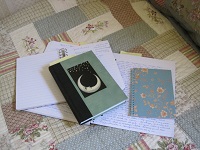
    Journals on quiltOnce I’ve gathered the material I need, I become a quilter. I remember my grandmother laying out her swatches of fabric on the living room floor until she found patterns that pleased her. That’s what I do, too: I take these fascinating scraps of material from people’s lives and piece them into unique patterns. Yes, I might add my own touches with the hand stitching, but that is strictly ornamental. The tone and cadence should belong distinctly to my client, so that anyone who reads the book can recognize the voice.

    The longer I do this work, the more honored I am. I have learned to banish my own experiences and expectations of what a story “should” look like. Instead, I let the pieces emerge and fall around me in an infinite variety of patterns, so that I can piece together powerful stories that deserve to be told.

    Originally posted on Holly’s Blog, February 24, 2016.

    Novelist, journalist and celebrity ghost writer Holly Robinson is the author of several books, including The Gerbil farmer’s Daughter: A Memoir and the novels Beach Plum Island and Haven Lake. Her articles and essays appear frequently in The Huffington Post, More, Parents, Redbook and dozens of other newspapers and magazines. She and her husband have five children and a stubborn Pekingese. They divide their time between Massachusetts and Prince Edward Island, and are crazy enough to be fixing up old houses one shingle at a time in both places.

  • What did you expect? Prompt #248

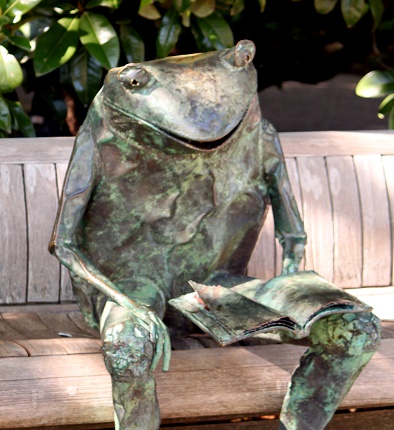
    Frog by Jeff


    Today’s writing prompt: What did you expect?

    Don’t think about it. Write about it.

    As soon as you can, write your response, your first reaction to What did you expect?


    Pro_Deluxe Photography by Jeff Cullen

  • The Blotter Magazine might be perfect for you

    The Blotter MagazineIs The Blotter Magazine a good place for you to submit your work? Maybe. Read on.

    “The Blotter Magazine exists to nurture underground, outsider literature and art and to provide it to a wide audience. We believe that the economic viability of good art and writing should not interfere with its life, liberty, or happiness; and we deliberately seek to avoid the pretension and “overintellectualism” for which the world of literature and art has become known. Our goal is to treat contributors, donors, and readers alike with dignity, friendship, and respect.

    The Blotter Magazine is a 501(c)3 non-profit organization. That organization currently publishes The Blotter Magazine and is pursuing a book-publishing venture. . . . In May, 2003, the magazine began distributing free at selected newsstands in the North Carolina Triangle area. Since then, our free distribution has expanded to other fine cities in the Southeast. We also ship subscriptions throughout the United States.

    Our editorial direction draws equally from classic and mundane, sublime beauty and a good Saturday-morning sugar buzz. What would be fun for our readers? What would yank their chains? What would make them laugh, or cry? How can we teach old dogs a new trick or two? Every emotion is fair game.”

    Note from Marlene: I say “go for it.” The Blotter Magazine sounds like a fun and interesting place to submit your work.


  • New ways of looking at old- Prompt #247

    If you have been writing for awhile, you might notice that you keep writing about the same things over and over again: how Aunt Luella always sticks her nose in everybody’s business; how Uncle Ray tells those awful jokes and doesn’t seem to notice that no one laughs; how Nonna’s getting on everybody’s nerves, should Aunt Silvie be put in assisted living and what the heck is up with Joey’s latest tattoo?

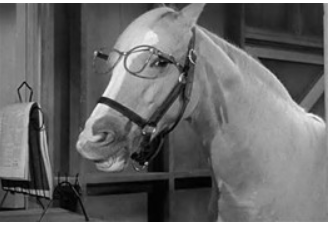
    Mr. Ed The Talking HorseWe all have our stable of characters that we dwell about incessantly. Here’s an opportunity to look at old things in new ways. Inspired by the poem, The visible and the in-      by Marge Piercy

    Read the stanza below (or the partial stanza), then quickly make a list of everybody this reminds you of. No prolonged thinking. You can always add names later.

    Ready? Go!

    First stanza of The visible and the in-:

    Some people move through your life
    like the perfume of peonies, heavy
    and sensual and lingering.

    This reminds me of:


    Some people move through your life
    like the sweet musky scent of cosmos
    so delicate if you sniff twice, it’s gone.

    This reminds me of:


    Some people occupy your life
    like moving men who cart off
    couches, pianos and break dishes.

    This reminds me of:


    Some people touch you so lightly you
    are not sure it happened.

    This reminds me of:


    Others leave
    you flat with footprints on your chest.

    This reminds me of:


    Some are like those fall warblers
    you can’t tell from each other even
    though you search Petersen’s.

    This reminds me of:


    Some come down hard on you like
    a striking falcon and the scars remain
    and you are forever wary of the sky.

    This reminds me of:


    We all are waiting rooms at bus
    stations where hundreds have passed
    through unnoticed and others

    have almost burned us down


    This reminds me of:
    and others have left us clean and new
    and others have just moved in.

    This reminds me of:


    That’s it. You can leave this as-is. Or the next time you write about Sophie and how she stole your lipstick in seventh grade. . . use some of these descriptions to expand upon her character, to draw out this experience with specific detail.

    Of course this will work for fictional characters, also.

    Have fun with this. Recreate the characters (real and imagined) who populate your real estate.

  • A poem, from the inside out . . . Prompt #246

    Today’s prompt is inspired by Poet Georgia Heard, who suggests the following as a way to create a poem from the inside out.

    Choose something on your body: a strand of hair, a nail, a ring, glasses, a belt, a necklace, an item of clothing, a freckle . . . anything!

    1. Describe the object with as much detail as possible.
    1. List all the feelings that the object evokes. Be specific.
    1. Create similes for the object: It is like. . . It reminds me of . . .
    1. Put yourself in the place of the object. Take on the voice of the object and write from the object’s perspective.

    Take your time with this. Read what you have written. Add anything that comes up while reading.

    Take a few moments to reflect. Settle in with what you have written. When you feel done with this part, go on to the next, the poetry part.

    You don’t have to rhyme, or follow any rules when writing your poem. You simply need images and inspiration and emotions. Anger, pain and bursts of joy are perfect material for poetry.

    Do not strive for perfection. This is still the freewrite phase of writing.

    When you are done and completely satisfied, then . . . set your writing aside for a day or two.

    Come back to it when you are ready to revise and polish. Then set it free: Share with a friend, submit to a journal, post on The Write Spot Blog. We would love to read your inside out poem.

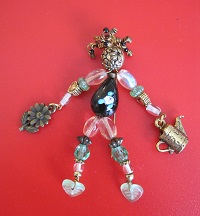
    Watering can girl. J.Pierce


    Girl with watering can and daisy, beaded pin by J. Pierce.


  • The First Poem — Lucille Clifton

    Night Sky. Colby Drake

    “Poetry began when somebody walked off a savannah or out of a cave and looked up at the sky with wonder and said, ‘Ah-h-h!’ That was the first poem.” — Lucille Clifton

    Photo by Colby Drake
  • Got fiction, essay , poetry, art? West Marin Review wants.

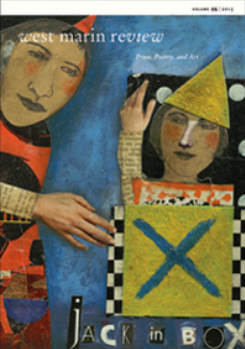
    West Marin ReviewFiction! Essays! Poetry! Art! Got any? West Marin Review, a literary and art  journal, wants ’em.

    Deadline:  September 1, 2016. West Marin Review is such an upbeat publication, this should be called Upline: September 1, 2016.

    Need ideas for material to write about? Click Prompts. Choose one and write. Edit. Submit.

    West Marin Review Submission Guidelines.

    Cover art for current issue of West Marin Review.


  • Imagine that . . . Prompt #245

    Have you heard of imagist poetry?

    “Imagism called for a return to what were seen as more Classical values, such as directness of presentation and economy of language, as well as a willingness to experiment with non-traditional verse forms. Imagists use free verse.”  Wikipedia

    The Red Wheelbarrow, by William Carlos Williams (1883 – 1963) is an example of an imagist poem.

    so much depends

    upon

    a red wheel

    barrow

    glazed with rain

    water

    beside the white

    chickens.

    There have been many discussions and theories about this simple little poem.  Was it meant to be simple, or is there hidden meaning, plumbing the depths of our sub-conscious?

    “I was fumbling around, looking for a way to make sense of my life, and seized on William Carlos Williams’s poems . . .  His poems were experimental yet safe—a combo I craved in my extra-dark teenage years.”  Craig Morgan Teicher, Poetry Foundation

    One teacher describes imagist poems as “use of exact words, avoid clichés, create new rhythms, freedom  of subject choice, presents an image, is tight/distilled/concentrated, and uses suggestion rather than stating things directly.” This teacher said, “Post WWI, people lost a lot of hope in religion and Williams was commenting on this. ”

    The teacher elaborated:

    “So much depends

    The use of 3 words in the beginning is a reference to the holy trinity.

    a red wheel

    barrow

    The second stanza: barrow is separated from wheel. “Barrow” is a large mound of stones, which symbolize Christ’s burial. “Red” represents the blood of Christ.”

    The teacher continues: “A wheelbarrow is used for hauling things, much like Christ carried mankind’s burden on himself. There’s transmogrification happening (unusual transformation). The wheelbarrow becomes Christ, the rain water symbolizes Holy water, and the white chickens represents angels.”

    Or, as another teacher said, “Williams, a country doctor, had been up all night with a sick child. He may have looked out the farm house window and saw this scene.”

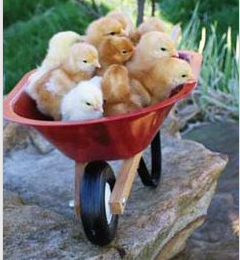
    Red wheelbarrow and chicksWhat do you think?  Is The Red Wheelbarrow full of hidden meaning, or is it a simple American haiku?

    Today’s Writing Prompt:  Write an imagist poem. Use any or all of these words:  tricycle, put, truly, blue, roll, next, afraid, upon, shape.


  • Is serialization in your future?

    Guest Blogger Daedalus Howell reveals a tried and true method to reach new audiences.

    The revolution will be serialized. As it’s always been. Much of episodic entertainment, from our favorite shows on Netflix or premium cable to the summertime superhero blockbusters, are issued in discrete elements that comprise a whole story. Comic books have long functioned in this manner, ditto popular literature, which was once serialized in newspapers. And, of course, there’s the staggeringly popular Serial podcast, which not only popularized a new storytelling medium but so embraced the concept of serialization that it branded itself with it. Clearly, serialization is back, representing to some, a vanguard in publishing. It can also be an integral part of your creative process.

    Howell.Quantum DeadlineThis is what I’ve found creating Quantum Deadline, a sci-fi crime romp that comically explores the death of newspapers through the foggy lens of a reporter tripping through the multiverse. Like many authors, my project found its first iteration as a National Novel Writing Month novel — one November, I arranged 50,000+ English words in a manner that produced the general effect of a novel. Despite the fact that the result was an unholy (if occasionally inspired) mess, I remained committed to seeing it through the bitter end of a Kindle download.

    I put it in the proverbial drawer through the winter to cool and found when I exhumed it the following spring, I was ready to rewrite it. That said, there is no “National Rewriting Your Novel Month” and I loathed the notion of working alone sans the esprit de corps I’d experienced with NaNoWriMo.

    I tried. I failed. I had no sense of accountability or “ticking clock” to compel me back to the work. Not that I was enthralled with the prospects I perceived in the book, it’s just that, as a career-long newspaper columnist, I’d grown accustomed to a weekly deadline. And someone to enforce it. With a speculative, self-generated project like Quantum Deadline, there was neither a deadline nor an irate editor to make me deliver. That’s when I began to contemplate serialization. I needed to feel accountable and I needed a schedule — two aspects of serialization that I theretofore hadn’t realized were possibilities.

    Moreover, I suspected serialization would allow me to “course correct” if I found that my readers were losing interest or recognize possibilities in the work that I hadn’t. I think of it as akin to The Lean Startup concept of creating a “minimum viable product” that allows for pivots between plot points.

    “The fundamental activity of a startup is to turn ideas into products, measure how customers respond, and then learn whether to pivot or persevere,” writes Eric Reis, The Lean Startup’s main advocate and author of a popular business tome of the same name.

    If we replace the term “startup” with the word “writing,” the path to serialization becomes self-evident. Instead of hunkering down, alone in the back of a Starbucks, the premise of releasing iterations of your work while refining it allows you the opportunity to grow and create community around it in the meantime.

    The trick is to be responsive to the concerns of your readership rather than defensive. You’re creating a feedback loop, not a combat zone. You don’t need to completely alter the vision of your paranormal YA romance when your readership is flagging, nagging or otherwise bagging on your work. However, you do have the opportunity to make adjustments in the next installment (and retroactively as well — serial readers are very forgiving, I find, so long as you point to relevant changes that improve their enjoyment of the work).

    Likewise, authors are advised to read Austin Kleon’s excellent book Show Your Work!, which extols the virtues of sharing your creative process as a means of cultivating an audience. Much in the same way film studios invite entertainment reporters on set to drum up interest in a film prior to its release, Kleon suggests sharing your process and inspirations as you create. This notion also dovetails nicely with “rewriting in public” through serialization.

    Writing a serial not only creates both context and momentum for one’s creative output, it cultivates community with your work as its rallying point. Chapter by chapter, week by week, you steer us deeper into your creative world — a world we may not have seen were it not for the revolutionary resurgence of the serial. As Gil Scott-Heron said, “The revolution will put you in the driver seat.”

    Note from Marlene: The “Now What” feature of National Novel Writing Month supports  “the revision and publishing process. It’s an extension of our anything-goes, wombat-infused noveling philosophy, with the added aim of helping you fulfill your novel’s potential: from first draft to final.”

    Daedalus will be the April 21 Writers Forum presenter, talking about, “Write Who You Know: How to Use Your Personal Life in Your Fiction And Memoir Writing Without Ruining Your Relationships.”

    Daedalus Howell is the author, most recently, of Quantum Deadline. He hosts the Culture Dept. podcast, is a radio personality on KSVY and KSRO, hosts the TV show 707, and blogs for Men’s Health and Petaluma’s Rivertown Report. Otherwise, he’s at DaedalusHowell.com.