Blog

  • Writing and editing is like sculpting a garden

    I love to work in the garden, pulling weeds, and occasionally being creative with new plantings. I love tugging at weeds and hearing the slrrp as they surrender their grip and let go. Writing is a lot like weeding . . . letting go and enjoying the moment. Not always worrying about the end product; just enjoying the moment of complete surrender.

    Later, after the writing seedlings have sprouted, it’s time for editing, which is a lot like pruning. When I’m pruning a fruit tree or a rose bush, I make a few snips, stand back to see how it looks and how it’s shaping up. It’s the same with editing. . . . make a few changes, then re-read. Keep what’s good and continue pruning until the piece has shaped to satisfaction.

    Crepe Myrtle & Sage 8.09

  • Yard sale, garage sale, tag sale . . . Prompt #91

    Yard sale, garage sale, tag sale. . . whatever you call ’em, what do you think about ’em?

    Or . . . write about an unusual find at a yard sale, garage sale, tag sale . . . whatever you call ’em.

    renoir dancingSandy's birdhouse    IMG_1442

  • Freewrites. . . what do you call them?

    When you are writing in a “freewrite” style of writing, using the types of prompts suggested in The Write Spot Blog, you can use your personal experiences for your writing. Or you can write about something that happened to someone else. Or you can write fiction. If you are writing fiction, respond to the prompt the way your fictional character would respond.

    Freewrites are also referred to as free flow writing, free association, writing freely and I’m sure there are more descriptions for this type of writing.

    Writing prompts are also referred to as: sparks, jumping-off points and, again, I’m sure there are more references to writing prompts.

    bookphoto I’m curious and interested. . . what do you call this type of writing? And what other phrases do you use for writing prompts?

    Whatever you call this form of writing and whatever sparks your imagination . . . Just write.


  • What I know . . . Prompt #90

    What I know . . .

    Write whatever comes up for you.

    StatueManJane

    Photo by Jane Person

  • West Marin Review accepting submissions

    West Marin Review, a literary and arts journal published by Point Reyes Books and Neighbors & Friends, is now accepting submissions of literary works, poetry, and visual art for Volume 6, for publication in 2015.

    Submission Deadline: September 1, 2014

    Click here for submission guidelines.

    Submit only unpublished work in all categories (excerpts from blogs are okay).

    Prose and poetry may be submitted online or through U.S. Mail. Visual art may only be submitted through U.S. Mail. 

    Submission fee: Please attach a check for $10.00 made out to West Marin Review with your submission. If you are submitting more than one piece or in more than one category, you need only pay once. If you are submitting online and through the mail (for example poetry and art), you need only pay with your online submission; please note this in your mailing. Mail to:

    West Marin Review
    Post Office Box 1302
    Point Reyes Station, CA 94956

    Simultaneous submissions are okay, but notify immediately if your work is selected elsewhere.  Compensation for published material is two copies of the volume of West Marin Review in which the piece appears.

    Questions? Write to West Marin Review at info@westmarinreview.org.

    West Marin ReviewVOLUME 5: This year’s Review is a sampler of extraordinary prose, poetry, and art. The issue includes actor/author Peter Coyote, composer Burt Bacharach, poets Linda Pastan and Howard Norman, artists Randall Gray Fleming and Wendy Schwartz, along with art and poetry from West Marin school children and Tomales High School students.

    Click here to purchase.

  • Guest Blogger Ted A. Moreno’s Top Ten Tips for Super Productivity

    Ted A. Moreno, Certified Hypnotherapist and Success Coach, shares his top ten tips for super productivity.

    1. Start the day centered and grounded. Jim Rohn said “Either you run the day, or the day runs you.” How you start the day will affect how your day goes. If you wake up and you are already rushing around and running late, the day is running you. Give yourself some space to be prepared mentally and feel super in the morning, even if it means getting up earlier to exercise, read or meditate.

    2. Write down your goals the night before. Make your to do list the night before. Plan to start the next day with the most important things that will make the biggest difference, or start with the hardest. This way, you move into the day with momentum and the feeling of productivity and being super!

    3. Keep yourself fed and watered. I have an avocado tree and a tangerine tree in my back yard. If I don’t water them and feed them, they don’t produce. Same with you.

    4. Have a routine or a system. Develop a habit of productivity by using a system that works for you. It might include a Franklin Covey type planner, Outlook tasks, or one of the many online tools available. I use the Pomodoro Technique and a daily calendar sheet with my list that I carry around in my shirt pocket. Not very high tech but it super works.

    5. Prioritize tasks. Some days you are not going to be able to do it all. Prioritization maximizes your productivity and focus so that you get the most super important stuff done. Roll the non-essential stuff over to another day.

    6. Pay someone to do those things that are not worth your time. What can you take off of your plate by paying someone else to do that gets paid less per hour than you do? For 10 bucks a week, my super gardener does in 45 minutes what it used to take me 3 hours to do.

    7. Work simultaneously instead of sequentially. Instead of working on something  for four hours, work on it for an hour and half, then another project for an hour,  then another for an hour or so.  You will be moving a number of projects forward at the same time. Waiting to start the next one until the current one is done is a super productivity killer.

    8. Get rid of distractions. Turn off email, Facebook and silence your phone while you are working on a task. These are the biggest time vampires that will suck the productivity out of you. Work for an hour, then take 15 minutes to return calls or email. One guy I know has a phone message: “I return calls between 4 and 6 pm,” thus setting the expectations for his callers as to when their call will be returned. Guard your time like the super precious asset it is.

    9. Be ok with failure. Dan Kennedy says “Success is cooked up in a messy kitchen.” Don’t wait for conditions to be super, or perfect, or for your desk to be organized or the moon to be full. Just start and keep moving forward. Things might get screwed up, you may need to scramble, improvise, or start over. Sometimes that’s what it looks like.

    10. Take a break. Being super productive doesn’t mean killing yourself or not spending time with loved ones. Productivity doesn’t necessarily mean struggle either. Play some music, take a walk, call a friend, eat some ice cream, then get back to your project refreshed, renewed and feeling super good!

    Need help with productivity or procrastination? I’d love to help you. Click here to contact Ted.

    Your companion on the path to possibility, Ted A. Moreno

    Ted A. MorenoTed A. Moreno is a hypnotherapist, success performance coach, published author, educator and sought-after speaker who helps his clients become free from fear and anxiety, procrastination and bad habits such as smoking. Ted works with  business professionals, performers, athletes, students and anyone seeking excellence in all areas of life. Ted’s book, “The Ultimate Guide to Letting Go of Negativity and Fear and Loving Life” is available on Amazon.com.

    Note from Marlene: I have worked with Ted. Hypnotherapy via phone lines works! Ted was very helpful in assisting me with getting past some roadblocks. I highly recommend him.

  • The only sin writers can commit is . . .

    “The only sin writers can commit is not to write.” — Eleanor Hyde, originally in the August 1976 issue of the Writer Magazine, reprinted in the August 2014 issue.

    Note from Marlene: So, you are itching to write and need a jumpstart? Go to the prompts page of this blog for ideas.

    Click here for more prompts and read what others have written. Scroll down and click on a plaque.

    Writing Prompts


  • Pocket Pronouncements . . . Prompt #89

    Today’s prompts are inspired by Write Free, Attracting the Creative Life by Rebecca Lawton and Jordan E. Rosenfeld.

    Pocket Pronouncements:

    Today I trust:

    Today I give:

    Today I celebrate:

    Note from Marlene: You can write on one of these, two of these or all three. You can mix and match them.

    Becca and Jordan write: “We call these ‘Pocket Pronouncements’ because you should be able to write them on something small enough to carry around with you, yet their size and power is far greater than you imagine.”

    Write Free.Becca.JordanMarlene has two copies of Write Free, Attracting the Creative Life to give away to the first two people who comment on this blog post.

    You can purchase Write Free Attracting the Creative Life at Becca‘s or Jordan’s website.

  • We all have an intuitive sense. . .

    I think we all have an intuitive sense, but we get side-tracked by what others think or we get distracted by all the “noise” both inside our heads and outside. It’s hard to get quiet and listen to what we think. But when we do, we experience the joy of discovering what’s going on for ourselves.

    A passage in Reading Water, Lessons From The River, by Rebecca Lawton, describes a situation when Becca was a white water rafting guide and had one person, a friend, in her raft. They capsized, lost the boat and nearly drowned. Becca managed to save the life of her friend.

    After it was all over, Becca asked her friend: “Do you regret running it?”

    Becca’s friend answered, “It might have been the right choice for you,” she said, “But from now on, I’m making my own decisions.”

    Here’s an idea for getting in touch with your intuition and writing deeply.

    You can use suggestions for relaxation from the June 24, 2014 Just Write Post, “Listen to your body as a way to creativity.”

    Settle comfortably in your chair. Breathe in deeply through your nose. Exhale loudly. Take a few deep breaths and let go. Release your worries. Let go of your fears. Just let go.

    Follow your inner sense, your intuition, your gut level feeling  …  pay attention, use what you’ve got. Don’t fight it. Relax into your own judgment and decision making.

    Choose a writing prompt and Just Write.

    Old meets new bridge.Jim C. March Old bridge meets new. Photo by Jim C. March.


  • Aprons . . . Prompt #88


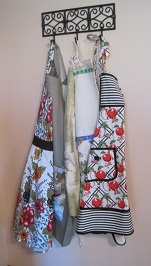
    ApronsMy grandmother put her apron on every morning right after she put on her house dress. She wore an apron every day, even to parties. She made all her clothes, including her aprons. She always chose a small flower design and used colorful seam binding for trim around the edges.

    I also wear aprons, but only when cooking and eating. . . saves many an outfit from food stains.

    Today’s prompt is: Aprons

    Thank you, Kathy Myers, for the inspiration to hang my aprons in the kitchen.

    Thank you, Pam Swanson, for emailing so many years ago, “The History of Aprons.”


                                            THE HISTORY OF APRONS

    The principal use of Grandma’s apron was to protect the dress underneath. Because she only had a few dresses, it was easier to wash aprons than dresses and they used less material, but along with that, it served as a potholder for removing hot pans from the oven.

    It was wonderful for drying children’s tears.

    From the chicken coop, the apron was used for carrying eggs, fussy chicks, and sometimes half-hatched eggs to be finished in the warming oven.

    When company came, aprons were ideal hiding places for shy kids.

    And when the weather was cold, Grandma wrapped her apron around her arms.

    Those big old aprons wiped many a perspiring brow, bent over the hot wood stove.

    Chips and kindling wood were brought into the kitchen in that apron.

    From the garden, the apron carried all sorts of vegetables.

    After the peas had been shelled, it carried out the hulls.

    In the fall, the apron was used to bring in apples that had fallen from the trees.

    When unexpected company drove up the road, it was surprising how much furniture that old apron could dust in a matter of seconds.

    When dinner was ready, Grandma walked out onto the porch, waved her apron, and the men knew it was time to come in from the fields to eat.

    It will be a long time before someone invents something that will replace that ‘old-time apron’ that served so many purposes, especially what many children and grandchildren received from the simple apron. . . Love!

    Adapted from:  The History of Aprons,  which may have been originally from  Grandma’s Apron.

    Writing Prompt:  Aprons