Blog

  • The Kathy Myers “Book in a Box” Method (patent pending)

    Guest Blogger Kathy Myers writes:

    Computers are great and all— without them, this blog wouldn’t exist and then what would I do? But when I was younger, my image of a writing life was less technical and more romantic: Jo in Little Women, writing her books in a drafty attic wearing fingerless gloves against the winter chill, or Jane Austen dipping her nib and contemplating her next chapter, while her parents plan a ball where she can meet eligible bachelors. Ah, the good old days.

    At a Jumpstart Writing Workshop in May, I wrote a fictional scene on the prompt “It happened because . . . ”  Marlene Cullen, always benevolent and encouraging to writers said, “That would be a good beginning for a romance novel.”

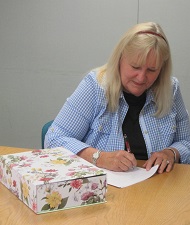
    Jumpstart was on hiatus for the month of June, and this coincided with a flirtation I’d been having about trying the fabled “sit-your-ass-in-a-chair-and-write-a–thousand-words-a-day” method I’d heard so much about— a discipline that so many writers (who actually have books published) swear by. So I thought what the heck, if Marlene can drag herself to her exercise boot camp, I can drag myself into the kitchen: make some toast and coffee, go back to bed with my fully charged laptop, and write until it runs out of juice. This averages about three hours and about a thousand words. I am no worse for wear for the effort, and I have the rest of the day ahead of me—fully charged with a great sense of accomplishment. I press print, and then put my day’s work into a lovely flowered document box (Home Goods $7.98). My box is fancy and romantic—much nicer than poor Jo’s manuscript—wrapped with brown paper and twine. It might not be as nice as Jane’s satin lined box inlaid with elephant ivory, but hey—now I’ve got something to buy with my future royalties.

    It’s July now and I’m thirty thousand words into my first novel. I have to tell you: The ass in a chair/ book in a box method works. You are free to do as you wish with your writing, of course. Do it on a whim or when the muse strikes. But get a fancy box to put it in. Remember that everything you write is a legacy of sorts. You can have a time capsule where your stories, journals, or Jumpstart notebooks can be collected—honoring your efforts with a neat and lovely testament to your creativity. Your voice in the form of your words can reside there in style.

    Kathy M. + boxKathy Myers is a big fan of Jumpstart and Writers Forum. She has waded into the submission pool this past year and been published by Every Day Fiction, Petaluma Readers Theater and Redwood Writers Anthology. She has done several guest book reviews on The Write Spot Blog and is an advocate for fancy boxes everywhere.

  • Fourth of July . . . Prompt #84

    July 4th is coming up. . . . what does this mean to you? Do you consider yourself patriotic? What does being patriotic mean to you?

    Which reminds me of one of my all-time favorite “brain teasers.”

    Fourth of JulyDo they have fourth of July in England?


    Yes. . .and third of July and fifth of July.

    Writing Prompt:  What does July Fourth mean to you?

  • Terrain is an online journal . . . writing plus multimedia.

    Terrain is an online journal of fiction, poetry, essays, photos and multimedia, currently looking for more fiction. June 2014 issue of The Writer magazine: “Readers are welcome to comment below Terrain’s pieces, and the online format allows them to share favorite writing through various social media outlet.”

    Terrain accepts general submissions from September 1 to May 30, and contest submissions year-round (with a September 1 deadline for mid-October publication). We do not accept regular submissions in June, July, and August. With the exception of accompanying artwork and queries, all work must be submitted online via Terrain.org’s Submission Manager, requiring the creation of a user account.

    check mark.1Note: From Marlene. . . flag these contest and submissions dates. Start writing now and be ready to send during submission dates.

  • Establishing a practice can help you move forward in magical ways.

    Guest Blogger Suzanne Murray writes about: The Power of Establishing a Practice.

    Until one is committed, there is hesitancy, the chance to draw back, always ineffectiveness concerning all acts of initiative and creation. There is one elementary truth, the ignorance of which kills countless ideas and splendid plans; that the moment one definitely commits oneself, then providence moves too. All sorts of things occur to help one that would never otherwise have occurred. A whole stream of events issues from the decision raising in one’s favor all manner of unforeseen events, meetings and material assistance which no one could have dreamed would have come their way. I have learned a deep respect for one of Goethe’s couplets: “Whatever you can do or dream you can, begin it. Boldness has genius, power and magic in it. Begin it now!” – W.H. Murray The Scottish Himalayan Expedition

    Whether it’s for writing, meditation, or exercise, establishing a practice can help you move forward in magical ways. Having a practice means that you show up every day, no matter what. You are going to want to release all expectations of outcome or where you think you want things to go. It doesn’t matter how good you are or what you accomplish or what happens with the practice. You sit down to meditate and your mind goes wild with chatter the entire time, that’s fine. You show up to write and find yourself whining on the page, that’s okay. The point is to show up and practice.

    A lot of things are happening when you show up consistently to something. You begin to forge the neural nets in your brain needed for the task and strengthen them so that whatever you are committed to actually becomes easier to do and you are able to increase our level of skill. In writing your subconscious mind is working 24/7 on whatever you give it to focus on, so showing up everyday allows you to access new insights and ideas arising from your expanded mind.

    You commit and take the action. The universe responds in kind to the power of your willingness and the force your commitment. Free from expecting that you need to accomplish something, you relax and open up to allowing. In this receptive state, the your subconscious mind aligns with the workings of the Universe and you find support, synchronicities and inspired ideas coming to you.

    Establishing a practice helps you move beyond any resistance that has been in the way. When you release the need for instant gratification you slip into a sense of satisfaction from the simple act of showing up for yourself. You learn to find joy in the practice itself and this allows you to expand your creative capacity.

    To begin, start small. When I coach writers who are having a hard time showing up,  I ask them at first to commit to writing ten minutes a day. This helps you cross the threshold of resistance and move past the associated voice that tells you that you don’t have enough time. Once you have established the habit of showing up you will find things flowing with greater ease.

    Suzanne MurraySuzanne Murray is a creativity and empowerment coach and offers healing work with EFT.  Her eBook contains material that she has used for more than twenty years in her writing classes. Her ebook helps followers to show up to write, find their voice, deepen their experience with the writing process and surrender to the creative flow and let the magic happen. The portable book is like being in one of her workshops and allows participatns to establish writing as a practice. Suzanne offers her book with a 14 day money back guarantee. For information about Suzanne’s ebook and her coaching packages,  please click here.

    Check out Suzanne’s inspiring Blog, Creativity Goes Wild, for ideas on writing, creativity and life coaching.

  • Feeling your way in the dark . . .

    “The way I write, it’s like feeling your way in the dark. You don’t know if it’s going to catch fire  — not just your imagination, but your emotions.” — Dan Coshnear

    Northern California writer Dan Coshnear is the author of two collections of stories, Jobs & Other Preoccupations (Helicon Nine 2001) and Occupy & Other Love Stories (Kelly’s Cove Press 2012). Born in Baltimore in 1961, he has traveled in Europe, Canada, Mexico, Haiti, and all over the U.S., often by thumb, and once for a few thousand miles by freight train. After living on Cape Cod and in New York and San Francisco, he finally settled with his wife, Susan, in a house under some very tall trees along the Russian River in Sonoma County, California. His stories have been published in Fourteen Hills, juked, The Missouri Review, Third Coast and Zyzzyva.

    Occupy CoshnearAbout Dan’s latest publication . . . Occupy & Other Love Stories

    “To occupy means to be present, to be available emotionally, to stand up for oneself, and sometimes to protest. The opposite is absence. To be rendered silent, useless, vacant because of fear or confusion or despair. Each of the stories presents a challenge, not only to an individual character but to a relationship. This short story collection from award-winning California author Daniel Coshnear includes 12 stories about occupation, featuring ordinary heroes. A thoughtful mood is reinforced with 16 full color images from Oakland artist and UC Berkeley Professor Emeritus Squeak Carnwath.”


  • Right now . . . Prompt #83

    Ireland, photo by Jim C. MarchSet your timer for 12-15 minutes and write.

    No judging.   Shoo your inner critic away.     Just write.

    Today’s Prompt:  Right now . . .

    Photo taken in Ireland by Jim C. March

  • Listen to your body as a way to creativity.

    In this Just Write post, we’ll take a look at the idea of listening to your body as a way to get past blocks toward your creativity.

    First, turn off your cell phone or put to vibrate. Unplug from Facebook and emails. Eliminate as many distractions as you can.

    If you are experiencing extreme grief or pain, please get professional help. This post, of course, cannot replace the need for professional assistance.

    Ready? Here we go.

    We all experience grief, trauma, sadness. And we have our own ways of handling those stresses. There is no one right or wrong way to handle these difficulties. What is right for one person, may be wrong for someone else. What works for me, might not work for you, so take what works for you from this post, ignore the rest.

    Let’s take a moment now to breathe, relax and get settled.

    Take a deep breath in and let out with a whoosh.

    Deep breath in. Relax. Let go.

    Drop your head to your chest and rotate in a circle.

    Rotate shoulders in a circle.

    Scan from head, down to your toes. Check in with your body.

    Notice places that are tight. Notice any uncomfortableness.

    As you scan your body, become aware of any place that draws your attention – notice what part of your body calls out to you.

    Place the palm of your hand on the part of your body that calls your attention. Or bring your breath there if it’s not reachable with your hand.

    Allow your hand to be filled with the information of that place.

    Take a deep breath in. Let it out with relaxing sigh.

    Thinking about that place in your body that calls out . . . what do you notice? Who hangs out there? Who do you see?

    If you could have a conversation with that part of your body, what would it sound like?

    If you have blockages in your life, your work, or your creativity, your body can tell you what’s going on. If you are stuck, notice where you feel it in your body.

    When you pay attention to that stuck feeling, you can work past it and then you will be free to work as you wish. Discover what’s really bothering you.

    When you are ready, write about what you have discovered. Write about that place in your body that wants attention. Or just write about whatever is on your mind.Hands

  • Sweatpants & Coffee wants your stories.

    The Story of Sweatpants & Coffee

    The idea for Sweatpants & Coffee was born, as many great ideas are born, during a time of personal reflection and solitude. That is to say, while its founder was taking a hot shower. The concept of a site that would celebrate all things comfort-related, one that would help people to feel good about themselves, was immensely appealing to Nanea Hoffman. With dripping hair, she bought a domain name and sketched out a plan. Nanea spends a lot of time in sweatpants, drinking coffee, so this was inevitable. Sweatpants & Coffee is a place where you can kick back, enjoy yourself, and be comfortable. Because when you are your most comfortable self, you can do anything.

    Sweatpants & CoffeeNote from Marlene: Sweatpants & Coffee is an amazing website. . . poetry corner, flash fiction, inspiration, interviews, all kinds of good stuff. So grab a cuppa and join in the fun.


  • Alicia Butcher Ehrhardt reveals her secrets for tight control.

    Guest Blogger Alicia Butcher Ehrhardt shares her secrets for keeping track of plots, characters and their shenanigans.

    Hi! Marlene asked me to write about the weird way I write – and I will, with one caveat: don’t try this at home.

    In fact, don’t try any of this at all unless you already know you’re an extreme plotter (as opposed to a pantser), and need to 1) have tight control over what happens in your novel, and 2) have a method that you are comfortable with to keep track of all that plot stuff. If you are a true pantser – following your instincts alone – I think the following will strike you as insane.

    I do this because my CFS-addled brain makes it very difficult for me to keep everything in my head – more about that in a minute.

    I gave up Word for managing a writing project because I had too many files, and no system to keep them under one management. I am good with Styles in Word after I finish writing – and it’s one way of formatting output to look exactly as I want it to.

    Scrivener manages my writing projects, and I use all its features to the max. While I’m working on a scene, I have a number of auxiliary files where I do my thinking, and use the synopsis, label, metadata, etc. features of the Inspector – little text files Scrivener provides for you automatically with each file in your main hierarchy. Scrivener will also ‘Compile’ your text from the pieces into an ebook, or a Word file with a lot of formatting control over the output.

    I use Dramatica to plot – and I don’t recommend it unless you want to spend years learning what it means (some of the terminology is tricky), but it leads to the possibilities of fiendishly complicated plots that hang together beautifully at the end. Again, I use almost ALL the text boxes in the program that allows me to store bits and pieces of thought – and they can all be transferred to the working files when I need them.

    I use Dramatica’s Scene/Chapter list function to set out what goes where, and then copy that structure to my Scrivener project for the writing. I end up easily with an outline of the whole project in either program, and I keep the correspondence between the two up-to-date. Dramatica keeps track of what goes where with checklists, so I can see that everything (called appreciations – apps for short) I answered when creating the story actually ends up in a scene in the final story.

    Because I have all this structure in place – which can be collapsed or expanded to any level – when it comes to the writing part, I have a single scene at a time in my workspace with several files containing every little piece of character, plot, or theme that is going into the scene. When I start the writing, I don’t yet know how these bits will be expressed by my characters within a scene that has a short title – “Scene 9.1 – Andrew restless after fight; sleeps at Kary’s house,” but with a solid structure I can have the fun of figuring out how to make the pieces fit – and the knowledge that when I’m done, the scene will fit neatly into its slot in the Chapter and Book.

    A scene is about how much I can work with at a time: my brain won’t keep more than that loaded without dropping bits. Since I usually take several naps during a writing session, I’d make no progress if I had to go look at the whole. Within the scene I set up as many beats as I have topics to expand, so that a scene is composed of one to several beats dealing with a small subset of ideas/dialogue/action/thoughts, and segues neatly into the next beat, so that a scene is a set of linked mini-stories with transitions that make sense. Structure within structure.

    Once I don’t have to worry about losing that absolutely wonderful Idea I had for a plot bit in Chapter 19 just because I’m writing Scene 9.1 about the fight aftermath, because I stored it for when I get there, in a searchable format I can’t mess up, it frees my mind to concentrate on the scene at hand – and how I want to actually tell the story I’ve invented. It’s like knowing I can bring the red thread from the back of the tapestry to the front to weave in a rose when I want one, because the red thread is there, on the back side, ready for me to use.

    Just writing a bit about this makes it seem impossible, but if you are interested in more control, and in some of the tools I use, please drop by liebjabberings.wordpress.com, and type into the search box: scene template [8 posts with screenshots of the Scrivener template I’ve created to store my bits; downloadable], Dramatica [for apps and plotting],  and structure [how I use it when writing]. Select Categories such as ‘CFS’ for how my brain works and why I have to manage it to even write at all, or ‘fears’ for the things I do battle with regularly which keep me from writing. Check out the Pride’s Children tab to see the novel being created with these tools posted, a new polished scene every Tuesday – and judge for yourself whether my method produces something you find readable. Or the short story ‘Princeton’s Dancing Child’ – also plotted with the tightest form of Dramatica.

    Hard to believe, but this complicated superstructure makes it possible for my writing to be simple: once I get the ideas in order, the writing flows – a topic for an entirely different kind of post.

    Note from Marlene:  Click here for 9 reasons why Nina Amir uses Scrivener.

    Alicia Butcher EhrdardtI’m Alicia (ah-lee-see-ah). I use: Alicia Butcher Ehrhardt. No ‘B.’ No hyphen. And no, I’m not related to Amelia. My middle name is Guadalupe.

    WRITING THE HARD WAY: I am a PWC (person with CFS); I try not to let it have more of my life than absolutely necessary, but it’s something I battle every day for possession of my brain. Sometimes I win. I take a lot of naps.

    I cannot NOT write. Fiction is my hobby – mainstream, SF, mystery, ? – and I will e-publish myself when I’m ready for prime time.

    I sing, garden, draw a little. I will tackle, subject to energy limitations, any household task short of Heating-and-Air-Conditioning. When my brain balks at learning something new, that’s when I know I have to. It can take a while.

    DH is now retired. We share a love of science, a home in suburban NJ, a bird-and-butterfly garden, and a chinchilla named Gizzy. My children, who were home-schooled, consider me opinionated and stubborn; they are mostly on their own, and a credit to their parents. My wonderful family and friends are responsible for my sanity, such as it is.