There’s the long goodbye. The short goodbye. The swollen goodbye and the thin goodbye. The brittle goodbye and the overwrought goodbye.
Short goodbyes can be quick for so many reasons. You don’t like someone, so you want to get away. You love someone too much and each moment of your parting makes you feel worse. Short goodbyes can occur because you’re ready to move on. Or you’re afraid. Or you’re late for an appointment. Or you just don’t like situations that drag on and on. Short goodbyes can be a brisk hug, a handshake, or even dropping someone off at the curb at the airport.
Long goodbyes can be swollen with tears. They can get wet and messy and sweaty. Long goodbyes can leave puffy eyes and red noses. Long goodbyes can have kids tugging at their parents’ coats, rolling their eyes because the adults are taking too long. Or they can be kids grasping at their parents’ coat, clinging, begging and screaming to not be let go.
Goodbyes to friends as we move away. Goodbye to children as they grow up and step away from you and into adulthood. Goodbye to parents as their souls complete their journey on earth and leave the dimensions we understand to go on to the ones we don’t.
Goodbye to dishes and dining room sets that were purchased for weddings then sold after divorce.
Goodbyes to pets who trusted their lives to you, then went over the rainbow bridge to dog heaven. Or the kitty ranch. Or the goldfish ocean. Or hamster haven.
Goodbyes to what we know, what we want and can no longer keep. To what we no longer love or use or need. Goodbyes are realizing that when it was with you, it served its purpose and its work is done.
San Francisco native Julie Wilder- Sherman is a long-time resident of Petaluma, California. She began reading books at an early age, encouraged by her mother, who would allow her to take books to bed when she was as young as two-years- old. Julie would “read” them until she was ready to go to sleep. To this day, Julie reads every night before turning out the lights.
QW is looking for writing that is: Exciting. Challenging. Risky. Unpredictable. And Different.
Send us your work. Seep in. Stomp in. Strike us. Set the familiar voice on fire.
QW is open to submissions of new media, translations, and book reviews year round. We are also open for submissions to a special feature of short poetry: 100 Syllables.
Quarterly West is open for regular submissions of poetry and prose from February 1 through April 1.
Chapbook submissions will open in summer. Poetry and prose contest submissions in the fall.
You have red shoes, blue shoes, teal shoes, pink shoes, silver and gold shoes, yellow shoes and black shoes.
So many black shoes!
Ones for staying in or going out, for dancing the night away, for long skirts or short skirts, or walking the dog.
You have black shoes for every possible occasion!
And this isn’t even counting all the boots. High ones, low ones, dressy ones, casual ones, ones for hiking, ones for the snow and ones just for rain. Boots galore!
And all your shoes are even separated by seasons! Winter, Spring, Summer, Fall.
And clear plastic boxes for each pair, neatly stacked in rows according to color and season. Your shoes are more organized than your taxes!
Oooh! Can I write off all my shoes?
Caitlin Cunningham lives and works in Petaluma, CA. She is an educator working with high school students who have mild learning disabilities. She especially loves helping students with math and writing. She has two adult children, a son who graduated from Iowa State with a history major and a daughter who is currently a pilot studying aviation and aeronautics at the University of North Dakota. She started writing with Jumpstart years ago but stopped when her husband became ill. After his death in 2020, she returned at Marlene Cullen’s urging. Returning to the Jumpstart group has been a supportive and therapeutic environment for resuming her writing and escaping her grief.
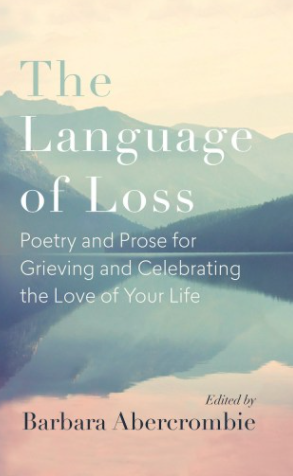
“We write the book we need to read and The Language of Lossis the book I needed when my husband died six years ago. It’s an anthology full of the very best poems and prose that I could find about losing the love of your life. These are the writers and poets who got me through my own grief. If you’re going through a loss right now, or know someone who is grieving, I hope this book will help.” —Barbara Abercrombie
In the house where my husband and I live, there is a room we call the “library.” Books overflow the shelves. Along the walls, five bookcases contain hundreds of volumes stacked top to bottom, back to front, overhanging the edges. One shelf holds books by authors I know—friends, teachers, and teachers who became friends. More books are piled on the floor and in bags, but our local public library stopped taking donations because of the pandemic. The disarray — books, bags, file boxes needing to be sorted — mirrors my emotions. I need to make sense of this room and so much else in my life.
I’ve come looking for a paperback recommended for my zoom book group. I joined the group a year ago, on March 25th, 2020, two weeks after our county shut down for Covid on March 13th. That was the day my husband and I cancelled the memorial celebration we had scheduled for the 15th. The celebration was to be in honor of our 31-year-old son, who had passed away in early January. I didn’t intend to write about his death in this post, but I’ve come to know the truth of these lines from W.S. Merwin: “Your absence has gone through me like thread through a needle. Everything I do is stitched with its color.”
The zoom book group, meeting once a month on a Friday, has been a bright spot in a brutal year. Books provide solace and inspiration—reading them, talking about them, and having them on the shelves. As disorganized as my books appear, they are not a burden. They are touchstones in a time of no touching. How many other people are feeling this way? I google for recent headlines. AP News declares: “Publishing saw upheaval in 2020, but ‘books are resilient.’” The Guardian shouts: “Book sales defy pandemic to hit eight-year high.” Yahoo Finance testifies to “America’s love for books and reading habits” with stats from iDashboards: “Sales in the print book market increased 8% in 2020.”
This upbeat news for writers and readers brings me to my topic question: “Why write?” I can’t address “Why write?” without considering “Why read?” They are conjoined, like twins. I read to understand, feel more deeply, experience more widely, and walk in someone else’s shoes. I read to learn what I don’t know, remind myself of what I believe, question those beliefs, and see the world from other viewpoints. I write for the same reasons.
For all of my adult life, I’ve written in sketchbook journals about painting, creative process, and all else. I write professionally for clients as a creative consultant. But I didn’t identify myself as a writer until the publication of my first book, “A Painter’s Garden: Cultivating the Creative Life.” The book sprouted in 1995 as a letter to a friend who gave me a rose bush; it grew out of a desire to reclaim my joy after a challenging year, one very different from 2020; it branched from my journals into a nonfiction narrative chronicling my life as an artist, novice gardener, and mother of the young, exuberant, and beautiful boy who was our son, Quinn. After the book’s publication in October 1997, I wrote a short story that became longer and longer—soon a novel. I completed that novel and another manuscript and began a new one inspired by the diaries that my paternal grandmother kept during the Great Depression. I am grateful that she left a trace of her life through which I can experience the arduous and wonderfully happy times of my father’s family. I set the novel in 1932 and titled it “Tap Dancing at the Bluebird Buffet.”
My second published book, “Wooleycat’s Musical Theater,” which I illustrated and co-wrote with my husband came out in 2003. It had its inception years earlier in the songs that Dennis and I wrote during a challenging time of disappointments in our attempts to become parents. Our siblings and friends were growing their families, so we created music for our nephews, nieces, and friends’ children. The songs went out into the world in 1986 and Quinn was born in 1988. He was our greatest joy.
I entered a graduate writing program in 2004, completed a third novel as my thesis, and received an MFA in Writing and Literature in Fiction in 2006. Following graduation, I focused on revising the three completed novel manuscripts, as well as painting, creative consulting, and teaching. The story begun from my grandmother’s diaries beckoned me, and I made intermittent progress.
Five years ago, I evolved “Tap Dancing at the Bluebird Buffet” to take place in 1932, 1960, and 2016, ending on the eve of the election of our first woman President, Hillary Clinton. That didn’t work out the way I’d hoped. I put the book aside. In late autumn of 2019, I was again working on the novel. I was unsure of how I would end it, just as I was unsure of how I would accomplish all of my ambitions in art, creative consulting, and writing in the coming year. During that first week of January 2020, I wrote resolutions and affirmations, feeling energized and full of promise, visualizing what might be.
Losing Quinn was a tragedy beyond imagining. In the aftermath of his death, I tried working on the novel. I didn’t know how to re-enter it, nor could I manage the mental acrobatics involved in constructing a novel. I was in disarray, depleted, despairing. Grief fogged my brain. Although I know how to craft fiction, I couldn’t organize my notes, much less sustain an interest in my imagined characters and story.
Joining the Friday zoom book group helped. In March of 2020, I couldn’t write a novel, but I could read one for discussion with a group of kind, interesting, and intelligent women. My friend Vicki, who invited me into the group, asked if I also wanted to have weekly talks with her about our novels in progress. The book group gave me renewed structure around my own teaching and learning philosophy of “read to write books” and heartened me to that purpose. The novel talks were an added boost. I started writing again on “Tap Dancing.” Hopefully, I would write a book that I wanted to read and that the women in the book group would eventually enjoy reading too.
By May, in deep grief over missing my son, I was also feeling renewed by reading and talking about books. Though isolated due to Covid, I was painting, taking walks with Dennis, and enjoying the spring season. Every day, sometimes several times a day, I’d pull up on my computer desktop a photo of Quinn and talk to him. I felt bereft of him, and writing the novel only took me further away to a time and place that didn’t include him. One day, it occurred to me to change a main character in the novel to embody many of my son’s characteristics: the way he moved, spoke, and laughed; his philosophies, strengths, and vulnerabilities. My Kip character is of another era and background. He is not Quinn, but I’ve given him some of Quinn’s essence. Now while writing the novel, I can spend time with my son through Kip. I have regained an ability to focus my thinking and juggle the elements of fiction.
Reimagining the story with a character informed by my son charged the novel with new life and intention. I am writing to learn about love and forgiveness, dancing and longevity, memory and time. I am writing because the story I’ve created is a place to go unlike any other available to me. I am writing because I would like to hold this book in my hands one day, read excerpts aloud at book events, and place it on my shelf, along with books I love written by authors who have give me reasons to write and read. The reasons to write become lessons for Writing Resilient. Here are just a few:
Lesson: Write to discover.
Ask questions of yourself and others. Seek to discover and understand. Put disparate thoughts and observations together. Let free associations reveal new meanings. Revise and revise to discover more.
Lesson: Write to remember.
Write and draw in journals, diaries, or on paper that can be collected into a notebook or box. This writing is not for publication, though it could be. Leave a trace of your life, your thoughts, how today looks and feels. It’s a compost pile, fertile and rich.
Lesson: Write to read.
Throughout good times and bad—wars, pandemics, economic depression, crises—people read and write books. If there isn’t a book that satisfies you now, maybe it’s because the one you want to read is within you. If it’s also one that you want to write, then begin.
Lesson: Write to thank.
Write a letter. Thank someone for his or her gift. Speaking to a specific someone helps you to establish your voice. Be grateful. Discover what you’re grateful for and why. Discover what’s missing.
Lesson: Write to leap.
The word resilient comes from the Latin “Resilire”—to leap back. “Resilience” means “capable of returning to an original shape or position, as after having been compressed.” Being resilient is being tensile—capable of being stretched or extended.
Francis Weller, a psychotherapist, author, and soul activist says, “The work of the mature person is to carry grief in one hand and gratitude in the other and be stretched large by them.”
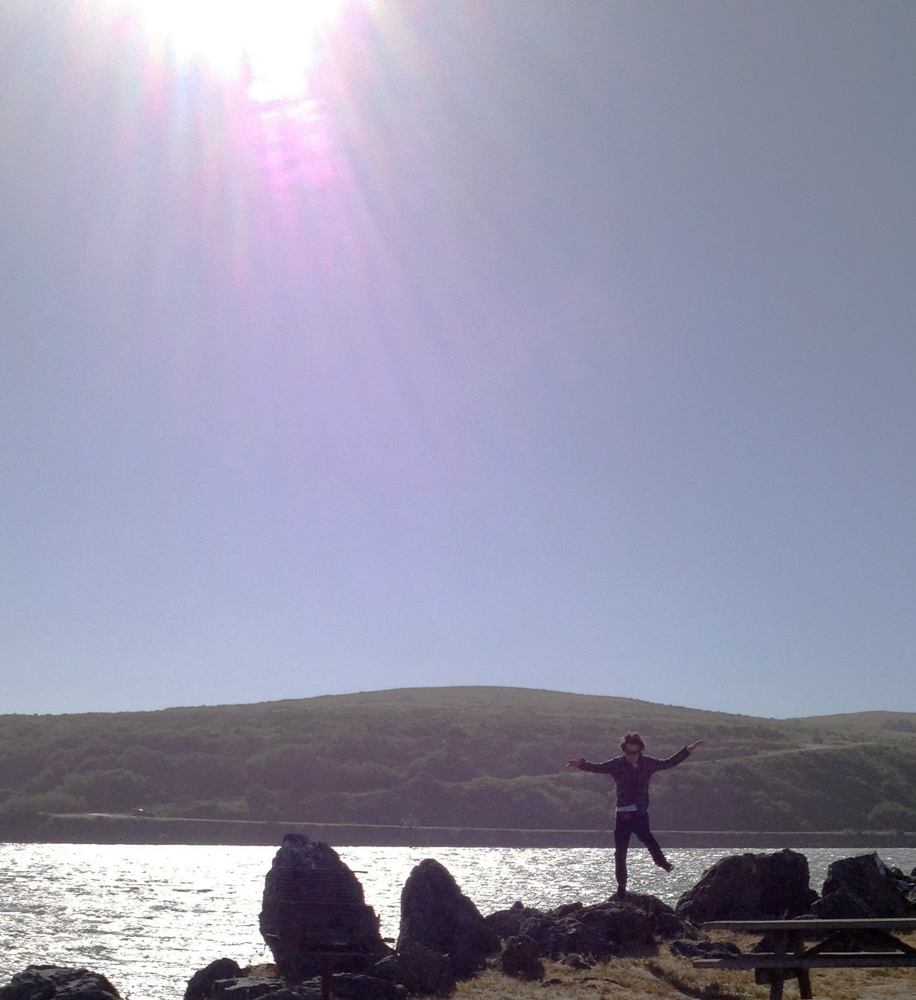
I have a photo of my son in mid-leap across stones along a Sonoma coast beach. I imagine that somewhere in the great beyond he is leaping among the stars. I direct the character in my novel to leap with buoyance and grace. I write to feel alive and remember the joy.
Christine Walker is a visual artist, writer, strategic visioning facilitator, and teacher whose guiding principle for fruitful creative process is: “Artful vision. Heartfelt action.” She has an MFA in Writing and Literature in Fiction from Bennington Writing Seminars and an MA in Creative Arts Interdisciplinary from San Francisco State. She is the author and artist of “A Painter’s Garden: Cultivating the Creative Life,” a memoir on creative process illustrated by her paintings, and the co-author and illustrator of “Wooleycat’s Musical Theater,” a children’s book with song CD.
She writes novels and short stories and teaches writing through her frameworks “Writing Fiction: 9 Ways to Mastery” and “Read to Write Books,” which are inspired by careful reading of masterful authors.
Anniversaries are a time of reflection, whether it be for a celebration, like a wedding, or the loss of a loved one.
We are now marking the anniversary of shutdown due to COVID.
As we reflect back on this year, we can observe where we, both personally and as a people, are now, in this moment.
Like many, I have observed myself navigate this past year on automatic pilot, at times not checking in, just marching ahead. Just marching is our need for survival.
March is now here and time to reflect upon marching, right?
With the availability now of the vaccine, and the possibilities for change ahead, we can pause. Take a deep breath and ask, “What is my deepest heartfelt prayer for myself at this time, right now?”
“What do I really need for myself and how might I hold my life with compassion and awareness in this moment?”
To honor our struggles and fortitude this past year, I am offering free weekly drop-in meditations from 4-4:50 (PST) on Wednesdays through March.
This type of meditation is usually done in a lying down position, and is called Yoga Nidra. Nidra means sleep, and although we are not sleeping and dreaming, one goes into a deep state of relaxation in which brain waves slow down. This deep dive into our being produces a state of relaxation that many say feels like one has had a very refreshing nap. While in this deep state, we observe and inquire into the various layers of ourselves: physical, energetic, feelings and thoughts, and opening to a sense of peace and well-being.
For more information and the zoom link, please contact Rhonda Gerhard to sign up through her email: helpmerhondanow@sbcglobal.net
Rhonda Gerhard is a Certified Yoga Teacher, Licensed MFT psychotherapist, writer, and photographer. Since 1994 she has enjoyed guiding and teaching meditation, yoga and mindfulness practices and workshops with groups and individuals throughout the Bay Area. Her passion for Buddhist psychology and non-dualism has led her to study with several teachers including Tara Brach, Jack Kornfield, Daniel Siegel, M.D., the works of Adyashanti and many more.
An iRest®/Yoga Nidra teacher, she has guided groups including the “At Home Within” program at COTS (Committee on the Shelterless) in Petaluma, Kaiser Permanente, Sonoma State University, and Integrative Yoga teacher training programs.
She may also be seen playing tamboura accompanying sitar or sarode performances alongside her husband, Mark Gangadhar Gerhard, tabla musician.
Blending psychology, meditation, mindfulness, and asana practice, Rhonda integrates mind, body, and spirit in her work with others.
I had been looking forward to the beginning of 2021; 2020 had been such a sad year, then January 6th happened. Chaos and uncertainty filled me.
Since the trouble at the nation’s capital, I’ve made an abrupt change in my paintings. Instead of the landscapes and fanciful trees from a nearby park, my usual work, I’ve been painting abstracts to capture the oddity life has taken.
I start by drawing straight lines across a canvas then I add curves. I step back and study these charcoal marks and try to find some pattern, some way of organizing the geometric spaces I have created. It may take a day of looking.
My color palette is usually blue, blue-violet, and purple with accents of peachy orange and pink. The contrast of light and dark pattern is important.
I am not interested in making great art; I don’t expect to like every piece. My goal is to have fun, to play, to forget the troubles of the world and just spend an hour or two enjoying myself.
Cheryl Moore grew up in the Midwest, then lived in San Francisco to finish high school and attend college where she studied biology. During the late sixties and into the mid-seventies she lived first in Sweden for a year, then for four years in Iran where she served as librarian in a small research library for wildlife biologists.
Nature and science have always been among her interests. After returning to the U.S., she moved to Petaluma and has dabbled in writing stories.
Since retiring from employment at Sonoma State University, she has taken up painting.
I suppose that if you are going to have a house, it should be a small enough house so that you can hear everyone at the same time. This is why I love my house My bedroom sits just across the hall from the kitchen, which, at night, is a passageway for the light that comes from the lamp that sits on the table next to my dad’s arm chair in the family room. The family room is where the TV is located, and is not to be confused with the living room, which does not have a TV, and instead, has the teapot with the crane that is flying over the blue water and creamer that goes with it. They sit next to the wooden fisherman with his delicate fishing pole and line, and the sofas that we cannot jump on even though they have an extremely busy pattern that wouldn’t show the slightest dirt.
My best friend Becky just moved to the new housing development across town, and her new house is very big. It has two stories. Two stories! It’s huge. It also has a bathroom with just a toilet for the guests to use while they are being entertained downstairs. Now, if we lived in a two-story house, the light from the lamp that sits on the table next to my dad’s arm chair in the family room would not make its way into my room, and I think I would find it hard to fall asleep at night I suppose I could use my Yogi Bear night light, but my Dad told me to stop using it for a while after he found me cleaning it in the bathroom sink. It was rather dusty, and the slide that sat on the top, projecting Yogi’s face onto my ceiling, was a little out of focus I didn’t really understand his objection because he is always so insistent that my room stay tidy, but when he explained that water and electricity didn’t mix, I forgave his abrupt volume change.
This house, this house looks like the perfect size. Even though people always want bigger houses, I always think that would spread people out too far from one another, and it would become lonely. Like the houses that my parents walk through once a year at The Street of Dreams. The Street of Dreams. Every year, they build these humongous houses in a swanky neighborhood. It is never in our town, because our town is not swanky. It is usually closer to Portland, the city, because as you get closer to the city, the towns get swankier. My town has sheep, and goats in the front yards. It is not swanky. But, every year, they build these humongous houses with all these fancy features, like an intercom that you can use to speak to someone on the second floor. My mom could push a button in the kitchen to tell us that dinner was ready as we sat in our rooms on the second floor. So fancy. And they all have pools. I would love to have a pool I honestly don’t know how long we would be able to swim though because it’s cold, and it rains all the time.
You should be able to hear people in the house, to make sure they are all still there. I can easily hear if the front door opens when my mom or dad returns home from work. If I was upstairs, in my bedroom, and my mom came home from work, she could be inside the house for at least an hour before I would even notice.
Kristin Cikowski resides in Novato with her husband, two energetic boys and an overly anxious dog. Writing has always been an escape, and when the pandemic forced everyone into their homes, she remembered a writer’s workshop that a friend had mentioned months before. Kristin has used writing as a therapeutic tool and is able to continue that custom thanks to her weekly Zoom meeting with a handful of strangers who provide her encouragement and motivation to write on.
Sycamore Review is Purdue University’s internationally acclaimed literary journal, affiliated with Purdue’s College of Liberal Arts and the Department of English.
Sycamore Review is looking for original poetry, fiction, non-fiction and art.
POETRY manuscripts should be typed single-spaced, one poem to a page, up to five poems.
FICTION & NONFICTION should be typed double-spaced, with numbered pages and the author’s name and title of the work easily visible on each page. There is not have a specific word count limit, suggest less than 6,000 words.
NONFICTION should be literary memoir or creative personal essay, interested in originality, brevity, significance, strong dialogue, and vivid detail. There is no maximum page count, the longer the piece is, the more compelling each page must be.
ART Sycamore Review is currently seeking artists for both the magazine’s cover and features artwork inside the issue. Interested artists should follow the instructions under the Art category on Submittable. You may attach 10-15 images or simply a link to an online portfolio. Cover letter is optional. All media and mediums welcome.