Blog

  • A Blues Poem . . . Prompt #530

    A blues poem takes on themes of struggle, despair, bad weather, any suffering.  

    It can also be funny: Fruit Flies Everywhere.

    Three-line Blues Poetry

    A statement in the first line,

    A variation in the second line,

    an ironic alternative in the third line.

    My baby walked out that door.

    My baby walked out

    and now my broken door won’t open up no more.

    And

    I had to walk back to Texas.

    I had to get on my feet

     cuz my baby she took my Lexus.

    Four-line:

    When a woman gets the blues

    She hangs her head and cries

    But when a man gets the blues

    He hops on a freight train and rides

    With both types, you can continue the pattern. You can also repeat lines.

    You can write something in narration, then pull out lines to condense for a poem.

    You can start with these lines:

    When I woke up this morning . . .

    I heard on the news . . .

    Excerpted from Writer’s Digest magazine, “Writing Your Woes” by Miriam Sagan, August 2004

  • Collage in Poetry . . . Prompt #529

    I would like to share collage in writing with you, some things I learned from the poet Dave Seter.

    His poem, “Fargo Airport, Waiting in a Bar” in The Write Spot: Writing as a Path to Healing is an example of using collage in poetry. The lines in italics in his poem are from signs on the wall and on the label on a bottle. He seamlessly incorporates “lines from others” into his poetry.

    Look around you . . . what writing do you see that you can use in your writing?

    Perhaps: A book title, a greeting card, writing on décor, writing on a tissue box, or a piece of mail.

    Or: A note you have written, writing on a coffee mug, a sign on a wall.

    A label on a jar, a can, or a bottle.

    You can also use song lyrics as a jumping off point for your writing.

    Writing Prompt: Today . . . or . . . Yesterday

    Incorporate written words that you see into your writing.

    A stanza from “Fargo Airport, Waiting in a Bar” by Dave Seter:

    Waiting for a funeral, it seems the years collapse

    into one moment. I want to find

    the right thing to say to firemen and farmers,

    who are kind, as they offer from

    A Bucket of Beer Nine Dollars.

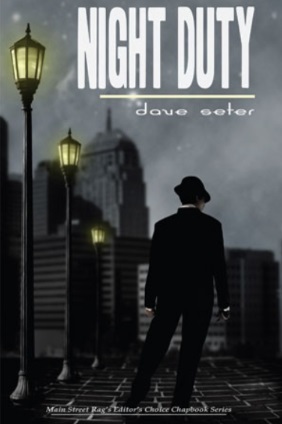
    Dave Seter is the author of  Night Duty,  and Don’t Sing to Me of Electric Fences, a poetry collection due out from Cherry Grove Collections in 2021. A civil engineer and poet, he writes about social and environmental issues, including the intersection of the built world and the natural world.

    Born in Chicago, he now lives in Sonoma County, California. He earned his undergraduate degree in civil engineering from Princeton University and his graduate degree in humanities from Dominican University of California, where he studied ecopoetics.

    Dave wrote his master’s thesis, “Introducing Godzilla to Marianne Moore’s Octopus of Ice at the Intersection of Global Warming, Environmental Philosophy, and Poetry,” based on Marianne Moore’s collage poem, “An Octopus (of ice).”

     “This paper explores the question: How can a poet write an ecologically aware poem about global warming?”
  • When I was in 7th grade . . . Prompt #528

    When I was in the seventh grade . . .

    Fill in the rest . . . what happened when you were in seventh grade?

  • When I was six years old . . . Prompt #527

    When I was six years old . . .

    Finish the sentence: When I was six years old . . .

  • What have you been thinking about? Prompt #526

    What have you been thinking about lately?

    I’ve been thinking about hair.

    The following is an excerpt from My Generation magazine, Sept-Oct 2001.

    “You can’t say hair without muttering a bitter, Ha!

    Hair is the Achilles’ heel atop our skulls: the curse of baldness, the pathos of the comb-over, the futility of the hairpiece.

    The double cross of auburn, chestnut, raven locks—your crowning glory—suddenly blanching the color of steel wool.

    Curly hair that won’t straighten, straight hair that won’t curl.

    The heartbreak of the impermanent wave, the bungled dye jobs, split ends, dandruff.

    Every head of hair in the civilized world is shackled to a monthly treadmill of maintenance, overhaul and gardening, hostage to the grooming industry and its literal clip joints.

    You could buy a new Ferrari with the money you shell out over a lifetime for the upkeep of that mat of third-rate fur.”

    Prompt: Hair

    Or: What have you been thinking about?

  • You Can’t Wait For Inspiration


    Today’s Guest Blogger post is about inspiration, by Suzanne Murray.

    Excerpted from Suzanne’s September 5, 2020 Creativity Goes Wild Blog Post.

    “You can’t wait for inspiration. You have to go after it with a club.” — Jack London

    Recently a new writing coaching client emailed me to say, “I haven’t been writing. I just don’t feel inspired.”

    I immediately shot a message back, “You can’t wait for inspiration. If you get nothing else out of our coaching together, this awareness will make a huge difference in your creative life.”

    No writer or other artist waits for inspiration before showing up. Painter Chuck Close said, “Inspiration is for amateurs. The rest of us just show up and get to work.” Flannery O’Connor, the noted Southern writer,
    described her habit of going to her office every day from 8 am to noon, “she wasn’t sure if anything was going to happen but she wanted to be there if it did.” 

    Most writers just start writing and find inspiration along the way. John Steinbeck would always end one day’s writing in the middle of the page, so he could pick up the thread the next day. He insisted that “In writing, habit seems to be a much stronger force than either willpower or inspiration.”

    Research in the neuroscience of the brain shows that creativity is activated when we are in the brain wave states of alpha and theta which are associated with meditation, intuition and information beyond our conscious awareness. This is why a writer often needs to write a page of what feels uninspired in order slow the mind down and hit the zone. 

    This is true of all acts of creativity. We have to show up and begin to play with the process to access the place of inspiration. The more we commit to our creativity through our intentions and actions the more our creativity flows and the more juiced, excited and inspired we feel.

    Now more than ever we need to play with our creativity in whatever way that calls to us and see where it leads. Even small creative acts can help lift our spirits and energy as we face the many challenges we see in our world. Exercising our creative muscles can open us to new possibilities and inspiration.

    Note from Marlene:
    Many writers use a method of freewriting to warm up before embarking on their writing project. You can use a prompt to inspire freewrites. Writing Prompts on The Write Spot Blog.
    Suzanne Murray is a gifted creativity and writing coach, soul-based life coach, writer, poet, EFT practitioner, and intuitive healer committed to empowering others to find the freedom to ignite their creative fire, unleash their imagination, and engage their creative expression in every area of their lives. 

    THE HEART OF WRITING COACHING Do you want to ignite your creativity and show up to your writing on a regular basis or go deeper into the process and craft? Suzanne offers online coaching to support you and coach you through any resistance or problems along the way.   She holds the space of unconditional acceptance and support to nurturing your unique voice and work on the stories that are really important to you.  

    The Heart of Writing eBook   Jumpstart the Process, Find Your Voice, Calm the Inner Critic and Tap the Creative Flow

    * Follow Suzanne on Twitter at @wildcreativity where she tweets inspirational quotes for creativity and life.      

  • I liked to . . . Prompt #525

    Be the kid you once were. What did you like to do when you were 4 or 5 years old?

    Or 12 years old?

    Remember that time of joy or angst.

    Scroll back in your memory bank . . . . write about a memorable time from your childhood.

    Or write about something you liked to do over and over again.

    Prompt: I liked to . . .

    Or: I remember . . .

  • Mapping The Journey . . . Prompt #524

    Stories are about characters desiring something and the things that prevent them from getting what they want. 

    This is true for both fiction and memoir.

    Another word for desire is yearning, suggesting the deepest level of desire.

    Characters have problems and yearnings.

    Do they overcome them?

    What obstacles get in the way?

    Answering these questions results in story-telling.

    Writing Prompts as a guide, or a map, leading the way to telling the narrator’s story:

    Interview yourself or your fictional character, by answering these questions:

    How did you get started in your line of work?

    How did you become interested in your hobby?

    What did you desire at age 18?

    What did you desire at age 25?

    What do you desire now?

  • Writing Advice

    I’m going through old writing magazines and finding gems, like this one, “Top Five Fiction Mistakes.” — by Moira Allen, The Writer, September 2002.

    “Ask most fiction editors how to avoid rejection, and you’ll hear the same thing: Read the guidelines. Review the publication. Don’t send a science fiction story to a literary magazine. Don’t send a 10,000-word manuscript to a magazine that never publishes anything longer than 5,000 words. Spell-check. Proofread. Check your grammar.”

    “The one piece of advice nearly every editor had to offer was: Read, read, read. Read widely. Read the authors who have won awards in your genre to find out what has already been done, so that you don’t end up offering old, trite plots without even realizing it.

    Then, ‘Write!’ says Max Keele of Fiction Inferno. And keep writing. And write some more.

    When you’re finished, ‘’Let the story sit for a few days or a week, ‘says Richard Freeborn of Oceans of the Mind. ‘Come back to it and read it aloud to yourself. I am still surprised at all the inconsistencies and bad transitions I catch when I do that.’

    ‘Once your story has aged a bit, seek someone else’s opinion. Find an educated reader who can provide valuable feedback . . .’ suggests Twilight Times’ Lida Quillen. ‘Find readers who can mention segments that were unbelievable, let you know where the story left them cold, and sections where they were pulled into the story.’

    Finally, make sure you don’t make the ultimate fatal mistake, cited by Tony Venables of Ad Hoc, thinking that people should read what you write simply because you write it. Writers need to understand that they have to earn their audience, to make their audience feel it’s worthwhile to read their work. This does not mean pandering to populist ideas or sugar-coating what you have to say—it means choosing not to be boring.”

    Want to know what the “Top Five Fiction Mistakes” are, according to this article? Paraphrased from the article:

    • Bad beginnings. A story needs a beginning that grabs the reader. Be sure that your story begins where it should . . . not too much backstory, but enough so readers know who characters are.
    • Wordiness. Avoid too many adjectives and adverbs. Don’t use big words when simple ones would do just as well.
    • Poor plots. Focus on characters with interesting goals and motivations.
    • Undeveloped characters. Create believable characters that readers care about. Avoid characters who do not grow, avoid stereotypes.
    • No point. Be certain what your story is about. Be sure you have answered the “why” of the story.

  • Last time . . . Prompt #523

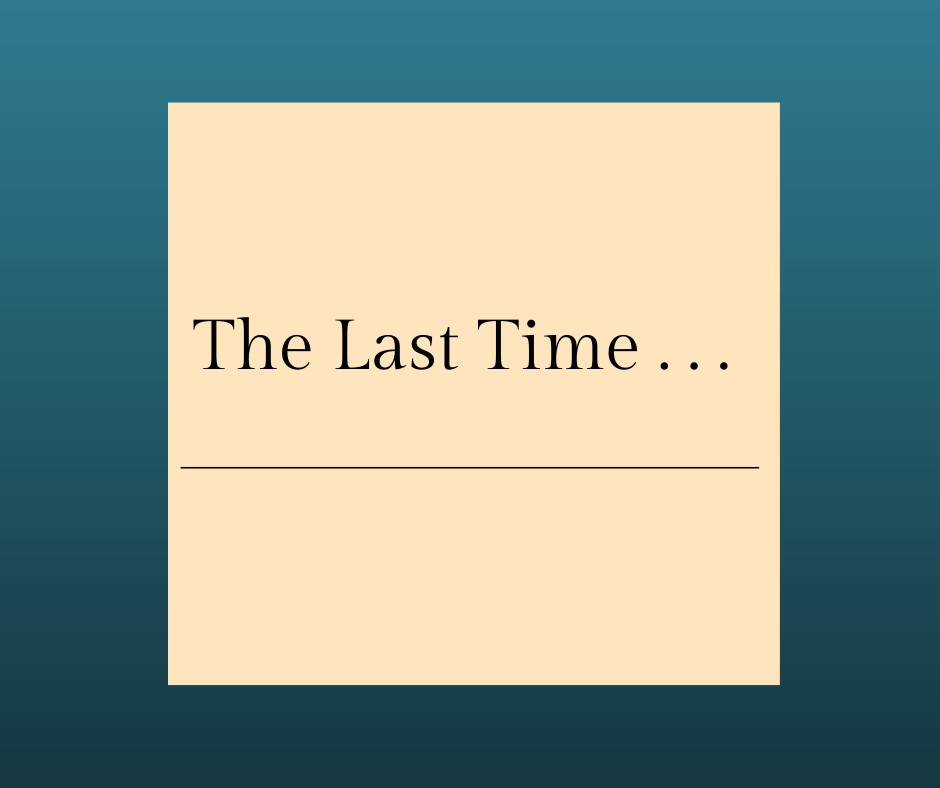
    Today’s Writing Prompt:

    The last time . . .

    Or:

    This is the last time . . .