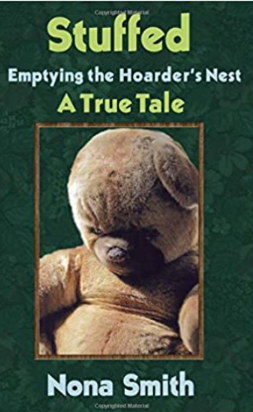
Today’s guest blogger, Nona Smith, relates her experience about how her book, Stuffed: Emptying the Hoarder’s Nest, came about.
Eight years after our friend, Al, died, and two weeks after his wife, Linda, was put to rest, my husband, Art, and I stood on their doorstep, key hovering at the lock. As the executor of their estate, Art had every right to be there. But still, we felt like trespassers. He gave a small shrug and turned the key in the lock. We pushed the door open, walked inside, and gazed around at the chaos that greeted us.
In the living room, twin oak desks stood in front of a window, their drawers exploding with old mail, catalogues, writing implements, and paper. A couch, laden with a mountain of stuffed animals, was sandwiched between two Tiffany floor lamps. On the floor, handwoven rugs were piled on top of handwoven rugs. The dining room had been transformed into a jewelry making studio, and the counters in the kitchen were obscured by apothecary jars filled with mystery liquids, boxes of costume jewelry, and unopened cooking gadgets.
In Linda’s bedroom, teddy bears ruled the roost. Dressed in elegant attire and jaunty outfits, some wore tutus and some wore nothing more than the fur on their backs. Bears lined the walls, trespassed on the headboard and spilled onto the bedside tables and dresser.
In the second bedroom, a queen size mattress was propped against a wall, and a daybed held more bears, a brass trumpet, cases of adult diapers, and several folded Navajo rugs. No horizontal surface remained visible.
Three decades earlier, Art had agreed to be the couple’s executor and now I turned to him.
“You knew about this?”
Yes, he nodded somberly. “But I didn’t think they would actually die.”
And so began our three year undertaking and the beginning of my book Stuffed; Emptying the Hoarder’s Nest.
I didn’t set out to write a book. But the task we undertook was so unique, troubling, and different than how Art and I live our lives, that I felt compelled to write about it. I found putting down on paper what we discovered, and the profoundly disturbing aggravations we encountered in liquidating this eclectic estate, helped me process the experience.
I wrote to bring about order. It was therapy . . . and it kept me sane
We began by choosing one collection at a time and gathering it up, accounting for every item. This part of the process alone was daunting because there was so much scattered over such a large area.
Al and Linda were well-educated, intelligent, and curious people who were also financially well off. So, not only were they able to acquire things, they had places to store their acquisitions: two houses in southern California, a store in the northern part of the California Bay Area, and a warehouse and apartment building in Berkeley near the UC campus. Stuff was stashed everywhere.
Once we corralled a collection, we needed to ascertain its value before we could decide whether to sell or donate it. The cartons of never-worn-and-still-in-their-original-wrapping plaid shirts, the used table linens, the mounds of staplers and plyers and cabinets filled with financial papers from businesses Al no longer owned were easy to deal with.
As the collections became more extraordinary, however, we needed to research and find experts in the field to advise us: What is a merry-go-round calliope worth? Are these gemstones real? What about the fleet of ’57 Plymouths parked tandem in the apartment garage? Are they worth anything? And the hundreds of player piano rolls? How about the profusion of original artwork by a famous botanical printmaker, each signed, dated, and numbered? The Navajo rugs? And, gosh, the teddy bears: are they of any value?
Dealing with one at a time, we went through the buildings and the collections. Once we knew its value, the entire collection was sold or donated . . . or sent to the dump . . . and I wrote about it.
I introduced the characters we met along the way and wrote about our frustrations and successes. I began bringing what I wrote to my weekly writing group for editing.
I didn’t think of them as such, but before long, my writing buddies began referring to these pieces as “chapters.”
As Art and I neared the end of our journey with this estate, I began to view what I’d written as a book. When we turned what was left over to an estate liquidator, I wrote the final chapter. It came to me as an epilogue, and almost wrote itself.
Now the question became, what did I want to do with it? Did I want to pursue an agent? Look for an editor? How much more time and energy did I want to spend with Al and Linda and their stuff? The answer came quickly: not much. But out of a desire to honor the time we spent and the education we received, I wanted to create something permanent out of these stories. So, working with a local publisher, Stuffed came into being. I held a small and satisfying book launch at our local independent bookstore, Gallery Bookshop in Mendocino, and sold out of my first two runs.
The three years Art and I spent dismantling this estate were disturbing and unsettling for me.
Writing about it as it was happening calmed and comforted me. Putting down on paper how we handled the chaos that surrounded us helped me process the events from the initial sense of overwhelm at the task ahead of us through our frustrations and successes.
Writing was a gift I cherished.
Nona Smith has been part of the very active Mendocino Coast writing community since she moved there in 2006.
Nona is the author of Stuffed: Emptying the Hoarder’s Nest: A True Tale and numerous other published short stories, humorous memoir pieces, and poetry. She is a board member of the Writers of the Mendocino Coast and has been president of the 31-year old Mendocino Coast Writers’ Conference for four years. Nona lives with her patient husband Art and two demanding cats.
More details about the writing of Stuffed: Emptying the Hoarder’s Nest.