“It doesn’t matter who we are, we all want stories. They help us make sense of our experiences and a complicated world. Because we’re inquisitive, social animals, stories help us understand and connect with one another. When we recognize and relate to characters and events in stories—particularly those we believe to be true—it strengthens our social bonds and confirms we belong. There’s a kinship that inspires, informs and comforts us and, though we might not always be conscious of it or understand why, we’re all searching for truths in the world.
Stories also evoke emotions and help us understand what it might be like to be different. We want to see the truth in those stories to help us understand people who are different and have different experiences of life.” — Posted on Jane Friedman’s Blog, July 31, 2025
“It is your brain connecting dots so quickly that you are not aware of the connections until you look backward to figure out why you know what you know, or did what you did.” — “The Secret Sauce for Writers: Intuition,” by KimBoo York on Jane Friedman’s September 4, 2024 Blog
“An editor’s job is to make you, the author, look good and save you from embarrassing mistakes.” — Unknown source
Hiring an editor is like looking in a mirror before you leave the house, checking to make sure everything is where it should be and nothing is showing that shouldn’t be showing. — Marlene Cullen
Editing is like a captain having a good crew to help steer the craft. — Marlene Cullen
Let’s talk about editing. Or, as I like to think: Re-visioning.
Some writers love to edit . . . making their writing better and better.
Other writers loathe to edit . . . finding it tedious and nerve wracking.
Some writers are in the middle, or elsewhere, on the continuum.
The best scenario:
Writers and editors work together as they dovetail their skills and expertise to come up with a product that is ready for publishing.
It’s a collaborative effort.
Editors are totally valuable and necessary to fact-check, spot-check, double-check and to make you, the writer, look good.
A brief overview of editing.
The Revision or Critique Writing Group, working with peers, sharing manuscripts, helping one another to produce polished work.
The DevelopmentalEditor can act as a coach or personal cheerleader and looks for continuity, discrepancies, clarity, and overall story development in terms of character, setting, plot, theme, point of view. Once these areas are addressed, the manuscript is ready for copyediting
Copy editing involves line-by-line checking for grammar, punctuation, spelling, formatting and consistency. A copy editor checks facts; is it likely someone would travel from Mill Valley to Oakland on the Golden Gate Bridge?
Proofreading involves looking at the manuscript for typos, misspellings, inconsistencies in spellings or capitalizing.
Editors and proofreaders want authors to look good and their manuscripts to be polished and professional.
Guest Blogger Sarah Chauncey writes about increasing energy, exploring ideas, and preventing burnout:
You’re driving on a long stretch of highway when you have an insight about your main character’s childhood. Or you’re mid-hair-rinse in the shower, when you suddenly understand how to bring together the braided strands of your novel. Or you wake up at 2 a.m. with the resolution to that thorny plot issue you’ve been wrestling.
Have you ever noticed how many ideas arise when you’re not sitting at the keyboard?
As writers, we’ve all experienced the law of diminishing returns—the point at which our writing stops being generative and begins to feel like we’re pulling each word from our synapses by hand. I spent the better part of a decade investigating how to create what I half-jokingly call a “law of increasing flow.” How might writers support our writing practice in a way that doesn’t leave us mentally burned out?
Conventional advice: butt in chair, hands on keyboard
For decades, writers have been told the most important thing to do is to put “butt in chair, hands on keyboard.”
BICHOK is essential to writing. You can’t publish a book without sitting down to write, to revise, to revise again (and again and again), to query, or to fill out your author questionnaire. Yet so often, it’s treated like a Puritan work ethic or a punishment: “You put your backside in that chair, young man, and don’t get up until you’ve written 10 pages.”
That may work for some writers, and if you’re among them, more power to you! That kind of disciplinarian approach, though, doesn’t work for me.
Putting hands on a keyboard doesn’t make someone a writer, any more than holding a Stratocaster makes someone a musician. There are many times when we can gain insight by looking away from our work. These include: Before we sit down to write, during the writing process, and between revisions. What we do during those times is every bit as important as getting the words down.
To understand how this helps your writing, it’s important to understand the interplay of the conscious and subconscious mind.
How the subconscious and conscious mind work
When I was younger, I used to tell people that my best writing bypassed my intellect entirely; it came from my heart and flowed down my arm. While that might sound precious and woo-woo, it turns out my instincts were right on. The intellect has many wonderful uses—categorizing and sorting (and revising, oh so much revising.)—but it’s a terrible writer.
The thinking mind informs our writing; it’s what allows us to conduct research, analyze information and execute the ideas we have. Original ideas, though, can only come up when we deliberately allow the mind to wander—and pay attention to its whereabouts.
The conscious or rational mind, including what we call the intellect, takes in about 2,000 bits of information per second. However, it can only process about 40 bits of information per second.
The subconscious mind, on the other hand, takes in upwards of 11 million bits of information per second. We know more than we are aware of knowing. The subconscious retains everything we’ve ever experienced. It combines seemingly disparate ideas and experiences and comes up with new and unusual connections. Just ask anyone who’s ever dreamt about their aunt Myrtle performing Riverdance in a T-Rex costume. The subconscious is creative.
Creativity comes from beyond the thinking mind
J.D. Salinger once wrote, “Novels grow in the dark.” By that, he meant that they emerge from the subconscious mind. In my experience, what we call intuition is logic of the subconscious, delivered to us in aha moments after it has had time to percolate.
Consider the old-fashioned tin coffeemaker, the kind you put on a stove. You add the ingredients—water in the bottom, coffee grounds on top—but you don’t expect coffee right away. The stove has to heat up; the water has to boil. Then it has to percolate, mixing the bubbling water with the grounds, as the water slowly takes on the flavor of the grounds. The process takes time and can’t be rushed. Creative percolation is the same.
Many of us get ideas from sudden insights, but waiting around for those is a fool’s errand, because there’s one major block: The thinking mind is as noisy as a jackhammer, whereas intuition whispers. As long as our thinking mind is engaged, it will be difficult to notice subconscious insights.
When we look away and we relax the thinking mind, we’re more receptive to our intuition.
Looking away gives the subconscious time to percolate.
Click on BICHOK to read the rest of this excellent and informative essay by Sarah Chauncey.
Originally posted on Jane Friedman’s Blog, January 18, 2024, “Beyond BICHOK: How, When and Why Getting Your Butt Out of the Chair Can Make You a Better Writer.”
Sarah Chauncey is a veteran writer, freelance editor and writing coach, as well as the author of P.S. I Love You More Than Tuna. She helps her clients enhance their creative flow through mindfulness. Subscribe to her newsletters: Resonant Storytelling (writing) and The Counterintuitive Guide to Life (inner peace).
I was raised to worship at the altar of the intellect. I studied at Sarah Lawrence College and graduated magna cum laude from George Washington University with a BA and partial Masters in social psychology, with a focus on psychoneuroimmunology and community health, through the lens of the AIDS epidemic.
When I burned out from grieving dozens of friends, I shifted into the theatre world and attended Yale School of Drama for stage management. Later, I attended Goddard College’s MFA in Creative Writing program (fiction).
In the 1990s, I was head writer for the web’s first entertainment magazine, Entertainment Drive, and I content-designed and ghostwrote several of the first official celebrity websites (Cindy Crawford, Britney Spears and others).
The bar is hushed. I stand at the podium, bright lights partially obscuring the crowd. I see a blur of faces and blank spaces, hear ice clinking in a glass somewhere to my right and murmurs from the back of the room where drinks are being ordered and served. I am about to start speaking when I remember a tip I was given by my first performance coach, Jon.
“Before you begin,” he said, “take a deep breath and remind yourself to . . . slow . . . down.”
This, I have found, is good advice and, as Oscar Wilde famously said, “The only thing to do with good advice is to pass it on” so…
1. Before you start a story (or anything new)—take a deep breath and remind yourself to slow down.
I begin to read the narrative nonfiction piece printed on the pages in front of me. It starts with some background about my dad, how he was a Latin, Hebrew, and Greek teacher, a Shakespeare scholar, and docent at the Art Institute of Chicago. Then the story places him in the hospital at age 81. He is about to go in for emergency surgery when he calls to me to share what might be his last bit of fatherly wisdom. I slow down in the reading, pause for a few seconds, and then explain that, instead of the profundity I expected given his extraordinary intelligence and the dire circumstances, I heard my dad say, “There are some Bob Chin gift cards in my wallet. Make sure you use them with your brothers and sisters.”
The crowd laughs.
I look up to see the blur of faces and spaces and lift my gaze to just above the heads, following advice from the minister at the church where my father’s funeral was held—a piece of advice I received when I was about to deliver the eulogy I’d written for my dad when, months after the Bob Chin gift card incident, we lost him to complications from that emergency surgery.
“Look just over their heads until you feel comfortable,” the minister told me. “They will think you are engaging directly with them. Only when you begin to feel at ease should you lower your gaze to their faces, and then engage with an open, amiable face or two around the room.”
2. Give the impression you are engaging directly until you can actually engage directly (in other words, fake it til you make it) and then look for the people who appear open and amiable.
I lower my eyes to the page again and share how my dad never walked again after that surgery, how he suffered from ODTAA syndrome, “One Damn Thing After Another,” and the grief and loss my siblings and I felt when he died. I share how we went on a scavenger hunt of his favorite paintings at the Art Institute together as if trying to find him somehow, and our fear that we weren’t ready to be the older, wiser, generation. My voice drops and wavers slightly as I allow myself to feel those feelings again. I hear an audience member sniffle.
I wait a moment, let the sadness settle, and then I begin to share how my siblings and I did indeed use my dad’s gift cards, how Bob Chin’s was a crab shack that served alcohol and how we proceeded to get drunk and tell bittersweet stories, how my brothers ended up fake-wrestling on the floor of the funeral home, and how the hotel clerk thought I was planning a bachelorette party when I called to inquire about the capacity of the hotel’s hot tub and whether we could bring our own booze into a conference room. I lift my eyes, now fully engaging with the blurry faces, and hear laughter again.
Then, slowing my voice again, I finish with the last piece of advice my father actually gave me, the words of wisdom and love he wanted to pass on to his grandchildren. The laughter fades into silence and I hear another sniffle, and another.
And I am reminded of something my second performance coach, Eber, told me. “If you can make them laugh or cry, it’s a good story. If you can make ‘em laugh and cry, it’s a great story. And if you can make ‘em laugh, cry, laugh, and cry again, then it’s an amazing story. Be authentic and make them feel it.”
3. Be authentic
Trust me, this does not contradict #2 because this is all about the delivery of your message. Let your emotions come through. Make them feel your passion, your dedication, your fear, your joy, your belief. Make the most of every moment. Grab ’em with what you know and what you feel and don’t let them go until the very last word.
Anastasia Zadeik is a writer, editor, and narrative nonfiction performer. She lives in San Diego, CA, where she serves as Director of Operations for the San Diego Writers Festival and as a mentor and board member for the literary nonprofit So Say We All.
When she isn’t reading or writing, you will find her hiking, practicing yoga, playing tennis, swimming, or hanging out with her husband and their empty-nest rescue dog, Charlie.
“The backbone of many university presses’ trade programs is probably familiar: local and regional history, cookbooks, photography books, and other sorts of consumer-friendly titles with an obvious connection to the area or university. But many also offer a home for books that are niche, experimental, challenging in various ways, and/or just kind of weird.” —Adam Rosen, Why You Should Consider a University Press for Your Book, Jane Friedman’s Blog, April 5, 2022
As for me? Yes, I have participated in NaNoWriMo. It was fun to “pretend to be a writer for a month.” And then, guess what? I did become a writer. I wrote about my experience, with tips on how to prepare and succeed with NaNoWriMo: “Concept is simple, execution is difficult.“
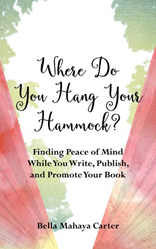
Excerpted from “Where Do You Hang Your Hammock?: Finding Peace of Mind While You Write, Publish, and Promote Your Book” by Bella Mahaya Carter.
When you’re out there promoting your book, you’ll have to ask for all sorts of things. This might feel hard. You may make up stories, such as I don’t want to “bother” people or be a nuisance. You may feel as if you have no right to ask for what you want. You may even feel, deep down, as if there’s something wrong with asking.
Of course, nobody likes rejection, either. We don’t want to hear the word “no.” But how people respond has more to do with them than with you. If you can blow by the nos, you’ll pick up enough yeses along the way. So don’t let that stop you.
Those stories running through your head, that make asking for what you want seem unsavory, doesn’t mean your ask will not be welcomed or even appreciated. I have had this experience too many times to count. Sometimes when I’ve struggled to ask a person for something, he or she is in fact happy to help. Here’s an example.
Years ago, I received an email from Jack Grapes, my old writing teacher and mentor, who published my poetry book in 2008. Jack is a well-known and beloved literary figure in Los Angeles and has been teaching for more than four decades. His email promoted an upcoming writing workshop offered by a former student of his. I wonder if he’d do the same for me, I thought, in the midst of putting together my fall writing classes.
The next day, I put “email Jack” on my to-do list. It didn’t get done. The following day, I wrote it again. Usually when I carry over an action item from one day to the next, I cross it off my list on the second day. Not this time. For a week straight, the directive “email Jack” continued to appear on my list. Why is this so hard to do? I wondered. I knew Jack loved me. I knew he respected my work. Still, asking him to do this for me felt monumental.
A week later, feeling uneasy, I forced myself to just do it.
Ten minutes after I hit the send button, I heard back from him. “I’d be happy to do that,” he responded.
A few days later, while exploring in my journal why writing and sending that email had been so hard, I realized the heart of the matter: shame. Deep down, I felt as if I shouldn’t need help, which created embarrassment and shame about asking. I worried that my request might seem needy or inappropriate. And from there, the sorry old I’m not good enough voice, a close sibling of I’m not worthy and therefore don’t deserve this, found its toehold and sprang into action, hoping I’d take the bait and fall. Once I realized that my reluctance to ask had stemmed not from a fear that he’d say no but rather from this feeling of unworthiness, something inside me released and I felt free.
How many times have you been reluctant to make a request of someone you perceived as more established, successful, or powerful than you? How often have you felt like you didn’t have the right to “bother” or “intrude upon” them? How many times have you reproached yourself, saying you shouldn’t need to ask for help? How many times have you berated yourself, thinking, I should have my shit together and not need anyone else—especially when it comes to my career?
Talk about “should-ing” all over yourself. Let’s agree right here and now to quit feeling crappy!
For years, I believed that one of the things writers needed most to succeed was chutzpah. Google defines this Yiddish word as “shameless audacity.” Some of its synonyms are “nerve,” “boldness,” and “temerity.” Hispanics use cojones, or “balls.”
I used to think writers needed balls of steel. Had my dilemma with Jack been a reminder that I needed to grow a pair, or toughen up the metaphorical ones I had?
And then it hit me: Instead of bigger balls, instead of fighting, I needed to drop down into myself, to connect with that place where absolute tenderness for and faith in myself and others reside. The key, I realized, was to be shameless in the sense of understanding that we are all worthy and that there’s nothing wrong with asking for what we want. There’s no shame in it; in fact, it’s a blessing. None of us lives alone on this planet. We are part of a community, a web of loving, supportive relationships. We all give and take all the time; these are reciprocal energies, regardless of our professional accomplishments (or perceived lack thereof). Thomas Jefferson once wrote, “Remember that no one is better than you, but that you are better than no one.”
In order to ask for what you want, you have to know what you want. Sometimes this is clear. Other times, you have inklings and intuitions. Trust your worthiness, even when you can use a little help. Especially then.
The definition of marketing is connecting with people in a human way and doing it as authentically as possible.
Writing can heal and transform lives.
Guest blogger Bella Mahaya Carter shares her
epiphany about newsletters and marketing.
Sometimes I want to lay down my ambition, hit cruise control, and glide through life. But as an author (and human being) there’s so much I don’t know and want to learn. Case in point: I had a wonderful experience publishing my memoir with She Writes Press. I’ve come close to selling out my 1000-book print run—except for a few boxes left in my garage, which remind me of this important fact: books don’t sell themselves.
The realization that I (along with most authors today) need to take responsibility for the business part of my writing life has been sobering—but also, surprisingly fun. I’ve been reading marketing books the way I used to read craft books as a young writer—inhaling them with wonder and awe. But these days, more than ever, authors are expected to sell their books, no matter how they publish. Knowing as much as we can about publishing and book promotion is essential for success, not to mention peace of mind.
Dan Blank, author of Be the Gateway, has been on my radar for years. His book sat on my shelf unread. When I finally picked it up a few weeks ago, I couldn’t put it down. Just as I was beginning to become curious about blogging and newsletters and wanting to understand these tools better, Dan offered a four-week workshop on this subject, so I signed up.
I didn’t expect what came next.
Dan had me evaluate my priorities, craft a mission statement, and get clear about what I was doing and why.
And then he challenged—disrupted—my ideas about author marketing.
Disruption is your friend.
I don’t know about you, but when someone tells me something that contradicts what I believe to be true, my default position is to become defensive. This makes learning difficult. But the reason we hire coaches and teachers is to learn from them. It made sense to set my ego aside and listen to, and at least try, Dan’s suggestions.
This instruction challenged me most:
Dispense with your fancy designed newsletter and send out a plain text email. Reach out to the people on your email list as a person, not a brand.
Publishing and book promotion are opportunities to deepen self-awareness, nourish meaningful connections, and delight in peak experiences while being of service.
I thought about how I paid my web designer to create a spiffy Mail Chimp template that reflected my brand, complete with banner, logo, and author photo. Dan said that I didn’t need these advertising bells and whistles.
But the thought of showing up without them—just me (as if I’m not enough without my “brand”)—made me nervous. I didn’t feel completely naked, but I definitely felt vulnerable—and scared.
That’s when I realized it was easy to hide behind the window-dressing of my newsletter/brand.
I asked myself: What do I like to see in my inbox? I had to stop and think about this. I knew what I didn’t like: anonymous advertising and people overwhelming me with information, offers, and promotions. By contrast, I realized that I looked forward to Dan’s emails, as well as others who regularly offer valuable insights (and free) advice and suggestions that enrich my life and work. People writing from their hearts about what they’re seeing and learning, and sharing their hard-earned discoveries with me. I savor this type of human connection. And then this became clear:
The definition of marketing is connecting with people in a human way and doing it as authentically as possible.
Many authors don’t realize that marketing can be as innovative and raw a process as writing. The difference is that instead of communicating just with yourself (and your higher power), you’re communicating with others. Sixteen (instead of the usual five or six) people on my email list replied to my first (experimental) plain text email. They responded with great ideas, conversation, and support. More people opened that email, too. And a few people even shared it with others! Hearing that made my day. Someone enjoyed what I wrote so much they felt compelled to share it! Amazing. I felt rewarded for my courage and grateful to Dan.
The deeper reason I hired him is that I’m working on a proposal for my new book, and although I have confidence in the material, I realize that my author platform may not be robust enough to attract a traditional publisher. And, regardless of how I publish, I want to learn more about finding and building an audience for my work.
The title of my new book is Where Do You Hang Your Hammock: How to Find Freedom and Peace of Mind While You Write, Publish, and Promote Your Book. Between the books I’m reading, the Nonfiction Writers Conference I attended last week, and the work I’m doing with Dan, my mind is flickering with marketing ideas. For example, I heard that there’s a “National Hammock Day,” which “commemorates the universal symbol for relaxation.” Who knew? Perhaps publishing my book on or near this date might provide publicity opportunities.
Although my book is geared toward writers, its message of resilience, flexibility, and cultivating freedom and peace of mind extend well behind this niche. Several ideas come to mind: I could write and pitch stories about relaxation to media outlets when my book launches—and every year after on my book’s “birthday.” I could reach out to special sales clients for bulk sales. Maybe writing associations, organizations, nonprofit groups, or even writers’ clubs might want to purchase copies to give to their author-members as a welcome or thank you gift. The possibilities are fun to consider.
I’m not saying I’ll never send out another designed newsletter, but for now I’m challenging myself to show up “plain”—just me and my thoughts about my unpredictable journey, in conversation with beloved readers and friends. One of the things I discovered while speaking to a writing colleague recently is that I’ve spent too much of my life hiding and trying to look good and it’s time to stop and just be me.
Here’s the mission statement I wrote for Dan’s class:
I believe in the power of writing to heal and transform lives, and I view publishing and book promotion as opportunities to deepen self-awareness, nourish meaningful connections, and delight in peak experiences while being of service.
Dan also encouraged me to get clear about my blog’s subject matter, which wasn’t hard to nail down. My blog explores intersections between the writing life, spirituality, and personal transformation and growth. That’s what my new book is about, too. I want to give this project its due. I want to give it space, let it breathe. I’m not in a hurry.
Is this easy? No! Does it diminish your overall creativity and writing output? No! Does it make you immune to vulnerability? No! But, honestly, I wouldn’t want to live any other way. I’m human. I vulnerable. I’m afraid. I take chances. And I sometimes fall on my ass.
There’s no one right way for authors to market their books. What works for one person may not work for another. The key, as I’ve said, is to come from your heart and to be authentic.
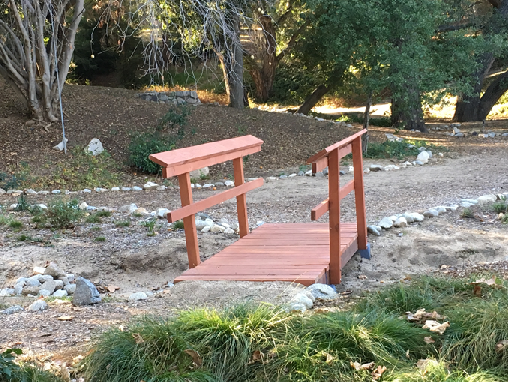
While visiting the Descanso Gardens, I took this photo. Bridges literally connect us from one place to another. They are also great metaphors for psychologically transporting us from where we are to where we’d like to go. People can be bridges. So can unexpected situations or sudden insights. While writing this post, it occurred to me to do some additional, authentic marketing by putting my memoir on sale for the holidays.
My memoir, Raw: A Midlife Quest for Health and Happiness, is available for $9.99 (no tax and free shipping)—if you buy it directly through my website. I’d be happy to sign the book to you or a friend or family member before mailing it. This offer is good through December 21. If you haven’t ordered a copy yet, please do. And if you read and enjoyed Raw, please consider buying a copy as a holiday gift. Your support means more than I can say.
[Note from Marlene: Raw is excellent. I have learned from it personally and have given it as gifts.]
Bella Mahaya Carter is a poet, author, teacher, and coach. In 2008 Bombshelter press published her poetry book, Secrets of My Sex. Her poems, stories, essays, and articles appear in dozens of print and online journals. A practicing Spiritual Psychologist, whose mission is to heal herself and others through creative work, Bella serves clients around the world with her transformational classes, workshops, and coaching.
I recommend the blogs and books mentioned below. And of course there are many other blogs, books, and information about blogging on the world wide web.
Highlights from my talk on “Myths and Realities of Blogging”
If you don’t have a blog, but think you
should, something to think about is why?
Why should you have an author blog?
“Blogging is simply a medium that allows you to connect with people who love the same books, hobbies and activities you do.” — Gabriela Pereira, May/June 2018, Writer’s Digest magazine
Author Blog
Find Your Target Audience: Read the reviews of
books in your genre on Amazon or Goodreads. Use words from the reviews for your
headlines and tags in your posts.
What to Post
Stories about you: Your interests, hobbies,
pets, hometown. Interviews.
Platform
One way to build your platform is to be a guest blogger. I welcome your essays about encouraging writers and writing tips on The Write Spot Blog. Go to “Guest Bloggers” to see what others have done (800-1200 words).
Book reviews are also welcome on The Write
Spot Blog.
The Benefits of Blogging for Writers by Nancy
Julien Kopp
Name recognition in the Writing World
Helps promote your books
Connections with other writers
Can exchange guest posts with other bloggers
Makes you write regularly/inspires other forms
of writing
The Write Spot to Jumpstart Your Writing:
Discoveries
The Write Spot to Jumpstart Your Writing:
Connections
The Write Spot: Reflections
The Write Spot: Memories
Should you host an author’s blog to build your platform? You don’t have to, but it’s a good idea . . . as long as you stay focused on your “main” writing . . . your fiction, non-fiction, poetry, memoir. And if you love posting on your blog . . . do it! Just write!