Writers have been told to “show” rather than “tell.” Do you wonder what that means?
Barbara Poelle, “Funny You Should Ask,” Writer’s Digest, September 2015 says this about that:
“Telling supplies information while showing explores information. In order to expand a narrative into more showing, think about the complete sensory experience of a scene.”
If you rely on narrative, you run the risk of an “information dump,” where you give all the facts in a few sentences. Poelle suggests, and I agree, “Don’t fall into the trap of quickly getting information ‘out of the way’ so you can ‘get to the story.’ . . . Take your time to explore [the facts] through action, dialogue and the senses of the characters involved.”This way, you set the scene with a “kinetic feel.”
All well and good, but what does this really mean?
I played around with some scenarios:
#1: I set my timer. I have thirty minutes to finish this blog post before starting dinner. My husband and I had to eat early so I could be at my writing workshop by 6:30 pm, my Monday evening commitment. In the old days, this would have been impossible, since there would have been carpooling for kids’ activities, overseeing homework and laundry.
So, you know that I’m just as busy now as when the kids lived at home. But you don’t know how I feel about my current commitments nor how I feel about being an empty-nester. Now, I’ll try for a kinetic feel:
#2: Twisting the dial on the timer to go off in thirty minutes, I settle into my cushy chair. Dinner would be easy, salad with whatever leftovers I can ferret from the fridge. My husband isn’t as picky as the kids were. Back in the day, it would have been pasta with marinara sauce and garlic French bread. Carbs for calories to sustain them through ballet, piano, baseball, soccer, basketball (depending on time of year) practice. Sometimes I miss the patter of sports-clad footwear and washing uniforms. I got so used to being interrupted, now I interrupt myself. I’ll be humming away, concentrating on a blog post when I must check Facebook. Twenty minutes later, I realize I need to prepare prompts for tonight’s writing workshop. Completely absorbed in creating clever and inspirational prompts, I remember I need to finish the blog post in time for tomorrow morning’s post. The timer dings, sending my heart racing. Gotta go.
So, what’s the difference? #1 is an “information dump.” Not too much detail, just a list of facts. You might not be able to “see” or “feel” this scenario.
#2:You can infer I am on deadline (setting the timer) and I am capable of cooking a nice dinner. You might imagine I miss the days when my activity-bound children needed me, but I’m pretty happy and content with my life now as an empty-nester with more me-time. #2 has more of my personality, so the reader might feel a connection . . a kinetic connection with me.
 Your turn: Write about something you routinely do . . . implementing sensory detail. Go ahead. . . Write with gusto as you writhe in agony over what to expound. Just write!
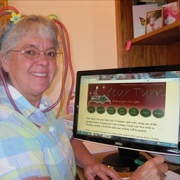
Candid shot of Marlene hard at work in her corner office. Can you see the wheels turning and steam rising as she madly meets deadlines with blog posts! Ignoring conventional punctuation, feeling free to dance along the page, her faux dreads keeping time to the muse.