
Today’s writing prompt: Expect the unexpected.
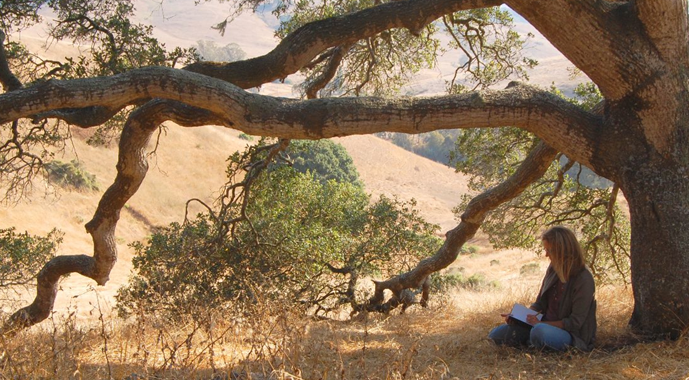
Marlene’s Note: I thought of this prompt, then remembered the photo from Susan Bono’s Inklings page on her website. They seem like a good match.
Today’s writing prompt: Expect the unexpected.
Marlene’s Note: I thought of this prompt, then remembered the photo from Susan Bono’s Inklings page on her website. They seem like a good match.
It’s only five minutes. Go ahead. Do it now. We’ll wait.
Humming in the background while writing gets done.
Quiet while writing gets done.
Are you still reading? Write! Just write. For five minutes.
After five minutes . . .
Yes, you. Now. Just write. Go ahead. We’ll wait.
Waiting. Waiting. Patiently waiting. I’ll write, too.
After five minutes . . .
Hmm . . . what will you choose from nature to write about?
Feathers, rocks, trees, birds, rocks, dirt, peach blossoms, river, waterfall, penguins, geese.
Write whatever comes up for you about nature.
Shhh. . . Writers are working here. Doing what we do.
Writing. Just writing. Keep on writing. For five minutes.
Next . . .
Can use repetition.
Doesn’t have to make sense.
Have fun with this.
Play with words.
“The personal essay begins as an act of exploration. We write in order to figure out where we’re going and make sense of where we’ve been.” — Susan Bono
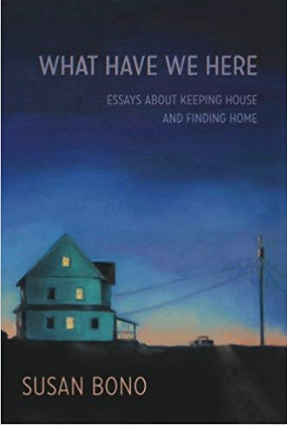
Susan Bono is an extraordinary writer whose words go right to the heart. You can read her excellent writing in her collection of short essays in
What Have We Here: Essays about Keeping House and Finding Home.
Susan is a writing teacher and freelance editor specializing in memoir. She facilitates writing workshops at Copperfield’s Books in Petaluma. California.
This past year has been difficult for me (Marlene), not just during the long month of November.
I have been playing catch up all year, trying to whittle down my never-ending to-do list. Susan Bono’s guest blog post reminds me to stop, notice, and savor the moment.
Susan writes:
Even those of us who start the day with a list know what it’s like when unplanned-for events start coming our way. In spite of our intentions, we start tackling the unscheduled instead of working on what we had planned. Emergencies come up, of course; we can’t control everything. No one can plan for bad news or times we are suddenly needed. But the list of unanticipated tasks is endless, and after a while, we just start doing what comes to us, instead of what we had intended.
You should have days when you follow your bliss. In fact, have them as often as you like, but the trick is in telling yourself right from the start, “Today I’m going to do whatever I feel like.” But a plan that’s been ignored is a sign of defeat, and most of us have long range goals—I mean, who doesn’t? So whenever you miss an opportunity to complete an intended task, you are altering the look of your Big Picture.
Whether you regularly schedule too much for yourself or sell yourself short, you’ll benefit from the TL list. TL stands for “Tough Luck,” because that’s what you say to anything that’s not on it. If you can complete your assigned tasks, then let the spirit of que sera, sera take over.
So tomorrow, do whatever is in your power to follow your list. The more in control you become in this area of your life, the fewer details your list will need to contain, but for tomorrow, make a schedule of what you think will cover every hour of your day. Include meals, personal care, regular errands, like carpooling, time sinks like phone calls, TV, or email. Now fit your to-do list into that existing framework. How much time do you really have?
Once you’ve made your list, do your best to stick to it. Each time you say, “Tough luck” to extraneous chores, you are giving yourself a big helping of Tough Love. You are proving to yourself and the world that the work you set out to do is important, and so are you.
See if you can love yourself enough to use the TL list until you discover what your true desires and capabilities are. As you plan your list for each tomorrow, note any substitutions you made earlier that day. Did you trade a trip to the grocery store for a surprise phone call from an old friend? Did you not get the ironing done because you couldn’t put down that exciting book you were reading at lunchtime? Were your “failures” or trade-offs satisfying, or did they leave you wishing you could have a do-over?
It’s important not to beat yourself up, because maybe what you really need is to make room for more fun. You can start scheduling that in, too, as you transfer whatever’s undone from the day’s list onto tomorrow’s. And if you’ve really missed the boat on some assignment you’ve given yourself, give it a decent burial. If what you failed to accomplish alters the Big Picture, accept this change with grace and trust that you were meant to change course anyway. As you learn to work with the TL list, you will internalize its rhythms and you won’t need to write everything down. But when you feel yourself getting out of control, you can always use this method to get yourself on track again.
We can’t control what life does to mess up our plans. But we can eliminate our own tendencies to sabotage ourselves. You’ll know when the TL list is working when you stop being so mad at yourself and start building a list of your accomplishments. That’s when Tough Luck goes beyond Tough Love and becomes True Love.
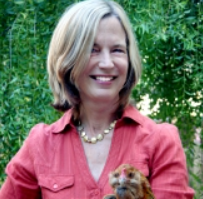 Susan Bono, author of What Have We Here: Essays about Keeping House and Finding Home, was once a high school English teacher, is now a freelance editor, and has been facilitating workshops, critique groups and free-writing classes for more than 25 years. She was the editor and publisher of Tiny Lights: A Journal of Personal Narrative from 1995—2014.
 Recently I was one of three judges for a writing contest. We didn’t agree during the first round of reading on the winners. It took re-reading and much discussion to select the three winners. So that got me to thinking. What do contest judges look for when choosing winning entries?
My fellow judges and I came up with:
Make sure to follow the guidelines. They aren’t arbitrary. The guidelines are specific for a reason.
Make sure to follow the criteria of what genre the contest is. Don’t submit memoir if the contest is fiction. Even though the judges may not be able to tell for sure if something is fiction or memoir . . . if it feels like memoir, it probably is. And that won’t work in a fiction contest.
The winning entries that stood out excelled in creative writing and well-crafted stories. The writing and stories were compelling, keeping reader engaged to the end.
Proofread. I know this is obvious, but many of the entries had typos or punctuation errors.
Have someone read your entry – both for feedback and to proofread.
If it’s a fiction contest, make sure your entry is a story. Many of the entries were anecdotes, rather than full pieces (beginning, middle, end with a definable plot and fleshed out characters).
Avoid clichés – in words, phrases and story line. This goes back to the unique story. Tell us something new, or write something old with an interesting twist.
Understand and use correct point of view. Many entries jumped around with point of view, sometimes it was hard to tell who “he” and “she” referred to.
Stay with the same verb tense, except when appropriate to use past or future tense. Stories got extra points from me when using present tense (because that’s harder to do than using past tense).
Susan Bono shares her views on contests in her essay, A Thought or Two on Writing Contests, originally published in Tiny Lights, A Journal of Personal Narrative, 2/9/2007.
“Don’t assume the winners of a writing contest were the only ones to submit excellent work. There are only so many prizes available in any given contest. Winning may equal good, but losing does not always equal bad. Your turn will come.” —Susan Bono, author of What Have We Here: Essays about Keeping House and Finding Home, has judged many, many contest entries.
“Make us see something about the world in a fresh way or remind us of something important that has an arguable public dimension.” — Dan Lehman, River Teeth, A Journal of Nonfiction Narrative
“There is a difference between experience and meaning-making. If we are reading along and this happens and this happens, and we still don’t know why it is important, then we know the writer might not be up to it . . . just writing about something that has happened to you is never enough. It’s what the writer does with her own experience, what she makes of it that counts.” —Joe Mackall, River Teeth, A Journal of Nonfiction Narrative, (paraphrased from original quote by Judith Kitchen).
River Teeth Journal, Editor’s Notes, Volume 17, Number 2, May 31, 2016
Are you motivated? Ready? Enter!
Redwood Writers, a branch of The California Writers Club sponsors contests year-round.
The Writer Magazine regularly calls for contest submissions.
Writer’s Digest Magazine lists contests.
Links to writing contests.
Do you feel guilty when you re-read a book (on purpose, not because you forgot you previously read it)?
Juan Vidal wrote a thoughtful essay about the joys and discoveries one makes when re-reading.
“Returning to a book you’ve read multiple times can feel like drinks with an old friend. There’s a welcome familiarity — but also sometimes a slight suspicion that time has changed you both, and thus the relationship. But books don’t change, people do. And that’s what makes the act of rereading so rich and transformative.
The beauty of rereading lies in the idea that our engagement with the work is based on our current mental, emotional, and even spiritual register. It’s true, the older I get, the more I feel time has wings. But with reading, it’s all about the present. It’s about the now and what one contributes to the now, because reading is a give and take between author and reader.”
Excerpted from: “You Can Go Home Again: The Transformative Joy Of Rereading,” by Juan Vidal, NPR, April 17, 2016 NPR. KQED Public Radio.
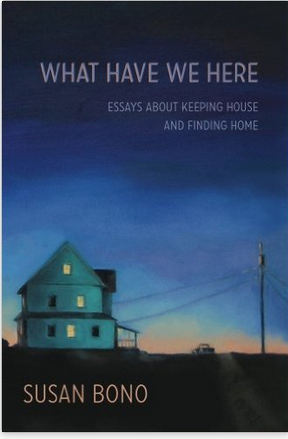
What books have you re-read?
Note from Marlene:
I have re-read so many favorites, it would be a long list.
One of my all-time favorites to re-read is What Have We Here, by Susan Bono.
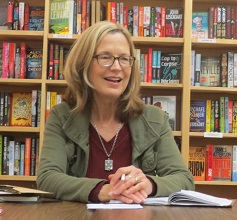
I had the good fortune recently to “sit on the other side of the table.” I attended a Jumpstart Writing Workshop facilitated by Susan Bono.
Susan talked about how there is tension between what the reader knows and what the narrator/character doesn’t know.
Photo of Susan at Jumpstart Writing Workshop in Copperfield’s Bookstore, downtown Petaluma. Photo by Breana Marie.
Susan read Shel Silverstein’s poem, “Something Missing.”
I put on my socks,
I remember I put on my shoes.
I remember I put on my tie
That was painted
In beautiful purples and blues.
I remember I put on my coat,
To look perfectly grand at the dance,
Yet I feel there is something
I may have forgot—-
What is it? What is it?. . .
Do you know what the narrator forgot? If you don’t know, read the poem again.
It rhymes with “dance.” . . . Pants!
Susan talked about how, in writing, there can be tension between what the reader knows and what the narrator/character doesn’t know. In the poem for example, the reader knows what the character doesn’t know . . . he forgot his pants.
Susan next talked about “yearning for an answer.” I think she’s on to something. . . readers yearn for answers as do writers. When writing, especially freewrites, we can learn about ourselves and as we write, truths can be revealed. Or, we might see an old situation in a new way. That’s what happened for me while writing on this prompt.
Writing Prompt: Write about the feeling of something missing.
Part 1 of 3. The next two prompts will continue with this subject of reader knowing, narrator not knowing and what’s missing. Stay tuned.
A reminder for making comments on The Write Spot Blog: There is no judging, no critiquing, no questions asked for clarification. With this type of freewriting, we are writing for ourselves, not for an audience nor for the entertainment of others. This type of writing can result in polished writing that is published, but that’s up to the writer to decide whether or not to share his/her writing. The first inklings of freewrites are kernels . . . ready to pop, or newly hatched, kind of like newborn babies seeing the world for the first time. Be kind with your comments.
And be gentle with yourself, dear writer, you are doing important work.
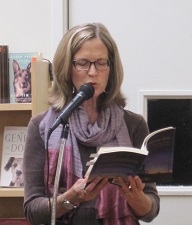
“Challenges always present themselves in any creative undertaking, but you’ll never get far if you let doubt rule you.”
Susan Bono author of What Have We Here: Essays about Keeping House and Finding Home.
 “Good writing comes from your willingness to be vulnerable, to peel back the layers of resistance, to offer up your heart, pulsing and defenseless, on a silver platter.” – Susan Bono, author of What Have We Here.
Your Life. You lived it. Surely you can write about it. Right?
In How To Write A Memoir, Part 1, we’ll discuss methods and ideas about writing personal stories, with links to published memoirs.
How To Write A Memoir, Part 2, we’ll cover organizing, revising and more.
You can write in chronological order, or build your story around pivotal events. In the beginning, it doesn’t matter what structure you use. Write in a style that is comfortable for you. Try one way and if isn’t working for you, try something else.
Memoirs written in chronological order (with back story woven in): To Have Not by Frances Lefkowitz and Grief Denied by Pauline Laurent.
Rachael Herron, A Life in Stitches, assembles her stories around her knitting experiences.
For the first draft, it’s fine to jump around in time. Don’t worry too much about making sense in the early stage of writing. Get your stories written. Organize later.
Paper or Computer?
You can write using paper and pen/pencil or on a computer. Or both. For the most part, it doesn’t matter which method you use. The advantage of a computer is it’s (usually) faster. The advantage of paper and pen or pencil is the portability. Some people suggest there are benefits to handwriting for accessing creativity.
Self-care
If remembering and writing details about your life is difficult, it’s very important to have a strategy to avoid additional trauma. Create a self-care plan to protect yourself when writing about deeply painful topics.
Writing Prompts
You can use writing prompts to jumpstart your freewrites, to trigger memories and to make discoveries. Choose a prompt, write for 15 or 20 minutes. Take a break. Next time, choose another prompt. Good prompts to get started are:
I remember . . .
I don’t remember . . .
In this photo, I . . .
In this photo, you . . .
 Photos
You can use photos to inspire your writing. First, look at the photo. Write all the details that you can see. Write about what happened before and after the photo was taken. Write about feelings you have connected with this photo.
Photos might remind you about activities, important occasions and details that you may have forgotten. Did Grandpa always wear that hat? Did Grandma wear her apron with the little flower print every day, even on holidays? My Nana did.
Other Memoirs
Read memoirs to get an idea of how you want to proceed with your memoir. Some styles will appeal to you. Others aren’t right for you. You can read reviews on both Amazon and Goodreads to research different styles of memoirs.
Susan Bono, What Have We Here, grouped her personal essays by theme.
Rayne Wolfe, Toxic Mom Toolkit, braids three strands: her memoir, excerpts from others and toolkits.
Janice Crow, I Give You My Word, created poems and watercolors to enhance exploring her journey.
Story Telling
When writing, think of yourself as a storyteller. In this story, you are the main character. Your family and friends are the supporting cast members. When you write, don’t think of any of these cast members. Write events (scenes) as you remember them, without worries (for now) about accuracy. With the first draft, put on your story-telling hat and write what happened.
Research
Interview family members, friends and acquaintances to learn details you may not know. You might realize a broader perspective from hearing other points of view.
Research news, locally and world-wide, during the time period your story takes place. Tie in events with your story, if appropriate. Fact check details: slang, clothing styles, popular dances, technical gadgetry, geographical, etc.
Take a few minutes
After you have written all that you want to say, spend some time reflecting. What compelled you to write these stories?
Perhaps your writing is a learning tool to understand what happened and to educate others as Piri Thomas does in Down These Mean Streets.
Maybe your desire is to get these stories off your chest, to vent, to release emotions as well as help others similar to Ellevie by Marcelle Evie Guy.
Maybe you want to record family stories, to document your family history.
How To Write A Memoir – Part 2, we explore what to do after you have written your memoir, revision and the business of writing.
 Final Comments
This likely will be an emotional project. Take whatever time you need for breaks. Remember to exercise, go on walks, drink water and find joy, wherever you can.
Just Write
There are over 200 prompts on The Write Spot Blog. Use them for your memoir, for personal exploration and for fun!