Tag: The Write Spot

  • Aprons . . . Prompt #88


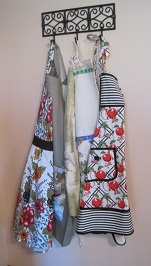
    ApronsMy grandmother put her apron on every morning right after she put on her house dress. She wore an apron every day, even to parties. She made all her clothes, including her aprons. She always chose a small flower design and used colorful seam binding for trim around the edges.

    I also wear aprons, but only when cooking and eating. . . saves many an outfit from food stains.

    Today’s prompt is: Aprons

    Thank you, Kathy Myers, for the inspiration to hang my aprons in the kitchen.

    Thank you, Pam Swanson, for emailing so many years ago, “The History of Aprons.”


                                            THE HISTORY OF APRONS

    The principal use of Grandma’s apron was to protect the dress underneath. Because she only had a few dresses, it was easier to wash aprons than dresses and they used less material, but along with that, it served as a potholder for removing hot pans from the oven.

    It was wonderful for drying children’s tears.

    From the chicken coop, the apron was used for carrying eggs, fussy chicks, and sometimes half-hatched eggs to be finished in the warming oven.

    When company came, aprons were ideal hiding places for shy kids.

    And when the weather was cold, Grandma wrapped her apron around her arms.

    Those big old aprons wiped many a perspiring brow, bent over the hot wood stove.

    Chips and kindling wood were brought into the kitchen in that apron.

    From the garden, the apron carried all sorts of vegetables.

    After the peas had been shelled, it carried out the hulls.

    In the fall, the apron was used to bring in apples that had fallen from the trees.

    When unexpected company drove up the road, it was surprising how much furniture that old apron could dust in a matter of seconds.

    When dinner was ready, Grandma walked out onto the porch, waved her apron, and the men knew it was time to come in from the fields to eat.

    It will be a long time before someone invents something that will replace that ‘old-time apron’ that served so many purposes, especially what many children and grandchildren received from the simple apron. . . Love!

    Adapted from:  The History of Aprons,  which may have been originally from  Grandma’s Apron.

    Writing Prompt:  Aprons
  • It doesn’t matter whether the story is set in the present day, 100 years ago hence, or . . .

    “It doesn’t matter whether the story is set in the present day, 100 years ago hence, or in a place that has never and could never exist outside the pages of a book: The writer’s job is to present an utterly convincing and wholly seamless world,” Simon Morden, author of fantasy novel Arcanum. — The Writer Magazine, July 2014

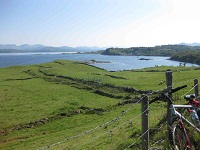
    Ireland Countryside. Jim C. March


    Photo by Jim C. March

  • Three-part prompt . . . Prompt #87

    Today’s prompt is three parts. Take about 20 minutes, or as much time as you need, for each section.

    Part One: Write a list of events from this past month:

    What aggravated you?

    What frustrated you?

    What made you laugh or cry?

    pin

    What made you lose your temper?

    What was the worst thing that happened?

    The best?

    The most disturbing or weird?

    Part Two:  Choose one thing from your list and write about it. Write whatever comes to mind. Write what you would really like to say to the other people involved.  Take your time with this. Write until you have no more to say on the subject.

    Write what happened from your point of view.  Lola.200

    Part Three: Only do this after you have done Part Two — If another person was involved, step into his or her shoes. Write what happened from the other person’s point of view.

    shoes.women                                                    shoes.men

    Just Write!

  • What should you throw away but just can’t? Prompt #86

    Write about something you should throw away but just can’t.

    IMG_1650

  • Guest Blogger Marjorie Richardson corrals the chatter and invites creativity.

    Guest Blogger Marjorie Richardson writes about waking our consciousness through gentle yoga.

    Want to calm your nerves, quiet your mind, decrease anxiety and heighten immunity? How about having more comfort and ease in your body? Developing a feeling of fluidity in your body? Accessing your creativity? All these things can and do take place through slow and gentle movement accompanied by focused rhythmic breathing. Gentle yoga enhances our ability to hear ourselves, to listen to the inner cues we are constantly being given. In deeply concentrated states of mind, restlessness calms down. Synchronizing breath and movement train the mind to sense the subtle layers of well-being below all the surface chatter.

    Hatha Yoga is a tool discovered thousands of years ago to be used to awaken consciousness and unite with all the levels of our being. When attention is directed inward, your body receives messages that you are safe and secure; your self is being looked after. Muscles relax, blood pressure drops, the nerves calm, the mind quiets, anxiety decreases and immunity heightens.. Our fast-paced busy lives tend to stimulate a high level of stress that runs our immune systems down as they try to cope. A Yoga practice is a counter pose to that life style.

    The gift of yoga is multifaceted. Through our yoga practice we break through and loosen old patterns of feeling and being. We develop a new relationship with ourselves physically, mentally, emotionally and spiritually. Yoga deepens our understanding of who we are and how we choose to be in the world. Yoga expands us, opens us to new territory, releases stuck places that were previously unavailable. Through our yoga practice we attune to our alignment at the core of our being. We increase physical strength, flexibility and balance. We develop non-judging acceptance and open heartedness. And through all of this we experience a calmer and more peaceful state of mind. We cultivate an ability to listen to our body, to hear what it really needs for well-being. We begin to move away from the push and the struggle and breathe into the little releases and insights that are revealed to us through our body as we learn to listen with curiosity and trust. In this way, yoga can enhance our writing.

    The body, mind and spirit responds to and loves the oxygenating benefits of deep rhythmic breathing and the balancing of all the body systems through the gentle stretching and relaxing into the poses. The true work of our yoga practice is cultivating self acceptance, kindness and patience, developing and integrating body mind and spirit. Our physical need is health, our psychological need is knowledge and our spiritual need is inner peace. Cultivating all three produces harmony and who the heck doesn’t want that?

    Marjorie Richardson.1Marjorie Richardson is a certified Integrative Yoga Instructor & Massage Therapist who has been teaching yoga in Petaluma, California since 1997. Her gentle style supports the process of letting go of tensions, worries and habits by using breath and movement synchronized together.

    Note from Marlene:  I just love serendipity. I’ve had this post ready for awhile, waiting for an “open spot” on the guest blogger calendar.  Today is The Day. There is a good article about “Yin yoga: A fascia-nating practice,” by Hana Medina in the July 2014 issue of The Costco Connection. Don’t you just love it when serendipity happens?

  • Your intangible treasure. Prompt #85

    What is the one intangible thing you treasure above all else?

    Intangible, meaning: you can’t touch it, feel it, smell it, hold it, see it . . . it may be a character trait, a personality trait, a quirk. . . a feeling. . . .

    Prompt:  Write about something intangible that you treasure.

    LifeJanePhoto by Jane Person


  • The Kathy Myers “Book in a Box” Method (patent pending)

    Guest Blogger Kathy Myers writes:

    Computers are great and all— without them, this blog wouldn’t exist and then what would I do? But when I was younger, my image of a writing life was less technical and more romantic: Jo in Little Women, writing her books in a drafty attic wearing fingerless gloves against the winter chill, or Jane Austen dipping her nib and contemplating her next chapter, while her parents plan a ball where she can meet eligible bachelors. Ah, the good old days.

    At a Jumpstart Writing Workshop in May, I wrote a fictional scene on the prompt “It happened because . . . ”  Marlene Cullen, always benevolent and encouraging to writers said, “That would be a good beginning for a romance novel.”

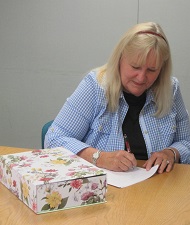
    Jumpstart was on hiatus for the month of June, and this coincided with a flirtation I’d been having about trying the fabled “sit-your-ass-in-a-chair-and-write-a–thousand-words-a-day” method I’d heard so much about— a discipline that so many writers (who actually have books published) swear by. So I thought what the heck, if Marlene can drag herself to her exercise boot camp, I can drag myself into the kitchen: make some toast and coffee, go back to bed with my fully charged laptop, and write until it runs out of juice. This averages about three hours and about a thousand words. I am no worse for wear for the effort, and I have the rest of the day ahead of me—fully charged with a great sense of accomplishment. I press print, and then put my day’s work into a lovely flowered document box (Home Goods $7.98). My box is fancy and romantic—much nicer than poor Jo’s manuscript—wrapped with brown paper and twine. It might not be as nice as Jane’s satin lined box inlaid with elephant ivory, but hey—now I’ve got something to buy with my future royalties.

    It’s July now and I’m thirty thousand words into my first novel. I have to tell you: The ass in a chair/ book in a box method works. You are free to do as you wish with your writing, of course. Do it on a whim or when the muse strikes. But get a fancy box to put it in. Remember that everything you write is a legacy of sorts. You can have a time capsule where your stories, journals, or Jumpstart notebooks can be collected—honoring your efforts with a neat and lovely testament to your creativity. Your voice in the form of your words can reside there in style.

    Kathy M. + boxKathy Myers is a big fan of Jumpstart and Writers Forum. She has waded into the submission pool this past year and been published by Every Day Fiction, Petaluma Readers Theater and Redwood Writers Anthology. She has done several guest book reviews on The Write Spot Blog and is an advocate for fancy boxes everywhere.

  • Fourth of July . . . Prompt #84

    July 4th is coming up. . . . what does this mean to you? Do you consider yourself patriotic? What does being patriotic mean to you?

    Which reminds me of one of my all-time favorite “brain teasers.”

    Fourth of JulyDo they have fourth of July in England?


    Yes. . .and third of July and fifth of July.

    Writing Prompt:  What does July Fourth mean to you?

  • Feeling your way in the dark . . .

    “The way I write, it’s like feeling your way in the dark. You don’t know if it’s going to catch fire  — not just your imagination, but your emotions.” — Dan Coshnear

    Northern California writer Dan Coshnear is the author of two collections of stories, Jobs & Other Preoccupations (Helicon Nine 2001) and Occupy & Other Love Stories (Kelly’s Cove Press 2012). Born in Baltimore in 1961, he has traveled in Europe, Canada, Mexico, Haiti, and all over the U.S., often by thumb, and once for a few thousand miles by freight train. After living on Cape Cod and in New York and San Francisco, he finally settled with his wife, Susan, in a house under some very tall trees along the Russian River in Sonoma County, California. His stories have been published in Fourteen Hills, juked, The Missouri Review, Third Coast and Zyzzyva.

    Occupy CoshnearAbout Dan’s latest publication . . . Occupy & Other Love Stories

    “To occupy means to be present, to be available emotionally, to stand up for oneself, and sometimes to protest. The opposite is absence. To be rendered silent, useless, vacant because of fear or confusion or despair. Each of the stories presents a challenge, not only to an individual character but to a relationship. This short story collection from award-winning California author Daniel Coshnear includes 12 stories about occupation, featuring ordinary heroes. A thoughtful mood is reinforced with 16 full color images from Oakland artist and UC Berkeley Professor Emeritus Squeak Carnwath.”


  • Right now . . . Prompt #83

    Ireland, photo by Jim C. MarchSet your timer for 12-15 minutes and write.

    No judging.   Shoo your inner critic away.     Just write.

    Today’s Prompt:  Right now . . .

    Photo taken in Ireland by Jim C. March