Hello, how ARE you?

  • Hello, how ARE you?

    By Sharmila Rao

    Writing Prompt on The Isolation Journals: How ARE you?

    What happened yesterday evening motivated me to attempt this prompt. I dropped in to meet one of my friends whom I was seeing after a year because of the Covid protocols. She is a cancer survivor and I had gotten closer to her during this challenging journey of hers. We exchanged the usual pleasantries and she replied I am fine, Sharmila.

    I could see her eyes were saying something else though.

    As we got talking about the past year and how it has affected each one us, I told her of the many changes I have begun to incorporate in my life, one of them being giving due priority to myself—something I felt I had seriously lacked all my life.

    The moment I mentioned this to her I was taken aback by her soft almost immediate plea to guide her as to how she could go about this herself.

    Then, swearing me to secrecy she slowly revealed without a pause, the story of her married life and the issues she was facing.

    It seemed to me the fall out of having an insensitive husband and the typical vacuum she and many women face mostly around middle-age. They grapple, often unsuccessful, like she was, as the opposite party denies or lacks the need for empathetic communication.

    Clearly, she was anything but ‘fine.’

    As I walked home, I couldn’t help but ruminate over this. I stopped to ask myself how often had I been able to respond honestly to: Hello, how are you?

    As far as I can remember, only till I was living in childhood.

    I remembered how I was called, “The Happy child” in my family as I was always attuned to the many little wonders of the world around me. I am still sure fairies sit on toadstools!

    It did make me feel special but undeniably a trifle embarrassed, even at that time, for it felt like being singled out under a spotlight for being different.

    Life however took care of that. Sometimes it can work efficiently overtime at the wrong time and so it ensured I was quick to learn that nothing comes for free. And, happiness? Never.

    Lots of water has flowed under the bridge. I swam along mostly fighting against the current, sometimes out of breath and at times even thinking I would drown. I continued to wear the “I am fine” badge. After all that is what is expected of you: be courteous, be brave, be stoic, be mature. Be everything, but yourself.

    And me, the good student, carried on living in the classroom of life till I realized the truth: there were no prizes for the best performance.

    Behind the ‘I am fine’ mask it gets suffocating; the self begins to decay in layers of untruth. Whenever I tried to lift it, only a few people accepted what they saw.

    It reminds me of my father who was an eternal optimist. I remember all so clearly, when anyone greeted him with a regular ‘How are you, he would cheerfully reply, “Can’t grumble.”

    I never thought much about it then but as the years pass by and I find it increasingly difficult to answer, I find his two little words so relevant and imperative to adopt.

    More so in these strange new times when I see people around me who are suffering untold pain and for whom even the next meal is a battle. For us, India does offer a conscience check every so often, even on my daily evening walk.

    The next time around, the answer to “how are you” will be for myself.  A reassuring, Well I AM fine. After all, aren’t I?

    And, maybe just, on an especially grey day I need not hide behind ‘I am fine.’ I can be my true self to the ones who really care to see what lies beneath.

    These are the ones I keep.

    Sharmila Rao

    As a child my father led me into the enriching world of books and my relationship with them continues. I am Sharmila Rao and I live in Western India in Mumbai, a hot, noisy and crowded city, vibrant enough to make you want to live nowhere else.

    A background of Journalism and a degree in teaching the Physically Handicapped broadened my mind and sensitized me to the imperfection of life. 

    I chose to be a stay-at-home Mum and enjoy the growing years of my son. My empty nest is now lined with books (I love the smell of old hardbound ones) and I sit in its warmth embracing the beauty of words.

  • Suleika Jaouad and The Isolation Journals

    Guest Post by Suleika Jaouad, creator of The Isolation Journals.

    The Isolation Journals was founded on the idea that life’s interruptions are invitations to deepen our creative practice.

    Suileika:

    When I started The Isolation Journals project, I had no idea so many would join me.

    In late March 2020, I was quarantining in my parents’ attic, having left New York City as Covid-19 was surging. I was no stranger to isolation. For much of my twenties, I was in treatment for leukemia, unable to travel, eat out, see friends, even take a walk.

    Now isolation was back—this time on a global scale.

    The Isolation Journals is an artist-led community and publishing platform that cultivates creativity and fosters connection in challenging times.

    We are in an unprecedented moment. This is one small way to stay grounded and hopeful to transform our isolation to connection.

    Suleika’s August 2, 2020 Isolation Journals Post:

    Today’s prompt is inspired by the relationship between movement and creativity. It’s something that artists and thinkers have observed for millennia. One of the earliest examples is the legend of Aristotle, who paced while he taught, and his students—called “the Peripatetics,” a word that means “to walk around”—followed suit. As Thoreau wrote in his journal, “Methinks that the moment my legs begin to move, my thoughts begin to flow.” 

    But what is new is scientific evidence to support the age-old phenomenon. In the last decade, studies have emerged showing that movement and thinking are symbiotic, and some neuroscientists theorize that the evolutionary process that allowed us to develop the ability to walk upright is the same one that helped us develop conscious cognition. It’s a fascinating idea, one with so many implications for the creative practice.

    I’ll say one last thing before getting to the prompt—that we’re all different, with varying access to places to walk, with bodies that have different abilities and disabilities. Because of that, it’s natural that how we move will vary as widely as the writing that will follow it. Just find what works for you; as always, this practice is yours, so make it your own.
    Prompt 103. The Singular Glory of a Solo Walk In mid-March, I was working on a grueling last edit of my memoir Between Two Kingdoms. From early in the morning until late at night, I sat hunched over my computer in my parents’ attic, second-guessing every comma, re-thinking every word. I was panicking, sure it was a total disaster, and my quarantine roommate Carmen offered to read the entire manuscript out loud with me. Between the stress of the deadline and being so sedentary, our bodies ached. From time to time, we’d have to take a break—walking in the woods and stopping for a spontaneous snowball fight, or doing yoga there in the attic.

    One afternoon, we were both in downward dog, and I said to Carmen, “I have an idea.” I rambled something vague about journal prompts and helping others complete a 100-day project. “Go write that down,” Carmen told me. “Now—before you forget it.” And I got up from the mat, and I did. I didn’t expect it would go anywhere, at least not immediately. But writing it down made the idea seem more real, and I kept mulling it over. Then as the number of cases of covid-19 rose, as cities and states and countries went into lockdown, that seed of an idea—one that had occurred in a moment when I was giving my mind a break—sprouted a week later into the Isolation Journals.

    This isn’t a one-off. When I’m stuck and can’t work something out on the page, or when my head is too full of chatter, I’ve learned to get out of my mind and into my body. I go for a walk, and as I move and fall into a rhythm, the chatter quiets. Whatever knots my thoughts are in begin to loosen. 

    It happened just yesterday. Over the weekend, Jon and I moved to an artist’s residency, to a house near a river with miles and miles of walking paths. I’ve been sick—last week I tested positive for Lyme disease, which has made my joints swollen, my movements slow and labored. But yesterday morning, I felt good enough to take a walk, and on a long gentle amble, I began to get an idea of what I want to write next. Right now, I’m just seeing little glimpses, like glints of sunlight on the river, but it feels good to be inspired again. As I settle into our new digs, I’m setting a new intention to take a quiet, solitary morning walk before I write. I trust that soon enough, the seed of this next idea will begin to sprout.

    Your prompt for the week:
    Begin with a movement that roots you in your body. Maybe take a walk outside, or dance around your house, or take deep breaths and blow each exhale through loose horse lips—whatever will get you out of your head. Capture what springs to mind using the voice recording app on your phone or by jotting quick notes. Do this for as long as you’d like.

    Next, write in your journal about what came up. You can elaborate on the thoughts and ideas you had, or you can get meta, reflecting on how movement carried you into a new contemplative space. 

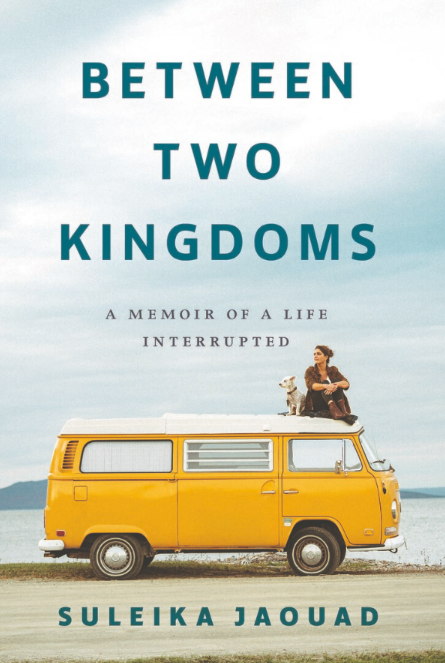
    Suleika Jaouad is an Emmy Award–winning writer, speaker, cancer survivor & author of the forthcoming memoir, Between Two Kingdoms.

    She is the creator of The Isolation Journals, a global movement cultivating community and creativity during hard times.

    You can pre-order her book, due to be released February 2021, Between Two Kingdoms, A Memory of A Life Interrupted.    

    Suleika’s humorous, informative, meaning-full Ted Talk.

    “The hardest part of my cancer experience began once the cancer was gone,” says author Suleika Jaouad. In this fierce, funny, wisdom-packed talk, she challenges us to think beyond the divide between “sick” and “well,” asking: How do you begin again and find meaning after life is interrupted?” — Official TED Conference, 2019