
“You are a real writer if you are writing, if you are working on your craft, listening to critique, and striving to be better.” —Lauren Danhof
Excerpt from the July/August 2023 issue of Writer’s Digest magazine
#justwrite #iamawriter #iamwriting
“You are a real writer if you are writing, if you are working on your craft, listening to critique, and striving to be better.” —Lauren Danhof
Excerpt from the July/August 2023 issue of Writer’s Digest magazine
#justwrite #iamawriter #iamwriting
 Recently I was one of three judges for a writing contest. We didn’t agree during the first round of reading on the winners. It took re-reading and much discussion to select the three winners. So that got me to thinking. What do contest judges look for when choosing winning entries?
My fellow judges and I came up with:
Make sure to follow the guidelines. They aren’t arbitrary. The guidelines are specific for a reason.
Make sure to follow the criteria of what genre the contest is. Don’t submit memoir if the contest is fiction. Even though the judges may not be able to tell for sure if something is fiction or memoir . . . if it feels like memoir, it probably is. And that won’t work in a fiction contest.
The winning entries that stood out excelled in creative writing and well-crafted stories. The writing and stories were compelling, keeping reader engaged to the end.
Proofread. I know this is obvious, but many of the entries had typos or punctuation errors.
Have someone read your entry – both for feedback and to proofread.
If it’s a fiction contest, make sure your entry is a story. Many of the entries were anecdotes, rather than full pieces (beginning, middle, end with a definable plot and fleshed out characters).
Avoid clichés – in words, phrases and story line. This goes back to the unique story. Tell us something new, or write something old with an interesting twist.
Understand and use correct point of view. Many entries jumped around with point of view, sometimes it was hard to tell who “he” and “she” referred to.
Stay with the same verb tense, except when appropriate to use past or future tense. Stories got extra points from me when using present tense (because that’s harder to do than using past tense).
Susan Bono shares her views on contests in her essay, A Thought or Two on Writing Contests, originally published in Tiny Lights, A Journal of Personal Narrative, 2/9/2007.
“Don’t assume the winners of a writing contest were the only ones to submit excellent work. There are only so many prizes available in any given contest. Winning may equal good, but losing does not always equal bad. Your turn will come.” —Susan Bono, author of What Have We Here: Essays about Keeping House and Finding Home, has judged many, many contest entries.
“Make us see something about the world in a fresh way or remind us of something important that has an arguable public dimension.” — Dan Lehman, River Teeth, A Journal of Nonfiction Narrative
“There is a difference between experience and meaning-making. If we are reading along and this happens and this happens, and we still don’t know why it is important, then we know the writer might not be up to it . . . just writing about something that has happened to you is never enough. It’s what the writer does with her own experience, what she makes of it that counts.” —Joe Mackall, River Teeth, A Journal of Nonfiction Narrative, (paraphrased from original quote by Judith Kitchen).
River Teeth Journal, Editor’s Notes, Volume 17, Number 2, May 31, 2016
Are you motivated? Ready? Enter!
Redwood Writers, a branch of The California Writers Club sponsors contests year-round.
The Writer Magazine regularly calls for contest submissions.
Writer’s Digest Magazine lists contests.
Links to writing contests.
The March/April 2016 issue of Writer’s Digest Magazine is bursting with excellent information for writers. For example: Details about submitting to New England Review.
 New England Review: “Offers readers poems, stories and essays that are formally inventive and traditional.”
There is a $2 fee for poetry submissions and $3 fee for prose.
About NER: “By publishing new fiction, poetry, and nonfiction that is both challenging and inviting, New England Review encourages artistic exchange and thought-provoking innovation, providing publishing opportunities for writers at all stages in their careers. ”
Payment: Payment for work published in the journal is $20 per page (with thanks to a grant from the NEA), $100 for cover art, plus two copies of the issue in which the work appears and a one-year subscription.
For online publication in NER Digital, payment is $50 and a one-year subscription to the print magazine.
 Jojo Moyes discusses her writing process with Jessica Strawser in the January 2016 issue of the Writer’s Digest magazine.
“Frequently I will write chapters that I end up having to ditch. And they might be beautifully crafted, they might contain things I’m really proud of, but you have to be ruthless. There comes a point when you know in your gut something just isn’t working, or isn’t as good as it should be. What I’ve found over the years is that I’ve never regretted anything I’ve ditched—I’ve only regretted stuff I’ve left in.”
The January 2016 issue of Writer’s Digest magazine is loaded with fantastic information for writers. Buy it now, because if you wait. . . you know how it goes. . . you’ll forget, or it will be off the newsstands. Or. . . aha! Lightbulb moment. . . Subscribe! I have been a subscriber for years and find something good in every issue.
If you have written your memoir, or are in the process, and it’s not shaping into what you envisioned, you could transform it into a personal essay.
It might be easier, at some point, to concentrate on writing a personal essay, rather than a book-length manuscript.
There are many posts on The Write Spot Blog about how to write personal essays. (Please scroll down for the how-to posts).
You may be writing vignettes to satisfy your desire to write family stories. You can publish these with the help of many do-it-yourself publishing companies.
If you want your personal essays to be published for public consumption, there are many opportunities for submission: Big Brick Review, Chicken Soup for The Soul, The Christian Science Monitor, Fourth Genre: Explorations in Nonfiction and so many more places. Check the back pages of Writer’s Digest magazine.
You can submit your writing to be included in anthologies. Conduct an internet search to find anthologies that are currently accepting submissions. An online search for “submit to anthologies” yielded thousands of results. You can also find anthologies that are looking for submissions in the back pages of Writer’s Digest magazine.
And of course, you can check in at The Write Spot Blog anytime to find publications that accept personal essays, just click on “Places to Submit.”
 You can subscribe to The Write Spot Blog and not miss a single post. When you subscribe, posts will be delivered to your email inbox. Just fill out the information on the home page of The Write Spot Blog — Right side, scroll down.
 What if you have written your memoir, or are in the process, and it just isn’t working? What to do?
You might decide to publish your work as fiction based on fact, rather than memoir. Adair Lara’s article might be helpful: “10 Ways to Tell if Your Story Should be a Memoir or a Novel” in the January 23, 2012 issue of Writer’s Digest magazine.
You can use prompts on The Write Spot Blog for inspiration, especially, “Make a list of pivotal events, Prompt #40” and “How to write fiction based on fact,” Prompt #41.”
If you don’t want to write about what happened exactly as it happened, you can use the emotions you felt during the event. Tap into those emotions to write strong scenes.
Sometimes it’s helpful to see examples of ideas you want to pursue. The following novels are based on fact.
Half-Broke Horses, by Jeannette Walls, is considered “A True-Life Novel”
Captive of Silence, by Alla Crone, is a “roman à clef.”
Diary of a Young Girl, Anne Frank
Into the Wild, Jon Krakauer
Memoirs of a Geisha, Arthur Golden
Eat, Pray, Love, Elizabeth Gilbert
I Know Why The Caged Bird Sings, Maya Angelou
We’ll explore the topic of where to publish personal essays in next week’s “Just Write.”
Meanwhile, keep writing. Decide later what you want to do with this precious writing.
 Modern Love is an essay column in The New York Times.
“Modern Love is an ideal place for beginning writers to break in with a piece written from the heart.” — February 2015 issue of Writer’s Digest magazine.
Bella Andre, David Corbett and Jordan Rosenfeld have all been Writers Forum of Petaluma presenters. Scroll down for details.
The September 2014 issue of Writer’s Digest magazine is filled with practical, helpful and inspirational articles. Bella Andre is on the cover. Her story, “Romancing Big Publishers With E-book Success” might encourage you to go the indie route for publishing or try traditional. She also talks about why she uses a pen name.
Do you wonder about “pacing and tension?” Jessica Page Morrell has written an article that explains it in easy-to-understand format.
Donald Maass writes about “Building Microtension Into Every Scene” and makes it seem like an easy thing to do.
 Writer’s Digest Contest #60 is one you can enter. “Write a short story of 750 words or fewer based on the prompt: A man opens his mailbox to find an envelope containing a set of instructions.” “You can be funny, poignant, witty, etc.; It is, after all, your story.”
To enter: Send your story using the online form at writersdigest.com/your-story-competition or via email to yourstorycontest@fmedia.com (entries must be pasted directly into the body of the email; attachments will not be opened).
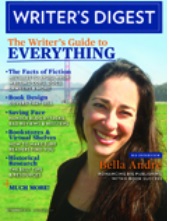 Note from Marlene: I don’t receive any money from endorsing Writer’s Digest Magazine. I just enjoy articles that are well-written, informative and inspiring for writers and this particular issue is jam-packed with good stuff.
Bella Andre has been a Writers Forum presenter twice. Other contributors in this issue who have also been Writers Forum presenters: Jordan Rosenfeld (twice), and David Corbett. Lots of talent in these pages, as well as at Writers Forum.
And be sure to check out the last page of Writer’s Digest, “Reject A Hit.” Amy Maricinick, a Petaluma’s Jumpstart Sonoma county writers cleverly spoofed a rejection letter for Great Expectations in the March/April 2013. Your name can be here, too. Write your Reject a Hit spoof.
You can build a career as an author by playing to your strengths, following your true passion, going at your own pace and never shying away from your unique voice. — David Sedaris Writers Digest Magazine, October 2013