Guest Blogger Suzanne Murray writes about the power of commitment and practice.
Whether it’s for writing, meditation, exercise, or anything you want to do but feel resistance to, establishing a practice can help you move forward in magical ways.
It signals to the universe that you are committed.
Having a practice means that you show up every day, no matter what.
Release all expectations of outcome or where you think you want things to go.
It doesn’t matter how good you are or what you accomplish or what happens with the practice.
You sit down to meditate and your mind goes wild with chatter the entire time, that’s fine.
You show up to write and find yourself whining on the page, that’s okay.
The point is to show up and practice.
A lot of things are happening when you show up consistently to something.
You begin to forge the neural nets in your brain needed for the task and strengthen them so that whatever you are committed to actually becomes easier to do and you are able to increase your level of skill.
In writing your subconscious mind is working 24/7 on whatever you give it to focus on, so showing up every day allows you to access new insights and ideas arising from your expanded mind.
You commit and take the action. The universe responds in kind, to the power of your willingness and the force your commitment.
Free from expecting that you need to accomplish something, you relax and open up to allowing.
In this receptive state, your subconscious mind aligns with the workings of the Universe and you find support, synchronicities and inspired ideas coming to you.
Establishing a practice helps you move beyond any resistance that has been in the way.
When you release the need for instant gratification, you slip into a sense of satisfaction from the simple act of showing up for yourself.
You learn to find joy in the practice itself and this allows you to expand your creative capacity.
To begin, start small.
When I coach writers who are having a hard time showing up, I ask them at first to commit to writing ten minutes a day.
This helps cross the threshold of resistance and move past the voice that tells you that you don’t have enough time.
Once you have established the habit of showing up you will find things flowing with greater ease.
Guest Blogger Megan Aronson writes about the seasons and cycles of life and being a writer.
“I’ve been lost and reclusive of late as I deal with the most recent iteration of my grief-growth cycle,” my friend Candace Cahill, author of Goodbye Again, wrote in an online writing group I belong to. “Learning—the hard way, mostly—new things about myself and the challenges still ahead.”
My eyes hovered over her words as her thoughts echoed my own. I wasn’t the only one who’d stopped at the words “grief-growth cycle.” Soon the comments were flooded with replies like, “Grief-growth cycle. I feel that. Never thought of it that way before.”
In two sentences, Candace had fully encapsulated the collective experience of being a writer. Continually turning ourselves inside out on the page and off, we each instantly recognized the “grief-growth cycle” as the intersection of life affecting our writing, and writing affecting our lives. I know this cycle: it courses through periods of personal doubt and professional rejection, retreating underground, nurturing the seeds of ideas for another creative phase, and harvesting acceptances and accolades.
“Where are we at in the cycle right now, each of us?” I wondered as I read my friend’s comments.
Lately, I’ve been thinking about the seasons of being a writer and how we cycle through them personally and professionally. I know from experience (and science) that when difficult life circumstances trigger my brain into fight or flight mode, the limbic system switches on its red alert button and my creative center is more difficult to access. I know stress can impact my creativity, and a broken heart can either open the flow for writing, or completely dam it. I’ve also seen how a round of rejections on my writing can paralyze me in life, sending me into a phase of reclusiveness that I must slowly nurse myself out of again. It can wreck my confidence not just as a writer, but as a mom, wife, and friend.
Productivity is often praised over personal growth and satisfaction in our society. We’re pressured to relentlessly produce, hustle, grind, and go. But the writer’s life demands time not just to harvest—we also need periods of renewal, recovery, and growth.
Recently, I’ve found comfort in Julia Cameron’s insightful and lesser-known book “The Sound of Paper.” After a series of challenges triggered another grief-growth cycle, I needed time to tend my personal and professional wounds. Julia gave me permission to embrace my place in the cycle with her powerful words: “I am resting, I am gathering steam,” she wrote. “I am in a low cycle, a time of dormancy, a period in which I will come to know exactly how much and how deeply I love the art I am not at the moment able to practice.”
Last week, I ran into a writing friend and instantly recognized on her face the look of panic I’d also been wearing during my months of “dormancy.”
“I haven’t been able to write,” she said, her eyes ablaze. “I’m caretaking my mom full-time. I can’t get myself to put a thing on the page.”
I told her how I’d just barely escaped this space myself, and how, paradoxically, the only thing that had sped it along was not speeding it along at all. My heart and mind needed time to heal, to wander in the woods, to walk the stacks at the library and grab anything that piqued my interest. As we spoke, I remembered the existential angst I’d felt in her shoes. I wished I could have granted myself the peace of accepting my season of recovery, rather than fighting against it the whole way.
I want to live the kind of artist’s life that flows gracefully through its seasons and honors the needs of my creative nature. When I’m incubating ideas for a new book, I live in curiosity—not producing, but gathering notes, ideas, life experiences, and reflections. An ideas file may be scraps and shards of random, unhinged scribbles, but those scribbles will become the words of an essay or book one day. I need time to be unhinged. I need time to wander and weed the corners of my mind and life. The time to harvest and produce will come again soon.
Moving forward now, I wonder: Can I be brave enough to continually honor where I am in the grief-growth cycle? Can we as writers grant ourselves a week, a day, or even a month (gasp!) to heal from life experiences before we write again? Can we go dormant for a winter and simply germinate our ideas, or celebrate a spring of creating just for ourselves, not for the world’s consumption?
I hope we can. I hope my recent experiences have taught me to let life inform my writing gracefully, with time to heal between the living and the writing, embracing the seasons as they come.
I’m coming out of my winter now, grateful for its lessons. The panic is subsiding as new ideas are beginning to burst forth again. Another spring is coming.
I’m a writer, a speaker, an advocate, a mom of four, a #YOLOGirl (You Only Live Once) and a survivor of…just about everything.
In 2011, I wrote a piece called Grim Reaper Girl that went viral, sharing how empathy saved my life after a string of 12 deaths had left me feeling like death followed me everywhere.
Over the next few years, the slew of tragedy continued at a relentless pace. In total, we lost 30 people in 8 years. We moved 4 times. We lost a baby, our home, my daughter’s best friend…and then I discovered my husband’s deadly painkiller addiction had escalated, and we became a miracle in the WE’LL BE COUNTING STARS story.
But my story is not a pity-party-table-for-one-please story. It’s one of triumph in tragedy. Little triumphs that came slowly and carefully while I fought for my life, my joy, and my love.
I’ve written myself through grief upon grief, and brought myself back to life again and again. I am still doing it now, and along the way, I’m sharing my journey, because I have become a self-certified Heal-Thyself Specialist (it’s a fancy title, I know, I earned it with 14 years at The School of Hard Knocks. Did you get a degree from there, too?!).
I’m here to tell you, I see you, I get you, I’ve been through it, too, and here’s how we pick ourselves up and keep moving forward again and again, with our broken, open hearts. I’m here to remind you how to open when you’re closed, to soften when you feel yourself turn hard like callouses.
I’m here to encourage you to dare greatly, even when vulnerability makes you quake in your boots. I’m here to urge you forward into unfolding again and again.
I’m also here to remind myself, and YOU, not to take ourselves or this thing called life too seriously!
Megan’s work has appeared in The New York Times, HuffPost, The Rumpus, and Creative Nonfiction’sTiny Truths. She is currently seeking a publisher for her memoir, We’ll Be Counting Stars, which tells the powerful “love vs. addiction” story she lived with her husband, Kory, a survivor of the opioid crisis.
Memorable writing that sparks imagination. Lean in. Hear the writer’s voice on the page.
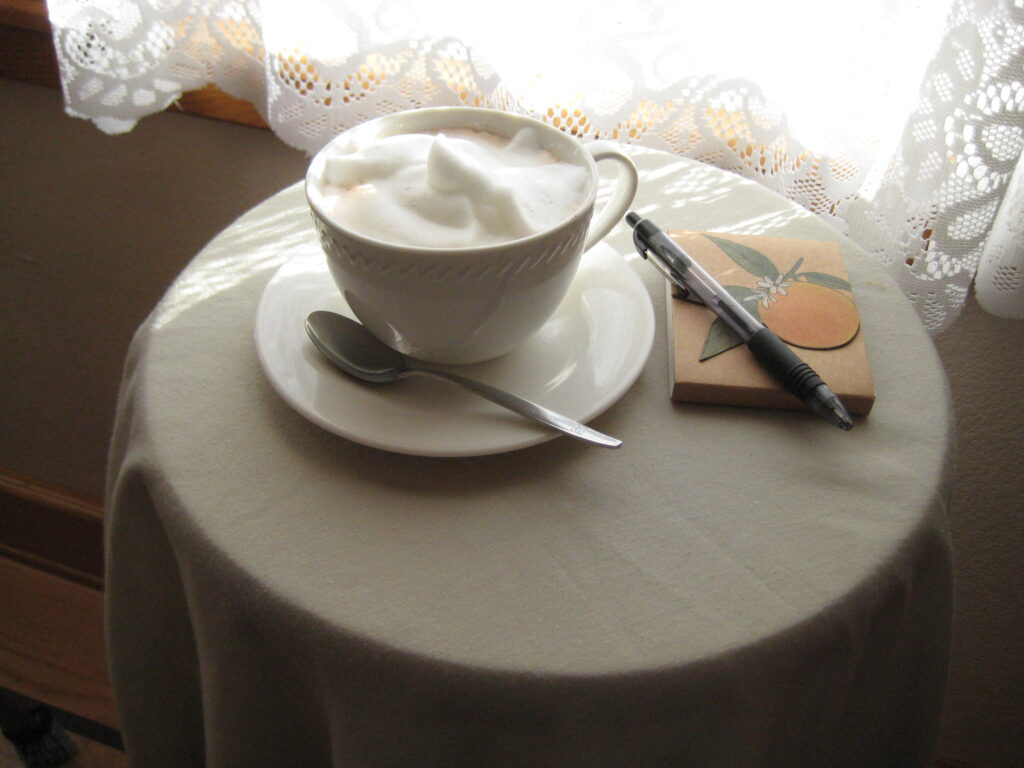
One Cup At A Time
By DSBriggs
Judith saw her hand reaching out and towards her mug. She noticed since her brain injury, she had to mentally plan any movement step by step.
She closed one eye so that only one mug was in her vision.
“OK. Lift the hand out of the lap. Make sure the arm isn’t taking a side trip of its own.
All right, aim for the mug on the right. Uncurl fingers. That’s progress. No one has to unbend and stretch ‘em.”
The knuckles on her hand were swollen and she noticed she was thinking in third person.
“My knuckles, my knuckles are swollen. I have crooked fingers too.”
She watched her arm and hand work in unison as she reached for her mug. She mentally told herself to grab as tight as she could and to slowly slide the glazed stoneware cup off the table.
It was heavy! Was it hot? She wasn’t sure. Her temperature gauge had been slow to return.
Judith watched the rim approach her face. She was quite relieved when her lips met the cup lip. The swallowing exercises had begun to pay off as only a little dribble from the left side slid down her chin to plop gently on her sweatshirt.
She couldn’t afford to get distracted, so she watched the mug slowly inch back towards the table.
She saw her hand begin to shake from the exertion of keeping herself from flinging. Overcompensating as the Occupational Therapist would say.
“Now lift! Dammit!” as she watched.
She let go of the breath she hadn’t realized she’d been holding.
“Good job,” she told herself and began to cry again.
DSBriggs continues to reside in Northern California. Dog, quilts and good friends occupy her time in between bouts of reading and writing.
She loves writing in short bursts and with prompts.
She has felt honored to have been published in The Write Spot Collections: “The Write Spot to Jumpstart Your Writing: Discoveries,” The Write Spot: Possibilities,” and “The Write Spot: Writing as a Path to Healing. Available in print and as ereaders at Amazon.
From the terrace, over the wooden fence with its lattice trim, the hills glow golden.
A shadow of eucalyptus stretches across, cutting off the light. Beyond, higher hills rise—these with a woodland coat, perhaps pines or other conifers, roll gently against the pale blue sky. A turkey vulture slowly circles with its ever-present eye.
A fence running across the golden grass bisects the slope—earlier cattle grazed, gone now.
The shadows grow—longer and longer—the glowing gold slowly dims as the sun edges lower and lower toward the earth’s rim.
On this September day with the equinox not far away, the evening approaches more swiftly, in preparation for the long nights to come, short days of limited sun—another year passing, another year to come.
Cheryl Moore grew up in the mid-west, went to college in San Francisco, then lived in foreign lands before returning and eventually settling in Sonoma County.
In recent years, she lives in a house and garden where deer nibble on roses, raccoons dine on fallen figs, and her bird feeders are busy.
A nearby river offers opportunities to observe waterfowl.
Seeing and writing about these miracles of nature are adventures in living.
Below is a list of things you may have experienced.
As you read the list, when a word causes a reaction . . . when you notice a feeling in your body . . . use that word or phrase as a writing prompt and start writing.
Write about where you were and who was with you.
If you ate it, played with it, read it, or wore it, write about it.
Add sensory detail of texture . . . what did these things feel like?
Add your memory of taste, smell, sound, and what the item looked like.
And, of course, you may have also experienced these things as a teen-ager and as an adult.
Just Write!
Jello salad
Hot Wheels
Roller Skates
Sugar Frosted Flakes
Poodle skirt
Hopscotch
Petticoats
Barbie dolls
Marbles
Jacks
Skipping
Nancy Drew books
Jump rope
Little League
Drive-in movies
Hula hoop
Trampoline Parks
Used a manual typewriter
Watched dance shows on TV
Sunday nights: Ed Sullivan, The Magical World of Disney