 Writing Prompt: Glimpse through the fog.
Set your timer for 15-20 minutes. Write whatever comes up. Keep writing until the timer rings, or until the fog lifts. Yeah, that might take awhile.
Writing Prompt: Glimpse through the fog.
Set your timer for 15-20 minutes. Write whatever comes up. Keep writing until the timer rings, or until the fog lifts. Yeah, that might take awhile.
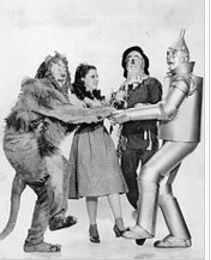 As you know, there are two sides to every story (sometimes more, depending on the number of characters involved). Let’s look at The Wizard of Oz, the movie version, with different perspectives, different points of view.
The Wizard: Wise and knowing? Or a fraud?
Dorothy: Sweet and innocent? Or a spoiled orphan?
Uncle Henry: Owner and Farm Manager? Or just a guy doing what he likes to do?
Auntie Em: Home Sweet Home and apple pie? Or bossy?
Hunk the farmhand/Scarecrow: Simple minded? Or observant and resourceful?
Hickory the farmhand/Tin Man: A hunk of machine parts? Or kind and sensitive?
Zeke the farmhand/ Cowardly Lion: A coward? Or a leader?
Miss Gulch/Wicked Witch of the West: Mean and ornery? Or misunderstood?
Glinda The Good Witch of the South: Too good to be true? Or conniving (why didn’t she tell Dorothy about the shoes when they first met?)
Toto: Just a frolicky little dog? Or pesky?
The Winged Monkeys: Horrible? Or loyal? Horrible and loyal?
When developing fictional characters, consider their strengths and their weaknesses; their triumphs and their faults. Make them feel real, like the characters in The Wizard of Oz.
By the way, which Oz character do you identify with?
The Wonderful Wizard of Oz Character List
7 Theories Of What The Wizard of Oz Is Really About
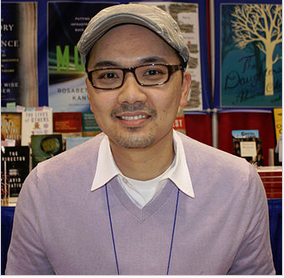 “Vietnamese American Vu Tran says when he writes fiction, he is less concerned about using any ‘factual experience’ he has had, but instead seeks to relate the ’emotional experience’ he has lived.” — The Writer Magazine, December 2015
When I read this, I sat up and paid attention.
“Aha,” I thought, “Brilliant idea to tap into the emotional element of an experience and bring that into fiction writing.”
Vu Tran used a traumatic event in his life to explain a pivotal character in his fiction.
“. . . fiction writers can often have more impact if they draw on their emotional experiences rather than just relating what actually happened.”
Vu Tran used this philosophy when writing Dragonfly (set in Las Vegas) while in Chicago. “. .. the distance from Las Vegas worried me at first. But I decided the emotional memory of Las Vegas . . . allowed me to recreate the city in a more realistic way than if I was taking notes in front of the casino doors.”
Your turn. Write about an emotional experience. For ideas, click on Write Authentically About Difficult Subjects and How To Write Without Adding Trauma.
Use the details from that writing to develop character and scene when writing fiction.
File all of this writing where you can access it when you are ready to use it in your writing.
 “What is the source of our first suffering? It lies in the fact that we hesitated to speak….it was born in the moments when we accumulated silent things within us.” ― Gaston Bachelard
I first learned of Gaston Bachelard from my writing teacher, Terry Ehret, with her response to my poem, “What I Learned.”
Terry wrote on my paper, “Here’s a quote from Gaston Bachelard (French philosopher) that your poem makes me think of.”
I’m no poet, but it’s been fun to dabble. Click on Prompt #221, to read “What I Learned.” (scroll down)
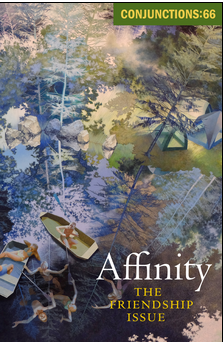 Conjunctions is accepting submissions for the Fall 2016 issue, Conjunctions: 67, Other Aliens, a collection of works of literary science and speculative fiction: innovative short stories, poetry, and essays that explore the vast precincts of unfamiliarity, of keen difference, of weirdness and not belonging.
“’Alien’” is a powerful and flexible word. Aliens are Other, aliens are the stuff of science fiction and fantasy, aliens are traditional literary figures who, when we witness our ‘normal’ lives through their strangers’ eyes (think Frankenstein), cause us to see ourselves anew. Indeed, we become the unfamiliar ones. ”
“Conjunctions on the Web features an ever-expanding constellation of innovative fiction, poetry, drama, interviews, and other work by some of the leading literary lights of our time. . . We are always adding new selections to our current inventory of contemporary writing. ”
 How to flesh out fictional characters . . . Give them depth . . . Get to know them intimately.
Let’s say your fictional character has just received devastating news such as a job loss, death of a family member or close friend.
How does he react?
What are her immediate thoughts?
What actions does he take next?
Imagine your fictional character had an epiphany about a betrayal, a loss, an old grievance. . . something new has been revealed. What does he or she do?
Take a few minutes to write about the purpose this character serves in the story.
Ready? Just write!
Guest Blogger Francis H. Powell writes about creating a great story.
Confronted with a blank screen, poised to tap away, how to go about creating that great story. Perhaps one primary consideration is the theme. Maybe the theme should be a ghostly shadow within the confines of the story, not screaming at the reader, but there none the less. It may make the reader think about their own lives, there might be a moral to be learned, but a writer should not take on the role of a preacher.
Then there has to be a plot, all the conflict or struggle that the main character or characters go through. The conflict should develop in intensity and excitement, reaching some kind of climax. If you are writing a novel there may be a number of conflicts interspersed, but a short story will have only one principal conflict.
Moving onto story structure, the story has to entice the reader, right from the first sentence. Equally then, ending has to round things off perfectly. You may have your theme and an outline of the story, but how are you going to tell it… a writer needs to decide about writing the story either in “first person” or in “third person.” Will you be using “he,” “she,” and “it”—so writing in third person means telling a story as if it’s all about other people., or will you be writing using “I”—so writing in first person means telling a story as if it happened to you. If in your head you have a rough idea of the theme, you will also know which tense you are going to use, either “present tense” or “past tense.” Writing in past tense means writing as if the story already happened, which is typical manner in which most stories are written. Writing in present tense means writing as if the story is happening right now. Normally you can’t mix the two.
An important consideration is the characters. I like to “live” with characters in my head, before committing to write about them. For me the name of the character, says a lot about the character, for example in my short stories, I have a character called “Bugeyes” and the story revolves around the fact that he is a person who suffers intensely, due to his oversized eyes. Lead characters should be someone readers can feel something in common with, or feel empathy. In my stories I love to create evil characters. My characters are far from perfect, have flaws and idiosyncrasies. Characters are interesting if they are not too one dimensional, even evil characters have to have some kind of redeeming feature, or perhaps they have been victims themselves in one way or another.
Settings are also paramount. In my book there is quite a range of different settings, some are set in America, for example my story “Opium” is set in America, post-civil war.
Then there is the question of language, it has to really correspond with your story.
A writer will tend to use actions and speech to let readers know what’s happening. Showing , rather than telling, using direct more “real life” quotes like “Go away!” instead of indirect quotes like “She told him to go away.”
You don’t have to write over elaborately to write well. Don’t shy away from using simple words and simple sentences, so you words and sentences cut through easily.
I often spend a long time mulling over what is the best word to use, glued to a thesaurus. Each sentence and paragraph should resonate, I often spend a lot of time, writing and rewriting so as to get the optimum sentence. Some sentences or paragraph can be redundant. You can get carried away, lose sight of the story, or go off on tangents.
 Francis H. Powell‘s, Flight of Destiny , is a book of 22 short stories. Born in a commuter belt city called Reading and like many a middle or upper class child of such times, Powell was shunted off to an all-male boarding school at eight, away from parents for periods of up to twelve weeks time. What better way to put all angst into short stories.
Powell began writing while living in Austria. His writing evolved while living in Paris. Flight of Destiny won the Compilation/anthologies category in the Pacific Rim book festival.
 Today’s prompt: No one knows. . .
Broad Street magazine is “always looking for more talent . . . so if you have an interesting piece of nonfiction—poetry, essay, reportage, memoir or other writing—or art” . . . Submit!
“Nonprofit semi-annual magazine featuring true stories told in many different ways. Seeks beautiful crafted poetry, essay, reportage, memoir or other writing that present the truth in a way that’s new and special.” — The Writer magazine, June 2015
Submisssions/themes, see if there is something just right for you. Upcoming theme:
Birth, School, Work, Death (submit until April 1, 2017 for spring/summer 2017 issue).
The Seven Ages of Man have become the Four Ages of Humankind. We’re born, we learn, we work, we die. Broad Street has conceived of a four-part magazine with several features exploring each phase of life. Give us your origin stories, your schoolroom struggles, your cubicle frustrations, your tales of passing on. Where has this road taken you?