Strengthen Your Writing

  • Strengthen Your Writing

    Ideas for strong writing.

    Use active voice rather than passive voice.

    ~From www.dailywritingtips.com  –  sign up to receive free daily emails with writing tips:

    English verbs are said to have two voices: active and passive.

    Active Voice: the subject of the sentence performs the action:

    His son catches fly balls. Creative children often dream in class.

    Passive Voice: the subject receives the action:

    The ball was caught by the first baseman.
    The duty is performed by the new recruits.
    The dough was beaten by the mixer.
    The mailman was bitten by the dog.

    ~From Manuscript Makeover by Elizabeth Lyon

    Adjectives: Use sparingly and consciously. Overuse indicates a need to find more precise nouns and to show rather than tell.

    Adverbs: Too often, writers use these to beef up weak verbs. Your goal should be to make verbs strong enough to do the work themselves and kill off your adverbs. You won’t be able to get rid of all of them, but circle each one in your draft and use a thesaurus to find strong verbs that characterize and carry emotions as well as convey action.

    Paraphrased from Victoria Zackheim, author, editor, writing teacher

    An adverb modifies a verb and clarifies the action. Avoid adverbs and use strong verbs instead, because adverbs “tell” rather than “show” the action.

    Example:

    “I don’t understand,” said the man angrily, his hands balled into fists. “Angrily” tells, and “balled into fists” shows that he is angry. So, “angrily” is redundant.

    Avoiding adverbs that end in -ly:  “The boy raced quickly along the sand.” If he was racing, we know it’s quickly.

    Adjectives describe nouns. Try using strong verbs so adjectives aren’t necessary.

    Examples:

    “Tears came to her eyes and she looked away” rather than “Sad tears came to her eyes.”

    “A nerve in his jaw pulsed and his fists were clenched” rather than “He was angry and a nerve . . . “

    Verbs are the action words and can be scene stealers when used well. A verb that is used well rarely needs to be modified.  Example:

    “The bear responded angrily and he dangerously revealed his claws.”

    Delete adverbs for a stronger sentence:  “The bear growled and bared his claws.”

    It’s almost never a good idea to use an adverb when writing dialogue. It takes away the reader’s delight to imagine the scene.

    “Do this or I’ll kill you,” he said menacingly, can stand without that menacing adverb, since his comment is menacing.

    There are times when an adverb enhances and clarifies the sentence. For example:

    “The rain fell intermittently.” The adverb “intermittently” tells us that the rain fell off and on.

    “He paid the bill occasionally.”  In this sentence, occasionally is an important adverb.

    Paraphrased from Writer’s Digest magazine, January 2006, “Pick Up the Pace”

    Quick pacing hooks readers, creates tension, deepens the drama and speeds things along.

    Picking up the pace increases tension. How to quicken the pace:

    1. Start story in the middle of the dramatic action, not before the drama commences.

    2. Keep description brief. This doesn’t mean using no description, but choose one or two telling, brief details.

    3. Combine scenes. If one scene deepens character by showing a couple at dinner and a few scenes later they have a fight, let them have the fight at dinner.

    4. Rely on dialogue. A lot of story can be carried by spoken conversation. Readers seldom skip dialogue.

    5. Keep backstory to a minimum. The more we learn about characters through what they do now, in story time, the less you’ll need flashbacks, memories and exposition about their histories. All of these slow the pace.

    6. Squeeze out every unnecessary word. This is the best way of all to increase pace. There are times you want a longer version for atmosphere, but be choosy. Wordiness kills pace and bores readers.

    From Marlene:  Use present tense rather than past tense for “real time” — so the reader travels along with the protagonist as they explore and discover together.

    More on strengthening writing:

    How to be a better writer       

    Vex, Hex, Smash, Smooch by Constance Hale

    Sensory Details – Kinesthetic, motion in writing

    What tips do you have for strong writing? Post your tips on my Writers Forum Facebook Page.

  • How to be a better writer

    Many of us want to learn how to be better writers. The answer is very simple:

    WRITE. Write some more. Keep writing.

    It’s true!  The more you write, the better writer you will become.

    Here are some things you can do to improve your writing.

    READ. Read whatever you like to read. Read the genre you are writing in. Read other genres.

    BE SPECIFIC. ’57 Bel Air Chevy, not car. Sycamore, not tree.  Foxtrot, not dance.

    USE STRONG VERBS. Keep a list of strong verbs in your writer’s toolbox for easy reference.

    Resources for strong verbs

    Thesaurus in any format: Paper, on your computer, internet.

    Books:

    Vex, Hex, Smash, Smooch: Let Verbs Power Your Writing by Constance Hale.

    Strong Verbs Strong Voice by Ann Everett

    Websites:  Tip Sheet Using Strong Verbs  and Writing Tips: Use Active, Precise Verbs

    WRITING MAGAZINES often have article to improve writing: Writer’s Digest, The Writer, Poets & Writers.

    WORKSHOPS & CLASSES: Internet search on “writing” will yield a variety of results for writing workshops: Day-long, weekend, conferences, writing teachers online. If you add your city or county to your search, results focus on writing activities in your area. Consider UCLA Extension online classes.

    The Sonoma County Literary Update is an amazing compendium of writing resources.

    Summary, how to be a better writer

    • Write.
    • Read.
    • Be specific.
    • Employ strong verbs.
    • Peruse writing magazines.
    • Attend workshops and classes

    Pen, gold background


    Whatever methods you use . . . Just Write!

  • Sensory Details – Kinesthetic, motion in writing

    How do we convey the sense of touch, or feel, or kinesthetic (motion) in writing?

    “The key to good imagery is engaging all five senses.” Five Types of Imagery:

    “The five senses: visual, auditory, kinesthetic, olfactory (smell), and gustatory (taste).”

    Previous posts about using sensory detail in writing:  visual, auditory and olfactory.

    Now, let’s explore using the sense of touch to embellish and enhance writing.

    Sometimes, the best way to learn is by example, learning from what others have written.

    “At school, the guilt and sadness were like wearing clothes still damp from the wash,” and “Whenever I moved, I felt as though I were touching something icy.” —Family Life by Akhil Sharma

    I know what that feels like, so when I read this, I can feel those damp clothes and know what the author wants to convey.

    Here’s an example of using movement in writing:

    “By the thirteenth loop, my hands were cement-scuffed and my head was spinning from being at knee height for so long, but the parade of hoping, bear-crawling, push-upping women showed no sign of slowing.” — Natural Born Heroes by Christopher McDougall, describing parkour (a training discipline using movement developed from military obstacle course training.)

    McDougall could have written “I was worn-out” or “I was tired.”  Instead he uses specific details: “cement-scuffed” and “my head was spinning.” He employed strong verbs: “bear-crawling” and “push-upping.”

    With this type of strong writing, readers can feel the chafed hands and most of us probably can relate to “head-spinning.” I can see “bear-crawling” and “push-upping.”

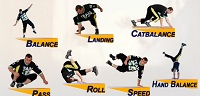
    A note about parkour: “Practitioners aim to get from one point to another in a complex environment, without assistive equipment and in the fastest and most efficient way possible. Parkour includes running, climbing, swinging, vaulting, jumping, rolling, quadrupedal movement, and other movements as deemed most suitable for the situation.” — Parkour, Wikipedia

    Looking at websites about physical activities (martial arts, gymnastics,dance, etc) could help you find action verbs.

    In Vex, Hex, Smash, Smooch, Let Verbs Power Your Writing, Constance Hale regales readers with her unique style about usage of the English language, especially strong verbs.  Constance has been dubbed “Marion the Librarian on a Harley, or E. B. White on acid.” Kathy Myers wrote an excellent review of Vex, Hex, Smash, Smooch.

    Practice using strong verbs and specific descriptive words to make your writing strong and create images the reader can see and sense.  You can go to Parkour Images, choose a photo and describe it, using sensory detail. Just write!

    Parkour

    Basic Parkour Movements

  • One pearl is better than a whole necklace of potatoes.

    Constance Hale launches Sin and Syntax, How To Write Wicked Good Prose with:

    “The French mime Étienne Decroux used to remind his students, ‘One pearl is better than a whole necklace of potatoes.’ What is true for that wordless art form applies equally to writing: well-crafted prose depends on the writer’s ability to distinguish between pearls and potatoes. Only some words are fit to be strung into a given sentence. Great writers are meticulous with their pearls, sifting through piles of them and stringing only perfect specimens upon the thread of syntax. The careful execution of beautiful, powerful prose through beautifully, powerful words is guided by my five principles.”

    Hale’s five principles:

    • Relish Every Word
    • Aim Deep, But Be Simple
    • Take Risks
    • Seek Beauty
    • Find The Right Pitch

    Peruse Sin and Syntax to discover the pearls of wisdom of these principles and how to distinguish between words that are pearls and words that are potatoes. Read a review of Sin and Syntax, How To Write Wicked Good Prose by clicking here.

    IMG_1451

  • Crafting scenes a reader can see—and sense by Constance Hale

    Crafting scenes a reader can see—and sense by Constance Hale

    Place looms large in all the work I do—whether in travel writing (when I’m trying to capture the essence of another country or culture), or in narrative journalism (when I often begin with a scene to draw my reader into the story), or even in Facebook status updates (when I try to sketch a place with a few poetic images).

    When crafting scenes, many writers make the mistake of loading up adjectives. But, as always, nouns and verbs do the best detail work. Take for example this description by the Indian writer Arundhati Roy, in The God of Small Things:

    May in Ayemenem is a hot, brooding month. The days are long and humid. The river shrinks and black crows gorge on bright mangoes in still, dustgreen trees. Red bananas ripen. Jackfruits burst. Dissolute bluebottles hum vacuously in the fruity air. Then they stun themselves against clear windowpanes and die, fatly baffled in the sun. The nights are clear, but suffused with sloth and sullen expectation.”

    Roy doesn’t shy from adjectives, but she starts out by grounding us in a specific time and place (May, Ayemenem). She fills the scene with concrete things (crows, mangoes, dustgreen trees, red bananas, jack- fruits, bluebottles), and she uses nouns to give us big ideas (sloth and expectation).

    William Finnegan relies on verbs in his 1992 New Yorker opus on surfing, “The Sporting Scene: Playing Doc’s Games.” He fills his entire story with sentences that use active verbs to make inanimate things animate, like this one:

    The waves seemed to be turning themselves inside out as they broke, and when they paused they spat out clouds of mist—air that had been trapped inside the truck-size tubes.

    These passages are taken from the all-new edition of Sin and Syntax, which also contains exercises and writing prompts.

    Laconic landscapes, and not so laconic ones

    In Bad Land, a book about the settling—and abandonment—of the Great Plains, Jonathan Raban uses extended metaphor to sketch a scene in Eastern Montana as he drives along in his car:

    A warm westerly blew over the prairie, making waves, and when I wound down the window I heard it growl in the dry grass like surf. For gulls, there were killdeer plovers, crying out their name as they wheeled and skidded on the wind. Keel-dee-a! Keel-dee-a!

    Raban recasts the plains as a seascape, with the wheat making waves, the wind growling like surf, and the killdeer plovers crying out like seagulls.

    To practice your own scene-writing muscles, try two of my favorite exercises. First, describe a vast and empty landscape—or a deserted street. Can you write about the scene so that it does not seem static or dead? Can you make it bristle with energy, even if human action is long gone?

    Second, situate yourself in a place that offers a symphony of sound. (A busy street corner? A screeching subway? A quiet courtyard in which each footstep registers?) Tune in to those sounds only. (Ignore the panhandlers, the change of the traffic lights, the people looking at you askance.) Find words that are onomatopoeic in some way, that suggest the sounds themselves. Write sentences whose rhythms evoke the sounds you are hearing

    The Raban passage and these writing prompts appear in Vex, Hex, Smash, Smooch, which is now out in paperback. If you’ve given these prompts a try and like what you wrote, please post your quick scene sketch in the comments section below. [After you register, posting can be done with a quick log-in.]

    Places that inspire

    For an opportunity to find inspiration in a scenic setting, and to be guided through exercises that will develop more of these muscles, join me at the Mokule’ia Writers Retreat from May 4-9, 2014. With the Waianae Mountains of O’ahu at your back and the blue ocean before you, learn from the masters, write in the shade of ironwoods, wander along the beach, salute the sun in morning yoga, and come to understand the essence of Hawaii through evening programs led by island composers, dancers, and musicians. The program includes daily workshops, private writing time, and one-on-one meetings with faculty. The theme, nā wahi ho‘oulu, acknowledges that a sacred spot like this will inspire us to explore other places— whether in the heart, in memory, or in the moment.

    If you live in the Bay Area, I’d like to invite you to the Petaluma Writers Forum on March 20, 2014. I will be appearing with my friend and travel-writing colleague Michael Shapiro, who has written a book titled A Sense of Place: Great Travel Writers Talk About Their Craft, Lives, and Inspiration. Needless to say, we’ll be digging into the craft of scene writing in our remarks.

    Finally, if you’d like more of this kind of thing, come visit my Web site, or sign up for my mailing list. (I also post on Facebook via the Constance Hale Scribe page.) I post regularly on how to straighten out your syntax, how to make your sentences sing, and how to survive and thrive in this sometimes difficult but always enriching writing life.

    CONSTANCE HALE is a fiend about the craft of writing and covers it at sinandsyntax.com. She also writes about style and language in her books: Vex, Hex, Smash, Smooch (the most recent), Sin and Syntax, and Wired Style. She has been an editor at the Oakland Tribune, San Francisco Examiner, Wired, and Health; her journalism has appeared everywhere from The New York Times and The Los Angeles Times to The Atlantic and Honolulu. She directed the narrative journalism program at the Nieman Foundation at Harvard and edits books, turning narratives about serious subjects into serious page-turners. She also runs writing retreats in Vermont and Hawaii.
    Hale, Constance