Get past ego to connect

  • Get past ego to connect

    “I think American society alienates us from ourselves, and we have a great need to reconnect. Human beings yearn to connect and to tell our stories before we die.

    Sometimes we want to write, but when we get down to it, there’s resistance, because the ego gets scared.” — Natalie Goldberg in an interview with Genie Zeiger, “Keep The Hand Moving,” The Sun November 2003.

    Ideas on how to get past ego and Just Write

    The Inner Critic Tar Pit of Doom and Despair

    Is “Go Big or Go Home” Right for You?

    Rachel Macy Stafford: Live Love Now

    #amwriting #creativewriting #justwrite #freewrites

  • I knew I wanted to write . . .

    Natalie Goldberg The Art Of Writing Practice:

    “By my early twenties, I knew I wanted to write and I knew I couldn’t learn to do it through traditional writing classes. I had to begin with what I knew, something no one could tell me I was wrong about. And so, I studied my mind. As I wrote, I would discover things about my mind, how it would move, wander, settle.

    I began teaching writing from the inside out. Usually, writing teachers tell us what good writing is, but not how to get to it . . . in 1986 [when “Writing Down The Bones” was published] people were starving to write, but they didn’t know how, because the way writing was taught didn’t work for them. I think the idea of writing as a practice freed them up. It meant that they could trust their minds, that they were allowed to fail, and this helped them develop confidence in their own abilities. But that wasn’t all, I also told readers, ‘Pick up the pen, take out a watch, and keep your hand moving.’”

    — Excerpt from The Sun November 2003, “Keep The Hand Moving,” by Genie Zeiger

    More about writing practice from Natalie Goldberg.

    Join Writers Forum on Saturday afternoons in October, 2021, to practice. Free on the Zoom platform. October 2, 9, 16, 23, 1-3 pm (PST).

    #amwriting #justwrite #nataliegoldberg #practicewriting @freewriting

  • Bella Mahaya Carter & The Priority Pyramid

    Today’s guest blogger, Bella Mahaya Carter offers inspiration with a “Priority Pyramid.” The following is an excerpt from her original post.

    Last November, I worked with Dan Blank, author of Be The Gateway: A Practical Guide to Sharing Your Creative Work and an Audience. In his book, Dan recommends an exercise to help creative professionals get clear about their life and work priorities.

    If you’d like to try this exercise, get fifteen index cards and write down one word on each card indicating what’s important to you. Then prioritize your cards into a pyramid, with your most important priority at the apex, and work down from there. These cards are a wonderful reminder of what matters if you lose your way. Each person will obviously have different words on their cards.

    Here’s what mine looks like:

    For me, a deep spiritual connection with Self comes first. When I lose that I’m like seaweed tossing in the ocean, and life feels disorienting, even painful. After that my priority is my family and also my writing. While the importance of family is obvious, it’s not always been easy for me to explain why my writing holds such a high priority in my life. The best way to describe it is to say that writing enhances my connection with my True Self. It helps me remember who I am.

    Many of my students and clients tell me that writing is also foundational in their lives. It helps them navigate their days with greater clarity and grace, stay grounded, identify and release limiting thoughts, express joy, share stories, and reimagine what’s possible.

    It’s useful to look at priorities independently, but also in relationship to one another.

    I’ve added “I believe” statements to my “pyramid landscape” to remind me why I do what I do.
    I believe in the power of writing to heal and transform lives, and I view publishing and book promotion as opportunities to deepen self-awareness, nourish meaningful connections, and delight in peak experiences while being of service.
    I believe in authentic, creative self-expression.
    I believe that we all have access to unlimited creativity.
    I believe miracles happen when we consciously choose love over fear.
    I believe suffering is not the price of admission to a creative life.
    I believe that freedom and peace of mind are available when we look in the direction of our own innate wisdom.

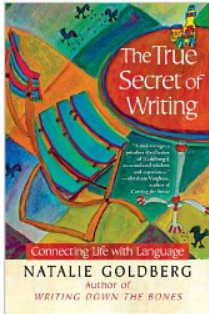
    I agree with Natalie Goldberg, who, in her book, The True Secret of Writing: Connecting Life with Language, says “you can anchor your mind with your breath, but also you can anchor your mind with pen on paper.”

    But perhaps the most reliable “anchor” of them all is love, which, ironically, is also the ideal launching pad. The best of what gets created through us comes from love.

    This index card—the oldest of my bulletin board relics which I wrote around age six—sat for years beneath a sheet of glass that protected my mother’s mahogany sewing machine table. Mom put in long hours there. It was a palace of creation and love—and so was she!

    I had no clue when I wrote this all those years ago that as an adult I’d need to keep reminding myself to be guided by love rather than fear. Old habits may die hard, but they pass more peacefully—and lose their power over us—when we see them for what they are and let them go.

    Love is patient and kind, and it allows us to start over and reinvent ourselves. Again and again.

    As I sorted through the items I removed from my bulletin board, two of them went right back up. I wasn’t ready to clear these messages. One says, “Listen,” and the other says, “The only time is NOW!” I don’t know about you, but I need reminders like these.

    I’ve also left a lot of blank space on my bulletin boards to create room for what’s coming.

    Writing Circles begin January 29th. Enroll here.

    I have two openings for private coaching clients. Let me know if you’d like to work with me one-on-one.

    I wish you a new year filled with health, happiness, creative expression, and love.

    Thanks for being part of my journey.

    Blessings and gratitude, Bella

    Click to read Bella Mahaya Carter’s original post.

  • Lose Control and Just Write!

    Goldberg.SecretNatalie Goldberg expands her thinking about writing practice in her latest book, The True Secret of Writing. You may have heard these ideas before and may be familiar with her other books, Wild Mind and Writing Down The Bones. And it’s good to be reminded of “the basics” of freewrites.

    Helpful ideas for writing from Nat:

    1. Keep your hand moving. If you say you will write for ten minutes, twenty, an hour, keep your hand going. Not frantically, clutching the pen. But don’t stop. This is your chance to break through to wild mind, to the way you really think, see, and feel, rather than how you think you should think, see and feel. This does not mean you have to write orgasmic sex scenes smeared with butter to touch wild mind. You might end up writing about toast, your sore throat, your fingernail. But it will be alive, real.

    Yes, even you who have never left home, never stepped out of your gray suit, even you have wild mind . . .

    You might write for ten minutes and never land. That’s okay. If you accept your mind at whatever level it is as you begin to write, if you don’t fight it, it will eventually settle . . .

    1. Feel free to write the worst junk in America. You have to turn over your mind a lot for the gems to pop out . . .
    2. Be specific. Not car but Cadillac. Not horse but palomino. Not fruit but tangerine
    3. Lose control. Say what you want to say, not what you think you should say.

    Note from Marlene: Pick something to write about and Just write!  For ideas on what to write about, click here and here.  You can read what others have written and post your writing on The Write Spot Blog.

  • Books on writing

    There are more how-to-write books than we have time to read. IF we tried, we would spend all our time reading about writing and not writing. But there are a few especially good how-to write books. Here are some of my favorites. What are your favorite writing books?

    Dorothea Brande was an early proponent of freewriting. In her book Becoming a Writer (1934), she advises writers to sit and write for 30 minutes every morning, as fast as they can.

    Peter Elbow advanced freewriting in his books Writing with Power and Writing Without Teachers (1975), and freewriting has been popularized by Julia Cameron through her books The Artist’s Way and The Right to Write.

    A few more writing books:

    Aronie, Nancy Slonim – Writing From the Heart

    Baldwin, Christina – Storycatcher

    Barrington, Judith – Writing the Memoir, From Truth to Art

    Baty, Chris – No Plot? No Problem!

    Bennet, Hal Zina – Write From The Heart

    Clegg, Eileen M. – Claiming Your Creative Self

    DeSalvo, Louise – Writing As A Way of Healing

    Epel, Naomi – Writers Dreaming

    George, Elizabeth – Write Away

    Goldberg, Natalie:   Living Color, Long Quiet Highway, Wild Mind, Writing Down the Bones, The Great Failure

    Heffron, Jack – The Writer’s Idea Book

    Kabat-Zinn, Jon – Wherever You Go, There You Are

    Keene, Sam and Anne Valley-Fox – Your Mythic Journey

    Kelton, Nancy Davidoff – Writing From Personal Experience

    King, Stephen – On Writing

    Lauber, Lynn – Listen to Me

    Lamott, Anne – Bird by Bird

    Lara, Adair – Naked, Drunk and Writing

    Nelson, Sara – So Many Books, So Little Time

    Rosenfeld, Jordan – Make a Scene

    Saltzman, Joel – If You Can Talk, You Can Write

    Schneider, Pat – Writing Alone And With Others

    Smith, Michael C. and Suzanne Greenberg – Everyday Creative Writing

    Ueland, Brenda – If You Want to Write

    Walker, Christine – A Painter’s Garden

    Walton, Todd & Toomay, Mindy – The Writer’s Path

    Zimmerman, Susan – Writing to Heal The Soul

    Just a few of my books on writing. Yes, I have two copies of Jordan’s Make A Scene: One for my personal use and one for lending.

                               writing books 1                                writing books 2

  • “Pass on the dream and tell its truth” — Natalie Goldberg

    In her book, “The True Secret of Writing” Natalie Goldberg writes:

    Writing is for everyone, like eating and sleeping. Buddha said sleep is the greatest pleasure. We don’t often think of sleep like that. It seems so ordinary. But those who have sleepless nights know the deep satisfaction of sleep. The same is true of writing. We think of it as no big deal, we who are lucky to be literate. Slaves were forbidden to learn to read or write. Slave Owners were afraid to think of these people as human. To read and to write is to be empowered. No shackle can ultimately hold you.

    To write is to continue the human lineage. For my grandfather, coming from Russia at seventeen, it was enough to learn the language. Today, it’s our responsibility to further the immigrant dream. To write, to pass on the dream and tell its truth. Get to work. Nothing fancy. Begin with the ordinary. Buddha probably knew, but forgot to mention, that along with sleep, writing can be the greatest pleasure.

  • Get started – how to use writing prompts

    Charles de LintGet out some paper and a fast moving pen or set up your computer.

    Set the timer for ten minutes.

    Look at something  in your room, anything, it doesn’t matter. Now write. Just write whatever enters your head.

    Or, open your dictionary to a random page, run your finger down a column. Stop on a word and freewrite, using that word as your prompt.

    Or, use one of the prompts in this blog.

    Think of this as practice writing, just as a badminton player practices before an actual meet.

    Follow Natalie Goldberg’s six rules of writing listed in a previous post.

    Try it right now. Paper and pen or computer ready? Glance at your clock. Note the time.  Or set your timer for ten minutes. Write for ten minutes about “trees.” After that, write for ten minutes, using “I remember” as your prompt. Now go with, “What I really want to say.”

    Those first thoughts as you start thinking about the prompt is where the energy is. And that’s where you will find the good stuff. The nitty-gritty that means something. As Natalie Goldberg says, “The aim is to burn through first thoughts. Say what you want to say. Don’t worry if it’s correct, polite or appropriate. First thoughts have tremendous energy. First thoughts are the way the mind flashes on something.”

    Keeping your hand moving is essential. If you stop to think, your inner critic enters the scene. Write quickly so there is no time to censor yourself. If you get stuck, just write the prompt again and go from there. New thoughts might come up. Or write “What I really want to say . . .” Or write, “the trouble started when. . . ” Keep going, trust the process, your mind will give you something to write about.

    If you cross out, you are letting your editor take charge. There is time for the editor to work later, when you are revising. For now, invite the editor to sit this one out.

    Do not worry about spelling, punctuation and grammar. You are the only one who will see this writing, unless you choose to share it. Don’t lose the thoughts that are propelling your writing energy by worrying about grammar.

    Just write.

  • Natalie Goldberg’s Six Rules of Writing Practice

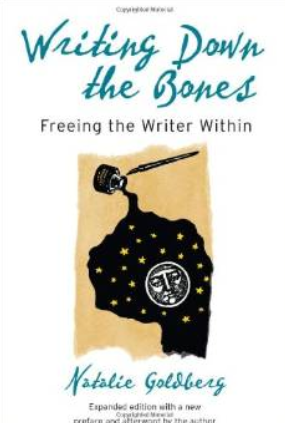
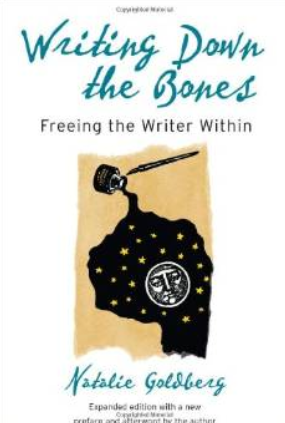
    Writing Down the BonesNatalie Goldberg’s Six Rules of Writing Practice from her books: Writing Down the Bones and Wild Mind

    1. Keep your hand moving.
    2. Don’t cross out.
    3. Don’t worry about spelling, punctuation, or grammar.
    4. Lose control.
    5. Don’t think.
    6. Go for the jugular