When you are writing and you have more time to write, but you feel ready to stop . . . try to keep going. Push the limits. Push past the urge to go no farther.
Writing Prompt: Play with the word and the concept of “ghost.”
Writing Prompts
Seeing a ghost.
Have you ever seen, or thought you saw, a ghost?
Ghost of a former self
Not a ghost of a chance
Ghost of a smile
Give up the ghost
Caspar, The Friendly Ghost
Relationship (past or present) as a ghost
Rituals as ghosts
Look in a mirror and “see a ghost” . . . see grandmother or grandfather
Ghost writing
Ghost town
Ghosting someone: to cut off all contact abruptly and without explanation, pretending that person doesn’t exist.
“Readers seek the experience of the world through character emotion and consciousness. What we remember about books and movies is the way they made us feel/experience, which is why we crave another story-hit, more, more, more.” — Juneta Key, “A Look at World Building and the Reader Experience”
Juneta elaborates:
Use your character’s emotional attachment to places, things, and feeling of home–longing, or contentment, or discontentment. World building is an external and internal journey with the character.
World building includes using all the senses, to create atmosphere, texture, and attachment: Sight, Smell, Touch, Hearing, Taste, and 6th sense.
STORY EXAMPLE:
Anne of Green Gables L. M. Montgomery uses the senses and emotions in such a way that her world is a character in itself. Read the freeProject Gutenberg ebook.
Chapter 1: First paragraph:
“MRS. Rachel Lynde lived just where the Avonlea main road dipped down into a little hollow, fringed with alders and ladies’ eardrops and traversed by a brook that had its source away back in the woods of the old Cuthbert place; it was reputed to be an intricate, headlong brook in its earlier course through those woods, with dark secrets of pool and cascade; but by the time it reached Lynde’s Hollow it was a quiet, well-conducted little stream, for not even a brook could run past Mrs. Rachel Lynde’s door without due regard for decency and decorum; it probably was conscious that Mrs. Rachel was sitting at her window, keeping a sharp eye on everything that passed, from brooks and children up, and that if she noticed anything odd or out of place she would never rest until she had ferreted out the whys and wherefores thereof.”
You will notice MRS is all capitalized.
Immediately we know she is important to the story.
She relates the character to us via the world building (setting).
Simile and metaphor are the vehicle of setting that create visually and emotionally strong images in our minds. She uses the setting to tell the reader about the character’s attitude, disposition and temperament. The further you read the more she builds on this and strengthens the scene paragraph after paragraph.
Montgomery particularly uses the river to describe and create a parallel impression of the road, specifically the people passing by MRS. Rachel Lynde’s home.
MRS. is a busy body cataloging details while sitting at her window. Through the use of a ferret, as a comparison tool, she demonstrates the trait of persistence for MRS. following every crumb in pursuit of other people’s business.
If you think about it, the senses are triggered in that paragraph even though sound is not mentioned exactly. The sound of flowing water—a river, the sound of people passing by on the road, the sound of children—it’s implied, I don’t know about you but I heard it.
The bar is hushed. I stand at the podium, bright lights partially obscuring the crowd. I see a blur of faces and blank spaces, hear ice clinking in a glass somewhere to my right and murmurs from the back of the room where drinks are being ordered and served. I am about to start speaking when I remember a tip I was given by my first performance coach, Jon.
“Before you begin,” he said, “take a deep breath and remind yourself to . . . slow . . . down.”
This, I have found, is good advice and, as Oscar Wilde famously said, “The only thing to do with good advice is to pass it on” so…
1. Before you start a story (or anything new)—take a deep breath and remind yourself to slow down.
I begin to read the narrative nonfiction piece printed on the pages in front of me. It starts with some background about my dad, how he was a Latin, Hebrew, and Greek teacher, a Shakespeare scholar, and docent at the Art Institute of Chicago. Then the story places him in the hospital at age 81. He is about to go in for emergency surgery when he calls to me to share what might be his last bit of fatherly wisdom. I slow down in the reading, pause for a few seconds, and then explain that, instead of the profundity I expected given his extraordinary intelligence and the dire circumstances, I heard my dad say, “There are some Bob Chin gift cards in my wallet. Make sure you use them with your brothers and sisters.”
The crowd laughs.
I look up to see the blur of faces and spaces and lift my gaze to just above the heads, following advice from the minister at the church where my father’s funeral was held—a piece of advice I received when I was about to deliver the eulogy I’d written for my dad when, months after the Bob Chin gift card incident, we lost him to complications from that emergency surgery.
“Look just over their heads until you feel comfortable,” the minister told me. “They will think you are engaging directly with them. Only when you begin to feel at ease should you lower your gaze to their faces, and then engage with an open, amiable face or two around the room.”
2. Give the impression you are engaging directly until you can actually engage directly (in other words, fake it til you make it) and then look for the people who appear open and amiable.
I lower my eyes to the page again and share how my dad never walked again after that surgery, how he suffered from ODTAA syndrome, “One Damn Thing After Another,” and the grief and loss my siblings and I felt when he died. I share how we went on a scavenger hunt of his favorite paintings at the Art Institute together as if trying to find him somehow, and our fear that we weren’t ready to be the older, wiser, generation. My voice drops and wavers slightly as I allow myself to feel those feelings again. I hear an audience member sniffle.
I wait a moment, let the sadness settle, and then I begin to share how my siblings and I did indeed use my dad’s gift cards, how Bob Chin’s was a crab shack that served alcohol and how we proceeded to get drunk and tell bittersweet stories, how my brothers ended up fake-wrestling on the floor of the funeral home, and how the hotel clerk thought I was planning a bachelorette party when I called to inquire about the capacity of the hotel’s hot tub and whether we could bring our own booze into a conference room. I lift my eyes, now fully engaging with the blurry faces, and hear laughter again.
Then, slowing my voice again, I finish with the last piece of advice my father actually gave me, the words of wisdom and love he wanted to pass on to his grandchildren. The laughter fades into silence and I hear another sniffle, and another.
And I am reminded of something my second performance coach, Eber, told me. “If you can make them laugh or cry, it’s a good story. If you can make ‘em laugh and cry, it’s a great story. And if you can make ‘em laugh, cry, laugh, and cry again, then it’s an amazing story. Be authentic and make them feel it.”
3. Be authentic
Trust me, this does not contradict #2 because this is all about the delivery of your message. Let your emotions come through. Make them feel your passion, your dedication, your fear, your joy, your belief. Make the most of every moment. Grab ’em with what you know and what you feel and don’t let them go until the very last word.
Anastasia Zadeik is a writer, editor, and narrative nonfiction performer. She lives in San Diego, CA, where she serves as Director of Operations for the San Diego Writers Festival and as a mentor and board member for the literary nonprofit So Say We All.
When she isn’t reading or writing, you will find her hiking, practicing yoga, playing tennis, swimming, or hanging out with her husband and their empty-nest rescue dog, Charlie.
“The Mask Self is that part of ourselves that we dare to present to the world. It is a way of being that we have put together, frequently in a rather haphazard way, and often through the trials and errors of our lives.
For the most part, the Mask Self protects us from having to look more closely at the dream figures that lie behind it. It protects the more vulnerable creatures of our inner world.
As we struggle with our masks, there are often many different layers to be peeled away.
In the meantime, life becomes a melodrama, a soap opera, as we find ourselves drawn to this person or that, all in an effort to make our lives work and still hold onto our masks.” — Hal Zina Bennet, “Write From the Heart”
Visualization
Before the writing prompt, please enjoy this visualization.
Imagine you are in the mountains in the springtime.
Walking on a soft, earthy path, breathe in the fresh mountain air.
Regal trees reach up to a calm blue sky.
Birds are singing with no cares.
There is a lake, so crystal clear you can see rocks underwater.
See the reflections of the sun sparkling on the lake like diamonds.
There is a waterfall that feeds the lake.
The sun shines down through the falls, creating rainbows.
Imagine . . . the sounds of water . . . the smells of earth, trees, and fresh water . . . the dance of light.
The majesty of the mountains surrounds you, creating a feeling of safety, like a sanctuary.
Sitting comfortably on a rock, breathe in the profound beauty and stillness.
Taking a deep breath, you are ready to release what no longer serves you.
When you are ready, write . . .
What would you like to release, or let go of?
Or: What would happen if you took your mask off?
Or: If you have taken the mask off, how did that go?
Memorable writing that sparks imagination. Lean in. Hear the writer’s voice on the page.
Simply A Shoot
By Jane Person
I was born a sweet onion
my core protected by layers of peel
As the brown dry layers peel off, a stink
surrounds. Eyes water
There will be more
down to my core
Under the faucet dirt and grime
the externals simply slide off
There will be more
down to my core
Tender layers peel
a bulb thinner, lighter
There will be more
down to my core
Fear. What will be left of me?
A little voice coaches—Just peel.
There will be more
down to my core
Protecting peels now gone.
Left a small, green shoot.
There is more
down at my core
The person, me
The small shoot unmasked
Free from disguise
Perhaps free at last
Jane Person, who has lived in Petaluma since 1986, is on the third leg of her Triathlon—Aging while trying to shuck the protective layers. Run, Jane, run.
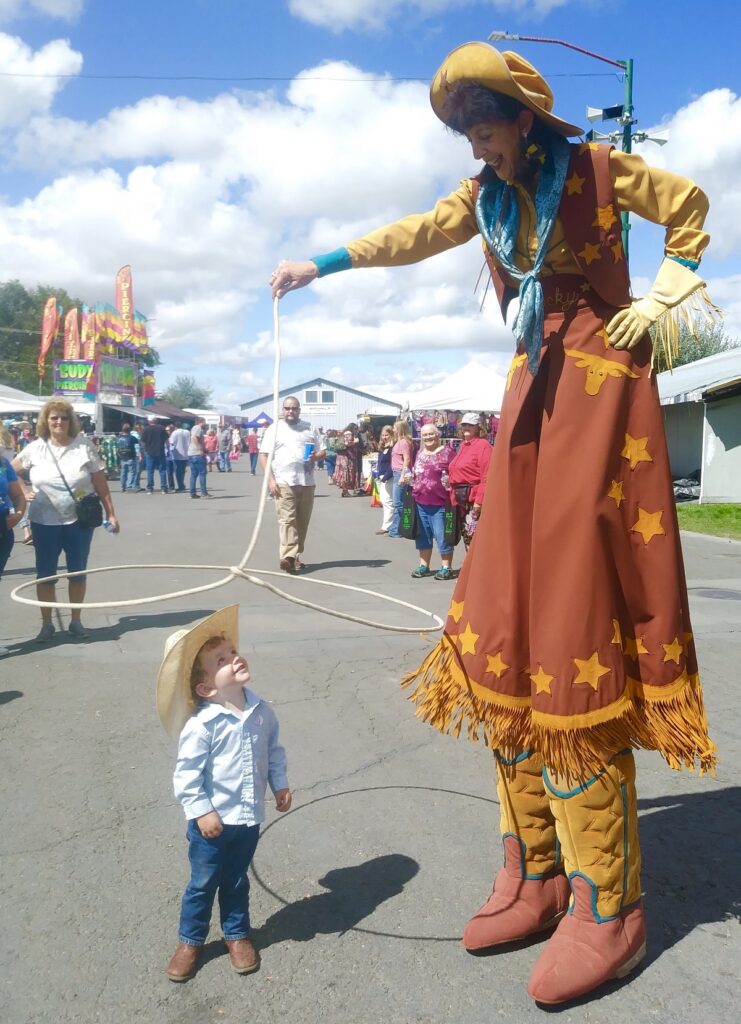
Or, what talent do you have that you are proud of?
Dubbed “America’s Funniest Cowgirl,” Karen Questhas been blazing a trail since 1998 with her one-woman award-winning original comedy act, Cowgirl Tricks. Skillful trick roping, impressive whip cracking, outstanding audience rapport and improvisational kooky cowgirl shenanigans have proven wildly popular at venues for audiences of all ages.
Karen’s talents include juggling, clowning, acrobatics, fire-eating, unicycling, and stunt work,
Your turn:
Write about your talents. Or your fictional character’s talents.
During a trip to Disneyland, a priest became fascinated with the costumed figure of Mickey Mouse. Every time Father Sean turned around, there was Mickey Mouse shaking hands with people, talking with kids, keeping everyone’s spirits up. And Father Sean began asking himself, “I wonder who that person is under that costume? What are they like at the end of the day, when they take off their Mickey Mouse suit?”
Instead of being who we really can be, we take on masks like the Good Little Girl, or we become the Black Sheep of the Family or the Rebel. Early on, we learn that if we are to be loved and cared for, we’d better buckle under and be what is safe for us to be.
Su Shafer is a creative crafter, fabricating bits of writing in poetry and short stories, and other bits into characters that appear in paintings or sit on various bookshelves and coffee tables. She lives in a cottage on the Olympic Peninsula of Washington, where the tea kettle is always whistling and the biscuits freshly baked. One never knows who might stop by to share a rainy afternoon.