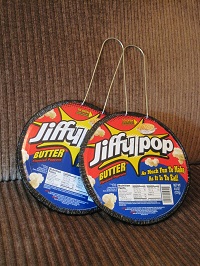
Today’s prompt. . . look at the photo and write whatever comes up for you.
Jiffy Pop!
“The only sin writers can commit is not to write.” — Eleanor Hyde, originally in the August 1976 issue of the Writer Magazine, reprinted in the August 2014 issue.
Note from Marlene: So, you are itching to write and need a jumpstart? Go to the prompts page of this blog for ideas.
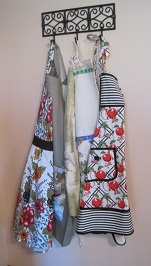 My grandmother put her apron on every morning right after she put on her house dress. She wore an apron every day, even to parties. She made all her clothes, including her aprons. She always chose a small flower design and used colorful seam binding for trim around the edges.
I also wear aprons, but only when cooking and eating. . . saves many an outfit from food stains.
Thank you, Kathy Myers, for the inspiration to hang my aprons in the kitchen.
Thank you, Pam Swanson, for emailing so many years ago, “The History of Aprons.”
THE HISTORY OF APRONS
The principal use of Grandma’s apron was to protect the dress underneath. Because she only had a few dresses, it was easier to wash aprons than dresses and they used less material, but along with that, it served as a potholder for removing hot pans from the oven.
It was wonderful for drying children’s tears.
From the chicken coop, the apron was used for carrying eggs, fussy chicks, and sometimes half-hatched eggs to be finished in the warming oven.
When company came, aprons were ideal hiding places for shy kids.
And when the weather was cold, Grandma wrapped her apron around her arms.
Those big old aprons wiped many a perspiring brow, bent over the hot wood stove.
Chips and kindling wood were brought into the kitchen in that apron.
From the garden, the apron carried all sorts of vegetables.
After the peas had been shelled, it carried out the hulls.
In the fall, the apron was used to bring in apples that had fallen from the trees.
When unexpected company drove up the road, it was surprising how much furniture that old apron could dust in a matter of seconds.
When dinner was ready, Grandma walked out onto the porch, waved her apron, and the men knew it was time to come in from the fields to eat.
It will be a long time before someone invents something that will replace that ‘old-time apron’ that served so many purposes, especially what many children and grandchildren received from the simple apron. . . Love!
Adapted from: The History of Aprons, which may have been originally from Grandma’s Apron.
Writing Prompt: Aprons
 Set your timer for 12-15 minutes and write.
Photo taken in Ireland by Jim C. March
In this Just Write post, we’ll take a look at the idea of listening to your body as a way to get past blocks toward your creativity.
First, turn off your cell phone or put to vibrate. Unplug from Facebook and emails. Eliminate as many distractions as you can.
If you are experiencing extreme grief or pain, please get professional help. This post, of course, cannot replace the need for professional assistance.
Ready? Here we go.
We all experience grief, trauma, sadness. And we have our own ways of handling those stresses. There is no one right or wrong way to handle these difficulties. What is right for one person, may be wrong for someone else. What works for me, might not work for you, so take what works for you from this post, ignore the rest.
Let’s take a moment now to breathe, relax and get settled.
Take a deep breath in and let out with a whoosh.
Deep breath in. Relax. Let go.
Drop your head to your chest and rotate in a circle.
Rotate shoulders in a circle.
Scan from head, down to your toes. Check in with your body.
Notice places that are tight. Notice any uncomfortableness.
As you scan your body, become aware of any place that draws your attention – notice what part of your body calls out to you.
Place the palm of your hand on the part of your body that calls your attention. Or bring your breath there if it’s not reachable with your hand.
Allow your hand to be filled with the information of that place.
Take a deep breath in. Let it out with relaxing sigh.
Thinking about that place in your body that calls out . . . what do you notice? Who hangs out there? Who do you see?
If you could have a conversation with that part of your body, what would it sound like?
If you have blockages in your life, your work, or your creativity, your body can tell you what’s going on. If you are stuck, notice where you feel it in your body.
When you pay attention to that stuck feeling, you can work past it and then you will be free to work as you wish. Discover what’s really bothering you.
When you are ready, write about what you have discovered. Write about that place in your body that wants attention. Or just write about whatever is on your mind.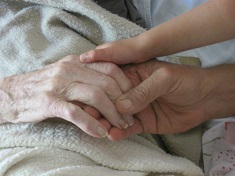
Writing prompts on The Write Spot Blog are designed to encourage writing that takes the writer on a journey of discovery.
Our freewrites can refresh our memories and remind us of times past. It’s like excavating — digging deep and dredging up memories.
You can start writing very simply — with pen or pencil and paper or keyboard.
To go deep into your writing — rest both feet on the floor, rest your hands lightly on your lap or on the table. Take in a deep, nourishing breath and slowly let it out. Another deep breath in and s-l-o-w-l-y release. Sink into your breath and relax on the out breath.
Review the prompt and start writing. If you get stuck and don’t know what to write next:
~ Write the prompt . . . sometimes re-writing the prompt brings up new ideas.
~ Write “I remember. . . ” and go from there.
~ Write “I don’t remember. . . ” and see where that takes you.
~ Write “What I really want to say . . . ” This is my favorite to inspire deep writing.
 Whatever methods you use . . . just write.
What is the worst thing that could be taken from you?
Set your time for 12 minutes. Write. No thinking. Just write.
 Post your freewrite here on The Write Spot Blog.
Photo by Jane Person
Write about someone you know who is currently serving in the military or who has served. What branch of the military? What country? What would you like us to know about this person?
Is there an author who writes about the armed services or books you like with a military theme? Tell us, we want to know.
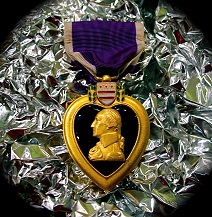
Photo of Purple Heart Medal taken by Jane Person. Her father, First Lt. John Person, was posthumously awarded the Purple Heart following his combat in World War II, April 1943.
The Purple Heart is one of the most recognized and respected medals awarded to members of the U.S. Military armed forces. Introduced as the “Badge of Military Merit” by General George Washing in 1782, the Purple Heart is also the nation’s oldest military award.
Prompt: Write about someone in the military.