Writing settles my soul —Rachael Herron

  • Writing settles my soul —Rachael Herron

    Today’s “Just Write” post is an excerpt of Holly Robinson’s interview of Rachael Herron. (Edited for brevity. Click on Huffpost link below to read entire interview.)

    Holly Robinson writes:

    One of my favorite things about being a writer is having the chance to meet other writers whose books I admire. I probably admire few books as much as I do Splinters of Light, my new friend Rachael Herron’s powerful, poignant, and surprisingly comic novel inspired by a People magazine article about the impact of early-onset Alzheimer’s on a woman and her family.

    In the hands of another writer, this topic could be dreary and depressing, but Rachael spins a story of resilience and love that leaves you believing in the healing power of family and forgiveness. Splinters of Light is a reading experience you won’t soon forget. Here’s a look at how Rachael works — she’s a prolific author of romance novels, women’s fiction, memoir and essays.

    Give us a peek at your workspace. (I’m imagining lots of animals milling about, baskets of yarn, an unfinished sweater.) Do you have any special foods or drinks that keep your butt in the chair as you write?

    I recently found the desk of my dreams, a roll top behemoth with cunning pigeon-holes and drawers for everything. I literally have a drawer for lip balm, one for beach glass, one for hair ties (all very important in the writing process, of course). I do have baskets of yarn around and usually have a cat or two on my lap, but what keeps me in my chair is having nothing else in front of my gaze but my computer and a mug of coffee with cream. Moving my desk away from the window was one of the best things I ever did for myself, productivity-wise.

    Splinters of Light is both one of the most joyful and one of the most devastating novels I’ve ever read, partly because you do such a wonderful job of tapping into the worst fear we all have as parents: that we will somehow fail our children. What was the inspiration for this novel, and for the brave, wonderful, and touchingly resilient character of Nora Glass?

    The inspiration for the novel came from, of all places, a People magazine article about a young teen-aged boy taking care of his mother who’d been diagnosed with early-onset Alzheimer’s. This was before Still Alice, before many of us had ever heard of this disease, and I was transfixed by the thought of a parent having to teach their child how to be an adult so long before it was time. Nora herself comes from a good mix of my sisters and my mother, the strongest, bravest women I’ve known.

    You do a stellar job of writing from the point of view of a resentful but loving teenager in Splinters of Light. Was that difficult?

    Should I admit it was easy? I’m forty-two, but I was a terrible teenager. When I was turning seventeen, Ellie’s age in the book, I thought I hated my mother. I couldn’t stand to be in her presence. Everything she said grated on my nerves, and I couldn’t understand how we could possibly be related. Of course, when I turned nineteen or twenty, she suddenly “became” much smarter and more interesting (go figure!), and by the time I was twenty-five, she was my best friend and stayed that until the day she died. I really regret what a pain in the ass I was to a phenomenal woman. Ellie is, in a small way, an apology for that (and maybe a beacon of hope to mothers of teen girls—they do snap out of it).

    You’re originally from New Zealand. How did you end up living in the U.S.? And what do you think being an “outlander” contributes to the fiction you write set in the U.S.?

    Actually, I’ve always been a half-and-halfer. My mom was Kiwi, my dad an Arizonan. I have dual citizenship, and I had the New Zealand accent until I was seven (I still remember embarrassing myself in first grade for asking for the cello-tape). Living on the imaginary border gave me a really good place to stand growing up. My mother never became an American, and national holidays like Thanksgiving were celebrated, of course. But we also pulled the thrippence out of the flaming plum duff on Christmas and I knew more about Maori myth than Native American. My parents let us choose our identity, and I’m happy to say that all three of us girls are proud of both heritages.

    Prior to Splinters of Light, you authored a memoir. Was the process of writing nonfiction very different from your fiction writing process? Which do you prefer?

    Nonfiction is so much easier! You’re limited to the truth (or as close as you can come to it, years later) so the only big choice is how you frame the storytelling. For that book, I chose to look at my life as seen through the sweaters I’d knitted, from the first one I attempted at eleven in an attempt to bond with my entrepreneurial father to the dress I failed to knit for my wedding. I love creative nonfiction, but I have to confess, while novels are more difficult, I find a bigger sense of satisfaction in their completion.

    As a writer who previously wrote a series of successful romance novels as well as a memoir before producing Pack Up the Moon and Splinters of Light, both of which I would describe as “literary” or “women’s fiction” (if I had to use typical publishing categories), how do you describe your work?

    Oh, god. I never know what to say. Writing literary women’s fiction has always been my goal—and what I’m probably best at—so I lead with that. But then I usually fade out and mumble something lame like, “I guess I write mainstream? And, um, romance. And um, memoir. Um. Do you need more coffee?”

    With all of the different types of writing you’ve done, you must have met some challenges and hurdles along the way. What has kept you going through times of self doubt?

    Publishing is not for the faint of heart, that’s for sure. Hard times come fast and often, but two things have kept me going. First, I’ve always known this was what I was meant to do, even before I was actually doing it. I spent my teens and twenties yearning to write and not getting the work done. Writing is the only thing that settles my soul, whether it’s fiction or just a private journal entry. I could never let that part of myself go. Second, my writer friends have been my rock. The most important thing for a new writer to do (besides writing) is to make writer friends who are at the same stage in their careers. Nothing is more valuable.

    Did getting an MFA help you on your writing journey? Would you recommend that path to other aspiring writers?

    Nope, I rarely recommend it even though I don’t regret getting mine. It was lovely to be in the ivory tower for those two years. But what I needed to learn about writing I didn’t learn there. School can’t teach you how to finish a book. It can’t teach you how to find your core story. It can’t teach you how to get back up and start over after your first publisher drops you. It can’t teach you how to cultivate real, rich relationships with your readers. I only learned how to do this by writing, every day, for many years after I got that MFA.

    If you could list three unbreakable rules for writers, what would they be?

    Write as much as you can every day. Even if that’s just a sentence. Write.
    Read. Read every day, read everything. Don’t be snobby.
    Be generous and gracious, giving of yourself, your knowledge, your time, and your words. In this profession, what goes around comes around in an almost insta-karma way. Be good.

    Interview originally posted on Huffpost Books  3/3/2015

    Novelist, journalist and celebrity ghost writer Holly Robinson is the author of several books, including The Gerbil farmer’s Daughter: A Memoir and the novels Beach Plum Island and Haven Lake. Her articles and essays appear frequently in The Huffington Post, More, Parents, Redbook and dozens of other newspapers and magazines.

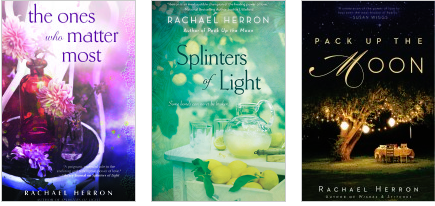
    Rachael Herron’s Beautiful Book Covers.
    Herron.3 covers


  • Friends . . . Prompt #249

    I met a new friend recently. As we emailed back and forth, I felt as though it was destined for our paths to cross.  So far, ours is an internet relationship. No, we didn’t hook up via Match.com. Rather, I found Author, Blogger and Ghostwriter, Holly Robinson, while researching another author.

    Today’s writing prompt is inspired by the glorious feeling of making a new friend.

    Writing Prompt: Write about making a new friend.

    Or, write about someone you have known for awhile. A friend you can call night or day. A friendship that is as comfortable as a pair of soft jeans. Someone who has been with you through thick and thin.

    Write about your new, or old, friend.

    Make new friends, but keep the old. One is silver and the other is gold.

    Holly RobinsonAnd now, I’d like you to meet my new friend, because her writing journey might encourage you to keep writing.

    Holly Robinson’s Unofficial Biography

    I never meant to be a writer.  I studied biology in college because I either wanted to be a veterinarian or a doctor – preferably one of those doctors who’s always jetting off to villages in Africa or Tibet to save thousands of lives while wearing one of those khaki vests that’s mostly pockets.  But life intervened during my last semester of college, when I had to take one more elective and I chose a class in creative writing with a professor who started out by telling us that writers are born, not made.

    I believed him.  I was sure that I couldn’t have been born to be a writer, because I’d never imagined myself as one.  In fact, I had never even met a writer.  The only thing I knew about most famous writers was that they were unhappy, drank themselves into oblivion and eventually stuck their heads in ovens, shot themselves, or got run over by streetcars.  Who would want to be a writer, if that’s what happened to you?

    Yet, from the moment I sat down to write, I became completely absorbed in my work.  Unlike my clock-watching sessions trying to learn physiology or organic chemistry, whenever I was writing seven hours could pass like seven minutes.  To the horror of my parents, I abandoned the idea of medical school.  I promised them that, if I didn’t get to be rich or famous (preferably both) in one year,  I would let common sense rule and find a real career, something that required an advanced degree and letters after my name.  Something with a steady paycheck.

    Of course, none of that happened.  A year went by.  Two.  Three.  As I became even more engrossed in the writing process, I did what all writers do to support my secret habit:  I worked a thousand odd jobs, from proofreading telephone books (really) to construction.  Along the way I earned an MFA in creative writing at the University of Massachusetts in Amherst.  Some of my classmates there were talented, even brilliant writers, but not all of them became successful.  In fact, as I look back on it now, I realize that the most successful writers to emerge from my program were the ones who were scarcely noticed at the time.  They weren’t necessarily the flashy ones at parties or the award winners.  They certainly weren’t the ones who sat around in pubs chatting about the cabins they would build in the woods with the advances from their first novels.  No, the success stories were the hard workers, the writers who spent a lot of time alone, churning out rewrites and new pages every week.

    After finishing my MFA, I meandered into journalism, marketing, and teaching jobs.  Most were enjoyable, but none were as deeply satisfying as writing on my own.  I kept at it, filling up the corners of my life and lots of paper with words and more words.  Every now and then I sent something out and got rejected.

    I got married, had children, got divorced, got remarried, had another child.  I worked, too.  All of that took time.  A lot of time.  Still, I kept writing:  at night after the kids were asleep, on weekends at the playground while my kids were eating sand.  Years slipped by with nothing published other than a couple of literary stories and a few newspaper articles, but I was happy.  Writing for me had become  an escape, not away from my life, but into myself, in a life where family responsibilities and work deadlines tried to jimmy themselves into every free minute.

    And then a funny thing happened:  as I navigated the strange process of getting divorced and getting married again, all while trying to stay friends with my ex-husband, I read an essay by Joyce Maynard in Redbook magazine about being a single mom.  And I thought:  Hey.  I’d like to write something like that.  So I did, in response to a literary contest.

    To my surprise, I won an award in the contest.  This gave me the courage to pluck the name of an editor off the masthead of Ladies’ Home Journal magazine — something the writers’ guides tell you never to do – and send it to her.  The editor bought it.

    Note from Marlene:  A similar thing happened to me. Won a writing contest, which inspired me to continue writing. You can read the rest of Holly’ story here

    To sum up:

    Your [writing] success will be determined not by some miracle of genetic inheritance, but by your own persistence.  We each find our own paths.  Believe in yourself and put in the hours.  The rest will follow.

  • Is there a ghost in your future?

    Guest Blogger Holly Robinson writers about ghost writing:

    Recently, I appeared on a radio show to promote a literary event. We were talking about my latest novel, but inevitably the host asked, “So you’re a ghostwriter, too? Who have you written for?”

    I laughed and gave my standard answer: “Sorry. If I told you, I’d have to kill you.”

    “But don’t you even care if your name’s not on the cover?” he asked, sounding offended on my behalf.

    The truth? No. I write novels, essays, and articles under my own name, but when I’m ghostwriting, my job is to stand behind the curtain and channel a voice.

    By now, I have ghosted over twenty books. I fell into the profession accidentally when my agent, who knew I’d studied biology in college, asked if I’d be interested in helping an editor fix a messy health book written by a doctor. In other words, I was the book doctor to the doctor. It was fun, and it paid enough that I started fantasizing about taking out smaller college loans for my kids.

    Fixing that one book quickly led to another. The jobs seemed to fall into my lap. Ghostwriters may be invisible to the public, but editors know who’s behind the curtain. Gradually I expanded my projects from just health and science books to include memoirs by business executives, cookbook authors, and celebrities. I was being introduced to whole new worlds both on the page and off.

    These projects also led me to develop more creative ways of working, since one reason celebrities make all of that money is because they never sit still. I interview my clients in person occasionally, but more often by phone, as the client rushes to the next TV shoot or salon appointment. One actress was so busy on a stage production that she had to answer my questions via Dropbox; I fed the questions to her talent agent, who then sent me audio files of her responses. Another actor could call me only late at night, after hosting his TV show.

    “I bet you hate not being able to write fiction full-time,” a friend said recently, when I mentioned a new ghostwriting project. “I mean, it’s not like a book is really yours if you’re ghostwriting it, right?”

    Yes, it’s a little surreal to walk into a bookstore during an author event, as I did recently, while someone else is reading a chapter I wrote—especially in a sonorous male voice very unlike my own. It’s often difficult for me to sit quietly in the audience without shouting, “Hey! Read from chapter four! That’s the really exciting part!”

    But, once you finish ghosting a book, it’s not yours anymore. The book now belongs to your client, as well it should. And writing these books is a gold mine for a fiction writer like me who is interested in studying character development, new settings, and how to build narrative tension. “Ghostwriting” can mean anything from developing a messy partial manuscript to riding shotgun through another person’s life in real time. Sometimes I’m acting as a journalist, researching background material. More often, I’m in a therapist’s role, asking, “How did you feel when that happened? What impact did that have on your life?”

    My goal is to ferret out the truth of a story. I love hearing a client say, “Wow, I can’t believe I just told you that,” because then I know we’ve got something raw and real that we can polish and share.

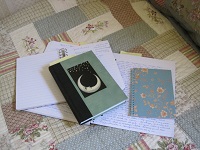
    Journals on quiltOnce I’ve gathered the material I need, I become a quilter. I remember my grandmother laying out her swatches of fabric on the living room floor until she found patterns that pleased her. That’s what I do, too: I take these fascinating scraps of material from people’s lives and piece them into unique patterns. Yes, I might add my own touches with the hand stitching, but that is strictly ornamental. The tone and cadence should belong distinctly to my client, so that anyone who reads the book can recognize the voice.

    The longer I do this work, the more honored I am. I have learned to banish my own experiences and expectations of what a story “should” look like. Instead, I let the pieces emerge and fall around me in an infinite variety of patterns, so that I can piece together powerful stories that deserve to be told.

    Originally posted on Holly’s Blog, February 24, 2016.

    Novelist, journalist and celebrity ghost writer Holly Robinson is the author of several books, including The Gerbil farmer’s Daughter: A Memoir and the novels Beach Plum Island and Haven Lake. Her articles and essays appear frequently in The Huffington Post, More, Parents, Redbook and dozens of other newspapers and magazines. She and her husband have five children and a stubborn Pekingese. They divide their time between Massachusetts and Prince Edward Island, and are crazy enough to be fixing up old houses one shingle at a time in both places.